

Let’s talk about something that doesn’t often make the Valentine’s Day small talk: the reality that this time of year can be a turning point for relationships that aren’t working anymore.
If you’re reading this on or around February 15th, you’re not alone. Research consistently shows that divorce-related searches spike by approximately 40% in the weeks surrounding Valentine’s Day, with legal inquiries reaching their highest levels in late February and early March. While few people actually file on the 14th itself, the emotional weight of the holiday often crystallizes what many have been feeling for months: it’s time to move forward separately.
Why Valentine’s Day Acts as a Relationship Pressure Test
Valentine’s Day isn’t just about flowers and chocolates: it’s about expectations. For couples already experiencing difficulties, the societal pressure to demonstrate love publicly can feel suffocating rather than romantic. Studies indicate that 48% of women and 23% of men report feeling disappointed by the holiday, with 6% describing it as outright stressful.
When you’re questioning your relationship, being surrounded by grand romantic gestures and Instagram-worthy date nights can make the gap between expectation and reality painfully clear. It’s not that the holiday causes relationships to fail: it simply illuminates cracks that were already there.
Our family law team at Judge Law’s Windsor and London offices see this pattern every year. The week after Valentine’s Day brings a noticeable increase in first consultations, often from people who’ve spent months deliberating but finally feel ready to take action.
You’re Part of a Documented Pattern
(And That’s Okay)
Let’s put some numbers to this experience. Data from the University of Washington found a measurable spike in divorce filings during the first week of March: approximately two weeks after Valentine’s Day. CNN Money reports that February 15th kicks off an elevated period for divorce filings, with rates up about 18% from the average month.
Interestingly, while Valentine’s Day creates a noticeable surge, January actually remains the peak month overall for divorce filings, with 30-40% increases in lawyer searches in early January. What does this tell us? Post-holiday reflection: whether after Christmas or Valentine’s Day: often provides the clarity and resolve people need to make significant life changes.
A 2014 study by legal matching site Avvo found that 67% of those searching for divorce attorneys during this period are women, with major activity concentrated in urban areas including London. If you’re a woman reading this and wondering whether you’re overreacting or being dramatic: you’re statistically in the majority, and your feelings are valid.
The Legal Journey: From Decision to Decree
Understanding what lies ahead can remove some of the anxiety around taking that first step. Here’s a realistic timeline infographic for what to expect:
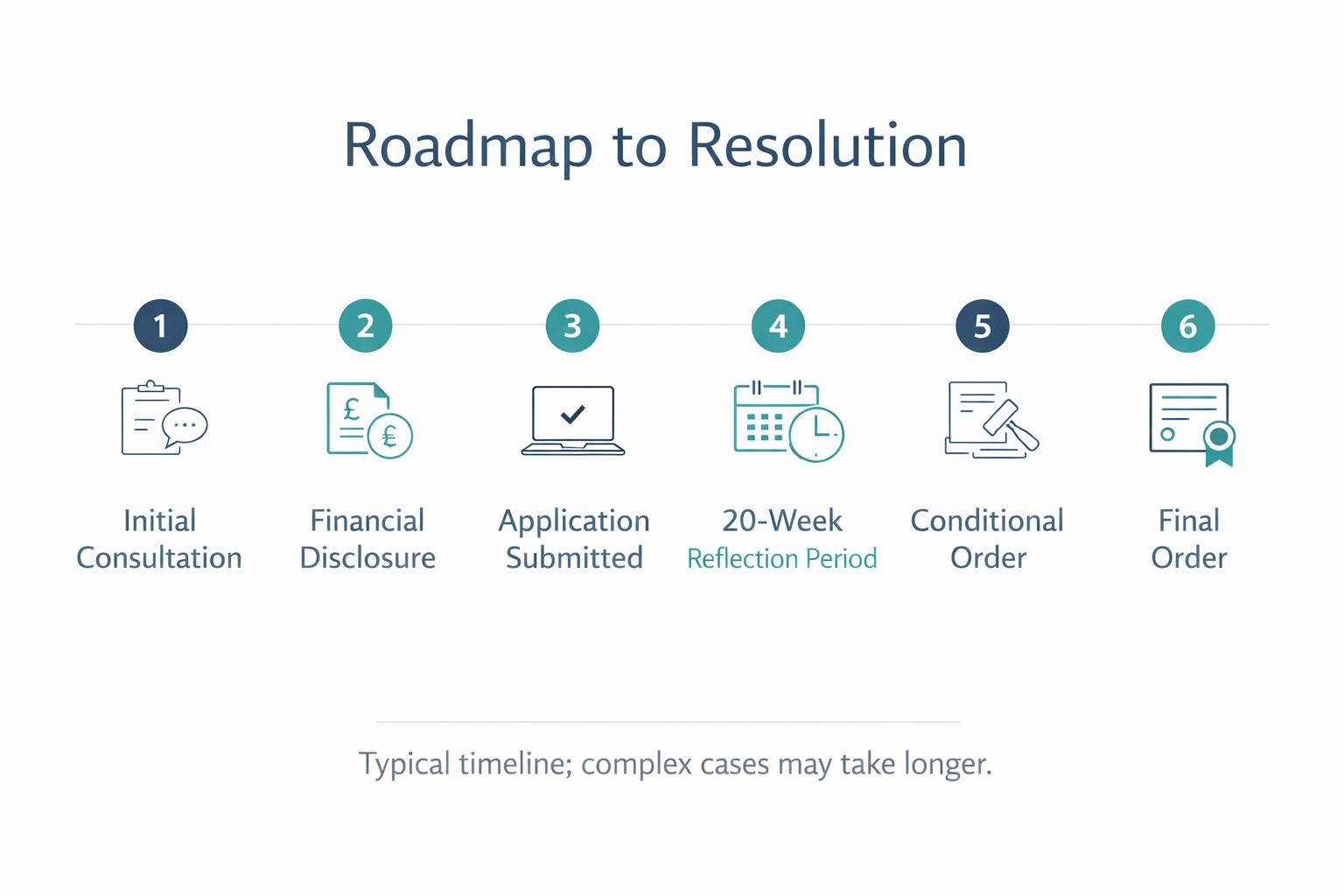
- Initial Consultation (Week 1): Meet with a solicitor to discuss your situation, understand your rights, and outline your options for Windsor or London-based proceedings.
- Financial Disclosure (Weeks 2-6): Gather documentation about assets, pensions, debts, and income. Your solicitor will help you understand what you’re entitled to.
- Application Submission (Week 4-8): File your divorce application online via GOV.UK’s divorce service. Under the 2022 reforms, you no longer need to prove fault: “irretrievable breakdown” is sufficient.
- 20-Week Reflection Period (Months 2-6): The mandatory minimum wait after application before you can apply for a Conditional Order. Use this time for financial settlement discussions and, if relevant, child arrangement planning.
- Conditional Order (Month 6): The court confirms the divorce can proceed. Think of this as the legal acknowledgment that your marriage has ended.
- Final Order (Decree Absolute) (Month 7+): Six weeks after the Conditional Order, you can apply for the Final Order. Once granted, you’re legally divorced and free to remarry if you choose.
Timeline Note: Typical timeline; complex cases involving business assets, international property, or contested child arrangements may take longer (often 12–18 months).
Immediate Steps vs. Long-Term Planning: What to Prioritize Now
One of the most common questions we hear at our Windsor and London offices is: “What do I need to do right now?” Here’s a practical breakdown:
| Immediate Steps (First 2 Weeks) | Long-Term Planning (First 3-6 Months) |
|---|---|
| Book a confidential consultation with a family law solicitor | Begin formal financial disclosure process |
| Open a separate bank account in your sole name | Engage a financial advisor or chartered accountant for asset valuation |
| Document your current financial situation (bank statements, payslips, mortgage) | Develop a parenting plan if you have children (either through mediation or solicitor negotiation) |
| Change passwords for online banking and personal accounts | Consider property arrangements: who stays in the family home during proceedings? |
| Notify your employer (if needed for legal time off) | Update your will and review life insurance beneficiaries |
| Research emotional support resources like Relate | Explore mediation vs. court proceedings for financial settlement |
| Keep a diary of significant conversations or incidents (evidence if needed) | Plan for post-divorce living arrangements and budget |
The left column is about protection and preparation; the right column is about building your new life structure. Both matter, but in different timeframes.

Protecting Your Financial Interests Right Now
Before you’ve even filed anything, there are practical steps you can take to safeguard your position:
Open Communication (Where Safe): If your relationship allows for it, discuss separation openly before taking legal action. This can prevent hostile reactions and protect shared finances.
Financial Snapshot: Take screenshots or photocopies of all joint account balances, credit card statements, and investment portfolios. These establish a baseline for what existed at the point of separation.
Don’t Empty Joint Accounts: Withdrawing large sums without agreement can damage your credibility in court. If you need emergency funds, take only what’s reasonable for immediate necessities and document why.
Notify Mortgage Lenders (Eventually): You don’t need to do this on day one, but your solicitor will advise when to inform your mortgage provider, especially if one party plans to remain in the property.
Our divorce solicitors can walk you through these financial protections in detail during your first consultation, whether you’re based in Windsor, London, or elsewhere in the Southeast.
What About the Children?
If you have children, their wellbeing is naturally at the forefront of your mind. The good news is that the UK family court system prioritizes the child’s best interests above all else, and most parents reach agreements without needing a judge’s intervention.
Key principles to keep in mind:
- Continuity Matters: Courts generally favor arrangements that minimize disruption to children’s schooling, friendships, and routines.
- Both Parents Are Important: Unless there are safeguarding concerns, the court will encourage meaningful relationships with both parents.
- Communication Is Key: Even if you can’t stand your ex, maintaining civil communication about the children’s needs makes everything smoother.
Mediation is often the first step for child arrangements, and it’s far less adversarial than court proceedings. We can refer you to accredited mediators in the Windsor and London areas, or discuss how our family law team can represent your interests if court involvement becomes necessary.
For more detailed guidance, explore our resources on child arrangements and what the courts consider when making decisions.

The Emotional Side: You Can’t Skip This Part
Legal processes are structured and predictable. Emotions? Not so much. If you’re feeling relief, grief, anger, guilt, or all of the above simultaneously: that’s completely normal.
Here’s what we recommend:
Seek Professional Support: Therapy or counseling isn’t just for “people who can’t cope”: it’s for anyone navigating a major life transition. Relate offers both individual and couples counseling across the UK, including telephone and online options.
Build Your Support Network: Lean on trusted friends and family, but be mindful about oversharing on social media. What you post online can potentially be used in proceedings, particularly around child arrangements or financial disputes.
Give Yourself Permission to Grieve: Even if you initiated the separation, you’re allowed to mourn the end of what you’d hoped the relationship would be. Divorce isn’t just a legal process: it’s the end of a chapter.
Pace Yourself: You don’t need to have everything figured out by next Tuesday. One decision at a time, one day at a time.
Why Location Matters: Windsor and London Divorce Proceedings
Where you file your divorce petition can sometimes make a practical difference, particularly if you and your spouse live in different areas or if one of you has recently moved.
At Judge Law, we operate from both Windsor and London, which gives our clients flexibility for face-to-face meetings without the stress of long commutes during an already difficult time. Whether you’re navigating financial settlement negotiations in our Windsor office or discussing child arrangements in central London, we’re here to provide consistent, compassionate guidance.
Our local knowledge also means we understand the property markets, cost of living considerations, and local resources that might affect your financial settlement discussions: whether that’s Windsor’s premium property values or London’s competitive rental market.
Taking the First Step: What Happens in Your Initial Consultation
We know that picking up the phone or sending that first email is hard. Here’s what you can expect when you contact Judge Law:
- Confidential Conversation: Everything you tell us is protected by solicitor-client privilege. Your spouse won’t know you’ve consulted us unless you decide to proceed.
- No-Judgment Space: We’ve heard it all. Whatever your situation, we’re here to advise, not to judge.
- Realistic Assessment: We’ll give you an honest picture of what to expect: timelines, costs, likely outcomes: so you can make informed decisions.
- Options, Not Instructions: You’re in control. We’ll outline your choices, explain the pros and cons of each route, and support whichever path you choose.
- Fixed-Fee Options: For many divorce matters, we offer fixed-fee arrangements so you know exactly what you’re paying upfront. No surprises.
Our financial settlement specialists can also discuss how assets, pensions, and property will be divided under current UK law, giving you clarity about your financial future.
The Post-Valentine’s Reality: Moving Forward
If Valentine’s Day 2026 was the moment you realized you couldn’t continue in your marriage, you’re already taking the hardest step by acknowledging that truth. What comes next is process, paperwork, and planning: all things that can be managed with the right support.
Filing for divorce isn’t giving up; it’s choosing honesty over pretense, and your own wellbeing over societal expectations. It’s choosing to build a life that aligns with who you are now, not who you were when you said “I do.”
The surge in post-Valentine’s divorce inquiries isn’t just a statistic: it’s a reminder that you’re part of a community of people making brave, difficult, necessary decisions. And whether you’re in Windsor, London, or anywhere else in the UK, professional support is available to guide you through every step.
If you’re ready to talk, we’re ready to listen. Reach out to Judge Law today for a confidential consultation, and let’s start mapping out your path forward.
Resources:
- Apply for a divorce online – GOV.UK Official Service
- Relate UK – Relationship support and counseling
- Judge Law Family Law Services – Windsor & London divorce solicitors