

To enforce a child arrangements order, apply to the family court on Form C79, usually to the court that made the order. The court fee is £215 (as of 2026). The order needs a warning notice, which you can request on Form C47. If the court finds a breach without reasonable excuse, it can order unpaid work, compensation or new arrangements.
When a child arrangements order is ignored or repeatedly breached, it can feel like the legal system has failed you. You’ve been to court, secured an order, and yet the other parent still cancels contact, changes plans last minute, or simply refuses to comply.
An order of the court is not optional. The family court has specific enforcement mechanisms designed to address a child arrangements order breach, but using the right step at the right time matters. This guide explains how to enforce child arrangements order terms in practice, what counts as non-compliance, and what the court can do where a child contact order is not followed, always with your child’s welfare as the central focus.
| Form C79 at a glance | What you need to know |
|---|---|
| What it is | The Application for Enforcement of a Child Arrangements Order |
| Before you apply | Check the order includes a warning notice (use Form C47 if it does not), and keep a record of your attempts to resolve things |
| What to include | The order, which parts were not followed, the date and nature of each breach, and the outcome you are asking for |
| Where to send it | The court that made the original order, or your nearest family court if appropriate |
| Court fee | £215 (as of 2026). Fee exemptions may be available if you are on benefits or a low income |
| Standard of proof | Beyond reasonable doubt |
| What the court can do | Warning, 40 to 200 hours of unpaid work, a parenting programme, compensation, varying the order, a fine, a change of residence, or (rarely) committal |
What Is a Child Arrangements Order?
A Child Arrangements Order is a legally binding court order made under the Children Act 1989. It determines:
- Who a child lives with
- When a child spends time with each parent
- How contact should take place (in-person, supervised, phone calls, etc.)
These orders are designed to provide certainty and stability for children when parents can’t agree on arrangements themselves. But an order is only as effective as its enforcement: and that’s where many parents feel the system lets them down. If you do not yet have an order, or need one changed, see our children and child arrangements page.
What Actually Counts as a Breach?
Not every disagreement or missed contact is a legal breach. The court distinguishes between non-compliance and genuine, unavoidable circumstances.
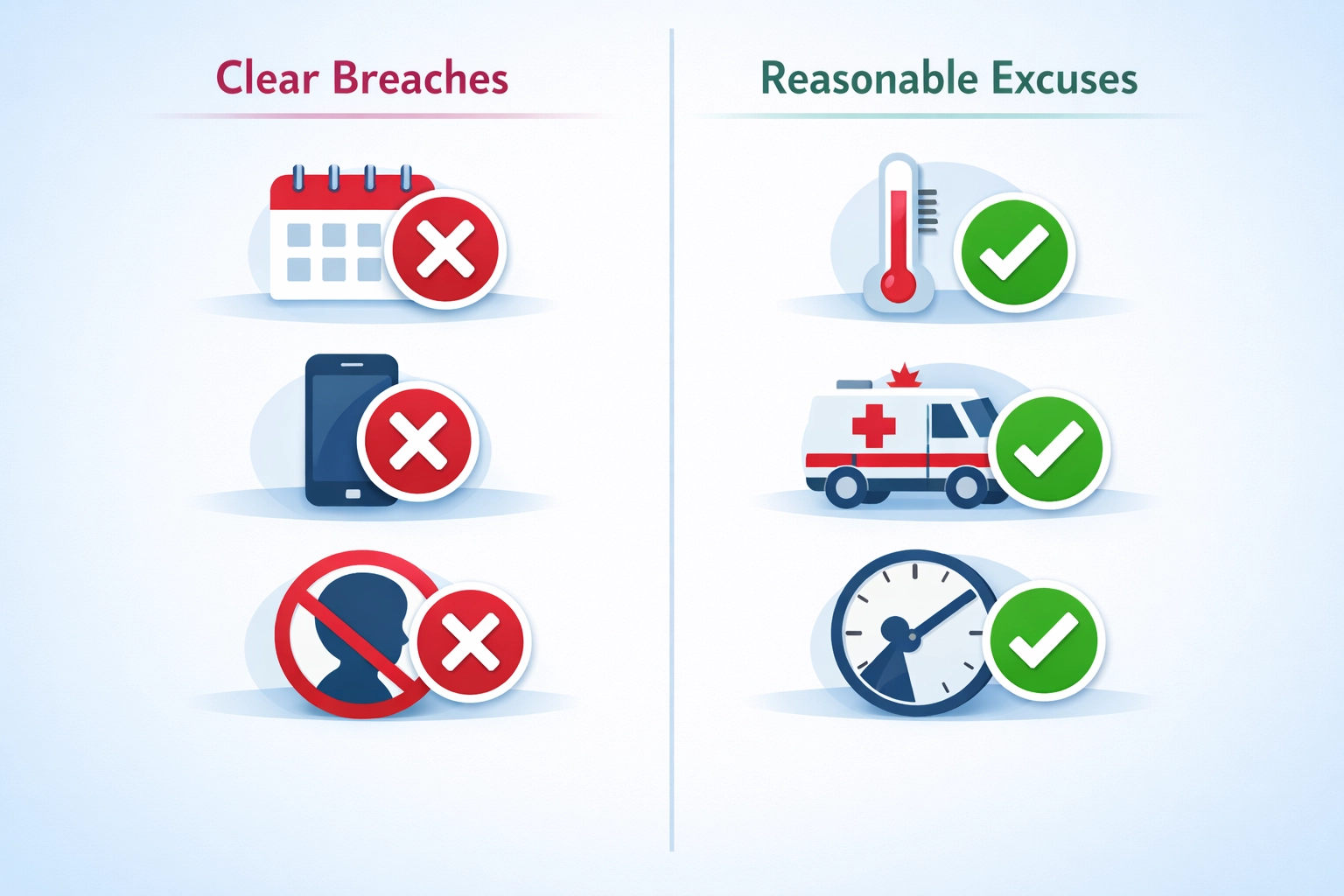
Clear Breaches Include:
- Refusing contact outright without reasonable excuse
- Repeatedly cancelling agreed contact at the last minute
- Not returning the child at the specified time
- Blocking communication when the order allows it
- Preventing contact during school holidays or special occasions outlined in the order
- Relocating the child without permission when the order specifies residence
What Usually Doesn’t Count as a Breach:
- The child is genuinely unwell (with evidence such as a doctor’s note)
- There’s an emergency (hospital visit, family bereavement, etc.)
- The child is older and expresses a genuine, independent refusal to attend contact
- Unforeseen transport issues beyond the parent’s control
- Being 10–15 minutes late occasionally due to traffic
The key question is: Did the other parent act reasonably?
If they’re withholding contact to punish you, that’s a breach. If the child has a fever and can’t travel, that’s not.
When Should You Try to Resolve Things Outside Court?
Before applying for enforcement, the court expects you to have made reasonable attempts to resolve the issue directly. This is not a legal requirement, but judges look favourably on parents who’ve tried.
Practical Steps to Try First:
- Send a polite, factual message outlining the missed contact and asking for compliance
- Propose alternative arrangements if the original plan genuinely didn’t work
- Suggest mediation to address ongoing communication problems (see our mediation and out-of-court options)
- Keep a written record of your attempts to cooperate
If the other parent refuses to engage, ignores you, or continues breaching the order, it’s time to escalate.
How to Apply on Form C79: Step by Step
A C79 enforcement application follows a formal court process. Here’s what to expect when you need to enforce child arrangements order terms because a child contact order is not followed.
Step 1: Check the Order Includes a Warning Notice
For the court to make an enforcement order, the child arrangements order should include the standard Warning Notice. This warning notice is typically attached to the original order made by the court and explains the potential consequences of non-compliance.
If the warning notice was missing from the original order, you can apply for the court to attach one using Form C47 before (or alongside) taking enforcement steps.
Step 2: Gather Your Evidence
The court will want clear, factual evidence of the alleged child arrangements order breach. Collect:
- A copy of the child arrangements order (and any later variation orders)
- Dates and times of missed, shortened, or refused contact
- Messages, emails, or texts showing what was agreed and what happened
- Evidence you tried to resolve matters (reasonable proposals, mediation invites, etc.)
- Notes on the impact on your child (for example, distress, disrupted routines, missed key events)
Keep it child-focused and factual. For example, “Contact on 12 February did not take place. No alternative was offered” is more helpful than accusations about motive.
Not sure it counts as a breach? Early legal advice can help you focus the application on the strongest points and avoid a weak or unfocused C79 enforcement application. Contact our family team: your first call is free, and legal advice is given in a paid consultation.
Step 3: Fill In Form C79
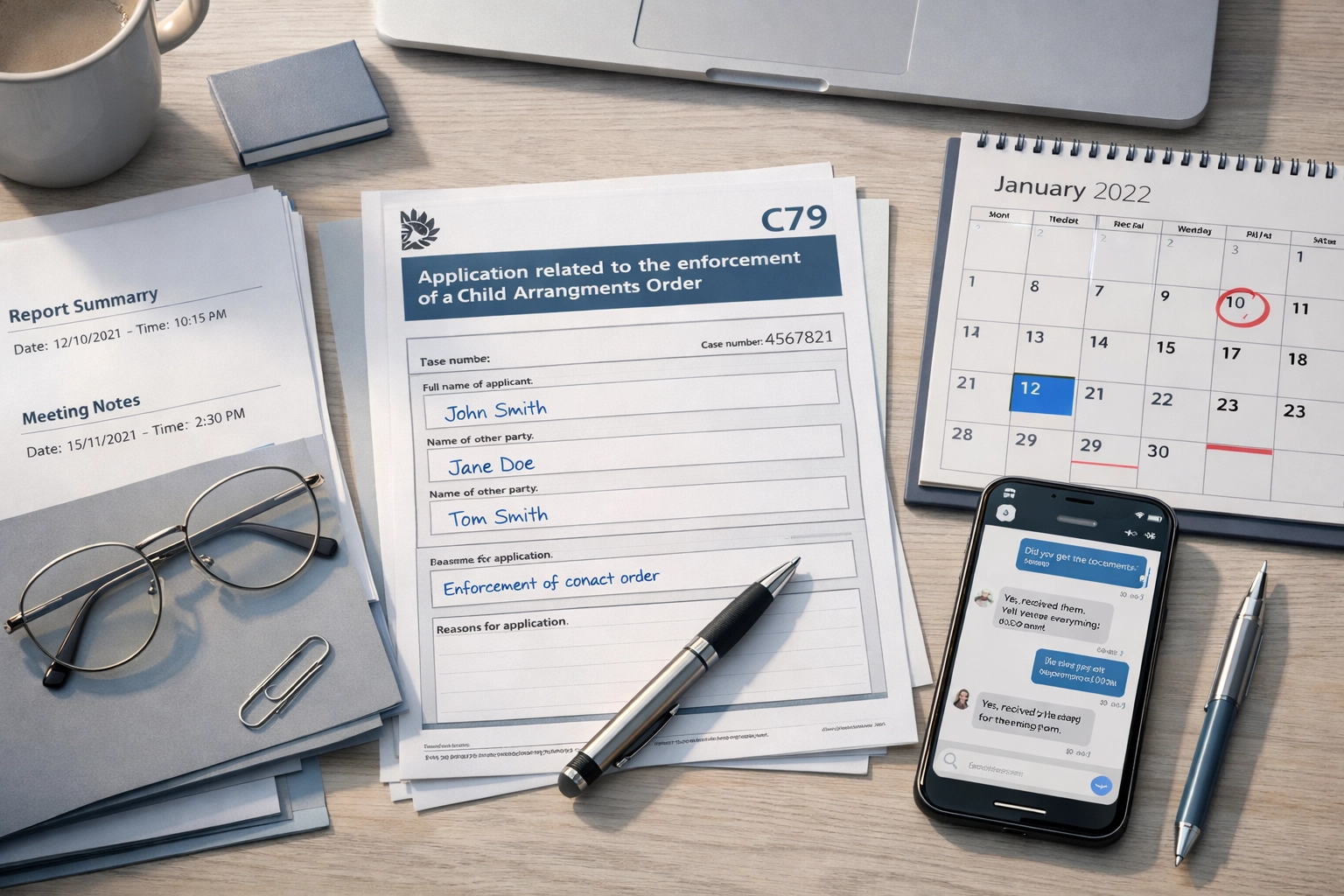
Form C79 is the Application for Enforcement of a Child Arrangements Order. You can download it from GOV.UK.
You’ll need to set out:
- The order you want enforced
- Exactly which parts were not complied with
- The dates and nature of each alleged breach
- What outcome you are asking the court to consider
Step 4: Submit Your Application
Send your completed Form C79 and supporting evidence to the court that made the original order. You can also submit it to your nearest family court if appropriate.
Court fees apply. As of 2026, the application fee is typically £215, though fee exemptions or reductions may be available if you’re on a low income.
Step 5: The Court Issues Your Application
The court will issue your application and send copies to:
- The other parent (the respondent)
- CAFCASS (Children and Family Court Advisory and Support Service), if applicable
- Any other parties to the proceedings
You’ll be given a case number and the court will list the next hearing.
Step 6: Gatekeeping and First Hearing
The court will review your C79 enforcement application as part of its gatekeeping process. In many cases, the court will then list a first hearing for the parties to attend, to clarify the issues, consider any safeguarding information, and decide what directions are needed next.
If CAFCASS is involved, an officer may be asked to undertake initial checks or provide input focused on your child’s welfare. Timescales vary between courts.
Step 7: The Hearing Where the Court Decides the Allegation
At the hearing, both parents can present evidence. The judge will consider:
- Whether a breach occurred
- Whether there was a reasonable excuse
- The impact on the child’s welfare and stability
- Whether enforcement is proportionate and what order best supports the child’s arrangements
If you do not attend without good reason, the court can make decisions in your absence.
What Evidence Does the Court Expect?
For enforcement, the court must be satisfied beyond reasonable doubt that the breach occurred. This is the criminal standard of proof. The burden is high because enforcement can involve penal consequences (for example, unpaid work requirements and, in very rare cases, committal for contempt). The court will still make decisions through a child-welfare lens, but it must apply this stricter test before it can impose enforcement sanctions.
Strong Evidence Includes:
| Type of Evidence | Example |
|---|---|
| Written communication | Text messages or emails showing refusal or cancellation |
| Diary or log | A detailed record of missed contact with dates and times |
| Third-party statements | Statements from grandparents, teachers, or other witnesses |
| Photos or videos | Evidence of you arriving for contact and being turned away |
| School records | Proof you were denied contact during term-time arrangements |
Weak Evidence Includes:
- Hearsay or assumptions (“I think they’re turning the child against me”)
- Emotional statements without factual backing
- Selective screenshots that lack context
What Happens If a Child Arrangements Order Is Broken?
If the court finds a breach occurred without reasonable excuse, it has a range of enforcement powers under Section 11J of the Children Act 1989.
Possible Outcomes:
- Warning
The court may issue a formal warning and make it clear that further breaches will result in stricter action. - Enforcement Order (Unpaid Work Requirement)
The breaching parent may be required to complete 40–200 hours of unpaid community work. This is the most common enforcement measure. - Attendance at a Separated Parents Information Programme (SPIP)
The court may order both parents to attend a program designed to improve communication and reduce conflict. - Variation of the Order
If the original order isn’t working, the court may vary it to be more specific or realistic. - Compensation Order
If you’ve incurred financial losses due to the breach (e.g., lost travel costs or holiday expenses), the court may order the other parent to reimburse you. - Fine
In some cases, the court may impose a financial penalty. - Change of Residence
In extreme, persistent cases, the court may transfer residence of the child to the compliant parent. - Committal to Prison
This is rare and only used in the most serious, repeated cases of contempt of court. The maximum sentence is two years, though custodial sentences are typically suspended.
The court’s primary concern is always the welfare of the child. Enforcement is not about punishment: it’s about ensuring the child has a meaningful relationship with both parents.
Will Enforcement Affect Future Contact?
A common worry is that applying to enforce child arrangements order terms will damage co-parenting or be viewed as “aggressive”.
In practice, the court expects court orders to be followed. Where a child contact order is not followed, the court will focus on what outcome best supports the child’s welfare and stability.
- Enforcement is a legitimate process when there is a genuine child arrangements order breach
- The court will look for a child-focused, proportionate response
- A clear outcome can sometimes reduce conflict by setting expectations and improving reliability
That said, the court will consider whether an application is reasonable and proportionate in the circumstances.
How Much Does a C79 Application Cost?
Cost is a major concern for parents considering C79 enforcement, particularly where the underlying issue is repeated disruption to a child’s routine.
Before you spend money on an application, it can help to sense-check proportionality. If you’d like, our family team can talk you through likely outcomes, evidence needs, and whether enforcement is the right step based on your child’s welfare and the pattern of the child arrangements order breach.
Court Fees
- Form C79 application fee: £215 (as of 2026)
- Fee exemptions available if you’re on benefits or a low income
Legal Representation:
- Self-representation: Possible, but enforcement applications can be legally complex
- Fixed-fee advice: Some solicitors offer initial consultations to assess your case (typically £150–£300)
- Full representation: Costs vary widely depending on case complexity, but expect £1,500–£5,000+ for a contested enforcement hearing
Is It Worth It?
This depends on:
- The severity and frequency of breaches
- The impact on your child
- Your ability to present evidence clearly
Many parents successfully represent themselves in enforcement cases, especially if the breach is clear-cut and well-documented. However, if the case is complex or the other parent is also legally represented, professional advice can significantly improve your outcome.
At Judge Law, we offer initial consultations to assess your case and advise on the best course of action.
When Enforcement May Not Be the Right Step
Enforcement is not always the best first option, even where there has been a child arrangements order breach. The court’s priority is the child’s welfare, and sometimes a different step better protects stability and reduces conflict.
Enforcement may not be the right step where:
- It’s a minor one-off and contact can be sensibly re-arranged without escalation
- The order needs updating because it no longer fits school routines, work patterns, or the child’s needs. In that situation, an application to vary the order may be more appropriate than C79 enforcement
- The issue is communication rather than refusal, and mediation or structured discussion could help (where it is safe and suitable)
- There are genuine safeguarding concerns that need addressing first, so the court can make child-focused decisions based on safe arrangements
A practical way to sense-check your next step is to ask: will this application help the child have safe, reliable time with each parent, and is it proportionate to the pattern of breach?
When Should You Seek Legal Advice?
You should consider professional legal advice if:
- You’re unsure whether the breach is serious enough to warrant enforcement
- The other parent is making counter-allegations against you
- CAFCASS has been involved and their report is unfavourable
- You’ve already tried enforcement and it didn’t work
- The other parent has legal representation
- Your case involves complex issues like relocation, allegations of harm, or international elements
Early advice can prevent months of delay and help you present a clear, child-focused case to the court.
Frequently asked questions
What is Form C79?
Form C79 is the application to enforce a child arrangements order. You use it when the other parent has not followed the order and did not have a reasonable excuse. You can download it from GOV.UK.
How much does a C79 application cost?
The court fee is £215 as of 2026. Fee exemptions or reductions may be available if you are on benefits or a low income.
Where do I send Form C79?
Send it, with your supporting evidence, to the court that made the original order. You can also submit it to your nearest family court if appropriate.
What if my order does not have a warning notice?
The court needs a warning notice on the order before it can make an enforcement order. If it is missing, you can apply for one to be attached using Form C47, before or alongside your enforcement application.
Final Thoughts
If a child contact order is not followed and the pattern is impacting your child, it may be appropriate to enforce child arrangements order terms through a C79 enforcement application. The court’s aim is not to “punish” a parent, but to secure arrangements that are safe, reliable, and in the child’s best interests.
Keep records, be measured in your wording, and stay focused on what supports your child’s welfare and stability.
If you’re dealing with a repeated child arrangements order breach, you can also speak to our Family Law solicitors. A paid consultation can be a sensible way to assess proportionality, evidence strength, and the most child-focused route forward, including whether C79 enforcement is the right step.