
Going through a separation when children are involved is one of life’s most challenging experiences. You’re likely feeling overwhelmed, uncertain, and, above all, worried about what’s best for your kids.
Here’s the reassuring truth: you don’t have to figure this out alone. A dedicated child arrangement solicitor can guide you through every step, helping you and your family find a practical, fair solution that puts your children’s wellbeing first.
At Judge Law, we’ve supported hundreds of parents across Windsor, London, and the surrounding areas through this process. In this guide, we’ll explain exactly what child arrangements are, when you might need legal support, and how our team works to help families like yours reach the best possible outcome.
What Is a Child Arrangement?
A child arrangement is simply the plan that sets out where your children will live and how they’ll spend time with each parent after a separation or divorce.
In the UK, these arrangements can be agreed informally between parents or formalised through a Child Arrangements Order issued by the family court. The order covers two main things:
- “Lives with” arrangements – which parent the child primarily resides with
- “Spends time with” arrangements – how and when the child sees the other parent (sometimes called “contact”)
The beauty of these arrangements is that they’re flexible. Whether you’re looking at a traditional setup where the children live mainly with one parent, or a shared care arrangement where time is split more evenly, the focus is always on what works best for your children’s day-to-day life.
Important: The court’s guiding principle is always the child’s welfare. Every decision, whether made by parents or a judge, should prioritise what’s in the child’s best interests.
Why and When Should You Seek a Child Arrangement Solicitor?
Not every separated family needs legal help. Many parents manage to agree on arrangements amicably, and that’s wonderful when it happens.
However, there are plenty of situations where speaking to a child arrangement solicitor can save you time, stress, and conflict down the line.

You Might Need a Solicitor If:
- You and your ex-partner can’t agree on where the children should live or how often they see each parent
- Communication has broken down and discussions keep ending in arguments
- There are safety concerns, such as domestic abuse, substance misuse, or mental health issues affecting parenting
- One parent wants to relocate (within the UK or abroad) with the children
- You need to enforce or change an existing order that’s no longer working
- Grandparents or other family members want formal contact rights
- International elements are involved, such as different nationalities or a parent living overseas
Even if you think you can reach an agreement, a quick consultation with a solicitor can give you peace of mind that your arrangement is fair, practical, and legally sound.
The Child Arrangement Process: Step by Step
Feeling anxious about what’s ahead? Let us walk you through exactly how the process works, from that first phone call to a final resolution.
Step 1: Initial Consultation
Everything starts with a friendly, no-pressure chat. We’ll listen to your situation, explain your options, and give you honest advice about what’s realistic. This is your chance to ask questions and understand your rights.
Step 2: Negotiation and Communication
Wherever possible, we help you reach an agreement directly with your ex-partner. This might involve exchanging proposals, drafting a parenting plan, or simply helping you communicate more effectively. It’s often the quickest and least stressful route.
Step 3: Mediation Support
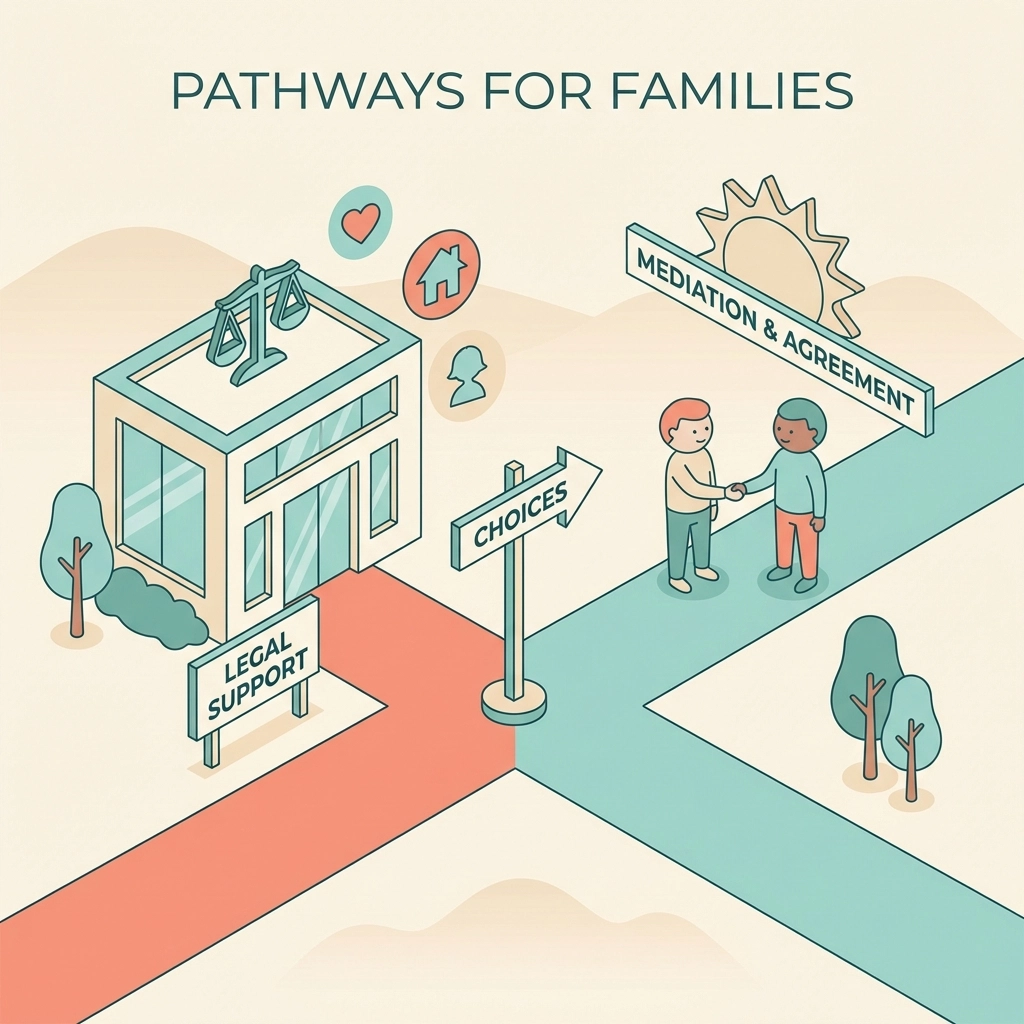
If direct negotiation isn’t working, family mediation is usually the next step. A neutral mediator helps you both discuss arrangements and find common ground. We can attend mediation with you (or advise you before and after sessions) to ensure your interests, and your children’s, are protected.
Note: In most cases, you’re required to attend a Mediation Information and Assessment Meeting (MIAM) before applying to court.
Step 4: Court Application (If Needed)
When agreement isn’t possible, or where there are urgent safety concerns, we’ll prepare and submit a court application on your behalf. We’ll handle all the paperwork, represent you at hearings, and advocate for the outcome that’s best for your children.
Step 5: Ongoing Support
Life changes, and so do families. If circumstances shift (new jobs, new partners, relocation), we’re here to help you vary or enforce existing orders so your arrangements stay workable.
Infographic: The Child Arrangement Journey
Visual Flowchart
| Stage | What Happens |
|---|---|
| 🏠 Separation | Parents decide to live apart |
| 📞 Speak to Solicitor | Get initial advice on your options and rights |
| 🤝 Negotiation | Try to agree arrangements directly |
| ⚖️ Mediation | Neutral mediator helps find common ground |
| 🏛️ Court (if needed) | Apply for a Child Arrangements Order |
| ✅ Agreement/Order | Arrangements are finalised and legally binding |
| 🔄 Ongoing Support | Vary or enforce orders as life changes |
Infographic: When Should You Get a Solicitor? (Decision Tree)
Ask yourself these questions:
- Can you and your ex-partner communicate calmly about the children?
- ✅ Yes → You may be able to agree informally or through mediation
- ❌ No → A solicitor can help facilitate communication or represent you
- Are there any safety concerns for you or your children?
- ✅ Yes → Speak to a solicitor immediately, urgent court orders may be needed
- ❌ No → Continue to next question
- Is one parent planning to move away with the children?
- ✅ Yes → Legal advice is essential before any relocation
- ❌ No → Continue to next question
- Do you want your agreement to be legally binding?
- ✅ Yes → A solicitor can help you apply for a court order
- ❌ No → Informal agreements can work, but aren’t enforceable
Bottom line: If you’re unsure, a quick consultation can give you clarity and confidence.
Infographic: Types of Child Arrangements Explained
| Arrangement Type | What It Looks Like |
|---|---|
| 🏠 Primary Residence | Child lives mainly with one parent; regular contact with the other |
| 🔄 Shared Care | Time split more evenly (e.g., week-on/week-off or mid-week handovers) |
| 📅 Alternate Weekends | Child stays with non-resident parent every other weekend |
| 👀 Supervised Contact | Visits take place with a third party present (for safety reasons) |
| 📞 Indirect Contact | Communication via phone, video calls, or letters (when direct contact isn’t appropriate) |
Every family is different, there’s no “one size fits all.” We help you find what works for your children’s routine, schooling, and emotional needs.
Why Choose Judge Law as Your Child Arrangement Solicitor?
At Judge Law, we know that behind every case is a real family going through a tough time. That’s why we do things a little differently.
Local and Accessible
With offices in Windsor and London, plus support for clients in Slough, Maidenhead, Reading, and beyond, we’re never far away. We offer in-person, phone, and video consultations to suit your schedule.
Personal and Approachable
You’ll work with a dedicated solicitor who genuinely listens. We explain things in plain English, no confusing legal jargon, and keep you updated every step of the way.
Child-Focused, Always
We never lose sight of what matters most: your children’s happiness and stability. We encourage cooperative solutions wherever possible, only turning to court when it’s truly necessary.
Honest and Transparent
We’ll always give you realistic advice about your options, timescales, and costs. No surprises, no hidden fees, just straightforward support.

Frequently Asked Questions
How long does it take to get a Child Arrangements Order?
If you can agree through negotiation or mediation, arrangements can be finalised in weeks. Court proceedings typically take 4–6 months, though urgent applications can be heard much faster.
How much does a child arrangement solicitor cost?
Costs vary depending on complexity. We offer transparent pricing and can discuss fixed-fee options for certain stages. Your first consultation will give you a clear idea of likely costs.
Do I have to go to mediation before court?
In most cases, yes. You’ll need to attend a MIAM before making a court application, unless there are urgent safety concerns or other exemptions apply.
What if my ex-partner ignores the court order?
We can help you apply to enforce the order. The court takes breaches seriously and has powers to ensure compliance.
Can grandparents apply for child arrangements?
Yes, grandparents and other family members can apply for contact, though they usually need the court’s permission first. We can advise on the best approach.
Ready to Take the Next Step?
If you’re facing uncertainty about your children’s future, please know that support is available: and things really can get better.
Our friendly child arrangement solicitors at Judge Law are here to listen, advise, and guide you towards a resolution that works for your whole family.
Get in touch with our team today for a confidential consultation. Whether you’re in Windsor, London, or anywhere in England and Wales, we’re ready to help.