
Let’s be honest: when a relationship breaks down and there are children involved, your world doesn’t just tip over, it shatters. Suddenly, the person you used to share a life with is the person you’re negotiating school runs and weekend schedules with. It’s exhausting, emotional, and, frankly, a bit scary.
At Judge Law, we hear the same questions every day: “Will I lose my kids?” “Does the mother always get custody?” “How do I make sure my child is okay through all of this?”
First, take a deep breath. In the UK, the legal system has moved away from old-fashioned ideas of “custody” and “access.” Today, it’s all about child arrangements. The focus isn’t on the “rights” of the parents, but on the needs of the child.
Whether you are looking for family law solicitors in Windsor or need expert family law solicitors in London, understanding how the courts make these life-altering decisions is the first step toward finding a sense of peace.
1. The “No Order” Principle: Why Less is Often More
In UK law, there is a fundamental concept called the “No Order” Principle. It sounds a bit counter-intuitive, doesn’t it? You’d think a court’s job is to make orders.
However, the courts believe that parents are usually the best people to decide what’s right for their children. The principle states that a court should not make an order unless it is convinced that doing so would be better for the child than making no order at all.
If you and your ex-partner can sit down (perhaps with the help of a solicitor or a mediator) and agree on a schedule that works, the court won’t interfere. This is the gold standard. It keeps the heat out of the situation and allows for flexibility as the kids grow up.
Pro-Tip: A “Parenting Plan” is a fantastic way to document these agreements without the stress of a courtroom. It’s a living document that covers everything from Christmas holidays to who pays for the new football boots.

2. The Welfare Checklist: The Judge’s Secret Roadmap
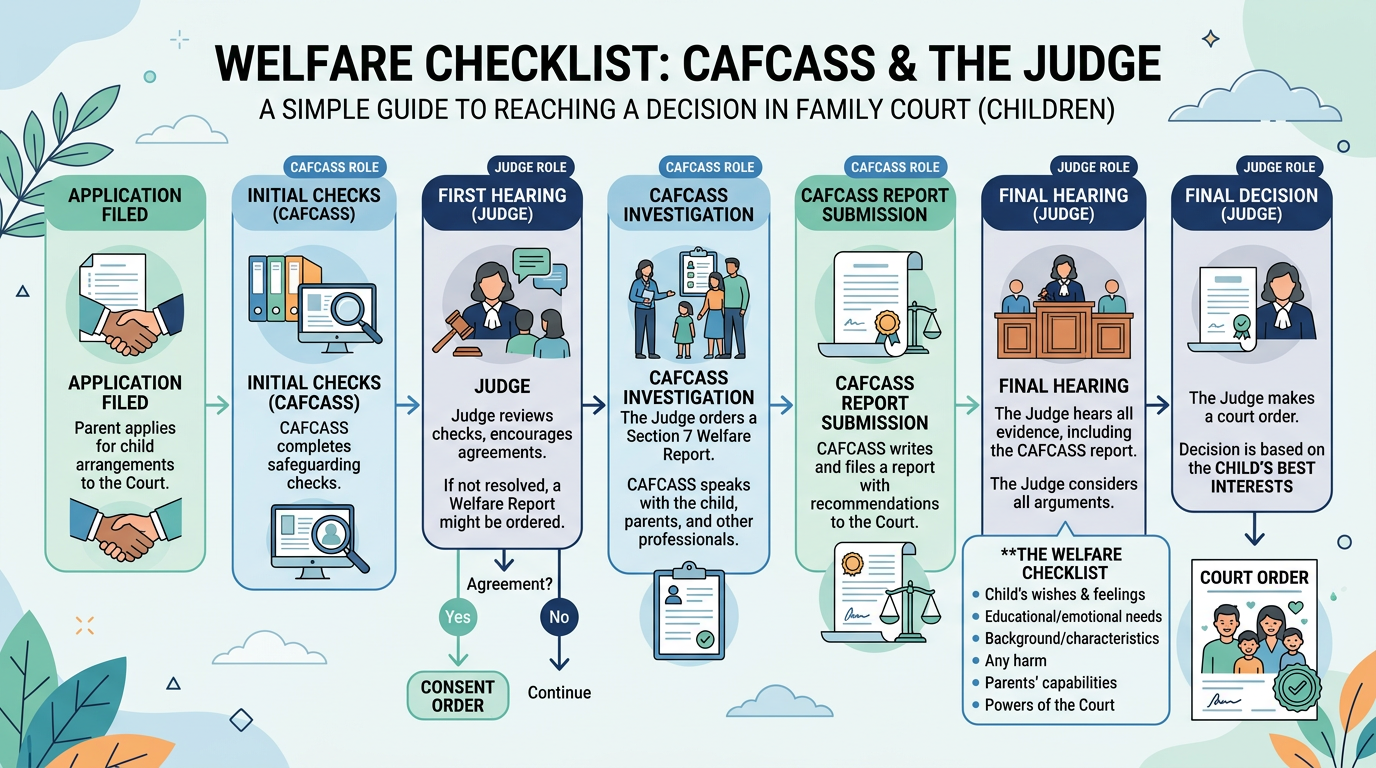
When parents simply cannot agree, and the case goes before a judge, the court uses a specific tool called the Welfare Checklist. This is a list of seven factors set out in the Children Act 1989. This is exactly what a judge is looking at when they sit on the bench.
The 7 Factors of the Welfare Checklist
| Factor | What it actually means |
|---|---|
| The Child’s Wishes | What does the child want? (Given more weight as they get older). |
| Physical & Emotional Needs | Who can provide the best home, food, love, and stability? |
| The Likely Effect of Change | How much will a move or a new schedule disrupt their life? |
| Age, Sex, & Background | Consideration of the child’s specific identity and heritage. |
| Harm or Risk of Harm | Any history of abuse, neglect, or safety concerns is a top priority. |
| Parental Capability | Is the parent physically and mentally able to meet the child’s needs? |
| Range of Powers | The court considers all available options before making a final call. |
If you’re worried about how these factors apply to your specific situation, our family law solicitors can help you prepare your case to ensure your child’s best interests are clearly highlighted.
3. Mediation First: The MIAMs Hurdle
Before you can even set foot in a courtroom for a child arrangements order, the law usually requires you to attend a MIAM (Mediation Information and Assessment Meeting).
The government and the courts are very keen on mediation because it works. It’s a chance for a neutral third party to help you and your ex-partner find common ground. It’s cheaper, faster, and much less aggressive than a full-blown legal battle.
There are exceptions, for instance, if there has been domestic violence, but for most people, mediation is the mandatory first step. Even if it doesn’t solve everything, it can often narrow down the points of disagreement, making the legal process much smoother later on.
4. Understanding Child Arrangements Orders
If mediation doesn’t work, you’ll be looking at a Child Arrangements Order. In the “old days,” we used terms like “Joint Custody” or “Sole Custody.” Now, the order is split into two main parts:
- “Lives with”: This determines which parent the child will live with most of the time. This can be one parent, or it can be shared (e.g., “Lives with Mother from Monday to Thursday and Father from Friday to Sunday”).
- “Spends time with”: This covers the contact the child has with the parent they don’t live with. This includes weekends, holidays, phone calls, and video chats.
The courts generally start with the presumption that it is in the child’s best interests to have a meaningful relationship with both parents, provided it is safe to do so. There is no automatic “50/50” split, but the court will fight to ensure both parents remain an active part of the child’s life.
What about Parental Responsibility?
This is a huge one. Parental Responsibility (PR) means the legal rights, duties, and authority a parent has for a child. This includes making big decisions about their education, religion, and medical treatment. Usually, both parents have PR, and even if the child “lives with” one parent, the other still has a right to be involved in these major life choices.

(Ensuring your child’s future involves more than just custody; it involves long-term planning for their welfare.)
5. Judge Law’s Approach: Putting the Child First
At Judge Law, we don’t just see a case file; we see a family trying to find its new normal. Whether we are working out of our London hub or meeting you in Windsor, our approach is always the same: reassuring, direct, and child-centric.
We know that you want to fight for your rights, but we also know that the best outcome is the one that leaves your child feeling loved and secure. We work tirelessly to:
- Navigate the complexities of CAFCASS (The Children and Family Court Advisory and Support Service) reports.
- Advocate for fair and sustainable contact schedules.
- Ensure your voice is heard while keeping the focus on the Welfare Checklist.
- Guide you through the “Who gets what” stage, not just with assets, but with time and memories. (Check out our guide on divorce financial settlements for more on the money side of things).
Moving Forward with Confidence
The journey through the family courts can feel like walking through a fog. It’s hard to see what’s ahead, and every step feels uncertain. But you don’t have to do it alone.
The UK legal system is designed to protect children, and while it isn’t perfect, it provides a structured way to resolve disputes when emotions are running high. By focusing on the Welfare Checklist and embracing mediation where possible, you can reach a resolution that allows your child to thrive.
If you’re currently facing a dispute over child custody in the UK, or if you just need someone to talk through your options with, reach out to us. We’re here to help you turn the page and start this next chapter with confidence.
Ready to talk? Browse our latest articles for more insights or contact our team today to discuss your situation in a safe, confidential environment.
Quick Summary Table for Parents
| Topic | The Core Truth |
|---|---|
| “Custody” | It’s now called a Child Arrangements Order. |
| The Court’s Priority | The child’s welfare is the only thing that matters to the judge. |
| Mediation | You usually have to try it before going to court. |
| 50/50 Split | It’s common but not an automatic legal right; it depends on the child’s needs. |
| Wishes & Feelings | Your child’s voice gets louder in the eyes of the court as they get older. |
Disclaimer: This blog post provides general information and should not be taken as formal legal advice. Every family situation is unique. For advice tailored to your circumstances, please consult with one of our qualified family law solicitors London or Windsor.