
Inheritance Tax (IHT) remains one of the most misunderstood areas of UK tax law. Despite affecting thousands of families each year, myths and half-truths continue to circulate: particularly around the infamous “7-year rule.” With property values rising and frozen tax thresholds, more estates are being dragged into the IHT net in 2026 than ever before.
If you’re worried about how much of your hard-earned wealth will actually reach your children or grandchildren, you’re not alone. The good news? With proper inheritance tax planning advice, there are legitimate strategies to protect your family’s financial future.
Understanding UK Inheritance Tax in 2026
Inheritance Tax is charged at 40% on the value of your estate above the tax-free threshold when you die. For most people, that threshold: called the nil-rate band: sits at £325,000. If you own a home that you’re passing to direct descendants, you may also qualify for the residence nil-rate band of £175,000, bringing your total tax-free allowance to up to £500,000.
For married couples and civil partners, these allowances can be combined, potentially protecting up to £1 million from IHT. But here’s the catch: those thresholds have been frozen since 2009 (for the nil-rate band) and 2020 (for the residence band), while house prices in London, Windsor, and across the South East have soared.

The result? A growing number of “accidental millionaires”: ordinary homeowners who never considered themselves wealthy: are now facing substantial IHT bills for their families.
Myth 1: “I Can Just Give Everything Away Now”
Perhaps the most dangerous misconception is that you can simply gift away your assets and immediately escape IHT. Many people believe that once they’ve transferred money or property to their children, it’s no longer part of their estate. Unfortunately, HMRC doesn’t make it that simple.
Gifts made during your lifetime can still be subject to IHT if you die within seven years of making them. These are known as “potentially exempt transfers” (PETs). The key word here is potentially: they only become fully exempt if you survive seven years after making the gift.
Even more problematic are “gifts with reservation of benefit.” If you give your house to your children but continue living in it rent-free, HMRC will treat that property as still being part of your estate. You can’t have your cake and eat it too.
Myth 2: “The 7-Year Rule Means I’m Safe After Seven Years”
The 7-year rule is real, but it’s often misunderstood. Here’s how it actually works:
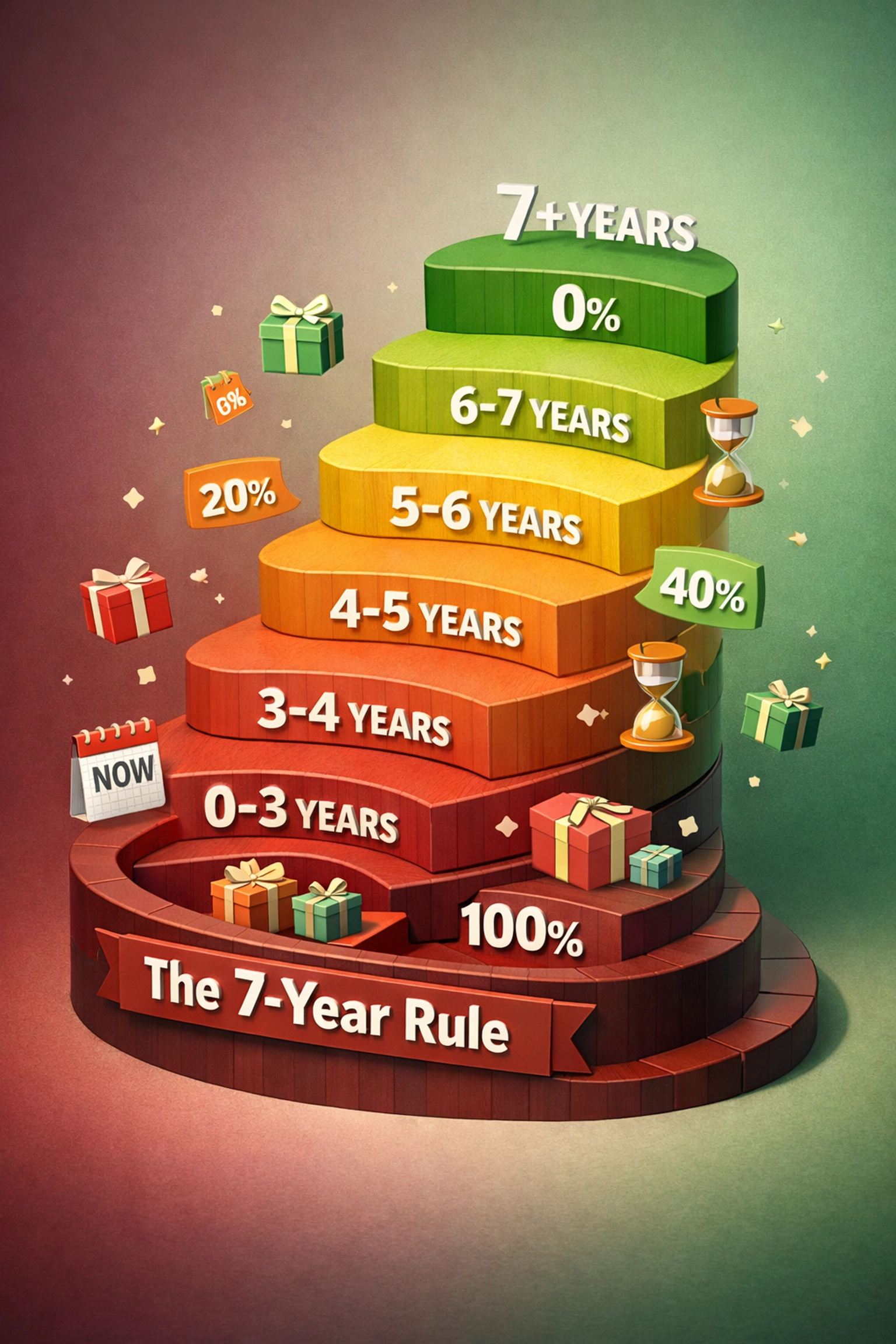
If you make a large gift (above your annual exemptions) and survive for seven full years, that gift usually falls outside your estate for IHT purposes. However, if you die within those seven years, the gift may be taxed: though there’s a sliding scale of relief called taper relief.
The Taper Relief Scale:
- Years 0-3: No relief: full 40% IHT applies
- Years 3-4: 20% relief (32% effective tax rate)
- Years 4-5: 40% relief (24% effective tax rate)
- Years 5-6: 60% relief (16% effective tax rate)
- Years 6-7: 80% relief (8% effective tax rate)
- 7+ years: Gift is fully exempt
But here’s the crucial detail most people miss: taper relief only applies if the gift itself exceeds the nil-rate band. If the total value of gifts in the seven years before death is less than £325,000, no IHT is due on the gifts anyway. Taper relief only helps reduce tax on gifts that push the estate over the threshold.
Myth 3: “Trusts Are Only for the Super-Rich”
When you hear the word “trust,” you might picture aristocratic families managing vast country estates. In reality, trusts are practical planning tools that can benefit a wide range of families: particularly those with property wealth in London and the South East.
A properly structured trust can:
- Protect assets from care home fees
- Ring-fence inheritance for children from previous marriages
- Provide for vulnerable beneficiaries who can’t manage money
- Reduce or eliminate IHT liabilities over time
The most commonly used trust for IHT planning is a discretionary trust. While assets placed into this type of trust may incur an immediate IHT charge (usually 20% if above the nil-rate band), the assets then sit outside your estate. After ten years, any growth in value is protected from IHT, making them particularly effective for younger individuals with significant assets.
For married couples, nil-rate band discretionary trusts used to be standard practice before 2007. While transferable nil-rate bands have made them less essential, they’re still valuable in second marriages or where you want to protect assets from future care costs.
Myth 4: “Life Insurance Doesn’t Count Towards My Estate”
Many people take out life insurance policies specifically to cover an anticipated IHT bill. The logic seems sound: you die, the policy pays out £200,000, and your family uses it to pay HMRC. Problem solved.
Except there’s a catch. If the life insurance policy is written in your own name, the payout becomes part of your taxable estate. You’ve just increased your IHT liability rather than solving it.
The solution? Write your life insurance policy in trust. This ensures the payout goes directly to your beneficiaries outside your estate, bypassing probate and IHT altogether. It’s a simple administrative step that many people overlook: and it costs nothing to set up.
Practical Strategies That Actually Work
Beyond understanding the myths, let’s look at legitimate strategies for protecting family wealth in 2026.
Use Your Annual Exemptions
Every UK taxpayer can give away £3,000 per year without it counting towards your estate. You can also make unlimited small gifts of up to £250 per person (as long as you haven’t used another exemption for that person).
Wedding gifts have their own exemptions: £5,000 to a child, £2,500 to a grandchild, and £1,000 to anyone else.
Regular gifts from surplus income are also exempt, provided you can demonstrate they don’t affect your standard of living. This is particularly useful for grandparents who want to help with school fees.

Consider Business Property Relief and Agricultural Property Relief
If you own a trading business or farm, you may qualify for 100% relief from IHT on those assets, provided you’ve owned them for at least two years before death. This relief is one of the most powerful in the UK tax system: but it’s complex and subject to strict conditions.
Even shares in certain unlisted trading companies can qualify. This has led to the growth of “IHT portfolios” invested in qualifying Alternative Investment Market (AIM) shares, though these carry investment risk and aren’t suitable for everyone.
Make Use of Pension Death Benefits
Since 2015, pensions have become one of the most tax-efficient ways to pass on wealth. Pensions sit outside your estate for IHT purposes, meaning you can leave substantial sums to beneficiaries without a 40% tax charge.
If you die before age 75, your beneficiaries can usually inherit your pension completely tax-free. After 75, they’ll pay income tax at their marginal rate: but that’s still better than a 40% IHT hit followed by income tax.
This makes pensions an increasingly important part of estate planning, particularly for those who have other assets to live on in retirement.
The Residence Nil-Rate Band Trap
While the £175,000 residence nil-rate band sounds generous, it comes with strings attached. It only applies if:
- You leave your home to direct descendants (children, grandchildren, stepchildren)
- Your estate is worth less than £2 million
- You still own a residential property (or downsized after July 2015 and left equivalent value to descendants)
The band is also tapered away by £1 for every £2 your estate exceeds £2 million. For a couple with a £2.35 million estate, the residence nil-rate band disappears entirely.
When to Seek Professional Advice
Inheritance tax planning isn’t a DIY project: especially in 2026, when the rules are more complex than ever. A poorly drafted will or badly timed gift can cost your family tens or even hundreds of thousands of pounds.
You should particularly consider professional advice if you:
- Own property worth more than £500,000 (or £1 million as a couple)
- Have been married more than once or have stepchildren
- Own a business or shares in a family company
- Have made significant lifetime gifts in the past seven years
- Want to protect assets from future care home fees
The earlier you start planning, the more options you’ll have. IHT planning works best when you have time on your side: which means addressing it while you’re healthy and well, not as an urgent last-minute exercise.
Final Thoughts
Inheritance Tax doesn’t have to devastate your family’s finances. Despite the myths and misconceptions, there are legitimate strategies to reduce or eliminate IHT: but they require understanding, planning, and professional guidance.
The 7-year rule isn’t a magic wand that makes your assets disappear. Trusts aren’t just for the aristocracy. And giving away your home while continuing to live in it won’t fool HMRC.
What will work is a comprehensive, properly structured estate plan that uses all the available reliefs and exemptions while protecting your own financial security. That’s where expert wills and estate planning advice makes all the difference.
After all, you’ve spent a lifetime building wealth for your family. With the right planning, you can make sure they actually receive it.