
Trust disputes are often driven by three main causes: unclear drafting, unsuitable trustees, and deep-seated family conflict. While a trust is designed to provide a stable framework for managing assets across generations, the reality of human relationships means that friction is sometimes inevitable. Some disputes can be resolved through simple clarification and better governance; others, however, require formal legal intervention or court directions.
At Judge Law, we understand that these disputes are rarely just about the money or the assets; they are often about legacy, fairness, and the protection of vulnerable family members. This article provides general legal information for England & Wales regarding the resolution of trust disputes. Please note that this content does not provide tax or accounting advice.
TL;DR
- Trust disputes usually stem from unclear drafting, unsuitable trustees or family conflict.
- Common disputes involve distributions, conflicts of interest, entitlement, trustee deadlock and trust land.
- Requesting information, mediation and structured negotiation should usually be tried before court.
- The court can appoint or replace trustees (Trustee Act 1925 s.41) and resolve trust of land disputes (TLATA s.14 and s.15).
- Trustees who act reasonably may have costs paid from the fund; those in breach may have to pay personally.
The Most Common Trust Disputes
Disputes within a trust framework can be incredibly varied, ranging from minor administrative disagreements to high-stakes litigation. However, most cases fall into a few key categories.
1. Disagreements About Distributions
In discretionary trusts, trustees have the power to decide who receives what and when. This inherent power can lead to allegations of bias, unfairness, or a failure to consider the needs of a specific beneficiary. Beneficiaries may feel they are being “locked out” or that the trustees are exercising their discretion capriciously.
2. Allegations of Conflict of Interest
Trustees have a strict fiduciary duty to act in the best interests of the beneficiaries. A dispute often arises if a trustee is seen to be benefitting personally from the trust assets, a concept known as “self-dealing”, or if their personal interests conflict with their duties to the trust.
3. Confusion Over Entitlement
Sometimes, the drafting of a trust deed is not as clear as it should be. Ambiguous language regarding who qualifies as a “beneficiary” or “remoter issue” can lead to legal battles over who is actually entitled to the trust fund.
4. Trustee Deadlock
If there are multiple trustees and they cannot agree on a course of action, the trust can fall into a state of paralysis. Without a robust mechanism in the deed to break the deadlock, the trust’s administration can grind to a halt, necessitating a court application to move matters forward.
5. Property and Land Disputes
Where a trust holds land, disputes frequently arise regarding who is allowed to live in the property, whether the property should be sold, or how the proceeds of a sale should be divided. These are often dealt with under specific legislation regarding trusts of land.
Pre-Action Steps: Resolve Before Court if Possible
Before escalating a matter to the High Court, it is almost always appropriate to explore alternative resolution routes. Litigation is not only expensive and time-consuming but can also permanently fracture family relationships.
| Step | Objective | Key Consideration |
|---|---|---|
| Request Clarity | Obtain a clear understanding of the trust terms. | Refer to the trusts overview to understand your baseline rights. |
| Information Request | Ask trustees for reasonable accounts and documents. | Trustees must act with transparency, though some reasons remain confidential. |
| Mediation | Use a neutral third party to facilitate a deal. | Mediation is confidential and often much cheaper than a full trial. |
| Structured Negotiation | Solicitor-led correspondence to reach a settlement. | Ensures that any “family deal” is legally binding and documented. |
It is important to remember that while informal “family deals” might seem like an easy fix, they can create significant legal complications if they contradict the original deed or prejudice certain beneficiaries (such as minors or unborn children). Any variation to the trust should be formally documented and, where necessary, approved by the court.
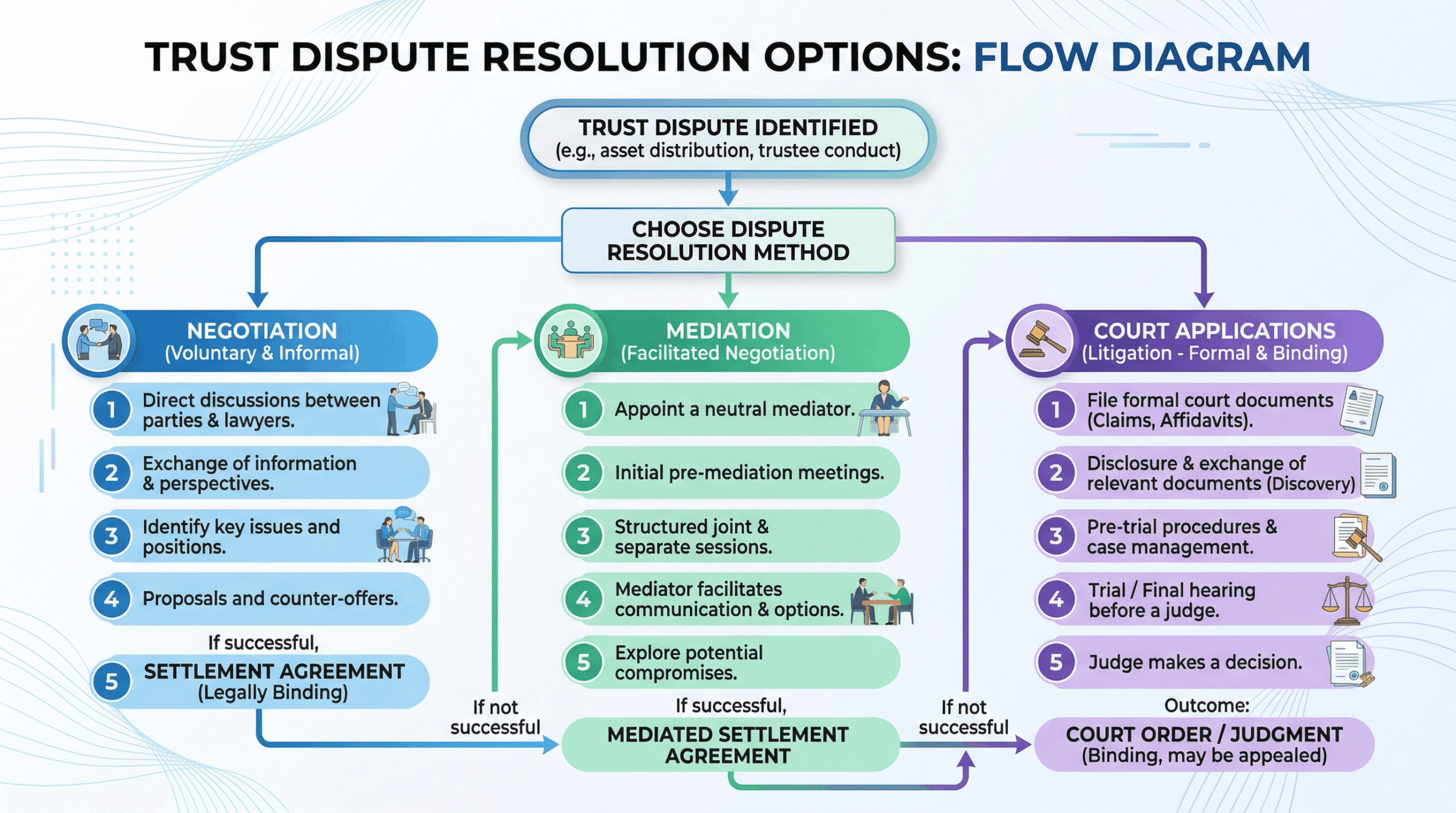
Alt text: Flow diagram showing options to resolve trust disputes: negotiation, mediation, and court applications.
Court Powers and Legal Routes
When internal resolution fails, the law provides the court with specific powers to intervene. The route taken depends entirely on the nature of the dispute.
Trustee appointment/replacement (Trustee Act 1925 s.41)
If a trustee has become unfit to act, has lost mental capacity, or is simply refusing to cooperate to the point that the trust cannot function, the court has the power to step in. Under Section 41 of the Trustee Act 1925, the court may appoint a new trustee in substitution for or in addition to any existing trustee. This power is usually exercised when it is “expedient” to do so and it would be difficult or impracticable to make the appointment without the court’s assistance. This is a vital safety net for trusts suffering from “trustee deadlock” or professional negligence.
Trust of land disputes (TLATA s.14/s.15)
Property is often the most contentious asset in a trust. The Trusts of Land and Appointment of Trustees Act 1996 (TLATA) provides the framework for resolving these issues. Under Section 14, any person who is a trustee of land or has an interest in property subject to a trust can apply to the court for an order relating to the trustees’ functions or to declare the nature and extent of a person’s interest.
When making a decision, the court looks at the factors listed in Section 15, which include:
- The intentions of the person(s) who created the trust.
- The purposes for which the property is held.
- The welfare of any minor who occupies or might reasonably be expected to occupy the land as their home.
- The interests of any secured creditors (e.g., mortgage lenders).
Trust variation (Variation of Trusts Act 1958)
As life changes, a trust that made sense 40 years ago may no longer be fit for purpose. This is often discussed in the context of the trust lifecycle. However, if the beneficiaries are minors or have not yet been born, they cannot legally consent to a change in the trust terms.
The Variation of Trusts Act 1958 allows the court to “consent” on behalf of those beneficiaries who cannot consent for themselves. This is commonly used to modernise investment powers or to extend the date on which a trust must end, provided the variation is for the benefit of those beneficiaries.
Disclosure and Information Disputes
One of the most intense areas of conflict involves the disclosure of trust documents. Beneficiaries often want to see “everything,” while trustees may wish to keep their deliberations private.
Historically, this was governed by the “Londonderry principle” (from Re Londonderry’s Settlement [1965]), which suggested that trustees are not generally required to disclose the reasons for their decisions or the documents relating to their private deliberations. The logic was that forcing disclosure would make the role of a trustee impossible and invite constant second-guessing.
However, legal thought has evolved. Following the case of Schmidt v Rosewood Trust Ltd [2003], the court’s approach has shifted. Disclosure is now seen as part of the court’s inherent jurisdiction to supervise trusts. While there is no “automatic” right to see every document, a cautious and modern legal position is:
- Fundamental Entitlement: Beneficiaries should generally receive enough information to understand the existence of the trust, the terms of the deed, and the nature and value of their interest.
- Court Discretion: Deeper disputes about “letter of wishes” or trustee minutes are fact-specific. The court will balance the beneficiary’s need for information against the need for confidentiality and the efficient administration of the trust.
A lack of transparency is often one of the common trust mistakes that fuels litigation. Clear, proactive communication from trustees can often prevent a request for information from turning into a court battle.
Costs and Risk Management
Trust litigation is notoriously expensive. In many cases, if a trustee acts reasonably, their costs may be paid out of the trust fund. However, if a trustee is found to have acted in breach of duty or has defended a claim purely out of self-interest, they may be ordered to pay costs personally.
For beneficiaries, the risk is equally high. If a claim is unsuccessful, they may find their own share of the trust depleted by legal fees. Practical risk management involves:
- Early Advice: Engaging a solicitor as soon as a conflict escalates.
- Record Keeping: Trustees must maintain clear records of their decisions, even if they do not intend to disclose them immediately.
- Protective Applications: Trustees can apply to the court for “directions” (sometimes called a Beddoe application) to get court approval for a course of action, which protects them from personal liability for costs.
Understanding trustee roles and duties is the best way to manage risk and ensure the trust remains a tool for protection rather than a source of litigation.
Frequently asked questions
What disputes most commonly end up in court?
The most frequent cases involve the removal or replacement of a trustee, disputes over the sale or occupation of trust-owned land, and challenges arising from unclear beneficiary definitions in the original deed.
Can the court replace trustees?
Yes. Under Section 41 of the Trustee Act 1925, the court has the power to appoint new trustees where it is difficult or impractical to do so without court intervention, such as in cases of trustee incapacity or total deadlock.
What is a TLATA application?
A TLATA section 14 application is a request to the court to resolve a dispute regarding land held in a trust. The court uses section 15 factors, such as the purpose of the trust and the welfare of minors, to decide whether to order a sale or change who occupies the property.
Can a trust be varied for minors or unborn beneficiaries?
Yes. Under the Variation of Trusts Act 1958, the court can approve an arrangement to vary the trust terms on behalf of those who cannot consent themselves, provided the court is satisfied the change is for their benefit.
Can beneficiaries demand trustee reasons?
Not automatically. While beneficiaries are entitled to see trust accounts and the deed itself, the “Londonderry principle” often protects the private deliberations of trustees. However, the court has the discretion to order disclosure if it is necessary for the proper supervision of the trust.
Should trustees keep written reasons?
Highly recommended. Good governance and meticulous record-keeping are the best defences against allegations of bias or mismanagement. Even if reasons are not shared immediately, having them on file proves that the trustees acted lawfully and considered relevant factors.
Disclaimer: This article provides general legal information for England & Wales only. It is not intended to provide tax, accounting, or specific legal advice. If you are involved in a trust dispute, you should seek professional legal counsel.