

So, the “talk” has happened. Whether it was a surprise “redundancy” meeting or a mutual realisation that things just aren’t working out, you’ve been handed a document. It’s thick, filled with “heretofore” and “notwithstanding,” and it’s called a Settlement Agreement.
First things first: take a breath. You aren’t the first person to face this, and you certainly won’t be the last. At Judge Law, we see these every single day. The most common question we get, after the initial “Wait, am I fired?”, is usually: “How much money am I actually getting in my bank account?”
Calculating the final figure of a settlement agreement UK isn’t as simple as adding up a few months’ salary. There are notice periods, “Garden Leave,” and the mysterious PILON to consider. If you don’t understand how these interact, you might be leaving thousands of pounds on the table.
Let’s break down the logistics of your exit so you can walk away with your head high and your pockets properly lined.
TL;DR
- A settlement agreement is only legally binding if you receive independent legal advice from a qualified solicitor.
- Your notice can be worked, taken as garden leave or paid in lieu (PILON).
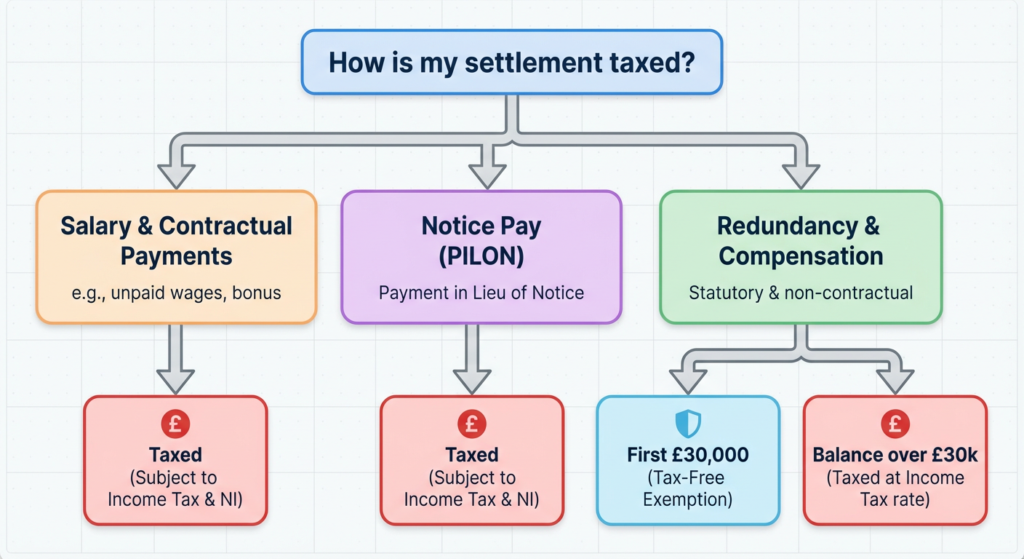
- Since 2018, notice pay is taxed as salary under the PENP rules, however it is paid.
- The £30,000 tax-free allowance generally applies only to compensation for loss of office, not salary, notice, holiday pay or bonuses.
- Check for unpaid holiday, bonuses, pension contributions and outplacement support before you sign.
The Settlement Agreement: The “Truth” Document
Before we dive into the nitty-gritty of the cash, it’s important to know what you’re looking at. A settlement agreement (formerly known as a compromise agreement) is a legally binding contract between you and your employer. You agree not to bring any legal claims against them, and in return, they give you a sum of money.
To make it legal, you must receive independent legal advice from a qualified solicitor. Without that signature, the document is about as useful as a chocolate teapot. For the full low-down on the legal requirements, check out our definitive guide to Settlement Agreements.
1. Notice Pay: The Basics
Everyone has a notice period. It’s either the statutory minimum (one week for every year worked, up to 12 weeks) or what is written in your contract, whichever is higher.
When you’re offered a redundancy settlement agreement UK, the employer has three main ways to handle this notice:
- They make you work it.
- They put you on Garden Leave.
- They pay you instead of making you work (PILON).
How they choose to handle this drastically changes the tax you pay and the final “net” amount you see.

2. Garden Leave: The Professional “Stay-at-Home” Order
Garden Leave sounds lovely, doesn’t it? You get paid your full salary and benefits to sit at home, walk the dog, and perhaps finally finish that 1,000-piece jigsaw puzzle.
The Logistics:
- Employment Status: You are still technically employed.
- Pay: You receive your normal salary and all benefits (pension, health insurance, car allowance).
- Restrictions: You cannot start a new job, and you usually aren’t allowed to contact clients or colleagues.
Why employers love it: It keeps you away from their trade secrets and clients while they transition your replacement.
Why you might love it: You get a fully paid break before your next role.
3. PILON (Payment in Lieu of Notice)
PILON is for when the employer wants you out now. Maybe the vibe in the office is awkward, or they just want a clean break. Instead of having you work your notice or sit in the garden, they pay you a lump sum and end your contract immediately.
The Catch:
Historically, people thought PILON could be paid tax-free as part of the “first £30,000” exemption. Wrong. Since 2018, HMRC introduced PENP (Post-Employment Notice Pay) rules. Essentially, the government wants their cut of your notice pay, regardless of how it’s paid.
Comparison: PILON vs. Garden Leave
| Feature | Garden Leave | PILON |
|---|---|---|
| Employment Status | Employed until notice ends | Employment ends immediately |
| Tax Treatment | Normal PAYE & NI | Subject to PENP (taxed as salary) |
| Benefits (Pension/Health) | Usually continue | Often lost (unless negotiated) |
| Ability to start new job | No (not without permission) | Yes, immediately |
| Holiday Accrual | Continues to accrue | Stops immediately |
4. The “Tax-Free” £30,000 Myth
You’ll often hear that “the first £30,000 of a settlement is tax-free.” While mostly true, it’s a bit of a minefield.
In a settlement agreement UK, the tax-free status generally only applies to ex-gratia payments (compensation for loss of office). It does not apply to:
- Your final salary for days worked.
- Your notice pay (due to the PENP rules mentioned above).
- Payment for untaken holiday.
- Bonuses or commission.
If your employer tries to bundle your notice pay into the “tax-free” portion to save themselves some National Insurance, HMRC will eventually come knocking. At Judge Law, we make sure the agreement is drafted correctly so you don’t end up with a surprise tax bill six months down the line.
5. Don’t Leave These on the Table
When we review agreements for our clients, we often find “hidden” money that hasn’t been accounted for. Before you sign, ask yourself:
Accrued but Untaken Holiday
You are legally entitled to be paid for any holiday days you’ve earned but haven’t used up to your termination date. Don’t let HR “forget” to calculate this.
Bonuses and Commission
If you’ve hit your targets, you should be paid for them. If your agreement says you “waive all rights to future payments,” you might be signing away a bonus that’s due in three months. We often negotiate a “pro-rata” bonus for the portion of the year you worked.
Pension Contributions
If you are on Garden Leave, your employer should continue paying into your pension. If they are paying you PILON, you should negotiate an amount equivalent to the employer’s pension contributions that you would have received during your notice period.
Outplacement Support
While not cash in your pocket, many employers will pay for a career coach or CV writing service to help you find your next role. This is usually a tax-free benefit for you!
Frequently asked questions
Do I need a solicitor to sign a settlement agreement?
Yes. For a settlement agreement to be legally binding, you must receive independent legal advice from a qualified solicitor.
How long is my notice period?
It is either the statutory minimum (one week for every year worked, up to 12 weeks) or the period in your contract, whichever is higher.
What is the difference between garden leave and PILON?
On garden leave you remain employed until your notice ends, receive your normal salary and benefits, and cannot start a new job. With PILON your employer pays you a lump sum, your employment ends immediately, and you can start a new job straight away.
Is notice pay tax-free?
No. Since 2018, the Post-Employment Notice Pay (PENP) rules mean notice pay is taxed as salary, however it is paid.
What does the £30,000 tax-free allowance cover?
It generally applies only to ex-gratia payments, meaning compensation for loss of office. It does not cover your final salary, notice pay, payment for untaken holiday, or bonuses and commission.
Why You Need a Pro (Like Us)
Employers often offer a “contribution” towards your legal fees. In many cases, this covers the entire cost of the legal advice, meaning you get a solicitor’s eyes on your contract for free.
At Judge Law, we don’t just “rubber stamp” the document. We look for the traps. We check if your “Restrictive Covenants” are too broad (which could stop you from getting a job at a competitor). We ensure the “Reference” clause is actually helpful and not just a basic “Name and Dates” confirmation.

Final Thoughts: The Million-Pound Question
So, how much are you actually getting? Your final take-home pay is:
[Notice Pay (Taxed)] + [Holiday Pay (Taxed)] + [Compensation Sum (Up to £30k Tax-Free)] – [Any outstanding loans/excess holiday taken].
Getting the logistics right is the difference between a stressful exit and a comfortable transition. If you’ve been handed a redundancy settlement agreement UK, don’t panic. Take a moment, grab a coffee, and let a professional help you navigate the math.
We’re here to make sure the “Law” part of your exit is the easiest part.

Ready to get your settlement agreement sorted?
Whether you’re in London, Windsor, or anywhere in the UK, the team at Judge Law is ready to give you the reassuring advice you need to move forward.
Disclaimer: This blog post is for informational purposes and does not constitute legal advice. Employment law is complex and depends on your specific contract and circumstances. Always consult with a qualified solicitor.