
TL;DR:
- Family lawyers manage complex procedures, ensuring deadlines are met and rights protected.
- Self-representation increases risks of errors, delays, and unenforceable agreements, costing more long-term.
- Early legal advice helps prevent disputes, protects children and finances, and reduces overall costs.
You are weighing up whether to handle your separation yourself or bring in a solicitor. It feels like a practical question, but it carries real consequences. 42% of marriages end in divorce in the UK, and a significant proportion of those cases encounter costly delays or lost rights when not handled professionally. The assumption that going it alone is quicker or cheaper is one of the most persistent misconceptions in family law. This guide sets out what a family lawyer actually does, where the risks of self-representation are greatest, and how professional legal support protects the things that matter most to you.
Table of Contents
- What does a family lawyer actually do?
- Risks of going it alone: DIY vs professional legal help
- Protecting children and finances: Core reasons for legal representation
- Safeguarding against abuse and coercion
- A fresh perspective: Why early legal advice saves more than just money
- How Judge Law can help protect your family
- Frequently asked questions
Key Takeaways
| Point | Details |
|---|---|
| Lawyers reduce risk | Using a family lawyer can prevent costly mistakes and ensure your rights are protected. |
| Safeguard children and assets | Professional guidance secures the well-being of your children and financial future during separation or divorce. |
| Essential in abuse cases | Legal support is vital to securing protection and safety where abuse or coercion is present. |
| DIY is often riskier | Trying to handle family law issues alone can lead to delays, lost rights, and unfavourable outcomes. |
What does a family lawyer actually do?
It is easy to assume that a family lawyer simply fills in forms and attends court hearings. The reality is considerably more involved. A good family solicitor manages your case from the very first disclosure of financial information through to the drafting of binding agreements and, where necessary, litigation. Each of those stages carries procedural rules, strict deadlines, and legal requirements that, if missed, can set your case back by months or cost you rights you did not know you had.
At the disclosure stage, your solicitor ensures that both parties provide full and frank financial information. This is not optional. Courts take a dim view of incomplete disclosure, and a lawyer knows exactly what to request, how to scrutinise what you receive, and when something looks incomplete. During negotiation, they translate your priorities into legally sound positions, helping you avoid agreements that appear fair on the surface but disadvantage you over time. When it comes to drafting consent orders or parenting plans, precision matters. A document that is poorly worded can be unenforceable, leaving you back in court at significant expense.
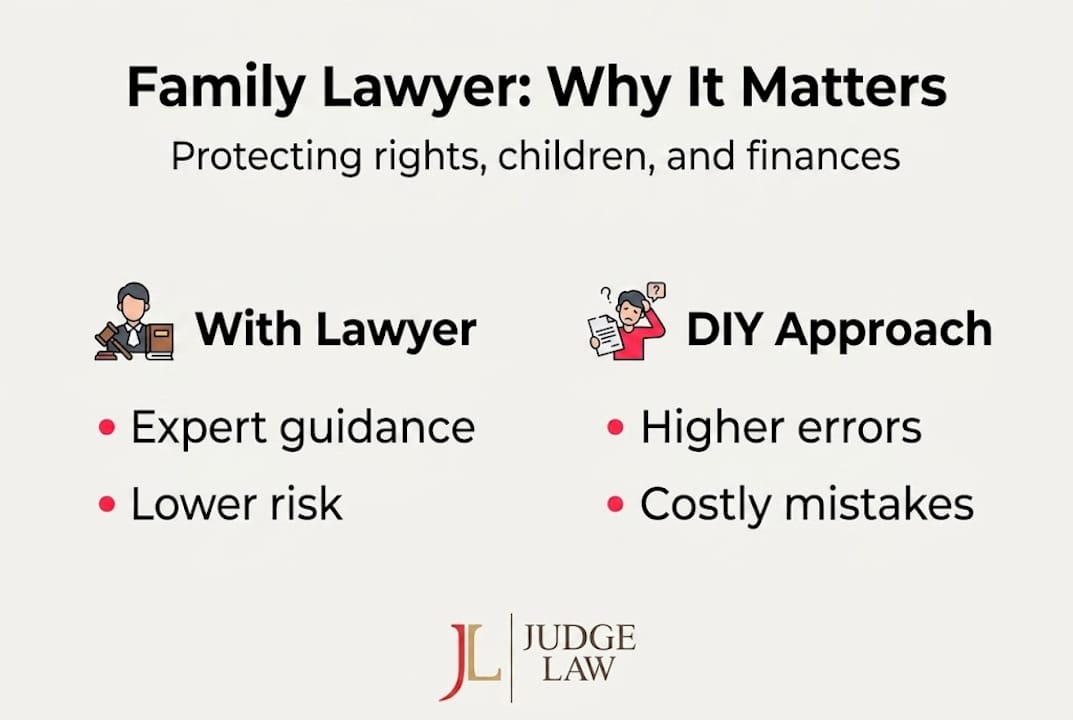
Family lawyers provide expert legal guidance on complex processes like divorce, financial settlements, and child arrangements, ensuring accurate paperwork and compliance with deadlines to avoid delays or rejections. That expertise extends to handling child custody cases with the sensitivity and procedural knowledge they require, as well as advising you on when to instruct a child arrangements solicitor before matters escalate.
Here is a comparison of the three main routes people take:
| Approach | Key benefits | Key risks |
|---|---|---|
| DIY | Lower upfront cost | Missed deadlines, unenforceable agreements, lost rights |
| Mediation | Collaborative, cost-effective | Not suitable where there is a power imbalance or abuse |
| Solicitor-led | Expert guidance, enforceable outcomes | Higher upfront cost, though often lower long-term cost |
Key functions a family lawyer performs include:
- Advising on your legal rights from the outset, before you make any decisions
- Managing financial disclosure and identifying incomplete or misleading information
- Drafting legally binding agreements, consent orders, and parenting plans
- Representing you at hearings and responding to court directions within strict deadlines
- Advising on enforcement when the other party fails to comply with an order
Pro Tip: Instructing a solicitor early, even just for an initial consultation before you have made any decisions, often prevents the kind of irreversible mistakes that cost far more to fix later.
Risks of going it alone: DIY vs professional legal help
Understanding a lawyer’s role is vital, but so is grasping the consequences of tackling it without expert support. Self-representation in family law is not simply a matter of saving money. It is a calculated risk, and the evidence suggests the odds are not in your favour.
Government data on family legal aid shows that 37% of divorces are delayed by costs, and 23% of unrepresented parties waive rights they were entitled to, often without realising it. These are not edge cases. They are patterns that emerge repeatedly when people navigate a complex legal system without professional guidance.
The most common mistakes made by people representing themselves in family proceedings include:
- Submitting incomplete or inaccurate financial disclosure, which courts can treat as a serious procedural failure
- Missing court deadlines, which can result in applications being struck out or unfavourable orders being made in your absence
- Agreeing to informal arrangements that are not legally binding and cannot be enforced if the other party changes their mind
- Misunderstanding the welfare checklist that courts apply under the Children Act 1989, leading to poorly framed applications for child arrangements
- Failing to obtain a clean break order on divorce, leaving yourself exposed to future financial claims from your former spouse
- Undervaluing assets during financial proceedings, particularly pensions, business interests, or property held in complex ownership structures
- Signing agreements under pressure without understanding the long-term implications, particularly where there is a history of coercive control
The challenges of self-representation in the family court are well documented, and many people who start the process alone find themselves seeking legal help at a much later and more expensive stage. There are also practical legal tips for families navigating divorce and custody that can help you understand what you are walking into before you decide.
The financial comparison is worth considering plainly. Legal fees feel significant at the outset. But the cost of rectifying an unenforceable agreement, reopening financial proceedings, or returning to court over child arrangements that were never properly formalised is almost always higher. The upfront cost of professional advice is frequently the cheaper option when measured against the total cost of getting it wrong.
| Outcome area | DIY representation | Solicitor-led |
|---|---|---|
| Paperwork accuracy | High error rate | Professionally verified |
| Financial settlement | Risk of undervaluing assets | Full disclosure and expert scrutiny |
| Child arrangements | Often informal, unenforceable | Court-approved, binding order |
| Time to resolution | Often longer due to errors | More predictable timeline |
| Long-term cost | Higher due to corrections | Lower overall in most cases |
Protecting children and finances: Core reasons for legal representation
Having shown the hazards of DIY, let us examine what you stand to gain and protect with quality legal assistance. The two areas where the stakes are highest in any separation are your children and your finances. Both require careful handling, and both are areas where professional expertise makes a measurable difference.
On the financial side, the risks of proceeding without advice are substantial. Pension assets are routinely undervalued or ignored entirely in unrepresented cases. Business interests, jointly held property, and investments all require proper analysis. A solicitor ensures that full financial disclosure takes place, that assets are properly valued, and that any agreement reached is structured in a way that protects you not just now but in the years ahead. Family lawyers deliver expertise in financial settlements that ensures compliance and proper safeguarding of your interests throughout the process.

For children, the considerations are different but equally serious. Courts apply the welfare checklist under the Children Act 1989 when making any decision about a child’s living arrangements or contact. A solicitor helps you understand how that checklist applies to your specific circumstances, frames your application appropriately, and ensures that any order made properly reflects your child’s needs. Where there are safeguarding concerns, professional legal input is not just advisable. It is essential.
Key areas where legal representation protects your children and finances include:
- Ensuring pension sharing or offsetting is properly addressed in financial proceedings
- Securing a clean break order that prevents future financial claims
- Obtaining a child arrangements order that is enforceable if the other party does not comply
- Addressing any safeguarding concerns through the appropriate legal channels
- Protecting your position where there is a significant imbalance of financial knowledge or resources between you and your former partner
For situations where arrangements break down after an order is in place, understanding how enforcing child arrangements works is important. Similarly, knowing the process for enforcing financial orders can save you significant time and cost if the other party fails to comply. Courts also take a structured approach to child custody decisions that a solicitor will help you navigate with clarity.
Pro Tip: Many people overlook the pension entirely when dividing finances on divorce. In long marriages, pension assets can exceed the value of the family home. Always obtain a pension valuation before agreeing any financial settlement.
Safeguarding against abuse and coercion
Beyond paperwork and court orders, some cases demand legal protection for you and your loved ones. Where there is a history of domestic abuse, coercive control, or harassment, the legal landscape shifts significantly. A solicitor does not simply manage your case. They act as a protective barrier between you and a process that an abusive former partner may attempt to weaponise.
Non-molestation orders and occupation orders are two of the most important protective tools available in family law. A non-molestation order prohibits the respondent from using or threatening violence against you, or from intimidating or harassing you. An occupation order regulates who can live in or enter the family home. Both can be obtained urgently, sometimes without the other party being notified in advance, where the risk is immediate.
Research on non-molestation orders and post-separation abuse confirms that in cases involving domestic abuse or coercive control, lawyers secure these protections, ensure safety in child arrangements, and counter tactics like repeated litigation used to maintain control after separation. This last point is important. Post-separation abuse through the legal system, sometimes called litigation abuse, involves using court applications to exhaust, intimidate, or financially drain a former partner. An experienced solicitor recognises this pattern and knows how to respond to it effectively.
Red flags that indicate you should seek immediate legal support include:
- Your former partner is making repeated, unfounded applications to the court
- You feel frightened to attend court or to communicate with your former partner directly
- Your former partner is using contact with your children as a means of maintaining control over you
- You have received threats, whether direct or implied, about what will happen if you pursue your legal rights
- You are being pressured to sign agreements quickly without being given time to take advice
Specialist child arrangement support is particularly important in these circumstances, where the safety of your children may be directly affected by the arrangements being sought.
The law provides real protections in these situations. But those protections are only accessible if you know they exist and how to apply for them. That is precisely where a solicitor’s knowledge becomes not just useful but necessary.
A fresh perspective: Why early legal advice saves more than just money
Most guides on this subject focus on what can go wrong. That is useful, but it misses something important. The greatest value a family lawyer provides is often not in the courtroom. It is in the conversations that prevent you from getting there.
Experienced family solicitors are skilled negotiators. They understand that the goal in most cases is not to win an argument but to reach a resolution that both parties can live with, and that protects the children caught in the middle. Early legal advice frequently de-escalates conflict rather than inflaming it, because it replaces fear and uncertainty with clarity. When you understand your rights, you negotiate from a position of knowledge rather than anxiety.
Waiting too long to seek advice is one of the most common and costly mistakes people make. Informal arrangements that feel manageable in the short term can become entrenched. Agreements made under pressure, without legal scrutiny, can be extraordinarily painful to undo. The longer you wait, the fewer options you may have. Practical family law tips can help you understand what questions to ask before you take any step, formal or informal.
The standard advice says “get a lawyer if it gets complicated.” Our view is different. Get advice early, before you decide what complicated looks like. The cost of a single consultation is almost always worth it.
How Judge Law can help protect your family
If you are navigating separation, divorce, or a dispute over children or finances, you do not have to work out where to start on your own. At Judge Law, we provide specialist family law support tailored to your specific circumstances, not a generic process. Whether your situation is urgent, sensitive, or simply unclear, we take the time to understand what matters to you and advise you accordingly. Our team includes solicitors experienced in complex financial cases, child arrangements, and protective orders. We also have a London-based family solicitors team for clients who prefer to meet in the city. To speak with a solicitor about your situation, contact us to arrange a consultation.
Frequently asked questions
When should I absolutely use a family lawyer?
You should always use a family lawyer when children, shared property, complex finances, or allegations of abuse are involved. In cases of domestic abuse or coercive control, lawyers secure protections such as non-molestation orders and counter post-separation litigation tactics that could otherwise put you at serious risk.
Is mediation required before going to court for family disputes?
Most courts now expect mediation or other non-court alternatives to be tried first, except in abuse or urgent cases. Courts expect alternative dispute resolution before litigation in the majority of family proceedings, and failing to engage with it can affect how the court views your conduct.
What can happen if I make a mistake representing myself?
Mistakes can cause costly delays, rejected paperwork, lost rights, or unfavourable settlements that are difficult to reverse. Government data shows that 37% of divorces are delayed by costs and 23% of unrepresented parties waive rights they were entitled to, often without realising it at the time.
Is legal aid available for family law cases?
Legal aid is still available in limited cases, mainly involving domestic abuse or child protection issues. Family legal aid data shows that provision is concentrated in specific areas of family work, and eligibility criteria are strict. Please note that Judge Law does not handle legal aid matters.