
The Quick Summary
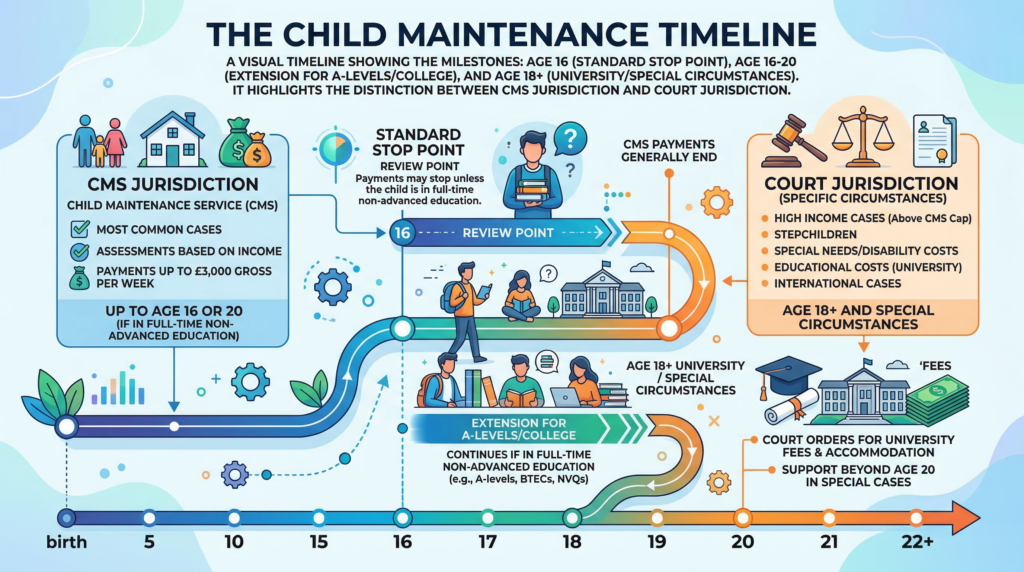
In the UK, child maintenance generally stops when a child reaches 16 years old. However, if the child stays in “approved” full-time non-advanced education (like A-Levels or NVQs), the payments continue until they finish that course or turn 20. It does not automatically cover university; for higher education, different legal routes: like a court order: are usually required.
Navigating these dates can be stressful, especially when you’re trying to plan for your child’s future. At Judge Law, we’re all about building relationships and providing expert, straightforward advice to help you manage these transitions smoothly.
Table of Contents
- The General Rule: Age 16 vs. Education
- What Exactly Is “Approved Education”?
- The “August 31st” Rule You Need to Know
- What Happens at University? (Higher Education)
- Special Needs and Disability: When Rules Change
- CMS Rules vs. Private Family-Based Agreements
- How Family Law Solicitors Can Help
1. The General Rule: Age 16 vs. Education
The most common question our child maintenance solicitors get is: “Do I stop paying the moment they turn 16?”
The short answer is: Maybe.
Under the Child Maintenance Service (CMS) rules, payments are required until the child is 16. However, if they remain in “approved education,” the liability extends. This is designed to ensure that the child is supported while they are still legally required to be in some form of education or training (which, in England, is until age 18).
If your child decides to leave school at 16 and goes straight into full-time work or starts an unapproved apprenticeship, maintenance usually stops. If they stay in school to sit their A-Levels or head to college for a vocational course, you’ll likely be paying until they finish or hit 20.
2. What Exactly Is “Approved Education”?
This is where things can get a bit technical. Not every “course” counts. To keep child maintenance active, the child must be in full-time, non-advanced education.
Approved education includes:
- A-Levels or Highers.
- NVQ/SVQ Level 1, 2, or 3.
- BTEC National Diploma or Certificates.
- International Baccalaureate.
- Home schooling (if it started before the child turned 16).
What is NOT included:
- University degrees (Higher Education).
- Level 4 NVQs or higher.
- Apprenticeships where the child is paid by an employer.

3. The “August 31st” Rule You Need to Know
Child maintenance doesn’t always stop on a birthday. There is a specific “cut-off” date used by the CMS and HMRC (who handle Child Benefit).
If a child finishes their secondary education in June, the maintenance payments usually continue until the 31st of August following their 16th (or up to 20th) birthday. This provides a “buffer” period over the summer holidays. If you are unsure about the exact date your payments should cease, it’s always worth speaking to family law solicitors to avoid accidentally building up arrears or overpaying.
| Scenario | When Maintenance Usually Stops |
|---|---|
| Leaves school at 16 for a job | August 31st after 16th birthday |
| Starts a paid apprenticeship at 17 | When the apprenticeship begins |
| Stays in College/6th Form | When the course ends or 20th birthday |
| Goes to University | Usually when CMS ends (unless court-ordered) |
4. What Happens at University? (Higher Education)
This is a major pain point for many parents. Once a child moves into Higher Education (University), the Child Maintenance Service (CMS) no longer has the power to manage the case.
However, this does not necessarily mean the financial responsibility ends. Parents can often agree to continue support privately. If an agreement can’t be reached, the “resident” parent (or even the student themselves in some cases) can apply to the court for a “Schedule 1 Order” under the Children Act 1989.
The court can order the non-resident parent to contribute toward:
- University tuition fees.
- Living costs (rent, food).
- Laptops or books.
At Judge Law, we often assist clients in drafting child arrangements that look ahead to these university years, preventing future conflict.
5. Special Needs and Disability: When Rules Change
For children with disabilities or special educational needs (SEN), the standard age cut-offs can feel unfair or insufficient. The law recognizes that some young people may remain dependent on their parents well into adulthood.
While the CMS still follows the age 20 cut-off, the Family Court has broader powers. If a child has a disability that prevents them from being financially independent, the court can order maintenance to continue indefinitely. This is a complex area of law, and having a reassuring expert by your side is vital. We focus on straightforward, jargon-free advice to ensure your child’s needs are met for the long term.

6. CMS Rules vs. Private Family-Based Agreements
You don’t have to use the Child Maintenance Service. In fact, many parents prefer a “Family-Based Arrangement.” This is a private agreement where you decide:
- How much is paid.
- When it’s paid.
- When it stops.
A private agreement gives you the flexibility to say,
"I’ll pay until they finish their Master's degree," or "I’ll pay until they get their first full-time job."
The downside? These aren’t always legally binding unless they are turned into a Consent Order by a court. If you’re considering a private deal, it’s a good idea to have our team at Judge Law review it to make sure it’s fair and enforceable.
7. How Family Law Solicitors Can Help
Whether you are the paying parent wondering when your liability ends, or the receiving parent worried about how you’ll afford the college years, we are here to help.
Legal matters involving children are rarely just about the money; they are about security, fairness, and the child’s best interests. At Judge Law, we pride ourselves on being more than just “lawyers.” We are your partners in navigating the complexities of property law (when homes are shared), family law, and even commercial lease issues if your business income is being assessed for maintenance.
We can help you with:
- Calculating the correct amount of maintenance.
- Challenging a CMS decision if you think the calculation is wrong.
- Drafting “Clean Break” or Consent Orders to include university costs.
- Negotiating family-based arrangements that actually work.

Let’s Talk
The rules around age 16 and 18 can be tricky, but you don’t have to figure them out alone. We offer expert, reassuring advice tailored to your family’s unique situation.
Contact Judge Law today to discuss your child maintenance or child arrangement concerns. We’re here to help you move forward with confidence.