Deciding to end a marriage is never easy, but when you’ve spent 20, 30, or even 40 years building a life together, the decision carries a unique weight. At Judge Law, we’ve seen a significant shift in the landscape of family law. “Grey divorce”: the term used for couples aged 50 and over who choose to separate: is on the rise.
While it might feel overwhelming to imagine starting over in your 50s or 60s, it’s important to know that you aren’t alone. This isn’t just about “splitting up”; it’s a strategic transition into a new chapter of your life. Whether you’re looking for a fresh start or simply a peaceful resolution, understanding the legal and financial landscape is the first step toward securing your future.
What Is Grey Divorce?
Grey divorce refers to the demographic trend of older couples opting for divorce later in life. In the past, many couples in unhappy marriages would simply “tough it out” until the end. Today, that script has been rewritten.
The Data Snapshot
According to the Office for National Statistics (ONS), while overall divorce rates in England and Wales have seen fluctuations, the rate for those aged 60 and over has more than doubled since the 1990s. In 2023 alone, over 20% of all divorces involved individuals over the age of 55.
Why the change?
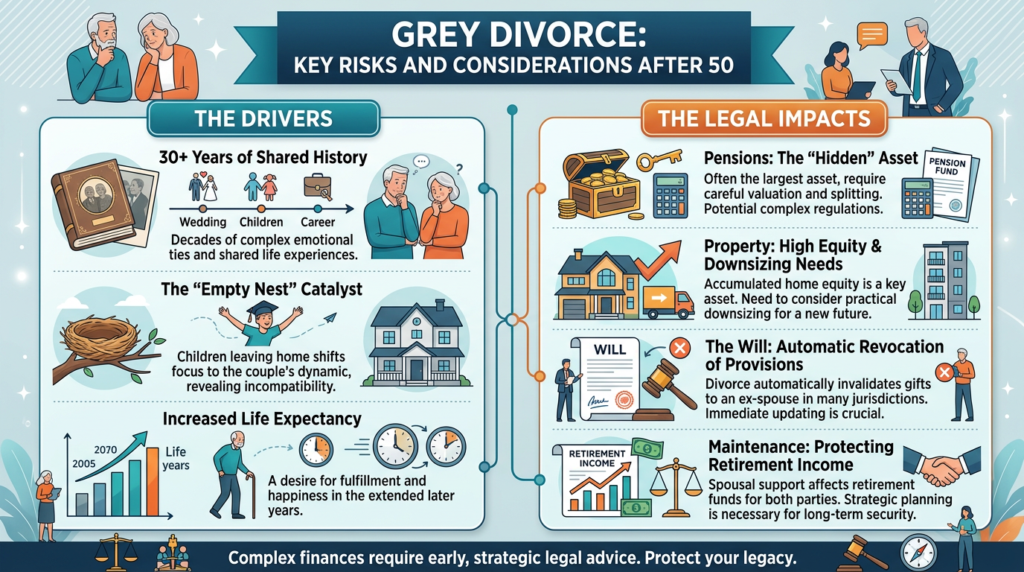
- Increased Life Expectancy: If you’re 60 today, you could easily have another 25 or 30 active years ahead of you. That’s a long time to spend in a relationship that no longer fulfills you.
- Reduced Stigma: Divorce is no longer the social “taboo” it was for previous generations.
- Financial Autonomy: More individuals, particularly women, have their own careers, savings, and pensions, making the prospect of living independently much more viable.
Why Are More Couples Over 50 Divorcing?
The reasons behind a grey divorce are rarely explosive. More often, it’s a quiet realisation that the paths two people were walking have finally diverged.
Common Reasons Behind Grey Divorce
| Reason | What It Looks Like in Practice | Emotional Impact |
|---|---|---|
| Financial Independence | One or both spouses no longer feel trapped by a joint bank account. | Increased confidence to leave a stale marriage. |
| Reassessment of Life | The “Is this it?” moment. Realising life is short. | A desire for personal fulfillment and growth. |
| Long-term Distance | Years of living “parallel lives” finally take their toll. | Quiet resignation rather than high-conflict anger. |
| Retirement Changes | Spending 24/7 together exposes fundamental incompatibilities. | Lifestyle friction and loss of personal space. |
| Empty Nest Syndrome | Once the children leave, the “glue” holding the marriage together is gone. | A shift in priorities and a feeling of “mission accomplished.” |
A. Financial Independence
Historically, many women stayed in unhappy marriages because they lacked the means to survive alone. Today, with more women having established careers and their own pension ownership, that barrier has crumbled. While independence is empowering, it also makes the financial settlement more complex, as there are more individual assets to untangle.
B. Reassessment of Life and Future
There is a reflective tone to most grey divorces. We often hear clients say, “I want the next 20 years to be about me.” Whether it’s a divergence in retirement visions (one wants to travel, the other wants to garden) or a simple desire for autonomy, the focus shifts from “us” to “me.”
C. Long-Term Emotional Distance
Many couples over 50 feel a sense of guilt for walking away after so long. They might have stayed together “for the kids,” but once the kids have moved out, the silence in the house becomes deafening. It isn’t always about a “big fight”; sometimes, the relationship has simply run its course.

Why Grey Divorce Is More Legally Complex
This is where the expertise of a firm like Judge Law becomes essential. In a short marriage, the goal is often to put people back where they started. In a long marriage (20+ years), the starting point is usually a 50/50 split of all marital assets, regardless of who “earned” what.
Key Legal Complexities After 50
| Area | Why It Is More Complex After 50 |
|---|---|
| Pensions | Often the largest asset after the family home; require actuarial valuation. |
| Property | Significant equity or multiple properties (holiday homes/rentals). |
| Inheritance | Anticipated or recently received inheritance can become a point of contention. |
| Wills & Estates | Divorce automatically changes how your Will operates. |
| Adult Children | Support for university fees or help with first-home deposits. |
| Spousal Maintenance | Longer marriages often lead to stronger arguments for ongoing support. |
The Power of the Pension
For many over 50s, the pension pot is worth more than the family home. Dividing a pension isn’t as simple as splitting a bank account. You have to consider:
- Pension Sharing Orders: A formal legal order to transfer a percentage of one party’s pension to the other.
- Offsetting: One person keeps the house, the other keeps the pension.
- Defined Benefit Schemes: These are complex and often require expert actuarial advice to ensure the true value is being split fairly.
Missing the nuances of a pension split can permanently affect your standard of living in retirement.
Wills, Legacy, and Estate Planning
Many people forget that divorce has a massive impact on Wills and Estate Planning. In the eyes of the law, a divorce usually treats your ex-spouse as if they have died before you: meaning they are removed as an executor or beneficiary. If you don’t update your Will immediately, your estate could end up in a legal limbo that causes huge stress for your adult children.

Amicable Does Not Mean Simple
We often see “amicable” separations where couples try to do it themselves to save money. While we support a calm approach, “calm” does not mean “straightforward.”
Even if you agree on everything, you need a Consent Order. Without a legally binding court order, your ex-spouse could potentially come back years later to claim a share of your future assets or inheritance. This is particularly dangerous in grey divorce, where one party might receive a large inheritance shortly after the split.
The Human Element: Rebuilding After 50
Beyond the paperwork, there is the emotional reality. Grey divorce involves:
- Navigating Adult Children: Even though they are grown, adult children often feel “stuck in the middle” or face a crisis of identity regarding their childhood home.
- Rebuilding Identity: Who are you when you aren’t “half of a couple”?
- Longevity Risk: Ensuring your half of the assets will last you for the next 30 years requires careful financial planning.
When Should You Seek Legal Advice?
If you are considering a separation, the best time to speak to a solicitor is before you make any major moves. At Judge Law, we recommend seeking advice:
- Before you announce the separation to understand your financial standing.
- Before you move out of the family home.
- Before you transfer any assets or withdraw large sums from pensions.
- Before you promise a “50/50 split” without knowing the true value of the assets involved.
Conclusion: A New Beginning, Protected
Grey divorce is not a failure; it is a transition. It is the brave choice to prioritize your happiness and autonomy in the second half of your life. However, because the stakes: your retirement, your home, and your children’s inheritance: are so high, you cannot afford to leave the details to chance.
At Judge Law, we provide the calm, expert guidance you need to navigate these complexities. We don’t just look at the law; we look at your future.
Ready to discuss your options? Contact us today for a confidential consultation and let’s start planning your new chapter with confidence.