
Navigating the UK’s immigration system can feel like moving through a maze where the walls are constantly shifting. If you are looking to build a career in the UK, or if you are a business owner in Windsor or London looking to hire international talent, the Skilled Worker Visa is your primary gateway.
At Judge Law, we know that behind every visa application is a person’s career, a family’s future, or a business’s growth. While the opportunities are vast, the Home Office maintains incredibly strict eligibility rules. A single oversight in a document or a slight mismatch in a salary figure can lead to a refusal that sets you back months. This guide is designed to provide clear, reassuring, and expert advice to help you get it right the first time. We believe in being proactive, getting your ducks in a row now prevents a legal headache later.
Section 1: What Is a Skilled Worker Visa?
The Skilled Worker Visa replaced the old Tier 2 (General) work visa. It is a points-based system designed to allow non-UK nationals to come to or stay in the UK to do an eligible job with an approved employer.
Unlike some other visa categories, this is not a “freelance” visa. You must have a specific job offer and be “sponsored” by an organisation that holds a valid license from the Home Office. One of the biggest draws of this visa is that it is a direct route to settlement; after five years of living and working in the UK under this category, you may be eligible for Indefinite Leave to Remain (ILR).
Section 2: Who Is Eligible?
To qualify for a Skilled Worker Visa UK, you don’t just need a job; you need the right job at the right pay scale. The Home Office evaluates your application based on several core criteria.
1. Sponsorship Requirement
You must have a “Certificate of Sponsorship” (CoS) from an employer that is cleared by the Home Office to sponsor foreign workers. You can check the official register of licensed sponsors to see if your potential employer is on the list.
2. Eligible Occupation List
Not every job qualifies. Your role must be on the list of eligible occupations, each defined by a Standard Occupational Classification (SOC) code. These roles are generally at a professional or associate professional level.
3. Salary Thresholds
As of the latest 2024 and 2025 updates, salary requirements have increased significantly. Generally, you must be paid at least £38,700 per year, or the “going rate” for your specific job, whichever is higher. There are exceptions for “New Entrants” (like recent graduates) and those in Health and Education roles.
4. English Language Requirement
You must prove you can speak, read, write, and understand English to at least level B1 on the Common European Framework of Reference for Languages (CEFR) scale.
5. Financial Requirement
You must usually have at least £1,270 in your bank account to show you can support yourself when you arrive in the UK, unless your sponsor agrees to “certify your maintenance” on your CoS.
Eligibility Summary Table
| Requirement | Criteria |
|---|---|
| Sponsorship | Must have a valid Certificate of Sponsorship (CoS) |
| Skill Level | Job must be at RQF Level 3 or above (A-level equivalent) |
| Salary | Generally £38,700+ or the “going rate” |
| English Language | B1 Level (Approved test or UK degree) |
| Maintenance | £1,270 in savings (unless certified by sponsor) |
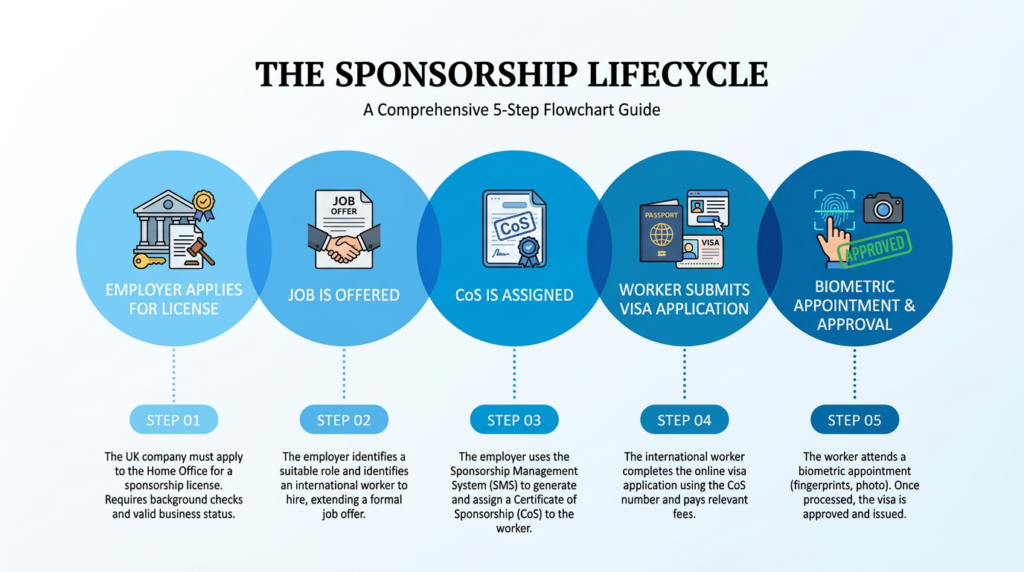
Section 3: How the Sponsorship Process Works
The sponsorship process is a partnership between the employer and the employee. It isn’t just a letter of intent; it is a formal legal undertaking.
The Certificate of Sponsorship (CoS)
The CoS is a digital record, not a paper certificate. There are two types:
- Defined CoS: For people applying from outside the UK.
- Undefined CoS: For people applying from inside the UK (switching or extending).
Employer Obligations
Employers in London and Windsor must realize that holding a sponsor license comes with “Sponsorship Duties.” You must report if the worker doesn’t show up for work, if their salary changes, or if their contract is terminated.
Compliance Risks
The Home Office frequently conducts audits. If a business fails to maintain proper records or pays below the agreed rate, they risk having their license revoked, which immediately puts the employee’s visa at risk. At Judge Law, we often assist businesses with employment law compliance to ensure they stay on the right side of the law.
Section 4: Required Documents
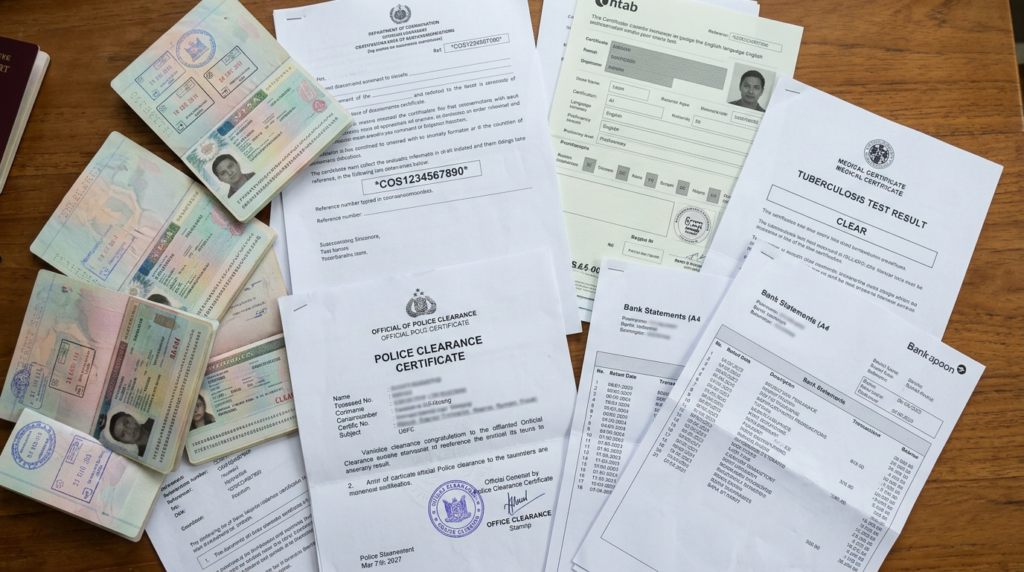
Gathering documents is often the most stressful part of the Skilled Worker Visa application process. You will typically need:
- Your Certificate of Sponsorship (CoS) reference number.
- A valid passport or travel document.
- Proof of your English language proficiency.
- A TB test certificate (depending on your country of residence).
- A criminal record certificate (for specific roles like healthcare or education).
- Bank statements (unless your CoS covers your maintenance).
Section 5: Switching to a Skilled Worker Visa
If you are already in the UK on a different visa, you might be able to switch to a Skilled Worker Visa without leaving the country. This is common for:
- Students: Moving from a Student Visa to a Skilled Worker Visa after finishing their degree.
- Graduate Visa Holders: Who have found a permanent role and need longer-term security.
- Dependants: Switching from a dependant partner visa to their own independent work visa.
However, you must apply to switch before your current visa expires. If your current visa doesn’t allow switching (like a Visitor Visa), you will have to leave the UK and apply from abroad.
Section 6: How Long Does It Take?
We know you’re eager to start your new role. Here are the realistic timeframes:
- Applying from outside the UK: Usually 3 weeks.
- Applying from inside the UK (Switching/Extending): Usually 8 weeks.
If you are in a rush, the Home Office offers “Priority” and “Super Priority” services for an extra fee, which can get you a decision within 5 working days or even 24 hours.
Section 7: Pathway to Indefinite Leave to Remain
One of the greatest benefits of the Skilled Worker route is that it counts toward “settlement.” After spending 5 continuous years in the UK on this visa, you can apply for Indefinite Leave to Remain (ILR).
ILR means you no longer have time limits on your stay and you are free to work for any employer (or be self-employed). This is the ultimate goal for many of our clients, and we pride ourselves on planning your 5-year journey from day one to ensure you don’t break the “continuous residence” rules.
Section 8: Common Reasons for Refusal
Refusals are heartbreaking, but they are often avoidable. Common pitfalls include:
- Incorrect SOC Code: The Home Office believes the job description doesn’t match the skill level assigned.
- Salary Mismatch: The salary offered is below the “going rate” for that specific code.
- Genuineness Test: The Home Office suspects the role was created solely to get the applicant a visa.
- Incomplete Documentation: Missing bank statements or an unapproved English test provider.

Section 9: When to Seek Legal Advice
The Skilled Worker Visa requirements are dense and the stakes are high. While you can apply on your own, having an expert eye can be the difference between a “Yes” and a “No.”
At Judge Law, we offer a reassuring hand through the complexity. Whether you are a business in Windsor looking to sponsor your first employee or an individual in London looking to switch visas, we provide straightforward, honest advice. We help with:
- Checking your eligibility and salary calculations.
- Reviewing your documents for errors.
- Liaising with the Home Office on your behalf.
- Handling complex “switch” cases or previous refusals.
Explore our Immigration Services.
FAQ Section
Can I bring dependants?
Yes, your partner and children can usually apply to join you as dependants, provided you meet the financial requirements to support them.
What happens if I lose my job?
If your employment ends, your sponsor must notify the Home Office. You will usually have 60 days to find a new sponsor and apply for a new visa, or you will have to leave the UK.
Can I change employers?
Yes, but you cannot simply “transfer” your visa. Your new employer must issue a new CoS, and you must apply for a new visa before you can start working for them.
What is the minimum salary?
Generally £38,700, though this can be lower if you are a “New Entrant,” have a PhD relevant to the job, or are in a “Shortage Occupation” (now known as the Immigration Salary List).
Can I apply without a sponsor?
No. The Skilled Worker Visa requires a job offer from a licensed UK employer who acts as your sponsor.
Can I apply from inside the UK?
Yes, as long as you are not currently on a Visitor Visa, Short-term Student Visa, or a few other restricted categories.
How long can I stay?
Your visa can be granted for up to 5 years at a time. There is no limit on how many times you can extend it, as long as you still meet the requirements.
Does it lead to settlement?
Yes. After 5 years on this visa, you can apply for Indefinite Leave to Remain (ILR), provided you meet the salary and residency requirements.
Contact Judge Law Today
If you need clarity on your visa status or want to ensure your application is airtight, don’t leave it to chance. Our team at Judge Law is here to provide the reassuring, expert guidance you need to move forward with confidence.