

We all like to think we’re in the driver’s seat of our own lives. We decide where we live, how we spend our money, and what kind of medical treatment we want. But what happens if, suddenly, you aren’t able to make those decisions anymore?
It’s a tough topic to bring up over Sunday lunch, but at Judge Law, we believe that talking about a Lasting Power of Attorney (LPA) is one of the most empowering things you can do for yourself and your family.
There is a common myth that if you lose the ability to make decisions, your “next of kin” automatically steps in. Unfortunately, the law doesn’t work like that. Without an LPA, your loved ones might find themselves locked out of your bank accounts and shut out of discussions about your care at the very moment you need them most.
In this guide, we’re going to break down exactly why this document is so vital, the risks of “leaving it to chance,” and how lpa solicitors can help you get it sorted without the headache.
TL;DR
- An LPA lets you choose trusted people to make decisions for you if you lose mental capacity.
- There are two types: health and welfare, and property and financial affairs.
- Your next of kin does not automatically get the right to decide for you.
- Without an LPA, your family may need to apply to the Court of Protection for deputyship, which is slower and more expensive.
- You can only make an LPA while you still have capacity.
What is a Lasting Power of Attorney (LPA)?
A Lasting Power of Attorney is a legal document that allows you to choose trusted people (your “attorneys”) to make decisions on your behalf if you lose mental capacity. This could be due to a sudden accident, a stroke, or a long-term condition like dementia.
The framework for this comes from the Mental Capacity Act 2005, which was designed to protect people who can’t make decisions for themselves. It ensures that any action taken on your behalf is done in your best interests.
There are two types of LPA:
- Health and Welfare: Covers things like your daily routine, medical care, and even moving into a care home.
- Property and Financial Affairs: Covers managing your bank accounts, paying bills, and selling your home.

The Danger Zone: Life Without an LPA
Many people assume they can wait until they are much older to think about a power of attorney. However, the catch-22 of an LPA is that you can only make one while you still have the mental capacity to understand what you’re signing. If you wait until you actually need it, it’s often too late.
Here is what usually happens if you lose capacity without an LPA in place:
1. Bank Accounts are Frozen
If you have a bank account in your sole name and you lose capacity, the bank will freeze it. Even if your family needs that money to pay for your mortgage or your care, they won’t be able to touch it. Even joint accounts can sometimes be restricted, leaving a spouse or partner in a very difficult financial position.
2. The “Next of Kin” Myth
Doctors and social workers are not legally required to follow the wishes of your “next of kin” regarding your medical treatment or where you live. While they will consult your family, the final say stays with the professionals unless there is a legal document, an LPA, stating otherwise.
3. No Say in Your Medical Care
If you have strong feelings about life-sustaining treatment, vaccinations, or even your diet, these wishes might not be honoured if you haven’t legally appointed someone to speak for you.
The Alternative: The Court of Protection and Deputyship
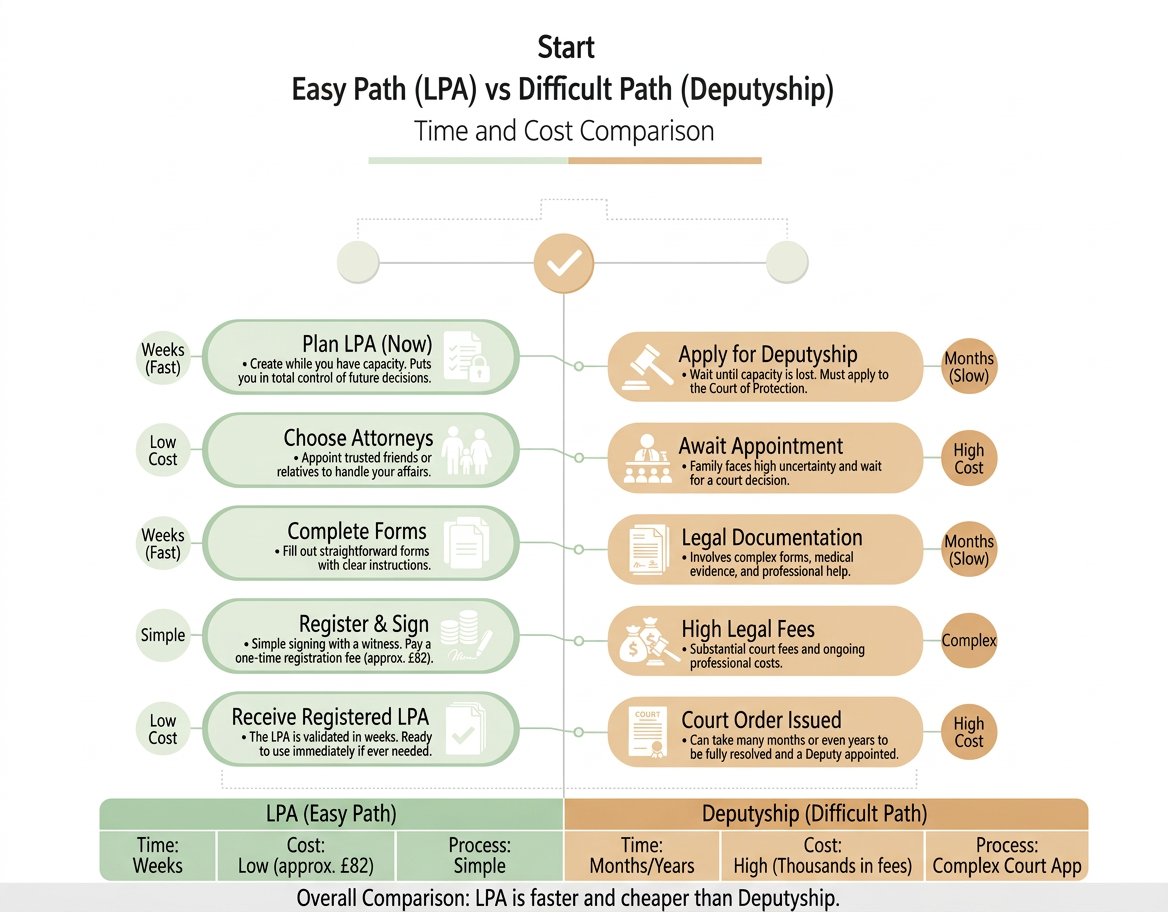
If you haven’t made an LPA and you lose capacity, your family’s only option is to apply to the Court of Protection for a “Deputyship.”
Think of a Deputyship as the “emergency break” version of an LPA. It is significantly more complex, and to be blunt, it’s a bit of a nightmare for families already dealing with the emotional stress of a loved one being unwell.
| Feature | Lasting Power of Attorney (LPA) | Court of Protection (Deputyship) |
|---|---|---|
| Who Chooses? | You choose your attorneys. | The Court chooses your deputy. |
| How Long? | Usually takes a few months to register. | Can take 6 to 12 months (or longer). |
| Cost | Fixed legal fees and a small registration fee. | Expensive application fees and ongoing annual costs. |
| Control | You set the rules and restrictions. | The Court sets the rules and requires annual reports. |
When people search for lpa solicitors near me, it’s often because they want to avoid the Court of Protection at all costs. A Deputyship involves intensive court supervision, and the person appointed might not even be the person you would have chosen.
Losing Your Voice: The Emotional Toll
One of the hardest parts of not having an LPA is the loss of control. It can feel like your identity is being erased.

Without an LPA, decisions about your life become a matter of “process” rather than “personality.” Your family might end up in legal battles with each other, or with the local authority, about what you would have wanted. This creates unnecessary friction and guilt during an already heart-breaking time.
At Judge Law, we see this frequently in our wills and estate planning work. The families who have an LPA in place are able to focus on spending quality time with their loved one, rather than fighting with banks and bureaucrats.
How Much Do Solicitors Charge for LPA?
This is the question we get asked most often. When looking for lpa solicitors fees, it’s important to remember that you aren’t just paying for a piece of paper; you’re paying for the peace of mind that the document is prepared properly.
Understanding the Costs
So, how much do solicitors charge for lpa? The fees generally depend on whether you are doing one or both types of LPA.
- Professional Fees: Most solicitors charge a fixed fee to draft and register the documents. At Judge Law, we pride ourselves on being straightforward. We don’t hide behind legal jargon or surprise costs.
- Registration Fee: There is a mandatory fee paid to the Office of the Public Guardian (currently £92 per LPA in England and Wales, or £184 if you make both types), though you may be exempt or eligible for a reduction if you are on a low income or certain benefits.
While you can technically fill out the forms yourself online, many people find the process overwhelming. One small mistake can lead to the document being rejected months later, often when it’s too late to fix. Using lpa solicitors helps ensure that the certificate provider’s statement and all signatures are completed correctly and in the right order and that your wishes are expressed in a way that is less likely to be challenged later.
Why Choose Judge Law?
We know that legal matters can feel cold and clinical. At Judge Law, we do things differently. Whether you visit our Windsor office or our London office, you’ll find a team that treats you like a person, not a case number.
We take a reassuring, personal approach. We’ll sit down with you, have a coffee, and talk through who you trust and what your concerns are. We aim to make the complex feel simple. If you are looking for solicitors in Windsor or London who understand the delicate nature of family dynamics, we are here to help.

Common Questions We Get Asked
Can I change my LPA later?
Yes, as long as you still have mental capacity. You can revoke an LPA or make a new one if your circumstances change (for example, if an attorney passes away or you get divorced).
Does an LPA mean I lose control now?
Absolutely not. A Property and Financial LPA can be used as soon as it’s registered (with your permission), but a Health and Welfare LPA only kicks in if you are actually unable to make decisions for yourself. You stay in control for as long as you are able.
What if I live alone?
This makes an LPA even more important. If there is no one living with you to notice a decline or help with bills, the local authority may have to step in, which can result in decisions being made by strangers.
Take the Next Step
Don’t leave your future: and your family’s sanity: to chance. Setting up a Lasting Power of Attorney is an act of love. It’s a way of saying, “I’ve got this handled,” so your family doesn’t have to worry.
If you’re searching for lpa solicitors near me and want a firm that offers straightforward advice with a human touch, get in touch with us at Judge Law.
We can help you navigate the Mental Capacity Act, explain the lpa solicitors fees clearly, and ensure your voice is heard, no matter what the future holds.
Contact Judge Law today for a consultation. Whether it’s for Wills & Estate Planning or advice on Family Law, we’re here to support you.