
TL;DR:
- Employment laws protect workers from day one, with recent reforms expanding rights through 2026 and 2027.
- Employees should review contracts carefully, negotiate terms, and understand dispute resolution processes.
- Staying informed and seeking legal advice are essential as legal complexity increases with new employment protections.
You might assume that employment law only kicks in once you have been in a job for a year or two. That assumption is wrong, and it can cost you. Many of the most important legal protections you have apply from the moment you start work, and a wave of reforms coming into effect through 2026 and 2027 is extending those rights further still. Whether you are on a permanent contract, a zero-hours arrangement, or a fixed-term engagement, the law has more to say about your situation than most people realise. This guide sets out what the law actually provides, how recent changes affect you, and what to do when things go wrong.
Table of Contents
- What makes up UK employment law?
- Key employee rights: From day one and beyond
- Contracts, changes, and negotiation: What to look for
- Solving disputes: The road from workplace issue to tribunal
- Why UK employment law is changing: The overlooked trade-offs
- Get expert help with your employment law issue
- Frequently asked questions
Key Takeaways
| Point | Details |
|---|---|
| Day-one protections | Most core employment rights in the UK now start from your first day and are expanding further over 2026–27. |
| Written particulars required | By law, you must receive a written statement of employment terms within two months, no matter your role. |
| Know contract change rules | Employment contracts can be changed, but only with proper notice or your agreement—know your negotiation rights. |
| Dispute process matters | Starting with Acas Early Conciliation is mandatory and understanding key deadlines can affect your claim’s success. |
| Complexity of reforms | New reforms bring both greater security and new challenges, so staying informed is critical. |
What makes up UK employment law?
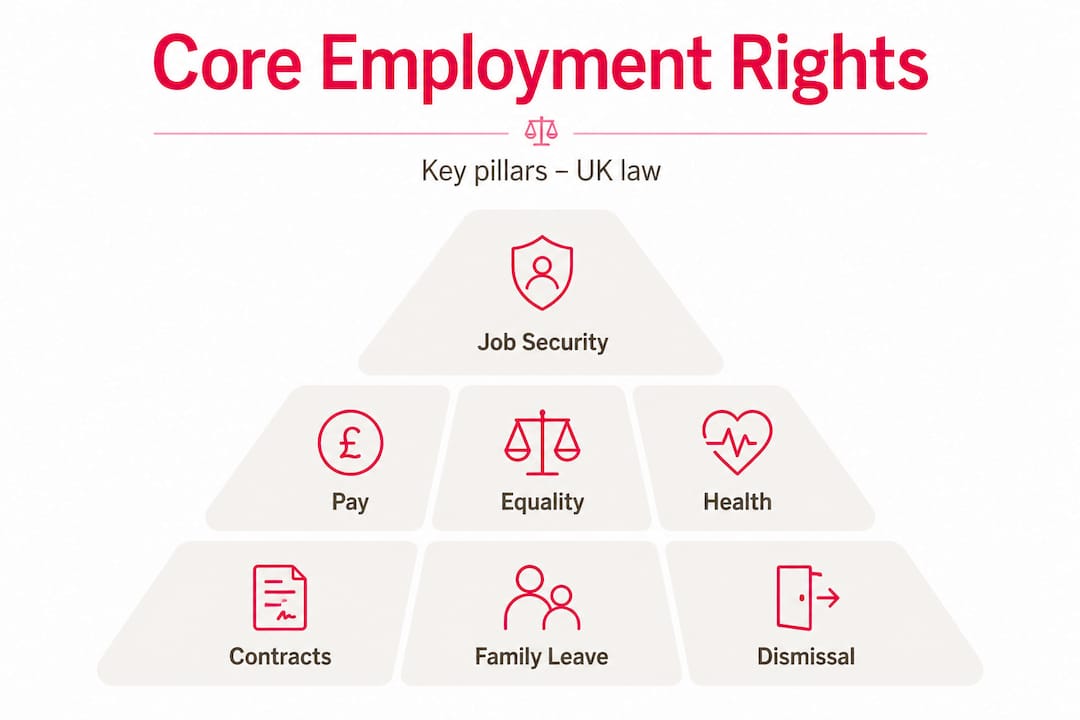
With a foundation set, it is vital to know exactly which laws protect you and what they cover. UK employment law is not a single document. It is a layered framework of primary legislation, regulations, and statutory codes, each addressing different aspects of the working relationship.
The employment law overview at its core consists of several key pillars. The Employment Rights Act 1996 sets out fundamental contractual and dismissal rights. The Equality Act 2010 prohibits discrimination on the basis of nine protected characteristics, including age, disability, race, religion, sex, and sexual orientation. The Health and Safety at Work Act 1974 places a duty on employers to provide a safe working environment. The National Minimum Wage Act 1998 guarantees a floor beneath which pay cannot fall. Alongside these Acts, Acas Codes of Practice establish expected standards of behaviour in areas such as discipline, grievance, and flexible working, and employment tribunals take those codes into account when assessing whether an employer has acted fairly.
| Legislation | Primary focus |
|---|---|
| Employment Rights Act 1996 | Dismissal, contracts, pay statements |
| Equality Act 2010 | Anti-discrimination, reasonable adjustments |
| Health and Safety at Work Act 1974 | Safe working conditions, risk assessment |
| National Minimum Wage Act 1998 | Pay floors for all worker categories |
| Working Time Regulations 1998 | Holiday entitlement, rest breaks, maximum hours |
| Employment Rights Act 2025 | Day-one rights, zero-hours reforms, enhanced protections |
These protections apply broadly. Permanent employees, fixed-term employees, zero-hours workers, and agency workers all fall within scope to varying degrees. The Employment Rights Act 2025 reforms extend key protections significantly, with phased implementation running from April 2026 to 2027 and beyond.
Core rights under the current and updated framework include protection from unfair dismissal (currently after two years’ service, reducing to six months from January 2027), the National Minimum Wage, at least 5.6 weeks’ paid holiday per year, statutory sick pay from day one as of April 2026 with no earnings threshold, and family leave including paternity and parental leave from day one from April 2026. Anti-discrimination protections under the Equality Act 2010 apply immediately, regardless of how long you have been employed.
Thinking about how managing mental health at work fits into this framework matters too. Employers now carry enhanced obligations in this space under the 2025 Act, including requirements to take all reasonable steps to prevent harassment, including third-party harassment.
Key employee rights: From day one and beyond
Now that the groundwork is clear, let’s look at which rights apply from your first day and how these are widening over 2026 and 2027.
From the moment your employment begins, a set of protections attaches automatically. You do not need to have served any particular period. Under the Employment Rights Act 1996, you are entitled to a written statement of employment particulars within two months of starting. That statement must set out your pay, hours, holiday entitlement, notice period, and disciplinary procedures. If your employer fails to provide it, you may be able to claim compensation.
Rights that apply from day one (current and incoming)
- Protection from unlawful discrimination under the Equality Act 2010
- The National Living Wage and National Minimum Wage
- 5.6 weeks of paid annual leave (pro-rated for part-time workers)
- Statutory sick pay from day one as of April 2026, with no lower earnings threshold
- Paternity and parental leave from day one as of April 2026
- Protection from unlawful deduction from wages
- Safe working conditions
Rights that accrue over time (current rules, with upcoming changes)
- Unfair dismissal protection: currently two years’ service, reducing to six months from January 2027
- Statutory redundancy pay: requires two years’ service (no change announced)
- Enhanced maternity pay: requires 26 weeks’ service at the qualifying week
Statistic: The statutory sick pay reform alone is expected to benefit approximately 1.3 million low-paid and part-time workers who previously fell below the lower earnings limit.
The position for zero-hours workers is changing materially. Under the Employment Rights Act 2025, workers on zero-hours or low-guaranteed-hours contracts will, from 2027, have the right to be offered guaranteed hours after a 12-week reference period, to receive reasonable notice of shifts, and to receive payment if shifts are cancelled, moved, or curtailed at short notice.

If you have a side job alongside your main employment, it is worth checking whether your primary contract contains an exclusivity clause, particularly because the 2025 Act restricts the use of exclusivity clauses in zero-hours contexts.
Pro Tip: If you are unsure whether your contract classifies you correctly as an employee, worker, or self-employed contractor, seek advice promptly. Your classification determines which rights apply, and misclassification by an employer can be challenged.
| Right | Current position | From 2026 or 2027 |
|---|---|---|
| Statutory sick pay | Day 4, earnings threshold applies | Day 1, no threshold (Apr 2026) |
| Unfair dismissal | 2 years’ service | 6 months’ service (Jan 2027) |
| Family leave | Varies by type | Paternity/parental from day 1 (Apr 2026) |
| Zero-hours guaranteed hours | No entitlement | After 12-week reference period (2027) |
Contracts, changes, and negotiation: What to look for
Understanding your basic rights is only half the story. Knowing what your contract should include and how to negotiate its terms can make a real difference to your working life.
An employment contract can be verbal or written, and it comes into existence on your start date, not when you sign any paperwork. That said, a written contract gives you far greater clarity and protection. Under Acas guidance on employment contracts, your contract should as a minimum cover your job title, pay, working hours, holiday entitlement, notice period, and any confidentiality or restrictive covenant obligations.
Changes to your contract require your agreement. An employer cannot simply impose new terms, whether that means cutting your pay, altering your hours, or adding new duties. If an employer attempts to do so without agreement, that may constitute a breach of contract, and in some cases it can amount to a constructive dismissal if it fundamentally undermines the employment relationship.
Steps to protect yourself when reviewing a contract
- Read every clause before signing, not after. Pay particular attention to restrictive covenants, which may restrict your ability to work for competitors or contact clients after you leave.
- Check the notice period on both sides. It should be mutual, or at the very least clearly set out what you will receive.
- Query any ambiguous terms in writing before you start, so there is a record of what was agreed.
- If the employer offers a verbal assurance about something not in the contract, ask for it to be written into the document or confirmed by email.
- If you are offered a settlement or variation, review it carefully before accepting, since once you sign, the terms are binding.
Negotiation is often more accessible than people expect. The best moment to negotiate is shortly after a strong performance review, a significant achievement, or at the point of a new job offer. Come prepared with market salary data and evidence of your contributions. If the employer cannot move on salary, explore alternatives such as enhanced holiday allowance, flexible working arrangements, a signing bonus, or a structured pay review date written into the contract.
Any agreed variation to your contract should be confirmed in writing. An email exchange is sufficient if both parties agree and the terms are clear. Do not rely on a handshake for something that affects your pay or working conditions. If a dispute later arises about what was agreed, that written record is your strongest asset.
If you are navigating garden leave, notice pay, or a settlement agreement, the contractual terms govern what you are entitled to, and taking legal advice before signing anything is strongly advisable.
Pro Tip: When negotiating, frame requests in terms of business value rather than personal need. Employers respond more readily to evidence of your impact than to statements about your financial circumstances.
Solving disputes: The road from workplace issue to tribunal
Even with the best contract, disputes can happen. Here is how the official process works if you need to challenge your employer.
Most workplace disputes should be raised internally first, through your employer’s grievance procedure. This is not simply good practice; employment tribunals expect it. If you skip internal steps without good reason, a tribunal may reduce any award it makes to you by up to 25% for failing to follow the Acas Code of Practice on grievance procedures.
The route from dispute to resolution
- Raise a formal grievance internally and keep copies of all correspondence.
- If the grievance is not resolved, notify Acas and commence Early Conciliation. This step is mandatory before you can lodge a tribunal claim.
- If Early Conciliation does not resolve matters, Acas issues a certificate, which you must include with your tribunal claim.
- Lodge your claim at the Employment Tribunal within the time limit. Currently that is three months from the act you are complaining about, extending to six months from October 2026 for most claim types.
- Prepare for tribunal, which includes exchanging documents and witness statements. Claims involving discrimination or whistleblowing tend to be significantly more complex and take longer to reach a hearing.
The tribunal backlog is a real concern. Tribunal statistics show approximately 58,000 outstanding single claims as of the third quarter of 2025/26, with average waiting times of 12 to 18 months or more for a full hearing. That reality should inform your strategy. Early Conciliation or a negotiated settlement agreement will often be faster and less exhausting than pressing on to a full tribunal hearing.
Statistic: Non-compliance with the Acas Code during disciplinary or grievance procedures can result in a tribunal adjusting the award by up to 25% in either direction, either increasing it against the employer or reducing it against the employee.
Discrimination and whistleblowing claims carry no cap on compensation and tend to attract greater public interest, but they also require more evidence, take longer to litigate, and place a greater emotional burden on claimants. If your case involves either, take legal advice as early as possible.
Why UK employment law is changing: The overlooked trade-offs
Most guides celebrate the expansion of employee rights without pausing to examine what the reforms actually mean in practice for everyone involved. The picture is more nuanced than a simple win for workers.
The Employment Rights Act 2025 introduces phased reforms spanning 2026 and 2027. Those reforms include stronger day-one rights, new restrictions on zero-hours contract exploitation, mandatory reasonable steps to prevent workplace harassment, and the creation of a Fair Work Agency to enforce employment standards. These are meaningful gains for workers, particularly those in insecure or low-paid employment who previously had little practical recourse.
But the reforms also increase legal complexity for everyone. Employers face a tighter and more technically demanding compliance environment. The removal of flexibility around zero-hours contracts, for instance, creates new obligations around shift scheduling that many smaller employers will find genuinely burdensome to manage. The lowering of the unfair dismissal qualifying period to six months will encourage some employers to use probationary periods more actively, with clearer documentation and structured reviews, which changes the dynamics of early employment for workers.
For you, as an employee, the expansion of rights brings real benefits. Statutory sick pay from day one removes the cruel position in which workers lost pay for the first three days of illness. Unfair dismissal protection from six months’ service gives people meaningful job security far earlier than before. These are not trivial improvements.
The important point, however, is that more rights also means more to understand and more to manage if something goes wrong. The law’s complexity is growing. That makes staying informed genuinely important, and it makes taking professional advice in anything other than a straightforward situation increasingly worthwhile. Thinking about employer obligations around mental health is one area where the evolving duties are subtle enough that neither employer nor employee always grasps what is expected without guidance.
Get expert help with your employment law issue
Self-advocacy matters. Knowing your rights gives you confidence and positions you to act decisively when something goes wrong. But some situations genuinely benefit from experienced legal support, whether you are reviewing a contract with restrictive covenants, facing dismissal, navigating a grievance, or considering a settlement offer.
Our employment law specialists at Judge Law work with employees across a wide range of situations, from contract disputes and workplace grievances to tribunal representation and settlement negotiations. We explain the law in plain English, set out your realistic options, and advise on the strength of your position without making promises about outcomes that depend on factors no one can control. If your situation extends beyond employment, our firm covers a broad range of legal areas, including family law, property, immigration, and civil disputes, so we can support you wherever your circumstances lead. Your story matters, and we are here to help you tell it clearly.
Frequently asked questions
What rights do zero-hours contract workers have under new UK law?
From 2027, zero-hours workers can request guaranteed hours after a 12-week reference period, must receive reasonable notice of shifts, and are entitled to pay for short-notice cancellations or curtailments under the Employment Rights Act 2025.
How soon can I claim unfair dismissal?
From January 2027, you will be able to claim unfair dismissal after just six months’ service; under current rules, you need two years’ continuous employment before that right arises.
What is the deadline for making a tribunal claim in 2026?
From October 2026, the time limit for most tribunal claims extends from three months to six months from the act complained of, giving employees significantly more time to act.
Do I need a written contract for my rights to be protected?
No. Your statutory rights apply from day one regardless of whether anything is written down, although you are entitled to receive a written statement of particulars within two months of starting employment.
What happens if my employer does not follow the Acas Code?
An employment tribunal may increase or decrease an award by up to 25% for non-compliance with the Acas Code of Practice on disciplinary and grievance procedures, depending on which party failed to follow it.