
TL;DR:
- Understanding property terms like freehold and leasehold helps buyers avoid costly legal issues.
- Completing and reviewing forms like TA6 and TA10 is vital for transparency and legal protection.
- Slow conveyancing processes and undisclosed disputes can cause delays and financial risks.
You are staring at a contract you do not fully understand, and completion day is approaching faster than you expected. Words like “leasehold,” “TA6,” “conveyancing,” and “freehold reversion” appear throughout the paperwork, and nobody seems to have explained what they actually mean for you personally. This is not a niche problem. Thousands of buyers across England and Wales sign documents each year without fully grasping their legal significance, and some pay a painful price later. This guide cuts through the jargon, explains every critical term in plain English, and maps each one to a real stage of the buying or selling process, so you can move forward with confidence rather than quiet anxiety.
Table of Contents
- Key property legal terms every buyer should know
- Step-by-step: What happens during property conveyancing?
- Decoding property forms: TA6, TA10, and what they mean for you
- Freehold vs leasehold: Risks, charges, and what to watch for
- Boundaries, disputes, and legal pitfalls: How to protect your interests
- Why understanding property legal terms is your best investment
- Connect with trusted property law expertise
- Frequently asked questions
Key Takeaways
| Point | Details |
|---|---|
| Master key legal terms | Knowing property jargon like freehold and leasehold helps you negotiate and avoid errors. |
| Understand vital forms | Essential forms such as TA6 and TA10 influence both your legal rights and transaction speed. |
| Spot major risks early | Careful scrutiny of lease details and disclosure forms can protect you from costly future disputes. |
| Conveyancing is multi-step | Understanding each stage of the process helps keep your property purchase or sale on track. |
| Expert advice saves stress | Getting specialist legal support when confused prevents errors and expensive setbacks. |
Key property legal terms every buyer should know
Legal vocabulary is not there to confuse you. It evolved to create precision, and once you understand the core terms, the rest of the process becomes far more logical. Start here, and everything that follows will make sense.
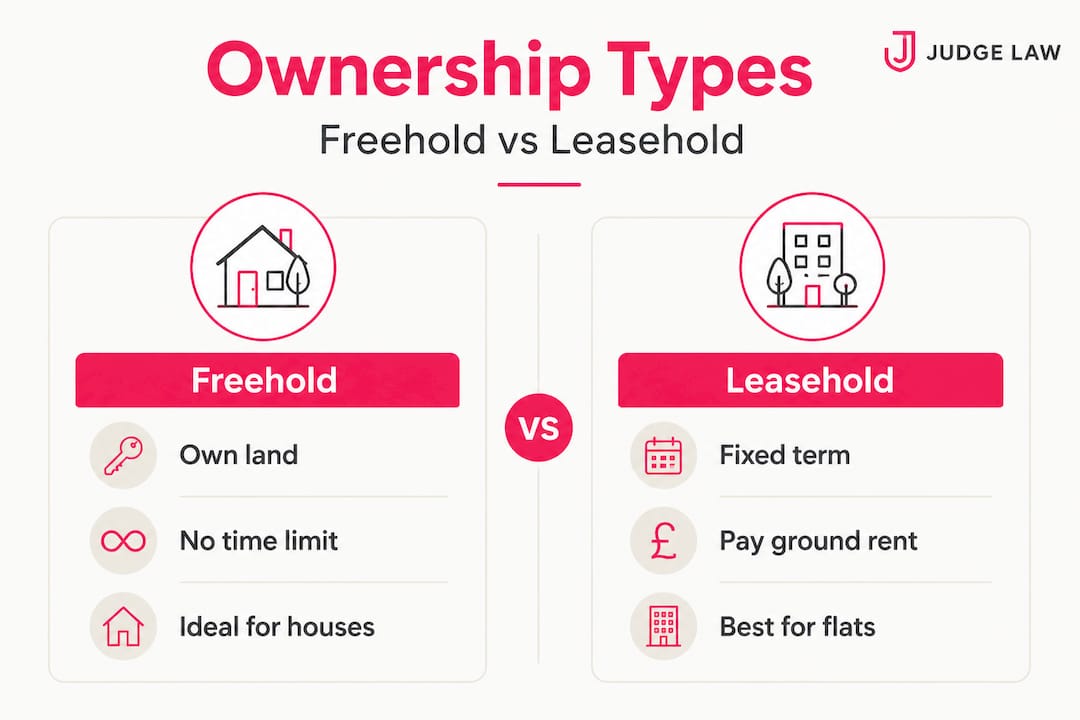
Freehold is the simpler of the two main ownership structures. As the Telegraph explains, freehold means outright ownership of both the property and the land beneath it, with no time limit attached and no ground rent or service charges payable to a third party. You are responsible for all maintenance, but you answer to nobody above you in a chain of ownership.
Leasehold is more layered. You own the property for a fixed term, commonly 99, 125, or 999 years, but the land itself remains with the freeholder. The same Telegraph source confirms that leasehold ownership typically involves ground rent (often reduced to a peppercorn after 2022 reforms) and service charges covering communal areas and maintenance. Most flats in England and Wales are sold leasehold, which is why understanding this structure matters so much to flat buyers in particular.
Commonhold is a third, less common option. It allows flat owners to collectively own the freehold through a commonhold association, removing the landlord entirely from the equation. It has existed in law since 2002 but has been adopted very slowly; reforms currently under discussion may change that picture.
Here is a quick comparison to anchor these definitions:
| Ownership type | Own the land? | Time limit? | Ground rent payable? | Best suited for |
|---|---|---|---|---|
| Freehold | Yes | No | No | Houses |
| Leasehold | No | Yes (fixed term) | Possibly (check terms) | Flats, maisonettes |
| Commonhold | Collectively | No | No | Converted or purpose-built flats |
Two forms you will encounter at the start of any sale are the TA6 and the TA10. The TA6 is the Property Information Form, completed by the seller, covering boundaries, disputes, alterations to the property, services, and planning history. The TA10 is the Fittings and Contents Form, which establishes precisely what the seller is leaving behind and what they are taking. Both are produced under the Law Society’s standard conveyancing protocol and sit at the heart of what you, as a buyer, are legally entitled to know before exchange. You can read more in our overview of property law essentials.
Stamp Duty Land Tax (SDLT) is the tax payable on property purchases above certain thresholds. It is banded, meaning you pay different rates on different portions of the purchase price rather than a flat rate on the whole amount.
Completion is the legal moment when ownership transfers. Money moves, keys are released, and the property is yours. Exchange of contracts is the step before completion, the point at which the transaction becomes legally binding and neither party can withdraw without significant financial penalty.
Step-by-step: What happens during property conveyancing?
Conveyancing is the legal process of transferring ownership from seller to buyer. It looks complex from the outside, but it follows a fairly consistent sequence of stages.
- Offer accepted. You agree a price, and both parties instruct solicitors. No legal obligation exists at this point; either party can still walk away.
- Solicitor checks and searches. Your solicitor orders local authority searches, drainage searches, and environmental searches to identify anything that might affect the property or your use of it.
- TA6 and TA10 received. The seller’s solicitor sends the draft contract pack, which includes the TA6 Property Information Form disclosing boundaries, disputes, alterations, and services, alongside the TA10 covering fixtures and fittings. Your solicitor reviews these and raises enquiries if anything is unclear.
- Mortgage offer issued. If you are buying with a mortgage, your lender conducts its own valuation and issues a formal offer. Your solicitor checks it against the contract terms.
- Exchange of contracts. Both solicitors confirm readiness. Contracts are exchanged, a completion date is set, and your deposit (typically 10%) is transferred. You are now legally committed.
- Completion. The remaining funds are transferred. Your solicitor registers the transfer at HM Land Registry. You receive the keys.
Typical timelines in England and Wales run from eight to fourteen weeks for a straightforward transaction, though chains and leasehold complications regularly extend this. The most common bottlenecks are slow search returns, incomplete responses to enquiries, and mortgage delays. Understanding your conveyancing timeline in advance helps you plan and reduces the anxiety of not knowing what is causing a delay.

Pro Tip: Ask your solicitor to flag any outstanding items at every stage rather than waiting for a weekly update. Proactive communication dramatically reduces the chance of last-minute surprises.
Decoding property forms: TA6, TA10, and what they mean for you
Now that you have a timeline in mind, let us go deeper into the paperwork side, the forms that do the real legal heavy lifting.
The TA6 is arguably the most important document a seller completes. According to the Law Society’s TA6 (6th edition) explanatory notes, it requires the seller to disclose boundaries, disputes, alterations, services, and key property history. It covers:
- Boundary responsibility (who maintains which fence, hedge, or wall)
- Disputes and complaints with neighbours or local authorities
- Alterations and building works, including whether planning permission and building regulations approval were obtained
- Services connected to the property (gas, electricity, water, drainage)
- Notices received from neighbours, councils, or government bodies
- Guarantees and warranties still in force
- Environmental matters, including flooding history
The TA10 is narrower but practically significant. It records precisely which items are included in the sale and which the seller is removing. Fitted kitchen appliances, curtain rails, bathroom fittings, light fixtures, and garden structures all need to be specified. Disputes over what was or was not included in the sale are surprisingly common, and the TA10 exists precisely to prevent them.
Accuracy in these forms is not optional. It is a legal obligation. If a seller provides misleading or incomplete information on a TA6, the buyer may have a claim for misrepresentation under the Misrepresentation Act 1967, which can result in damages or even rescission of the contract.
Sellers who tick “not known” on the TA6 to avoid disclosure, when they are in fact aware of an issue, take a significant legal risk. Courts have found against sellers in misrepresentation claims where the evidence showed they knew more than they declared.
This is where property law guidance becomes genuinely valuable, not just reassuring. A solicitor reviews these forms critically, not just administratively. They spot the gaps. Understanding contract essentials also helps you appreciate why precise wording in property agreements carries real legal weight.
Pro Tip: As a seller, read every question on the TA6 carefully and answer from your own knowledge. If you are uncertain whether something requires disclosure, ask your solicitor before leaving it blank.
Freehold vs leasehold: Risks, charges, and what to watch for
Filling in the forms is only half the journey. The real buyer-beware moments often arise when dealing with the freehold or leasehold structure of the property itself.
Freehold ownership gives you control. No third party can impose service charges, vary the terms of your occupancy, or require permission for structural changes. The trade-off, as explained in the freehold vs leasehold comparison, is that all maintenance costs are yours alone, and the upfront purchase price is typically higher.
Leasehold ownership is cheaper to enter, particularly for flats, but carries risks you must investigate before committing. The key issues are:
- Short lease length. A lease below 80 years becomes significantly harder and more expensive to extend, and mortgage lenders frequently refuse to lend on leases below 70 years. Aim for over 90 years remaining at the point of purchase.
- Ground rent escalation clauses. Historical leases sometimes include ground rent doubling clauses that can make a property unmortgageable and difficult to sell. The Leasehold Reform (Ground Rent) Act 2022 capped ground rent at a peppercorn for new residential leases, but older leases may still carry punishing terms.
- Service charges. These cover communal repairs, cleaning, insurance, and management costs. They vary enormously between developments. Always ask for the last three years of service charge accounts.
- Major works. If a building needs significant repairs (a new roof, for instance), leaseholders can face substantial bills under a Section 20 notice, sometimes running into tens of thousands of pounds.
- Sinking fund or reserve fund. Ask whether the building has a reserve fund set aside for major works, and what its current balance is. A fund near zero in an ageing building is a warning sign.
On the legislative front, the Leasehold and Freehold Reform Act 2024 introduced significant changes, including restrictions on new leasehold houses. The legislation makes freehold the default for new houses, which is a significant shift in how new-build purchasers will experience ownership going forward.
Pro Tip: Before making an offer on a leasehold flat, always ask the estate agent for the lease length, current ground rent, last year’s service charge figure, and the reserve fund balance. These four pieces of information will tell you immediately whether the property warrants further investigation or presents a financial risk.
For tailored advice on a specific lease, commercial lease considerations and the commercial property buying process offer useful frameworks for understanding how lease terms carry real financial weight.
Boundaries, disputes, and legal pitfalls: How to protect your interests
Some of the biggest headaches in property transactions come not from the main contract but from the details buried in the TA6, or worse, the details missing from it. Boundary disputes and neighbourhood disputes are among the most exhausting legal situations a homeowner can face, and they are far easier to avoid than to resolve.
Common property disputes include:
- Boundary disagreements. Who owns the boundary wall or fence between two properties is not always obvious from the title register. The Land Registry does not guarantee exact boundary positions; it records general boundaries only.
- Party walls. If your property shares a wall with a neighbour, the Party Wall etc. Act 1996 regulates what work can be done and when notice must be given. Failure to follow the process can lead to injunctions and compensation claims.
- Rights of way and easements. A right of way across your garden, or a neighbour’s right to run drainage pipes beneath your land, may be registered or may arise by long use. Either way, it affects what you can do with the property.
- Restrictive covenants. These are obligations tied to the land that bind future owners. A covenant preventing commercial use or requiring the freeholder’s consent for extensions can seriously limit what you can do.
The TA6 requires sellers to disclose known disputes and notices. As the Law Society’s TA6 explanatory guidance confirms, this covers boundary disputes, complaints involving neighbours, and any notices received from third parties or local authorities. If a dispute is disclosed, do not dismiss it as minor. Ask your solicitor to clarify its status and what, if any, legal proceedings have occurred.
A boundary dispute that appears settled on paper may resurface the moment you carry out building works. Checking title deeds, filed plans, and any agreements carefully before exchange is not bureaucratic caution; it is prudent ownership.
Your solicitor can also investigate potential trust and property disputes that arise where ownership is shared informally, a situation that becomes legally complicated very quickly if circumstances change. And if a dispute does arise post-purchase, understanding civil litigation outcomes will help you approach the situation realistically rather than with false optimism.
For boundary dispute help or general property law queries, speaking to a solicitor before exchange is almost always the right move.
Why understanding property legal terms is your best investment
Here is the editorial reality, drawn from years of handling property transactions of every kind. Legal mistakes in property nearly always cost more to fix than they would have cost to prevent. That is not a warning designed to frighten you into spending more on legal fees. It is simply true, and the evidence for it is visible in every conveyancing file that arrives late, contested, or incomplete.
The buyers who suffer most are not the ones who asked too many questions. They are the ones who trusted that everything was probably fine, signed documents they did not fully read, and discovered years later that a covenant prevented their planned extension, or that a service charge demand for major works arrived six months after they moved in.
Slowing down when you feel the pressure to exchange quickly is not timidity. It is the single most financially rational thing you can do. A solicitor who reviews real property law experience through hundreds of transactions will spot in minutes what takes an unguided buyer weeks to notice, if they notice it at all.
The temptation to skim the TA6, trust the estate agent’s summary, and focus only on completion day is understandable. Buying a home is exciting. But the legal structure of that home will govern your life in it for decades. The terms in the contract are not formalities. They are the architecture of your ownership.
Connect with trusted property law expertise
If you would like expert eyes on your documents or want reassurance before a major property transaction, here is where to get help. At Judge Law, our conveyancing solicitors work with buyers and sellers across England and Wales, guiding them through every stage from initial offer to completion. We explain what matters, flag what concerns us, and give you clear, honest advice about what to do next. We also support clients navigating online home buying processes, making expert legal guidance accessible wherever you are in the country. Your story matters to us, and the details in your property transaction matter too.
Frequently asked questions
What is the difference between freehold and leasehold?
Freehold means outright ownership of both the property and the land, with no time limit, while leasehold means you own the property for a fixed term and may pay ground rent and service charges to the freeholder.
When do I need to fill in a TA6 form?
You must complete a TA6 form when selling a residential property in England or Wales, as it discloses essential information about the property to the buyer before exchange of contracts.
What should I check in a lease before buying a flat?
Check the remaining lease length (aim for over 90 years), the ground rent terms, annual service charge history, whether major works are planned, and the balance of the building’s reserve fund.
Why are boundaries and disputes important in property buying?
Unclear boundaries or undisclosed disputes can lead to costly legal action after purchase, which is why the TA6 form requires full disclosure of any known issues before a sale completes.
Has the law changed for new leasehold houses?
Yes. Following the Leasehold and Freehold Reform Act 2024, most new leasehold houses are now banned, making freehold the standard structure for new-build houses in England and Wales.