
A deed of variation lets a beneficiary redirect their inheritance to someone else, or into a trust, without going back to court. Done correctly within the timeframe allowed by law, the change is treated for Inheritance Tax and Capital Gains Tax purposes as if the deceased had written it that way themselves. Miss the deadline, or get the wording wrong, and you lose that tax treatment entirely.
TL;DR
- A deed of variation must be made within two years of the death to be treated for tax purposes as if the deceased had made the change.
- Every beneficiary giving something up must sign, and the personal representatives must also sign if the variation increases the Inheritance Tax payable.
- The deed must include a statement that it is intended to take effect under section 142 of the Inheritance Tax Act 1984 and section 62(6) of the Taxation of Chargeable Gains Act 1992.
- A variation that would adversely affect a minor or unborn beneficiary needs the court’s approval.
- You only need to send the deed to HMRC, with an IOV2 checklist, if it increases the tax due; do this within six months.
What a deed of variation is and when it applies
A deed of variation does not rewrite the deceased’s will. It sits alongside it, redirecting what a specific beneficiary would have received to a different person, cause, or trust. The original will stands. The variation simply changes who benefits from one part of the estate, and, if the paperwork is right, changes the tax consequences too.
This applies whether the deceased left a will or died intestate. Beneficiaries under the intestacy rules can vary their entitlement in exactly the same way as someone named in a will.
It differs from a deed of disclaimer, which lets a beneficiary refuse an inheritance outright but gives them no say in where it goes next. A disclaimer sends the gift back into the estate to be distributed under the will or intestacy rules. A variation lets the beneficiary choose the destination.
Common reasons people use one include:
- Reducing the estate’s overall Inheritance Tax exposure
- Providing for a partner or dependant the will overlooked
- Setting up a trust for children or grandchildren
- Correcting an unfair or outdated distribution among family members
Who has to sign, and what the deed must say
Every beneficiary who gives something up under the variation must sign it. If the change increases the amount of Inheritance Tax payable, the personal representatives (executors or administrators) must also sign, because they become jointly responsible for settling that extra tax from the estate.
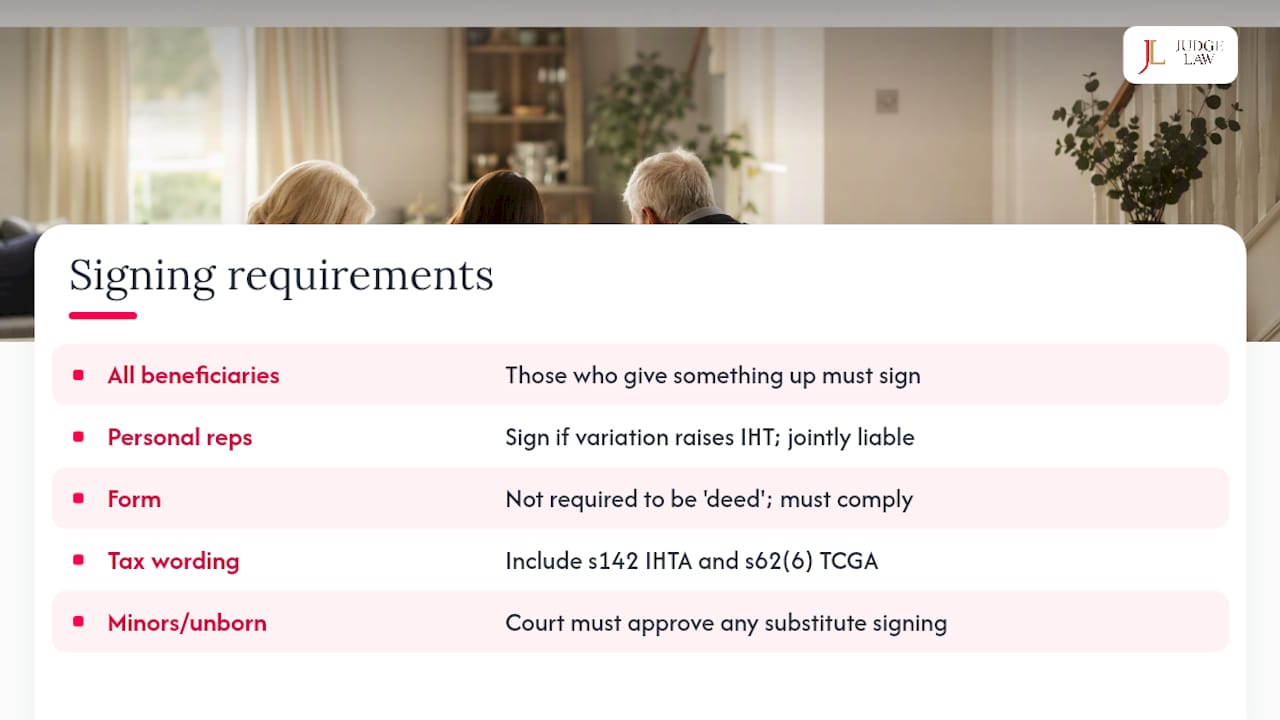
There is no rule that the document must be labelled a “deed.” GOV.UK guidance confirms that a written letter can work just as well, provided it meets the same legal conditions. In practice, most solicitors still draft it as a formal deed, because the strict requirements around wording leave little room for ambiguity.
To have tax effect, the document must include a statement confirming the parties intend it to take effect under section 142 of the Inheritance Tax Act 1984 and section 62(6) of the Taxation of Chargeable Gains Act 1992. HMRC’s IOV2 instrument of variation checklist sets out exactly what to include, from the date of death to identification of the specific gift being varied, and a stamp duty certificate where shares or other securities are redirected.
Where a minor or an unborn beneficiary would lose out under the variation, someone cannot simply sign on their behalf. The court must approve the arrangement first.
Pro Tip: Keep a copy of the original will, the grant of probate, and the deed together in one file. HMRC and any future buyer’s solicitor (if property is involved) will ask to see all three.
Tax consequences and when to tell HMRC
The two-year rule is the single most important constraint on this whole process. GOV.UK is explicit that any variation must be completed within two years of the date of death for it to count for Inheritance Tax and Capital Gains Tax purposes. Sign it on day 731 and, tax wise, it is as if nothing happened. The gift still passes to the beneficiary, but HMRC treats it as a gift from that beneficiary onward, not from the deceased.

Get the timing and wording right, and HMRC’s own manual confirms the variation is treated as if the deceased had made it. That backdating is what makes the tax planning work.
You don’t always need to tell HMRC. GOV.UK guidance is clear that if the variation does not change the amount of Inheritance Tax due, there’s no need to notify them at all. If it does increase the tax bill, you must send a copy of the deed and a completed IOV2 checklist within six months of making the variation.
A short compliance sequence looks like this:
- Establish whether the variation changes the Inheritance Tax payable on the estate.
- If it increases the tax, complete the IOV2 checklist and send it with the deed to HMRC within six months.
- Check whether the variation triggers a Capital Gains Tax point for the beneficiary giving something up.
- If the variation creates a trust, check whether trustees need to register with the Trust Registration Service.
- Speak to a tax specialist or solicitor if the estate involves business assets, agricultural property, or overseas elements.
Everyday examples of a deed of variation in practice
Three scenarios come up again and again. In each case, the mechanism is the same, redirect the gift, get the wording right, and the tax follows the new destination as though the deceased chose it.
- Redirecting a legacy to charity. A beneficiary gives up part of their inheritance to a registered charity, which can secure Inheritance Tax relief on that portion and, if the gift reaches 10% of the estate, reduce the rate applied to the rest.
- Providing for an omitted partner. Where a will predates a relationship, or simply overlooked someone, a beneficiary can redirect part of their share to that partner instead.
- Creating a discretionary trust. A beneficiary places their inheritance into trust for children or grandchildren. HMRC’s manual notes that trustees of a trust created this way may need to register it with the Trust Registration Service.
Where a deed of variation can go wrong
Deeds of variation are flexible, but flexibility invites mistakes. A few recur often enough to warrant real caution.
- If the beneficiary receives money or another benefit in exchange for making the variation, HMRC may refuse to treat it as effective, because the statutory relief depends on there being no consideration for the change.
- You cannot vary the same entitlement twice for tax purposes once it has already been the subject of an earlier deed.
- If the personal representatives have already distributed the assets before the variation is signed, the parties who received them must agree to hand them over or rearrange things themselves. A deed cannot compel a non-signatory to return an asset, as it only binds the people who sign it.
- Deeds that would adversely affect minors or unborn beneficiaries need court approval, and that is not a step to attempt without a solicitor.
How to draft and execute a deed of variation
The process is straightforward once you know the sequence, but each step has a formality that trips people up if rushed.
- Confirm the date of death and count forward two years, that is your hard deadline for tax effect.
- Identify every beneficiary whose entitlement changes, and confirm they are willing to sign.
- Decide the new destination, whether that’s a person, a charity, or a trust, and draft the precise wording, including the statutory statement of intent for Inheritance Tax and Capital Gains Tax.
- Execute the document as a deed or a compliant letter, with all necessary signatures witnessed.
- If the variation increases the Inheritance Tax due, send the deed and a completed IOV2 to HMRC within six months.
- If assets have already been distributed, arrange for the current holders to transfer them in line with the deed.
Pro Tip: Start the process the moment you’re considering a variation, not near the two-year deadline. Court approval for a minor’s interest, or agreement from someone who already received an asset, can take months to sort out.
Costs vary depending on how simple or contested the estate is. A single, uncontested redirection between adult beneficiaries with no trust involved is usually quicker and cheaper to draft than one involving minors, business assets, or a new trust structure, where a solicitor’s involvement becomes less optional and more necessary.
When we recommend instructing a solicitor for a deed of variation
Where the estate is simple and every adult beneficiary agrees, some families draft a deed themselves using HMRC’s IOV2 checklist as a guide. We tend to recommend instructing a solicitor once children, unborn beneficiaries, a new trust, or a materially altered tax position enter the picture, because the margin for error in the statutory wording is small and the consequences of getting it wrong fall on the whole estate.
At Judge Law, that typically means drafting the deed itself, checking the Inheritance Tax and Capital Gains Tax statements meet section 142 and section 62(6) requirements, liaising with personal representatives and HMRC where notification is required, and advising trustees on Trust Registration Service obligations if a trust is created. We’re regulated by the Solicitors Regulation Authority, registration number 634380, and we’re upfront about fees before any work begins. Bring the will, the grant of probate, and a clear idea of who’s affected, and we can usually tell you quickly what’s involved.
How Judge Law can help with a deed of variation
Getting the tax wording wrong on a deed of variation can cost an estate more than the solicitor’s fee would have, particularly once trusts, minors, or a shifted Inheritance Tax bill are involved. Our wills and estate planning solicitors draft deeds that meet the statutory statement of intent, handle HMRC notification where the tax position changes, and advise trustees on registration duties when a variation creates a trust. If your situation touches on wider Inheritance Tax planning beyond the variation itself, we can advise on that at the same time.
Before an appointment, gather the will, the grant of probate, and details of who’s affected by the proposed change. We’re regulated by the Solicitors Regulation Authority under number 634380, and our initial consultations are transparent on cost from the outset. Get in touch to discuss your situation.
This article is general information, not a substitute for advice from a qualified lawyer. Consult a qualified legal professional about your own circumstances before acting on anything here.
Sources
FAQ
How much does it cost to get a deed of variation in the UK?
Cost depends on complexity. A straightforward deed between agreeing adult beneficiaries costs less to draft than one involving trusts, minors, or a changed tax position, where more time and care are needed. Judge Law sets out fees clearly before work begins.
What are the disadvantages of a deed of variation?
The main risks are receiving payment or benefit in exchange for the variation (which can invalidate the tax treatment), trying to vary an entitlement already redirected once, and finding that assets have already been distributed, which means arranging for their return rather than simply relying on the deed.
Does a deed of variation need to be sent to HMRC?
Only if it increases the amount of Inheritance Tax payable. GOV.UK confirms that if the tax position stays the same, there’s no need to notify HMRC; if it increases, send the deed and a completed IOV2 within six months.
Can I avoid Inheritance Tax with a deed of variation?
A deed of variation can reduce an estate’s Inheritance Tax bill, for example by redirecting a legacy to charity, but it must be signed within two years of death and contain the correct statutory statement to qualify for that treatment.
What’s the difference between a deed of variation and a deed of disclaimer?
A disclaimer lets a beneficiary refuse an inheritance outright, sending it back into the estate under the existing will or intestacy rules. A variation lets the beneficiary choose exactly where their share goes instead.
Recommended
- Why Is My House Sale Taking So Long? 2026 Conveyancing Timeline Guide
- Essential Conveyancing Tips for UK Buyers & Sellers
- Drafting a Trust Deed: What the Document Must Achieve