
TL;DR:
- Teenagers experience unique emotional challenges during divorce, including anger, withdrawal, and risk-taking.
- UK courts consider teenagers’s wishes in arrangements, especially for those aged 13 and above.
- Maintaining routines and cooperative co-parenting are crucial for teen stability and emotional well-being.
Your teenager seems to be coping. They’re still going to school, still seeing friends, still scrolling their phone at the dinner table. It’s easy to assume they’re handling the divorce better than a younger child would. That assumption, while understandable, is one of the most common mistakes parents make.
Teenagers face their own distinct set of emotional and legal pressures during divorce, and those pressures are not always visible. This guide is written for you as a parent, covering what the evidence tells us about how teens experience separation, how UK law treats their views in child arrangement decisions, and what you can do day to day to keep your teenager as stable as possible while your family reorganises itself.
Table of Contents
- Understanding the unique emotional impact of divorce on teenagers
- Key legal considerations for divorcing parents of teens
- How UK courts involve teenagers in divorce decisions
- Practical strategies to support your teen through divorce
- A fresh perspective: what most families miss about teens and divorce
- Need expert help? Get support for your family
- Frequently asked questions
Key Takeaways
| Point | Details |
|---|---|
| Teens experience real impact | Teenagers often feel anger, guilt, or anxiety and benefit from clear routines and support. |
| Teenagers’ voices matter | UK courts take older children’s wishes seriously but still focus on welfare and safeguarding. |
| Routine and co-parenting help most | Maintaining routines and positive co-parenting sharply reduces teens’ distress and behaviour issues. |
| Legal steps start with mediation | Parents are encouraged to try mediation before making court applications over living or contact arrangements. |
| Specialist help is available | Family law experts can guide parents through legal, emotional, and practical hurdles during divorce. |
Understanding the unique emotional impact of divorce on teenagers
Teenagers are not simply older versions of younger children when it comes to processing family breakdown. Their developmental stage means they understand more, feel more acutely, and carry the weight of that understanding in ways that can be quietly destructive.
Research shows that parental separation increases behavioural and emotional problems in children aged 7 to 14 by around 16%, with boys statistically more affected than girls. The ONS estimates that approximately 42% of marriages end in divorce, affecting around 100,000 children every year in the UK. That is not a small number. And the emotional fallout for teenagers specifically is worth understanding in detail.
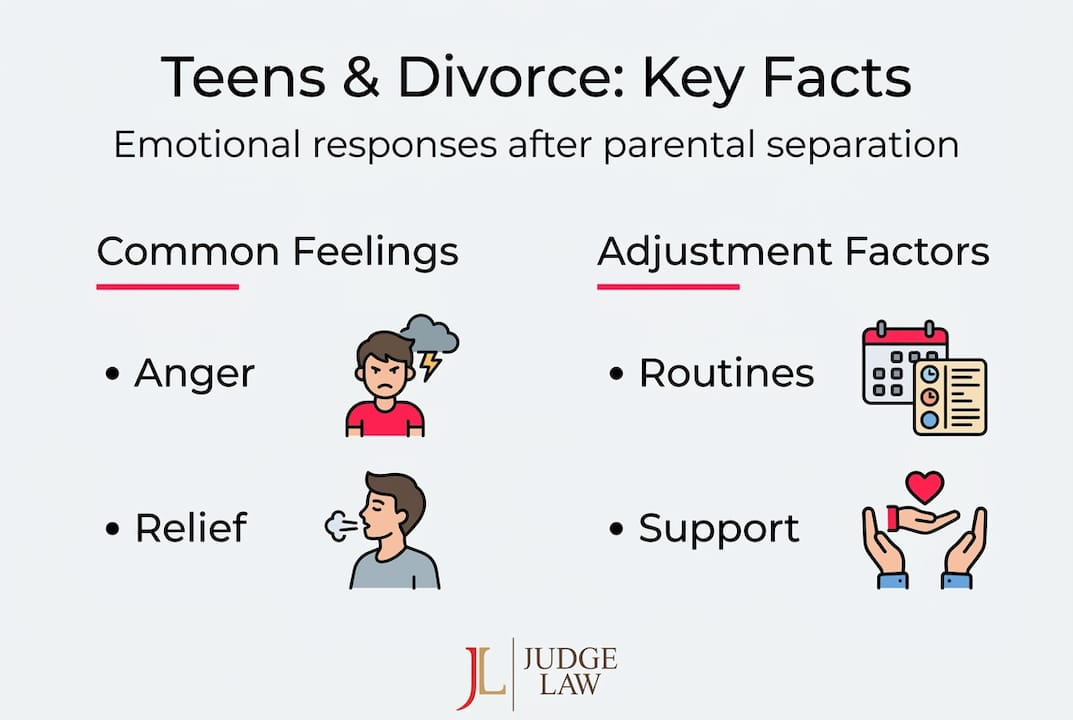
What does that fallout look like? Common responses in teens aged 13 to 19 include:
- Anger, often directed at one or both parents, sometimes at themselves
- Withdrawal from family life, friends, or activities they previously enjoyed
- Parentification, where a teenager takes on an adult emotional support role for one parent, which is exhausting and inappropriate for them
- Risk-taking behaviour, including changes in academic performance, substance use, or sexual activity
- Depression and anxiety, which may not be immediately obvious from the outside
It is also worth knowing that relief is a legitimate and common response, particularly where there has been prolonged conflict at home. A teenager who has watched years of tension or distress between parents may feel a genuine sense of calm when the separation is finally confirmed. That does not mean they are unaffected; it means their experience is layered.
| Emotional response | Likely trigger | What it looks like |
|---|---|---|
| Anger | Feeling of powerlessness | Arguments, defiance, irritability |
| Withdrawal | Emotional overload | Isolation, reduced communication |
| Parentification | One parent leaning on them | Teen becomes confidant or carer |
| Relief | End of visible conflict | Calmer demeanour, less anxiety |
| Risk-taking | Loss of structure or security | Academic decline, boundary-pushing |
The adjustment period for most teenagers is two to three years, which is longer than many parents expect. Importantly, research from the Understanding Society study found no significant difference in long-term mental health outcomes between children who experienced one parental separation and those who experienced multiple. The number of separations matters less than the quality of parenting and co-operation around each one.

Two specific findings are worth holding onto. Maintaining consistent routines can reduce anxiety in teenagers by up to 40%, according to Oxford research. And cooperative co-parenting, where both parents communicate respectfully and prioritise the teen’s needs, cuts anxiety and behavioural problems by around 50%, according to Cambridge research. These are not minor improvements. They are the most powerful tools you have.
Pro Tip: Think carefully about contact arrangements during holidays before they become a source of conflict. Agreeing these in advance, and keeping your teenager informed without burdening them with the negotiations, makes a real difference to their sense of security.
Key legal considerations for divorcing parents of teens
Understanding emotional consequences is only part of the equation. Knowing the legal framework helps you anticipate what comes next and make decisions with clarity rather than anxiety.
The starting point in English and Welsh law is the welfare of the child. Under Section 8 of the Children Act 1989, courts can make child arrangement orders that set out where a child lives and the contact they have with each parent. The child’s welfare is not just a factor; it is the paramount consideration. Everything else is secondary to it.
Before any court application is made, parents are required to attend a Mediation Information and Assessment Meeting, commonly known as a MIAM. This is a session where a trained mediator explains whether mediation is suitable for your situation. You do not have to mediate if it is not appropriate, for example in cases involving domestic abuse, but you do need to show the court that you have considered it. Skipping this step without a valid exemption can delay proceedings significantly.
Here is a practical overview of the process:
- Attempt to agree arrangements between yourselves, ideally with the support of solicitors or a mediator
- Attend a MIAM if you cannot agree, to explore whether mediation is viable
- Apply to court using a C100 form if mediation fails or is exempt, currently costing £232 in court fees
- First Hearing Dispute Resolution Appointment (FHDRA) takes place, usually within 4 to 6 weeks of the application
- CAFCASS safeguarding checks are conducted before or at this hearing
- Further hearings if needed, including a Section 7 report from CAFCASS if welfare concerns require deeper investigation
- Final order made by the court, setting out arrangements in legally binding terms
| Stage | Typical timeframe | Key action |
|---|---|---|
| MIAM | Before court application | Assess suitability for mediation |
| C100 application | Day one of court process | Formal application with £232 fee |
| FHDRA | 4 to 6 weeks after application | First court hearing |
| Section 7 report | 12 to 16 weeks if ordered | CAFCASS investigation and report |
| Final hearing | Varies, often 6 to 12 months | Court makes binding order |
If you are at the stage of considering court proceedings, understanding the divorce process in full will help you prepare. Taking early advice from a child arrangement solicitor can also prevent procedural errors that add time and cost to an already exhausting process.
How UK courts involve teenagers in divorce decisions
Once you understand the core legal principles, it is vital to know how courts explicitly bring teenagers into the process. This is where the age of your child genuinely changes the picture.
Courts apply the welfare checklist under the Children Act 1989, which includes the child’s ascertainable wishes and feelings, considered in light of their age and understanding. For teenagers, particularly those aged 13 and above, this carries real weight. A 16 or 17 year old’s clearly expressed preference will rarely be overridden without compelling reason. That does not mean their wishes are automatically followed, but it does mean they are taken seriously.
CAFCASS, the Children and Family Court Advisory and Support Service, plays a central role. In most cases involving children, CAFCASS conducts safeguarding checks at the outset, looking at police and social care records for both parents. Where a more detailed assessment is needed, a Section 7 report is ordered. As part of that process, a CAFCASS officer will typically interview teenagers directly, in an age-appropriate way, to understand their views, their relationships with each parent, and any concerns they have.
The welfare checklist covers:
- The child’s wishes and feelings
- Their physical, emotional, and educational needs
- The likely effect of any change in circumstances
- Their age, background, and relevant characteristics
- Any harm they have suffered or are at risk of suffering
- The capability of each parent to meet their needs
There is no presumption of equal contact in English and Welsh family law. How courts decide contact depends entirely on what arrangement best serves the individual child’s welfare. Where there are safeguarding concerns, supervised or indirect contact may be ordered. Where domestic abuse is alleged, Practice Direction 12J applies, which requires the court to conduct specific enquiries before making any contact order.
Pro Tip: If your teenager has strong views about their living arrangements, do not coach or pressurise them. CAFCASS officers are trained to identify when a child’s expressed views are their own and when they reflect parental influence. Allowing your teen to speak freely, and reassuring them that they will not hurt either parent by being honest, is the most protective thing you can do.
When navigating contact arrangements for teenagers specifically, flexibility matters. Teens have social lives, school commitments, and part-time jobs. Rigid arrangements that ignore those realities create resentment and non-compliance, which in turn creates further conflict.
Practical strategies to support your teen through divorce
With the legal and procedural aspects clear, here is how to make day-to-day life as supportive and stable for your teenager as possible.
Communication is the foundation. Teenagers need to know what is happening without being burdened with adult detail. Tell them the facts in plain terms. Avoid speaking negatively about the other parent. Do not use your teenager as a messenger between households. These are not just good manners; they are protective factors that directly affect your teen’s adjustment.
Practical steps that make a real difference:
- Keep school routines consistent. Same school, same activities where possible. Inform teachers of the situation so they can offer appropriate support.
- Maintain household rules in both homes. Inconsistency between households is unsettling, even if teenagers push against rules.
- Let your teen have input into arrangements, without making them responsible for the decisions. There is a meaningful difference between asking what they would prefer and expecting them to choose between parents.
- Check in regularly without interrogating. A simple “how are you feeling about things?” asked without pressure opens more doors than a formal conversation.
- Contact your teen’s school or GP if you notice sustained changes in mood, behaviour, or academic performance. General support from those who see your teen regularly can be invaluable.
Watch for signs that your teenager is struggling beyond the normal adjustment period. Sustained withdrawal, significant academic decline, or dramatic changes in their social life are worth taking seriously. You do not need to diagnose anything; you simply need to notice and respond with openness.
Co-parenting cooperation is not just morally preferable. It is, as the Cambridge research confirms, one of the most statistically significant predictors of better outcomes for teenagers. Even where your relationship with your former partner is painful, keeping communication child-focused and respectful pays dividends for your teenager’s stability.
Teenagers from all backgrounds are equally affected by parental separation, regardless of socioeconomic status. Privilege does not buffer a teenager from the emotional reality of family breakdown.
A fresh perspective: what most families miss about teens and divorce
Beyond day-to-day guidance, it is worth reconsidering some assumptions that well-meaning parents often carry into this process.
The first is the instinct to give teenagers significant decision-making power over their own arrangements. Parents sometimes do this out of respect for their teen’s maturity, or out of guilt. The result, more often than not, is that the teenager feels burdened rather than empowered. Being asked to choose between parents is frightening, not liberating. Inviting a teenager’s views is appropriate and legally relevant; making them responsible for the outcome is not.
The second is the assumption that an amicable divorce protects teenagers from lasting disruption. It helps enormously, but it does not remove the disorientation that comes from a family reorganising itself. Teenagers whose parents separate without visible conflict can still feel profoundly unsettled, and sometimes feel they have no right to express that because things seem fine on the surface. Acknowledging that your teenager may be struggling even when you are managing well is important.
The third is the underappreciated reality of indirect and supervised contact arrangements. Where domestic abuse is a factor, Practice Direction 12J safeguards apply and courts take a careful approach to any contact order. When court disputes escalate into contested hearings, the process can be prolonged and distressing for everyone, including the teenager at its centre. Getting early legal advice, before positions become entrenched, is almost always the better path.
Finally, it is worth knowing that in rare but increasingly recognised circumstances, teenagers have challenged court arrangements directly. The law is evolving in how it treats older teenagers’ autonomy within proceedings. This is not common, but it signals a broader direction of travel: courts are taking the expressed wishes of teenagers more seriously than they did a generation ago. As a parent, understanding that your teenager has a genuine legal presence in these proceedings, not just an emotional one, changes how you should approach the process.
Need expert help? Get support for your family
If you are working through child arrangements for a teenager and feel uncertain about your legal position, you are not alone. The process is more nuanced than many parents expect, and the stakes are high. Getting clear, personalised advice early makes a real difference to both the outcome and the experience of getting there.
Our family law team can help you understand your options, prepare for mediation or court, and make decisions that genuinely put your teenager’s welfare first. You can start by reading our legal tips for divorce and custody or exploring our full range of expert family law support. If you would prefer to speak with someone directly, our London family law solicitors are available to discuss your situation. Your story matters, and the right advice at the right time makes all the difference.
Frequently asked questions
Do teenagers get to choose which parent they live with after divorce?
UK courts give significant weight to a teenager’s views but still prioritise overall welfare and safety in every decision. A strong preference from a 16 or 17 year old will carry considerable influence, but it is never the sole determining factor.
How long does it take teens to adjust after a divorce?
Most teenagers need two to three years to adjust fully, though consistent routines and cooperative co-parenting significantly shorten the period of acute disruption.
What if my teen refuses to see the other parent?
Courts consider the teenager’s views seriously and CAFCASS may be asked to assess what arrangements best serve their interests. Refusal alone does not automatically end contact; the reasons behind it matter greatly.
Does divorce always affect a teenager’s mental health?
Not always. Teenagers with stable routines and cooperative parents fare considerably better, and research shows that long-term mental health differences between affected and unaffected teens often even out over time.
Can teenagers have a direct say in court proceedings?
Teenagers may be interviewed by CAFCASS as part of a Section 7 report, and in rare cases have challenged court arrangements directly. Older teenagers’ strongly expressed wishes carry increasing legal weight in family proceedings.