
There is arguably no accusation more painful for a protective parent than being told they are “alienating” their child. You’ve spent years: perhaps decades: nurturing, protecting, and loving your children. Yet, in the high-pressure environment of the UK family court system, you suddenly find yourself portrayed as the villain.
If you are navigating a high-conflict separation and feel like the “script has been flipped” on you, you aren’t imagining things. You might be witnessing a calculated psychological tactic known as DARVO.
At Judge Law, we see this frequently. It’s a sophisticated form of manipulation designed to make the victim look like the offender. This article explores how parental alienation uk claims are often used as a smokescreen for DARVO and what you can do to protect your reputation and your children.
What Exactly is Parental Alienation in the UK?
In a legal context, parental alienation uk refers to a situation where a child’s resistance or hostility towards one parent is unjustified and is the result of psychological manipulation by the other parent. It is a serious allegation that can lead to a change in residency or supervised contact.
However, there is a massive difference between a child being “alienated” and a child “estranging” themselves from a parent due to that parent’s own abusive or neglectful behaviour. The problem arises when the abusive parent uses the theory of alienation to explain away the child’s natural fear or reluctance to see them.

Understanding DARVO: The Ultimate Deflection Tactic
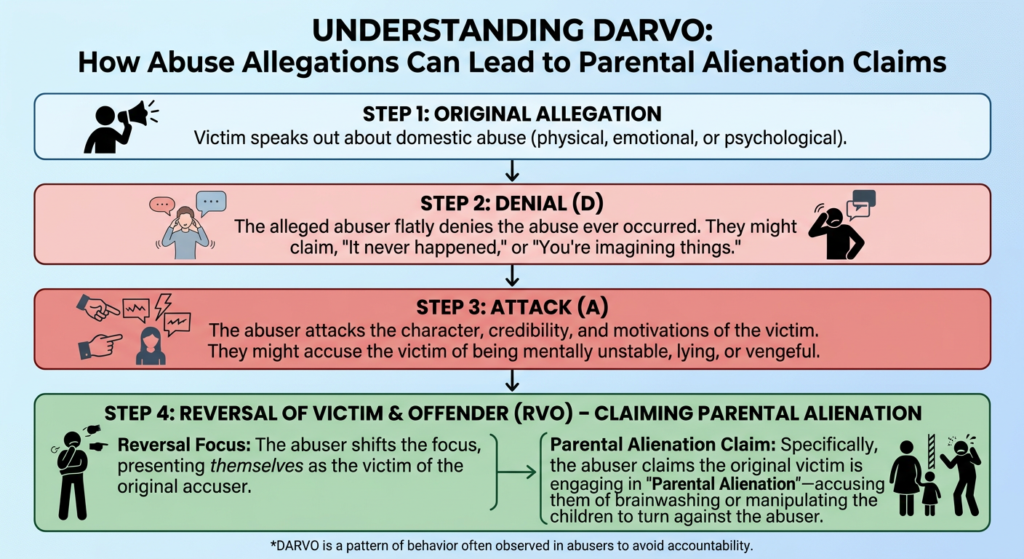
To understand why you’re being accused of something you haven’t done, you need to understand the mechanics of DARVO. We have a comprehensive guide on DARVO manipulation that dives deep into the psychology, but here is the breakdown of how it applies to family law:
- D – Deny: The abusive parent denies their own harmful behaviour (e.g., “I never hit her,” or “I’m not controlling”).
- A – Attack: They attack the person who is calling them out (e.g., “She is mentally unstable,” or “He is a liar”).
- RVO – Reverse Victim and Offender: This is the most damaging part. They claim they are the actual victim of the person they are abusing. In family court, this usually manifests as: “The only reason the children don’t want to see me is because their mother is alienating them.”
By using DARVO, the perpetrator shifts the focus of the legal proceedings. Instead of the court investigating the perpetrator’s behaviour, the court starts investigating the “alienating” parent.
The DARVO vs. Genuine Alienation Comparison
It can be difficult for CAFCASS officers or judges to tell the difference between a protective parent and an alienating one at first glance. Here is how the two typically differ:
| Feature | Genuine Parental Alienation | DARVO (False Accusation) |
|---|---|---|
| Child’s Behaviour | Child uses “borrowed” adult language to criticise the parent. | Child expresses specific, age-appropriate fears based on real events. |
| The Accuser’s Goal | To cut the other parent out of the child’s life entirely. | To protect the child from documented harm or coercive control. |
| Response to Contact | The alienating parent blocks contact for no valid safety reason. | The protective parent encourages contact but sets boundaries for safety. |
| History of Care | Often a history of one parent being the primary caregiver. | The accuser often has a history of being less involved until the split. |
| The DARVO Element | Not applicable. | The accuser is using the “victim” narrative to hide their own abuse. |
Why Parental Alienation is the “Weapon of Choice” in 2026
In recent years, the term “parental alienation” has become a buzzword in UK courts. Research suggests that accusations of alienation are frequently weaponised by abusive partners as a counter-tactic. When a survivor of domestic abuse raises concerns about safety, the abusive partner counters with an alienation claim.
This creates “reciprocal allegations.” To a judge who doesn’t understand DARVO, it looks like “six of one and half a dozen of the other.” In reality, it is often one person telling the truth and the other using a calculated strategy to maintain power.
As researchers have noted, the theory of parental alienation often conflates the symptoms of child abuse (fear, reluctance, distress) with evidence of “brainwashing.” This is a dangerous path. If a child is scared of a parent because that parent was violent, that is protection, not alienation.
The Emotional Toll of Being Falsely Accused
Being falsely accused of parental alienation is a form of legal gaslighting. It is incredibly isolating to know the truth of your family’s situation while watching a legal professional or an ex-partner paint a completely different picture in court.
The stress can be overwhelming. You may feel:
- Helpless: Because the more you try to “prove” your innocence, the more the other side claims you are “obsessive” or “alienating.”
- Fearful: That the court will take your children away and place them with an abusive parent.
- Exhausted: By the constant need to defend your character rather than focusing on your children’s well-being.
How to Defend Against DARVO in Family Court
If you are facing false accusations of parental alienation uk, you cannot simply hope the truth will come out. You need a proactive strategy.
1. Document Everything
DARVO thrives on “he-said, she-said” scenarios. You need to move the case into the realm of “evidence-said.” Keep a meticulous log of interactions, keep all text messages, and save emails. If your child is distressed before or after contact, record the details (date, time, what was said) without coaching the child.
2. Stay “Child-Centric”
The court looks for parents who put the child’s needs first. Even if you are angry (and you have every right to be), your communication with the other parent should be brief, informative, and neutral. Avoid getting into arguments that can be screenshotted and used against you.
3. Seek Expert Legal Advice Early
You need a solicitor who understands the nuances of coercive control and psychological manipulation. At Judge Law, we specialise in complex family disputes across Windsor, Slough, and London. We know how to spot DARVO tactics and how to present the reality of your situation to the court.
4. Focus on the “Why”
If your child doesn’t want to see the other parent, focus on the reasons why. Is there a history of domestic abuse? Is there a lack of emotional bond? Bringing the court’s focus back to the child’s lived experience: rather than the parent’s theory of alienation: is crucial.
How Judge Law Can Help
Navigating the family court system in 2026 requires more than just a knowledge of the law; it requires an understanding of human behaviour and manipulation.
We don’t just fill out forms; we build a defence for your reputation and a safeguard for your children. We understand that behind every “parental alienation” claim is a family trying to find peace.
If you feel like the script has been flipped on you, don’t wait. The sooner you identify DARVO, the sooner you can stop it from dictating the outcome of your case. Check out our main DARVO guide for more tools to identify these patterns, or contact us today to discuss your specific situation.
Remember: Being a protective parent is not a crime. Don’t let a manipulator convince the court otherwise.