Buying a property in England or Wales is one of the most significant financial and legal commitments you will make. Get the sequence right and the process, though demanding, is manageable. Miss a step and you risk delays, unexpected costs, or a transaction that falls apart at exchange. This property purchase checklist sets out every stage you need to work through, from assessing your finances to collecting the keys and registering your ownership.
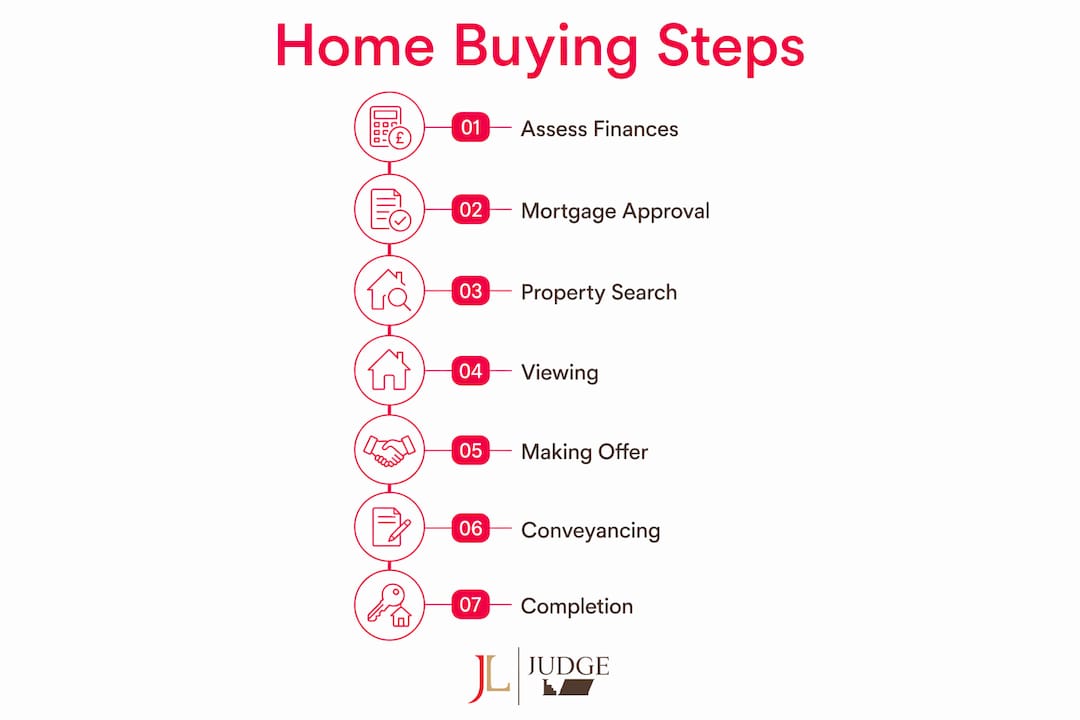
Here is the full sequence at a glance:
- Assess your finances. Calculate what you can afford, check your credit score, and start saving your deposit.
- Research government schemes. Explore shared ownership, the First Homes scheme, and other options that may reduce your upfront costs.
- Get a mortgage in principle. Approach a broker such as Mojo Mortgages or go direct to a lender to establish your borrowing limit.
- Define your search criteria. Location, property type, budget, and must-haves before you start viewing.
- View properties. Conduct thorough viewings, take notes, and return at different times of day.
- Make an offer. Submit in writing through the estate agent. Your offer is not legally binding at this stage.
- Instruct a conveyancer or solicitor. Appoint your legal representative as soon as your offer is accepted.
- Arrange your mortgage. Submit your full application and await a formal mortgage offer.
- Commission a survey. Choose the right survey type for the property’s age and condition.
- Legal searches and enquiries. Your conveyancer conducts local authority, environmental, and drainage searches.
- Exchange contracts. The point at which both parties are legally committed. You pay your deposit.
- Completion. Funds transfer, keys are released, and you become the legal owner.
- Post-completion. Stamp Duty Land Tax is paid, and your ownership is registered with HM Land Registry.
Each of these stages is covered in full below.
Table of Contents
- 1. Financial readiness: what you need to sort before you search
- 2. How to start your property search effectively
- 3. What to check when you view a property
- 4. Making an offer and understanding what it means legally
- 5. Arranging your mortgage: from principle to formal offer
- 6. Why you need a survey, and which type to choose
- 7. Appointing a conveyancer and navigating the legal process
- 8. Preparing to move in: before and after completion
- 9. What the process looks like from a legal perspective
- FAQ
1. Financial readiness: what you need to sort before you search
Before you look at a single property listing, your finances need to be in order. Not roughly in order. Properly assessed, documented, and stress-tested.

Deposit
Most lenders require a minimum deposit of a small percentage of the purchase price, though a larger deposit will typically unlock better mortgage rates. The larger your deposit, the lower your loan-to-value ratio, and the more competitive the mortgage products available to you.
Government schemes worth knowing
- Shared ownership. You buy a share of a property (typically between 25% and 75%) and pay rent on the remainder, which is owned by a housing association. You can increase your share over time through a process called staircasing. This scheme is particularly useful if you cannot afford to buy outright in your target area.
- First Homes scheme. Eligible first-time buyers in England can purchase certain new-build homes at a discount of at least 30% below market value. The discount is preserved when the property is sold, passing the benefit to the next buyer.
- Right to Buy. If you are a council or housing association tenant, you may be eligible to purchase your home at a discount.
Additional costs to budget for
Many buyers focus on the deposit and underestimate everything else. Build all of the following into your budget before you commit:
- Stamp Duty Land Tax (SDLT), which applies above certain thresholds (see section 8 for detail)
- Conveyancing fees and disbursements, typically £850 to £1,500 depending on property complexity
- Survey costs, ranging from a few hundred pounds for a basic condition report to over £1,000 for a full structural survey
- Mortgage arrangement fees, which some lenders add to the loan but which still increase your overall borrowing
- Removal costs and any immediate renovation or redecoration budget
- Buildings insurance, which must be in place from exchange of contracts
Credit and documentation
Check your credit report before you approach any lender. Errors on your file can delay or derail a mortgage application, and correcting them takes time. Lenders will want to see payslips, bank statements, proof of address, and photo ID. Self-employed applicants typically need two to three years of accounts or tax returns. The affordability assessment considers not just your current income and outgoings but also how you would manage if interest rates rose or your circumstances changed.
Pro Tip: Set aside a contingency fund of at least 1–2% of the purchase price for unexpected costs that emerge during surveys or after completion. Properties rarely arrive without surprises.
2. How to start your property search effectively

Once your finances are in order and you have a clear budget, the search itself needs structure. Browsing Rightmove without defined criteria is how buyers waste months and end up making rushed decisions.
Set your criteria before you search
Be specific about what you actually need versus what you would like. Consider:
- Location. Proximity to work, schools, transport links, and amenities. Check commute times at peak hours, not just on a Sunday afternoon.
- Property type. Flat, terraced, semi-detached, or detached. Freehold or leasehold (more on this distinction below).
- Size. Number of bedrooms, garden requirements, parking.
- Price ceiling. Set this at your maximum mortgage offer, not your aspirational figure.
- Future resale value. Regeneration plans, school catchment areas, and local infrastructure investment all affect long-term value.
Where to look
Online portals are the obvious starting point, but register directly with local estate agents too. Some properties are sold before they reach the major portals, particularly in competitive markets. Personal networks occasionally surface off-market opportunities. Set up email alerts so you are notified the moment a matching property is listed.
Stay organised
Keep a record of every property you view, including the address, asking price, key features, and your impressions. A simple spreadsheet works well. Without records, properties blur together quickly, especially if you are viewing several in a short period.
Freehold vs leasehold: understand the difference early
Freehold means you own the property and the land it sits on outright. Leasehold means you own the property for a fixed term, typically 99 to 999 years, but the land is owned by a freeholder to whom you may owe ground rent and service charges. Flats in England and Wales are almost always leasehold. A lease with fewer than 80 years remaining can make a property difficult to mortgage and expensive to extend. Ask the estate agent about lease length and annual charges before you arrange a viewing.
3. What to check when you view a property
A viewing is not a social occasion. It is an inspection, and you should treat it as one. Estate agents are legally required to disclose material facts about a property, but that does not mean every problem will be volunteered. You need to ask the right questions and look in the right places.
Visual checks during the viewing
- Damp. Look for tide marks on walls, peeling wallpaper, a musty smell, or dark patches near the floor or ceiling. Rising damp and penetrating damp are both costly to remedy.
- Structural condition. Cracks in walls or ceilings, particularly diagonal cracks near windows and doors, can indicate subsidence or settlement.
- Roof. From outside, check for missing or slipped tiles. From inside, look for water staining on ceilings in the top-floor rooms.
- Windows and doors. Do they open and close properly? Sticking doors can indicate movement in the structure.
- Electrics and plumbing. Ask when the boiler was last serviced and whether there is a current gas safety certificate. Check the age of the consumer unit.
Questions to ask the estate agent
- How long has the property been on the market, and have any previous sales fallen through?
- Is the property part of a chain, and if so, how many parties are involved?
- Have all necessary consents been obtained for any extensions or alterations?
- What is the council tax band, and what are the current utility costs?
- What is the Energy Performance Certificate rating?
The council tax band and EPC rating directly affect your ongoing running costs. A property with an EPC rating of F or G will cost significantly more to heat than one rated B or C, and that difference compounds over years of ownership.
Practical habits that pay off
Visit the property more than once, and at different times of day. A quiet street at 11am on a Tuesday can be very different at 8am on a weekday. Take photographs of anything that concerns you. These will be useful when briefing your surveyor.
Pro Tip: Ask the estate agent if you can speak directly to the sellers. They can tell you things the agent cannot, including why they are moving, how the neighbours are, and what the property is like to live in day to day.
4. Making an offer and understanding what it means legally
Submitting an offer is a significant moment, but it is worth being clear about what it is and what it is not. In England and Wales, an offer is not legally binding until contracts are exchanged. Either party can withdraw before that point without legal penalty. That is both a protection and a vulnerability.
How to submit an offer
Offers are made verbally or in writing through the estate agent. Written confirmation is sensible. State clearly what your offer includes, whether fixtures and fittings such as white goods, curtains, or garden structures are part of the deal.
What makes an offer more attractive to a seller
- Being a cash buyer removes the mortgage risk entirely and is often worth more to a seller than a slightly higher offer from a mortgaged buyer.
- Having a mortgage in principle in place signals that you are a credible buyer.
- Being chain-free, or at the top of a short chain, reduces the risk of the transaction collapsing.
- Flexibility on completion date can be decisive when a seller has specific timing needs.
After your offer is accepted
Acceptance is not a contract. The property remains on the market until exchange, and the seller can accept a higher offer from another buyer, a practice known as gazumping. Your conveyancer or solicitor will advise you throughout this period, and the sooner you instruct them the better. Understanding the legal steps involved in buying a home from the outset will help you move quickly and avoid being caught out.
5. Arranging your mortgage: from principle to formal offer
A mortgage in principle, sometimes called a decision in principle or agreement in principle, is a written statement from a lender indicating how much they are likely to lend you. It is not a guarantee of a mortgage, but it is an important signal to sellers and agents that you are a serious buyer. Brokers such as Mojo Mortgages can search across multiple lenders to find products suited to your circumstances, which is particularly useful if you are self-employed, have a complex income, or have had credit issues in the past.
Steps in the mortgage process
- Get a mortgage in principle before you start viewing seriously. Most lenders will run a credit check at this stage; ask whether it is a soft or hard search, as too many hard enquiries can affect your credit score.
- Submit your full application once your offer is accepted. You will need to provide proof of income, bank statements, proof of address, and photo ID. Your broker or lender will guide you through the specific requirements.
- Lender’s valuation. The lender will instruct a valuation of the property to confirm they are satisfied lending against it. This is not a survey and does not protect you if something is wrong with the property. It is purely for the lender’s benefit.
- Mortgage offer. Once the lender is satisfied with the valuation and your application, they issue a formal mortgage offer. This is typically valid for six months. Review the conditions carefully before you proceed.
A note on rates and product types
Fixed-rate mortgages give you certainty over your monthly payments for a set period, typically two or five years. Tracker and variable-rate products move with the Bank of England base rate or the lender’s standard variable rate. Your broker can help you weigh the options against your circumstances and risk appetite.
6. Why you need a survey, and which type to choose
The lender’s valuation tells you what the lender thinks the property is worth. It tells you almost nothing about the property’s condition. Commissioning your own independent survey is one of the most important steps in any home buying checklist, and skipping it to save a few hundred pounds is a false economy.
Surveys range from basic condition reports to comprehensive structural assessments, and the right choice depends on the property’s age, type, and apparent condition.
The three main survey types
| Survey type | What it covers | Best suited to |
|---|---|---|
| Condition report | Basic overview of condition; traffic-light ratings for key elements | New-build or recently renovated properties |
| Homebuyer report | More detailed inspection; flags defects and maintenance issues | Standard properties in reasonable condition |
| Full structural survey | Thorough assessment of structure, fabric, and all accessible areas | Older properties, unusual construction, or any property with visible concerns |
What surveyors look for
A surveyor will assess damp, structural movement, roofing condition, the state of the electrical installation and plumbing, drainage, and any signs of subsidence or heave. They will flag issues that were not visible during your viewing and, crucially, identify problems that could be expensive to fix.
Using survey results
If the survey reveals significant defects, you have options. You can renegotiate the purchase price to reflect the cost of remediation, ask the seller to carry out repairs before completion, or withdraw your offer entirely. The survey gives you the evidence to make that decision from a position of knowledge rather than guesswork. Our guide on property purchase red flags sets out the issues that most commonly justify walking away.
7. Appointing a conveyancer and navigating the legal process
Conveyancing is the legal process of transferring ownership of a property from seller to buyer. It is not optional, and it is not something to leave until the last moment. Instruct your solicitor or licensed conveyancer as soon as your offer is accepted. Delays in appointing legal representation are one of the most common reasons transactions take longer than they should.
Who can act for you
You can use a solicitor or a licensed conveyancer. Both are regulated and qualified to handle residential property transactions. A solicitor regulated by the Solicitors Regulation Authority (SRA) can also advise on related legal matters, such as title disputes or boundary issues, that fall outside the scope of a licensed conveyancer’s remit.
The conveyancing timeline
The typical conveyancing process spans 12 to 16 weeks, though chains and leasehold properties can extend this to 20 to 24 weeks or more. The main stages are:
- Instruction. You appoint your conveyancer and provide your ID and proof of funds.
- Draft contract and title documents. The seller’s solicitor sends the draft contract, title documents, and a property information form.
- Searches. Your conveyancer applies for local authority, environmental, and drainage searches. Local authority searches cover planning history, building regulations, and road adoption; environmental searches assess flood risk and contamination.
- Enquiries. Your conveyancer raises questions about the title, boundaries, planning consents, and any matters arising from the searches. The seller’s solicitor responds on the seller’s behalf.
- Mortgage offer. Once received, your conveyancer reviews the conditions and reports to you.
- Exchange of contracts. Both parties sign identical contracts and exchange them. You pay your deposit, typically 10% of the purchase price. From this point, both parties are legally committed.
- Completion. The remaining funds are transferred, the seller vacates, and you receive the keys.
Stamp Duty Land Tax
SDLT is payable on residential properties in England and Wales above certain thresholds. The rates and thresholds are set by HMRC and vary depending on whether you are a first-time buyer, a home mover, or purchasing an additional property. Your conveyancer will calculate the amount due and submit the SDLT return to HMRC within 14 days of completion. Check the current SDLT rates directly with HMRC, as thresholds are subject to change.
Conveyancing costs
Legal fees and disbursements typically range from £850 to £1,500, though complex transactions, leasehold properties, and higher-value purchases can push costs higher. Disbursements include search fees, Land Registry registration fees, and the SDLT payment itself. Ask for a full breakdown in writing before you instruct.
What you can do to keep things moving
Respond to your conveyancer’s requests promptly. Delays in returning signed documents or providing information are the single biggest cause of transactions stalling. If you are in a chain, your conveyancer will be coordinating with multiple other firms, and a slow response at any point affects everyone. Judgelaw’s conveyancing solicitors can advise you on the process and help you understand what is expected of you at each stage.
Exchange of contracts: the legal turning point
Exchange is the moment the transaction becomes binding. Before exchange, either party can withdraw without penalty. After exchange, withdrawal carries serious financial consequences, including forfeiture of your deposit. This is why your conveyancer will not recommend exchange until all searches are back, all enquiries are resolved, your mortgage offer is in place, and you are satisfied with the survey results.
8. Preparing to move in: before and after completion
Completion day is the day the remaining purchase funds are transferred and you become the legal owner. It is also one of the busiest days of the entire process, and the more you prepare in advance, the less fraught it will be.
Before completion
- Buildings insurance. You must have buildings insurance in place from the moment you exchange contracts, not from completion. If the property is damaged between exchange and completion, you are the one at risk.
- Removal company. Book well in advance, particularly if you are moving in spring or summer when demand is high. Confirm the booking once your completion date is set.
- Utilities and services. Contact your energy supplier, broadband provider, and water company to arrange transfer or new accounts. Note the meter readings on the day you move in.
- Council tax. Notify your local authority of your move-in date so your council tax account is set up correctly from day one.
- Review the completion statement. Your conveyancer will send a final financial statement showing the balance due on completion. Check it carefully and ensure funds are in place.
On completion day
Your conveyancer transfers the purchase funds to the seller’s solicitor. Once the seller’s solicitor confirms receipt, the estate agent is authorised to release the keys. This process can take until mid-afternoon, so plan your moving day accordingly and do not expect to have access first thing in the morning.
After completion
- Land Registry registration. Your conveyancer submits the application to register your ownership with HM Land Registry. This can take several weeks, sometimes longer for complex titles.
- SDLT return. Filed and paid within 14 days of completion by your conveyancer.
- Change of address. Notify your bank, employer, DVLA, HMRC, GP, and any other relevant organisations. Set up a Royal Mail redirection as a safety net.
- Check the property. Walk through the property on completion day and note anything the seller has left that was not agreed, or anything that has been removed that should have stayed.
9. What the process looks like from a legal perspective
Most buyers focus on the property itself and treat the legal process as an administrative backdrop. That is understandable, but it is also where things go wrong.
The legal milestones in a property purchase are not bureaucratic formalities. They are the points at which your rights and obligations crystallise. Before exchange, you have flexibility. After exchange, you have a binding contract. At completion, ownership transfers. At Land Registry registration, your title becomes a matter of public record. Each of these moments has real consequences, and understanding them changes how you approach the process.
What tends to catch buyers off guard is not the complexity of any individual step but the way delays compound. A slow search return pushes back enquiries. Unresolved enquiries delay exchange. A delayed exchange can put your mortgage offer at risk of expiring. Proactive management of the conveyancing process, chasing responses, returning documents promptly, and keeping your conveyancer informed of any changes to your circumstances, is not optional. It is how transactions complete on time.
Leasehold properties deserve particular attention. The lease itself, the service charge accounts, the management company’s conduct, and any planned major works all require scrutiny before exchange. A leasehold property with a short lease, high service charges, or a poorly managed building can be a liability rather than an asset. Your conveyancer should flag these issues, but you should also ask about them directly.
The UK property legal terms that appear in your contract and title documents are worth understanding before you sign anything. Terms like restrictive covenant, easement, and overriding interest are not obscure technicalities. They describe real constraints on what you can do with the property you are buying.
One thing that does not get said often enough: the cheapest conveyancer is rarely the best choice. A solicitor who communicates clearly, responds quickly, and flags problems before they become crises is worth paying for. The cost difference between a competent conveyancer and a poor one is trivial compared to the cost of a transaction that collapses or completes with an undiscovered legal problem.
FAQ
How long does buying a property in England take?
The average home buying process takes approximately five months, with the conveyancing stage alone typically spanning 12 to 16 weeks. Chains and leasehold properties can extend this to 20 to 24 weeks or more.
Is an offer on a property legally binding?
No. In England and Wales, an offer is not legally binding until contracts are exchanged. Either the buyer or the seller can withdraw before that point without incurring a legal penalty.
What documents do you receive when you purchase a property?
On completion you receive the title deeds or official copy of the register from HM Land Registry, the transfer deed, any guarantees for works carried out, and the Energy Performance Certificate. Your conveyancer will hold or forward these to you.
What order should you follow when buying a house?
The sequence is: assess finances and save your deposit, get a mortgage in principle, search for a property, make an offer, instruct a conveyancer, arrange your full mortgage, commission a survey, complete legal searches and enquiries, exchange contracts, and then complete. Post-completion, your conveyancer registers your ownership with HM Land Registry and files the SDLT return.
Can a £30,000 salary support a mortgage in England?
Lenders typically offer multiples of your annual salary as your borrowing limit, but the exact amount varies depending on your financial circumstances, deposit size, and lender criteria. Whether that is sufficient depends on your target area, deposit size, and individual lender criteria. A broker can give you a precise figure based on your full financial picture.
Recommended
- First-time buyer guide: Navigate your UK home purchase
- What Legal Steps Are Involved in Buying a Home? | Judge Law
- UK property legal terms explained: make better home decisions
- Resolving property disputes: A UK homeowner’s guide
Ready to Start Your Property Purchase?
Buying a home involves complex legal steps and tight deadlines. Our experienced conveyancing solicitors guide you through every stage, from offer acceptance to registration, ensuring your transaction proceeds smoothly.