

TL;DR
- Understanding who holds parental responsibility is vital because it determines who can make legal decisions affecting the child’s welfare.
- Parents often need to attend a MIAM unless exempted, to explore mediation options before applying to court for custody arrangements.
- Court proceedings typically take about 35 weeks, but successful mediation can resolve disputes more quickly and less adversarially.
You are staring at a blank page, unsure whether to contact a solicitor, call a mediator, or wait to see if things settle on their own. Your child’s routines, schooling, and emotional wellbeing hang in the balance, and every decision feels weighted with consequence. This guide walks you through the entire UK child custody process, from understanding who holds parental responsibility to enforcing a court order when things go wrong. It is practical, legally grounded, and written for parents who need clarity, not jargon.
Key Takeaways
| Point | Details |
|---|---|
| Parental responsibility basics | Know who has legal rights to make decisions about your child for a smoother custody process. |
| Mediation is often mandatory | Most parents must attend a Mediation Information and Assessment Meeting before court proceedings. |
| Custody process takes time | Family court cases average 35 weeks, so plan for a lengthy but structured process. |
| Mistakes can delay outcomes | Avoid common errors like ignoring mediation requirements or misunderstanding parental responsibility. |
| Help is available | Legal support and guidance make a significant difference at every stage, especially if disputes continue. |
Understanding parental responsibility and your legal standing
Before diving into the legal steps, it is crucial to understand who actually has the legal right to make decisions for your child. Many parents discover, painfully late, that they assumed rights they did not have, or failed to assert rights they did.
Parental responsibility is the legal term for all the rights, duties, powers, responsibilities, and authority a parent has in relation to a child. It covers decisions about schooling, medical treatment, religious upbringing, and where the child lives. Crucially, as set out in the official government guidance on who has parental responsibility, parental responsibility generally continues after separation or divorce, but it depends entirely on how it was acquired.
Here is how it typically works:
- Mothers acquire parental responsibility automatically at birth, in every case.
- Fathers acquire it automatically if they are married to the mother at the time of the child’s birth, or if their name is on the birth certificate (for births registered after 1 December 2003 in England and Wales).
- Unmarried fathers whose names are not on the birth certificate do not have automatic parental responsibility. They can acquire it through a parental responsibility agreement with the mother, a court order, or by subsequently marrying the mother. If you are in this position, understanding your parental rights as an unmarried father is an essential first step.
- Step-parents and partners do not automatically acquire parental responsibility. They can apply for it via a parental responsibility order or through adoption.
- Second parents in same-sex couples may have it depending on the method of conception and whether they were a civil partner or spouse at the time of birth.
The table below summarises the most common family situations:
| Family situation | Does this person have parental responsibility? |
|---|---|
| Mother (birth) | Yes, automatically |
| Father, married to mother at birth | Yes, automatically |
| Father named on birth certificate (post-2003) | Yes, automatically |
| Unmarried father not on birth certificate | No, unless acquired separately |
| Step-parent | No, unless a court order or agreement is in place |
| Same-sex second parent (civil partner at birth) | Yes, if civil partner or spouse at time of birth |
Knowing who holds parental responsibility matters because it affects who can seek certain court remedies and who has standing to make binding decisions about the child’s life. If there is any doubt about yours, address it now rather than mid-dispute.
Pro Tip: Check the original birth certificate and any court orders you already hold before taking any formal steps. Discrepancies between what you believe and what the legal record shows can derail applications at an early stage.
Preparing for the custody process: Mediation, preparation and exemptions
Once you know your legal standing, the next challenge is knowing how to start the process, or whether you must attend mediation first.
In England and Wales, before applying to court for a child arrangements order, parents are usually required to attend a Mediation Information and Assessment Meeting, commonly called a MIAM, unless they qualify for an exemption. The MIAM is not a full mediation session. It is a meeting with an accredited mediator who explains what mediation involves and assesses whether it is suitable for your situation. Courts take non-attendance seriously, and applying without evidence of a MIAM or a valid exemption can result in your application being returned.
MIAM exemptions do exist. You may not need to attend if:
- There is evidence of domestic abuse by the other party.
- The matter is urgent (for example, a child has been removed unlawfully or is at immediate risk).
- A child protection investigation is underway.
- The other party is contactable but refuses to attend.
- You live in an area where there are no authorised mediators within 15 miles of your home.
Understanding how courts decide custody matters here too, because the MIAM stage is your first opportunity to demonstrate a willingness to resolve matters constructively rather than confrontationally.
Here are the practical preparation steps you should take before any formal legal action:
- Gather documentation: collect school records, medical letters, communication logs, and any evidence relevant to the child’s welfare or your involvement in their life.
- Record all contact attempts and responses, including text messages and emails, as these may become relevant in court.
- Research authorised mediators in your area and make initial contact to understand costs and availability.
- Consider seeking early advice from a child arrangement solicitor so you understand your position before the MIAM appointment.
- Prepare a factual, child-focused narrative of what you want the arrangements to look like and why they serve the child’s best interests.
Pro Tip: Gather your communication records well before any formal step. Courts and mediators both assess how parents have behaved towards each other. A pattern of respectful, child-focused communication is genuinely persuasive.
How the child custody process works step-by-step
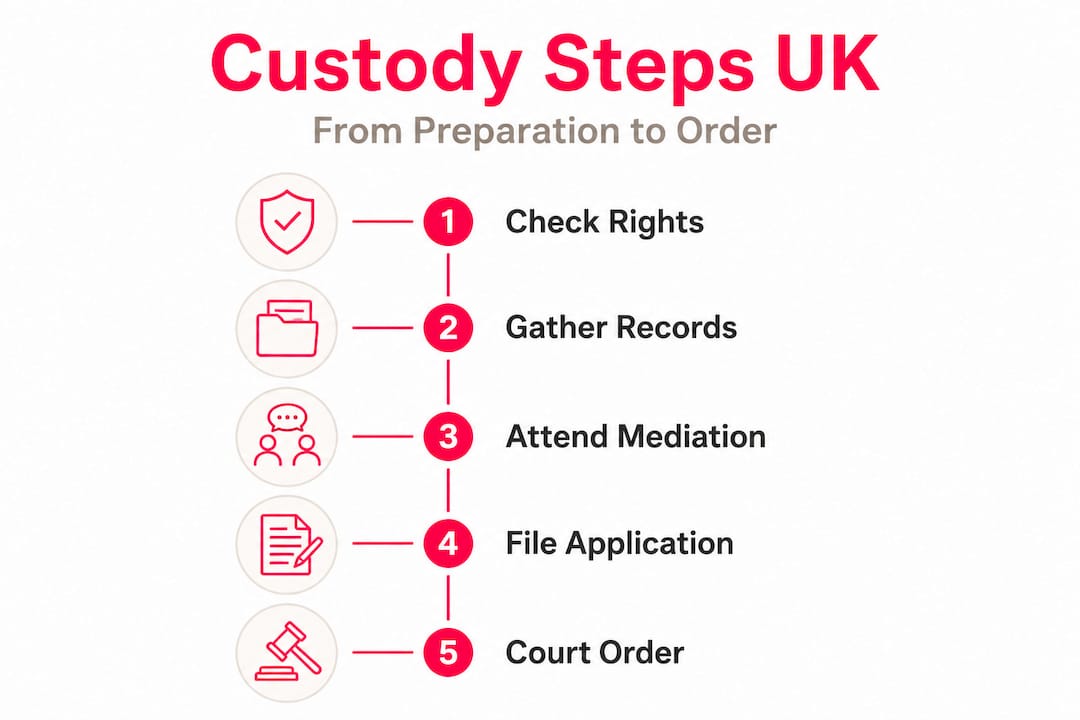
With preparation in place, you are ready to follow the practical roadmap through custody arrangements. The process is sequential, and understanding each stage reduces the disorienting uncertainty that makes this period so exhausting.
- Attend the MIAM. An accredited mediator meets with each parent separately or together to assess whether mediation is appropriate. If it is, the mediation process begins. If not, the mediator issues a certificate allowing you to proceed to court.
- Attempt mediation. If mediation is suitable, you and the other parent work with the mediator to reach an agreement. Agreements reached here are not automatically legally binding, but they can be turned into a consent order by the court.
- Submit a court application. If mediation fails or is not appropriate, you submit a C100 form to the family court, along with the mediator’s certificate. Court fees apply unless you qualify for a fee remission.
- First Hearing Dispute Resolution Appointment (FHDRA). The court schedules an initial hearing, usually within a few weeks of the application. A Cafcass officer will prepare a safeguarding letter based on checks with police and social services. The judge will explore whether agreement is possible or whether further directions are needed.
- Further hearings. If matters are not resolved at the FHDRA, the court may order a Cafcass report, known as a Section 7 report, and schedule a Dispute Resolution Appointment (DRA) or a full contested hearing.
- Final order. The court makes a child arrangements order setting out where the child lives and how much time they spend with each parent. Courts apply the welfare checklist under the Children Act 1989, meaning the child’s welfare is the paramount consideration.
Understanding how family law firms handle custody at each of these stages can help you approach them with realistic expectations rather than anxiety.
The volume of cases moving through the family courts is significant. In the quarter from October to December 2025, 14,038 private law cases were started in England and Wales, with 26,182 private law orders made in that same period. Private law Children Act cases averaged approximately 35 weeks to disposal, meaning the process from application to final order typically takes the better part of a year. You should plan accordingly, both practically and emotionally.
| Approach | Typical timeframe | Advantages | Drawbacks |
|---|---|---|---|
| Mediation | 6 to 12 weeks | Lower cost, quicker, less adversarial | Not suitable if there is abuse or serious conflict |
| Court process | 35 weeks on average | Legally binding outcome, Cafcass input | Longer, more costly, more stressful |
Knowing when to instruct legal help, specifically when to seek legal advice, can make the difference between a process that moves forward constructively and one that stalls.
Troubleshooting: Common custody mistakes, disputes and how to resolve them
Even well-prepared parents can hit roadblocks or disagreements. Here is how to spot and deal with them before they escalate into something far more costly and painful.
The most common mistakes parents make during custody proceedings include:
- Misunderstanding parental responsibility. Assuming you have it when you do not, or assuming the other parent does not. Knowing who holds parental responsibility is foundational because it determines who can make decisions and who has standing to seek court remedies.
- Communicating through the child. Using your child as a messenger or allowing them to absorb adult conflict is harmful and courts notice it.
- Skipping the MIAM without a valid exemption. This can result in a delayed or rejected application, wasting time you cannot afford.
- Making unilateral decisions about the child. Moving a child’s school, taking them abroad, or changing their surname without the other parent’s agreement (or a court order permitting it) can have serious legal consequences.
- Allowing conflict to overshadow the child’s welfare. Courts apply the welfare checklist to assess what is best for the child. Demonstrating hostility towards the other parent rarely serves that test.
If you have safeguarding concerns about your child’s welfare or safety, report them to the local authority children’s services or the police immediately. Do not delay in the hope that the court process will address them in time.
If you find yourself in a dispute that feels intractable, help with child arrangement disputes is available, and early legal advice is almost always more cost-effective than allowing a situation to deteriorate to the point of emergency applications.
Pro Tip: Seek legal advice before the dispute escalates, not after. A single early consultation can clarify your options, prevent a costly misstep, and save you months of distress.
What to expect after the court order: Monitoring, changes and support
Once a court order is in place, many parents wonder how to manage the new routine and what to do if problems arise. The order is not the end of the process. It is the beginning of a new structure that needs to be maintained.
- Keep a record of compliance. Note when arrangements are followed and when they are not. If the other parent repeatedly fails to make the child available or prevents agreed contact, this record becomes important evidence.
- Communicate in writing where possible. Emails and texts create a reliable log. This protects both parties and keeps conversations focused on practicalities rather than emotion.
- Attempt to resolve minor disagreements directly. Not every deviation from an order warrants a return to court. A proportionate response to genuine minor issues preserves goodwill and is better for the child.
- Apply to enforce if necessary. If breaches are serious or persistent, you can apply to the court to enforce the child arrangements order. The court has powers to vary the order, impose unpaid work requirements, or in extreme cases, commit the defaulting party to prison.
- Apply to vary the order if circumstances change. Children’s needs evolve. A school move, a parent’s relocation, or a significant change in a child’s wishes are all grounds to apply for a variation. Courts reassess using the same welfare checklist.
Family courts in England and Wales continue to handle high volumes of private law cases, and returning to court for enforcement or variation is far more common than many parents expect. Needing further support after an order is made is not a failure. It is a normal part of navigating arrangements that involve two separate households. Support during and after separation exists precisely for these ongoing situations.

Why lasting arrangements depend on clear communication, not just court orders
Here is something worth saying plainly. A court order is a legal framework. It tells each parent what is required and what happens if they do not comply. What it cannot do is create a cooperative relationship between two people who are finding the experience of separation frightening and painful.
We see it regularly. Parents leave court with a carefully drafted order and, within months, the arrangement is breaking down, not because of legal technicalities but because the communication between them has collapsed entirely. The order said every other weekend. Nobody specified what happens when the child is ill, or what to do over the Christmas period, or how to handle a last-minute change. These are human questions, and a court order cannot answer all of them in advance.
The arrangements that hold up over years are the ones where parents commit to a basic standard of communication, however imperfect. That means keeping each other informed about significant developments in the child’s life, responding promptly to reasonable requests, and resisting the temptation to treat every interaction as an extension of the dispute.
That is not naive idealism. It is practical advice grounded in what actually works for children. Courts formalise. Courts set boundaries. But the welfare of your child, day to day, depends on your willingness to set aside the grievance long enough to focus on them.
If you need support structuring that communication or navigating a situation that has become entrenched, a child arrangement solicitor can provide practical guidance that goes well beyond the mechanics of the legal process.
Get expert support for your child custody journey
Navigating child custody arrangements is rarely straightforward, and the stakes could not be higher. Whether you are at the beginning of the process and need clarity on your rights, or you are facing a breakdown in arrangements and considering enforcement, having the right legal support makes a measurable difference. Our team at Judge Law works with parents at every stage, from initial advice and MIAM preparation through to contested hearings and post-order variations. We treat your situation as your own, not a template. If you would find it helpful to talk through your options, our legal tips for families resource is a useful starting point. When you are ready to speak with someone, our family law specialists are here, and you can also explore our full range of family law services to understand how we can assist.
Frequently asked questions
Do I need to attend mediation before applying to court for child custody?
Yes, you usually must attend a MIAM before applying to court for a child arrangements order, unless you qualify for a recognised exemption such as domestic abuse or urgency.
How long does a child custody case take in the UK?
Private law child custody cases average approximately 35 weeks to disposal in England and Wales, though mediated agreements can be reached significantly faster.
Who has parental responsibility for a child?
Mothers always have parental responsibility automatically. Fathers and second parents may have it depending on their legal relationship with the mother and whether they are named on the birth certificate. The official guidance on parental responsibility sets out the full detail.
What happens if my ex-partner breaches the child arrangement order?
You can apply to the family court to enforce the order. The court has a range of powers including varying the order, imposing community service requirements, or in serious cases, committing the defaulting party for contempt of court.
Can court orders be changed if circumstances change?
Yes. If there has been a significant change in circumstances, such as a parent relocating or a child’s needs evolving substantially, you can apply to the court to vary the existing order. The court will reassess using the child’s welfare as the paramount consideration.
Recommended
- Child Contact & Custody: How UK Courts Decide
- How UK Family Law Firms Handle Child Custody Cases | Judge Law
- Child Arrangement Orders for Unmarried Fathers: A 2026 Guide | Judge Law
- Child Arrangement Solicitor: How We Help Parents Reach the Best Outcome