TL;DR:
- UK tribunals are informal, specialized courts that resolve specific civil disputes at lower cost.
- Most cases settle early, with a high success rate for simple claims and strong evidence.
- Self-representation is common and supported, but thorough preparation remains crucial for success.
You have a dispute with your employer, a benefits decision you believe is wrong, or an immigration ruling that does not seem right. Your first instinct might be to think about courts, barristers, and the kind of proceedings you have seen on television. But for a significant proportion of legal disputes in the UK, a tribunal is the appropriate venue, and it works very differently from what you might expect. Understanding the distinction is not just academic. It could save you time, money, and a great deal of unnecessary anxiety.
Table of Contents
- What is a tribunal? Key features and overview
- How the UK tribunal system works
- Tribunal procedures: application, hearings and decisions
- Your rights, support and appeals in tribunal cases
- Typical outcomes and what to expect from a tribunal
- A practitioner’s perspective: what most tribunal guides don’t tell you
- Need more support navigating a tribunal?
- Frequently asked questions
Key Takeaways
| Point | Details |
|---|---|
| Tribunals are specialist courts | They handle specific civil disputes in an accessible, less formal setting than traditional courts. |
| Clear procedures with support | The process features structured steps, with options for self-representation and disability accommodations. |
| Early resolution is common | Most cases settle or withdraw before a full hearing due to methods like ACAS conciliation. |
| Rights and deadlines matter | Claimants enjoy important rights, but must act quickly as strict deadlines apply to claims and appeals. |
| Outcomes depend on preparation | Good evidence and preparation increase the likelihood of results in your favour—expert advice can tip the odds. |
What is a tribunal? Key features and overview
A tribunal in the UK is a specialist judicial body handling specific civil law disputes, more informal and accessible than traditional courts and part of the administrative justice system. That definition matters because it sets tribunals apart from the Crown Court, the County Court, and the High Court. Tribunals exist to resolve particular categories of dispute with greater speed and at lower cost, often without requiring legal representation at all.
The range of matters handled by tribunals is broader than most people realise. Common tribunals for individuals include Employment Tribunals covering unfair dismissal, discrimination, and unpaid wages; the Social Security and Child Support Tribunal handling benefits appeals such as Personal Independence Payment (PIP) and Universal Credit; the Immigration and Asylum Chamber; and the Special Educational Needs and Disability (SEND) Tribunal. Each of these specialisms means the judges and panel members bring focused expertise to your case rather than applying generic legal knowledge.
The key distinctions between tribunals and conventional courts are worth setting out clearly.
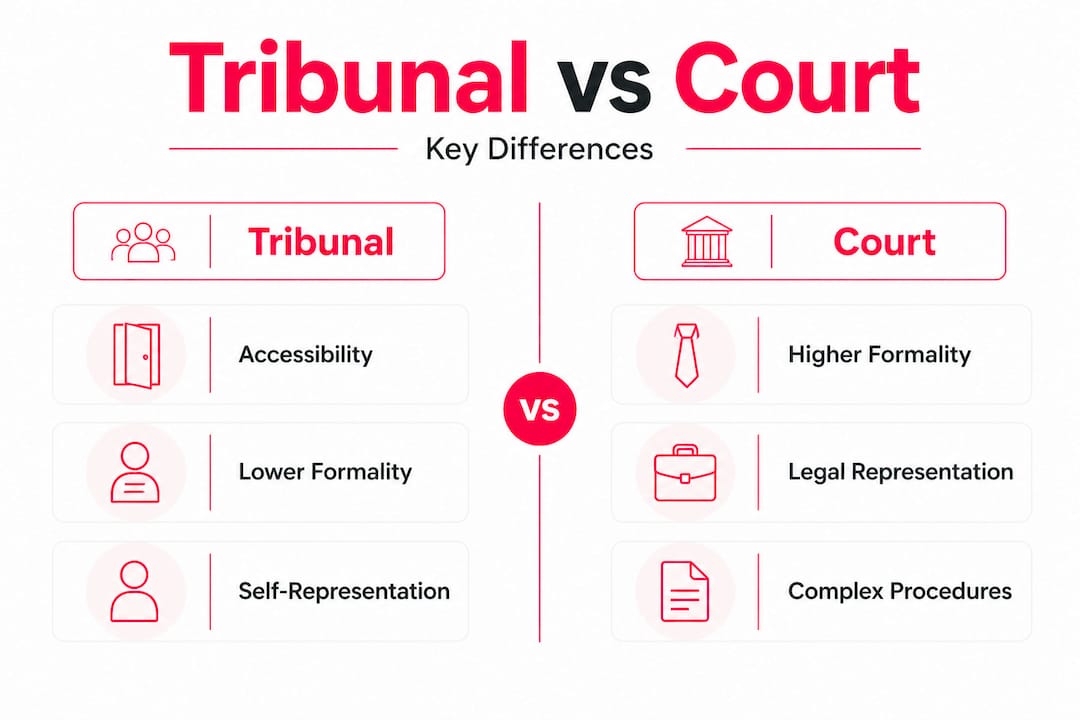
| Feature | Tribunal | Court |
|---|---|---|
| Formality | Lower, more accessible | Higher, more formal |
| Legal representation | Optional | Often expected |
| Fees | Free in most cases | Court fees usually apply |
| Specialist expertise | Yes, subject-specific | General jurisdiction |
| Speed | Generally faster | Often slower |
| Evidence rules | Simpler | Strict rules of evidence |
Several features make tribunals particularly accessible for individuals who are not legally trained. Proceedings tend to use plain language. Judges are expected to assist unrepresented parties in understanding the process. The atmosphere, while still serious and authoritative, is less intimidating than a formal courtroom. For anyone exploring their options around civil litigation, understanding where tribunals fit within the broader justice landscape is an essential first step.
How the UK tribunal system works
The tribunal system in England and Wales operates across two tiers. The First-tier Tribunal handles initial hearings and is divided into chambers, each covering a particular area of law. The Social Entitlement Chamber deals with benefits and tax credits disputes. The Immigration and Asylum Chamber handles visa and asylum cases. The Employment Tribunal, while technically sitting outside the chamber structure, operates on similar first-tier principles. The Upper Tribunal then handles appeals from the First-tier, but crucially only on points of law, not on questions of fact.
The chambers structure means you will encounter genuine specialists. A Social Entitlement judge will have deep familiarity with benefits legislation. An Immigration Chamber judge will understand the nuanced intersection of human rights law and immigration rules. This specialisation is one of the genuine advantages of the tribunal route over civil court proceedings.
Who is actually involved in a tribunal hearing? The composition varies by chamber and complexity.
- A legally qualified tribunal judge, who leads the proceedings.
- Lay members or expert panel members, in cases where specialist knowledge is required. A disability case might include a medically qualified panel member. An employment case may include members with backgrounds in employer and employee representation.
- The claimant (the person bringing the case) and the respondent (the person or organisation responding).
- Representatives for either party, if instructed, who may be solicitors, barristers, or lay representatives.
Expert panels in complex cases such as those involving disability assessments bring medical or technical expertise directly into the decision-making process. Appeals from the First-tier Tribunal to the Upper Tribunal are limited to legal errors. If you believe the facts were assessed incorrectly but there was no error of law, an appeal is unlikely to succeed. This is an important distinction to understand before committing to an appeal route.
The Upper Tribunal’s decisions carry significant authority. They set binding precedents within the tribunal system, shaping how future cases in the same chamber are decided. This gives the system a coherent legal framework, even though the proceedings at first-tier level are deliberately informal.
Tribunal procedures: application, hearings and decisions
Most people approaching a tribunal for the first time want to know the same thing. What actually happens, and in what order? The employment tribunal provides the clearest illustration, and the steps are broadly representative of tribunal procedure across most chambers.
- Early conciliation. For employment cases, you must contact ACAS (the Advisory, Conciliation and Arbitration Service) before submitting a claim. This mandatory step provides an opportunity to resolve the dispute without a hearing. The conciliation period extends the usual time limit for submitting your claim.
- Submit your claim (ET1 form). You must submit your ET1 claim within three months of the act complained of, extended by the ACAS conciliation period. The form sets out the basis of your claim in your own words.
- Respondent’s reply (ET3 form). The respondent has 28 days to submit an ET3 form responding to your claim. Failure to respond can result in a default judgment.
- Case management. The tribunal may issue case management orders, setting out timetables for exchanging documents, witness statements, and any preliminary hearings. A preliminary hearing might address whether the tribunal has jurisdiction, or whether a preliminary legal issue needs resolving before the main hearing proceeds.
- Final hearing. Both parties present their evidence, question witnesses under oath, and make submissions to the judge.
At the hearing itself, parties present evidence and witnesses under oath, cross-examination takes place, and the judge actively guides unrepresented parties through the process. A decision is often delivered on the day or issued within four weeks, and it is legally binding.
Key deadlines to keep in mind across tribunal types include:
- Employment claims: three months less one day from the act complained of (subject to ACAS extension)
- Benefits appeals (SSCS): one month from the decision letter
- Immigration appeals: fourteen days from the decision (or twenty-eight days from outside the UK)
- SEND appeals: two months from the local authority decision
Pro Tip: Even though tribunals are less formal than courts, thorough preparation remains essential. Organise your documents into a logical bundle, prepare a clear chronology of events, and identify your key witnesses well in advance. The informality of the setting can create a false sense of security. Tribunals reach their decisions on evidence, and weak evidence loses cases regardless of the venue.
Your rights, support and appeals in tribunal cases
One of the most important things to know is that you have genuine rights within the tribunal system, and those rights are not dependent on your ability to afford legal representation.
- No fees. Most tribunal claims carry no filing fee. Employment tribunal fees were abolished following the Supreme Court ruling in R (Unison) v Lord Chancellor [2017] UKSC 51, and the majority of other chambers remain free to access.
- Self-representation. You are fully entitled to represent yourself, and the rules of evidence are simpler than in civil courts. Tribunal judges are expected to assist unrepresented parties to understand what is happening and why.
- Disability accommodations. If you have a disability or health condition, you can request adjustments such as additional time, a ground floor hearing room, or assistance with documents.
- Right of appeal. If you believe a legal error occurred in your First-tier hearing, you can appeal to the Upper Tribunal or the Employment Appeal Tribunal. The deadline is generally 42 days from the date of the written decision.
There are edge cases and nuances that can catch people out. Strict time limits mean that non-response leads to default judgment, and non-compliance with case management orders can result in a strike-out. Some cases involve preliminary issues that must be resolved first, such as whether someone qualifies as an employee (rather than a contractor) or whether their condition meets the legal definition of disability under the Equality Act 2010. Costs awards are rare in tribunals but not impossible. In employment cases, costs can be awarded against a party who has behaved unreasonably or brought a claim with no reasonable prospect of success.
Immigration and asylum cases carry their own complexities, particularly where EU settlement scheme decisions or international protection claims are involved. If you are navigating those waters, specialist advice is worth obtaining early.
Pro Tip: If you are considering an appeal after an unfavourable tribunal outcome, move quickly. The 42-day deadline is firm, and extension applications are granted sparingly. An early assessment of the legal grounds available to you will save considerable stress.

Typical outcomes and what to expect from a tribunal
The statistics around tribunal outcomes are more reassuring than many people expect, and they tell an interesting story about how these cases actually resolve.
91% of employment claims resolve without a full hearing. Of that figure, approximately 29% settle through ACAS conciliation, and 24% are withdrawn by the claimant. Of the cases that do proceed to a final hearing, around 44% result in a claimant success. For the Social Security and Child Support Tribunal, overturn rates for PIP and DLA appeals sit at roughly 58 to 63%, which is a striking figure for anyone who has received an adverse benefits decision and assumed it was final.
What does this mean in practical terms? A few key points stand out.
- Most disputes settle before the hearing date. Both parties often prefer a negotiated outcome to the uncertainty of a tribunal decision.
- Financial claims tend to attract higher success rates than discrimination claims, partly because financial disputes are easier to evidence clearly.
- Withdrawing a claim is not always a failure. Sometimes the respondent makes a sensible offer, and accepting it is the right decision.
- Attending the hearing well-prepared significantly improves your position, even if you are representing yourself.
The most important mindset shift is this. Your real chance of success depends on your evidence, the strength of your legal position, and your preparation. No tribunal result is guaranteed, but the system is designed to give your case a fair hearing. That is worth remembering when the process feels uncertain.
A practitioner’s perspective: what most tribunal guides don’t tell you
The standard narrative around tribunals is that they are the accessible, user-friendly alternative to courts. That is true, as far as it goes. But it can lead people to underestimate what actually happens inside the hearing room.
Informality of process does not mean informality of scrutiny. Tribunal judges ask probing questions. They test the credibility of witness evidence. They apply the law carefully, even when neither party has legal representation. We have seen cases where a claimant with a genuinely strong position lost because their evidence was disorganised, their timeline was unclear, or they failed to attend a preliminary hearing and had their case struck out. The system is forgiving in its design, but it rewards those who treat it seriously.
The strategic value of early settlement is also consistently underestimated. If ACAS conciliation is available, engage with it genuinely. The majority of claims that settle do so at that stage, and a reasonable settlement achieved without a hearing preserves relationships, saves time, and removes the emotional weight of the process. Fighting every case to a final hearing is rarely the right approach, even when you believe you are entirely in the right.
Perhaps the most important thing we would say is this. Preparation at the outset is worth more than any legal argument at the hearing. Gather your documents early. Write down the key dates and events while they are fresh in your memory. If there are witnesses who can support your account, identify them and approach them before the tribunal timetable becomes pressing. The informality of the venue can make people feel they can turn up and explain themselves on the day. That approach rarely ends well.
Need more support navigating a tribunal?
Whether you are at the start of a tribunal claim, preparing for a hearing, or weighing an appeal, specialist legal advice can make a real difference to your position. At Judge Law, we work with individuals across employment disputes, civil disputes, and immigration matters including tribunal proceedings, providing clear, practical guidance tailored to your specific situation. We do not treat you as a case number. We listen to your story, assess your position honestly, and help you understand your realistic options. If you would like to speak to a solicitor about a tribunal matter, please get in touch and we will talk it through with you.
Frequently asked questions
Are tribunal hearings public or private?
Most tribunal hearings are open to the public, but some sensitive cases such as those involving disability evidence or appeals relating to children may be heard in private to protect the parties involved.
How long does it take to get a tribunal decision?
You will usually receive a tribunal decision on the day of your hearing or within four weeks afterwards, and that decision is legally binding on both parties.
Do I need a solicitor to go to a tribunal?
You do not need a solicitor because self-representation is permitted and the process is designed to be accessible, though legal advice can strengthen your position considerably in complex cases.
What happens if I miss the tribunal application deadline?
Missing a tribunal deadline usually means your claim will not be accepted unless you can demonstrate exceptional circumstances, so acting within the time limit is essential.
Can tribunal decisions be appealed?
Yes, if a legal error occurred in the First-tier proceedings, you can appeal within 42 days to the Upper Tribunal or the Employment Appeal Tribunal, though appeals are limited to points of law rather than factual disagreements.