TL;DR:
- Divorce does not automatically restore your maiden name; deliberate legal steps are required.
- Your options include using the decree absolute with a marriage certificate or obtaining a deed poll.
- Different organizations accept different evidence, necessitating individual verification and careful documentation.
You reach the end of your divorce and assume that, somewhere in the paperwork, your name has quietly reverted. It hasn’t. Divorce does not automatically change your name back to your maiden name in the UK. You need to take deliberate, documented steps using your decree absolute (now called a final order), your marriage certificate, or a deed poll. The distinction matters because different organisations require different evidence, and getting it wrong means starting the process over. This guide walks you through every stage, from choosing your legal route to updating the last record on your list.
Table of Contents
- Understanding your options for name change after divorce
- Deed poll explained: Enrolled vs. unenrolled
- Step-by-step divorce name change checklist
- Common mistakes and special cases
- Why UK divorce name change advice must be personal and precise
- Expert legal support for your divorce name change journey
- Frequently asked questions
Key Takeaways
| Point | Details |
|---|---|
| Name change is not automatic | You must take action to change your name after divorce; it won’t revert by itself. |
| Choose the right legal route | Understand whether decree absolute or deed poll suits your situation and check each organisation’s requirements. |
| Enrolled deed poll may be necessary | Some banks and companies only accept the official, enrolled deed poll, which costs £53.05. |
| Update records systematically | Use a checklist to notify HMRC, banks, employer, utilities, NHS, and others about your new name. |
| Edge cases require special attention | Children, Scottish and Northern Irish residents, and registered offenders must follow extra steps for legal compliance. |
Understanding your options for name change after divorce
Many people reach this point expecting the process to be straightforward. It can be, but only once you understand which legal route applies to your situation. According to the gov.uk guidance on deed polls, your two primary options are either using your decree absolute alongside your original marriage certificate, or obtaining a deed poll. Neither option is universally accepted by every organisation, and that inconsistency is the source of most confusion.
If you kept your married name throughout the marriage and want to revert to your pre-marriage name, your decree absolute combined with your marriage certificate is usually sufficient for government bodies such as HMRC, the Passport Office, and the DVLA. It proves both the name you held before and the fact that the marriage has ended. For many women in straightforward divorces, this route is the most convenient and costs nothing beyond the paperwork you already hold.
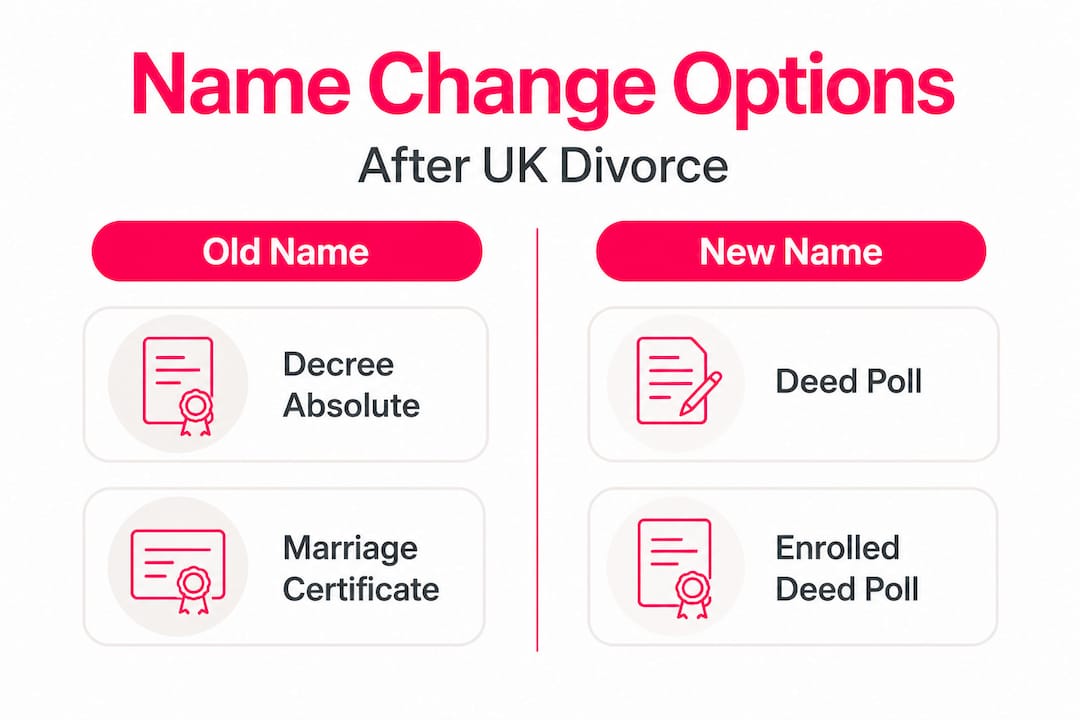
However, if you want to take a name that was not your pre-marriage name, or if you want to adopt an entirely new name, a deed poll is the appropriate route. Banks in particular tend to insist on a deed poll even when you are reverting to a maiden name, so it is worth checking their specific requirements before you visit a branch. The gov.uk guidance notes that some organisations will always require the enrolled version of a deed poll, which is lodged as a public record at the Royal Courts of Justice.
If your divorce happened later in life, you may find the emotional dimension of this decision especially resonant. Our grey divorce guide covers the unique pressures that come with separating after decades of marriage, including identity questions that a name change naturally brings to the surface.
Here is a comparison of the two main routes:
| Method | Cost | Accepted by government bodies | Accepted by banks | Public record |
|---|---|---|---|---|
| Decree absolute and marriage certificate | Free | Usually yes | Often no | No |
| Unenrolled deed poll | Free | Yes | Sometimes | No |
| Enrolled deed poll | £53.05 | Yes | Yes | Yes |
The key things to understand about each route:
- Decree absolute and marriage certificate. Works for reverting to your maiden name only. Simple and cost-free if you already have both documents.
- Unenrolled deed poll. A document you create yourself, signed by two witnesses. Accepted by most institutions but not all.
- Enrolled deed poll. Lodged at court, becomes a public record. Required by some banks and certain government offices.
- No method allows deceptive name changes. You cannot change your name to evade a debt, a court order, or any legal obligation.
Pro Tip: Before committing to either route, phone or visit the specific organisation you need to update first. Ask them directly what evidence they accept. This one step can save you weeks of delay.
If you are at the start of the divorce process rather than the end, our divorce process guide explains the full legal journey from petition to final order.
Deed poll explained: Enrolled vs. unenrolled
With the two main legal routes outlined, it helps to understand the deed poll process in greater detail before deciding which version suits you.
A deed poll is simply a legal document in which you declare that you are abandoning your old name and will use only your new name going forward. It must be signed in the presence of an independent witness who also signs. The distinction between unenrolled and enrolled comes down to whether the document is lodged with the Royal Courts of Justice and published in the London Gazette.
According to gov.uk’s deed poll guidance, an unenrolled deed poll is free to create if you are over 16 and can draft it yourself. It requires two independent witnesses and carries the same legal weight as an enrolled one in most circumstances. The enrolled version costs £53.05, takes longer to process, and becomes part of the public record. That public record element is why some institutions prefer it: there is no ambiguity about its authenticity or timing.
Here is a step-by-step overview of the deed poll process:
- Draft your deed poll document. You can use the government’s template or engage a solicitor to prepare it for you.
- Sign it in front of two independent witnesses. These cannot be family members. Each witness must provide their full name, address, and signature.
- Use the document consistently. Begin using your new name immediately and store several certified copies.
- Apply for enrolment if required. Send the completed form and fee of £53.05 to the Royal Courts of Justice if an enrolled version is needed.
- Wait for confirmation. The enrolled deed poll will be entered into the public record and you will receive official confirmation.
One detail people frequently miss is that changing your name on your passport does not automatically update your driving licence, and vice versa. Each update is a separate process with its own documentation requirements, as covered in more detail below.
The steps for applying to update your divorce filing steps are usefully explained alongside the full legal timeline, if you are still working through the formal end of your marriage.
Pro Tip: If you are unsure whether you will need an enrolled deed poll, opt for it from the outset. The £53.05 cost is modest compared to the time and effort of revisiting the process after being turned away by a bank or mortgage provider.
Step-by-step divorce name change checklist
Choosing your name change method is only the beginning. The more exhausting part is working through every institution that holds your name on record and updating each one systematically. According to the Money Helper name change checklist, the most important records to update fall across government, finance, employment, and personal categories.
Here is a structured order to follow:
- Passport. Apply via the HM Passport Office using your decree absolute or deed poll, plus your marriage certificate, birth certificate, and evidence of use of the new name. Processing typically takes up to ten weeks, so apply early if you have travel plans.
- Driving licence. Submit a D1 form to the DVLA along with your supporting documents. This service is free and usually takes between three and eight weeks.
- HMRC and National Insurance. Update your personal tax account online or contact HMRC directly. Your National Insurance number does not change, but your name on file must be corrected to avoid payroll discrepancies.
- Banks and building societies. Visit a branch in person wherever possible, bringing your deed poll or decree absolute and supporting documents. Some banks will require the enrolled deed poll.
- Employer and HR department. Notify your employer’s HR team to update payroll records, pension contributions, and employment contracts. A name mismatch on pension records can create complications years later.
- Utilities, broadband, and mobile contracts. Contact each provider and ask them to update your account. Most accept a letter with supporting documentation.
- NHS, GP, and dental practice. Contact your GP surgery directly. They will update their records and inform the NHS centrally.
- Electoral roll. Register your updated details with your local council, either online via gov.uk or by post.
- Insurance policies. Update home, car, travel, and life insurance to avoid any disputes at claim stage arising from a name discrepancy.
- Pensions. Contact any private or workplace pension providers. For older divorces, this is especially important when it comes to divorce entitlements and ensuring assets are accurately attributed to the right person.
Documents you are likely to need for most of these updates include: your decree absolute or final order, your original marriage certificate, your birth certificate, your deed poll if applicable, and proof of address.
One area people frequently overlook is their will. Your existing will may still refer to your married name, and a name change is the right moment to review it. If your circumstances have changed significantly, our guidance on making a new will after divorce explains why this is a critical step that protects your estate.
Common mistakes and special cases
Even with all your paperwork in order, some situations introduce complications that standard guidance does not cover.
The most common mistake people make is assuming one document does the job for every institution. It does not. A decree absolute satisfies HMRC but will not satisfy your bank. A bank may accept an unenrolled deed poll, or it may insist on an enrolled one. Going in without checking first wastes time and can feel demoralising when you are already tired from the divorce process.
There are also specific circumstances where the standard process does not apply at all. The gov.uk deed poll guidance is clear that:
- You cannot change your name to deceive or defraud. Any name change intended to evade debt, criminal investigation, or a court order is unlawful.
- Registered offenders must notify the police within three days of any name change, without exception.
- Children’s name changes require parental consent. If you want to change a child’s surname after divorce, both parents with parental responsibility must normally agree, or a court order must be obtained.
- Scotland and Northern Ireland have slightly different processes. In Scotland, for example, a statutory declaration may be used in place of a deed poll. If your divorce was finalised under Scots law, check the specific requirements that apply to you.
Some divorce edge cases serve as a useful reminder that family law is rarely one-size-fits-all. The same principle applies to name changes.
Pro Tip: If your situation involves a child’s name change, or if you have any concerns about legal restrictions on your name change, take specific legal advice before proceeding. The cost of getting it right first time is nearly always less than the cost of unpicking a mistake.
Why UK divorce name change advice must be personal and precise
Here is the uncomfortable reality: generic checklists only get you so far. The inconsistency between institutions is not a minor administrative quirk. It is a genuine source of stress for people who follow every step correctly and still find themselves turned away because one organisation has a different policy from the next.
As gov.uk confirms, some organisations accept a decree absolute alongside a marriage certificate, while others will not budge without an enrolled deed poll. That gap exists not because the law is ambiguous, but because private institutions set their own internal verification standards. Your bank is not legally obliged to accept the same evidence as the DVLA.
What this means in practice is that your name change process is not really a checklist. It is a series of individual negotiations with individual organisations, each with their own requirements, timescales, and staff training levels. Someone working through a grey divorce with decades of financial accounts, joint pension arrangements, and property records in their married name faces a materially different task from someone in their thirties with simpler finances.
The advice that holds across every situation is this: document everything. Keep copies of every letter sent and every response received. Note the name of anyone you speak to by phone. When an institution tells you they need a specific document, ask for that requirement in writing. This is not paranoia. It is simply the kind of precision that prevents things from going wrong quietly and surfacing at the worst possible moment, such as during a remortgage or a pension claim.
Expert legal support for your divorce name change journey
If you are finding the process more involved than you expected, or if your circumstances include children, property, or complex financial arrangements, legal tips for families navigating divorce can help you avoid the most costly mistakes. Judge Law’s family law team works with clients across a wide range of divorce-related matters, including name change support, financial settlements, and post-divorce planning. You can explore our expert family law support resources or speak directly with our family law solicitors about your specific situation. Your story matters, and the right guidance at this stage can spare you months of back-and-forth with institutions that will not budge without the correct paperwork.
Frequently asked questions
Can I revert to my maiden name after divorce without a deed poll?
Some organisations, including many government bodies, accept your decree absolute and marriage certificate as sufficient evidence, but banks often require a deed poll before they will update your records.
What documents are needed to update my passport after divorce?
You will need your decree absolute or deed poll, your marriage certificate, your birth certificate, and proof of use of your new name, all submitted to the HM Passport Office.
How much does an enrolled deed poll cost?
An enrolled deed poll costs £53.05 and is lodged at the Royal Courts of Justice as a public record. If you create your own unenrolled deed poll and are over 16, it costs nothing.
Are there special rules for Scottish or Northern Irish divorces?
Yes, there are slight procedural differences. In Scotland, for example, a statutory declaration may be used rather than a deed poll, so you should check the requirements specific to your jurisdiction.
What should offenders do after a name change?
If you are a registered offender, you are legally required to notify the police within three days of making any name change, regardless of the method used.