
TL;DR:
- Most property disputes in the UK are resolved through evidence, negotiation, and mediation before court action.
- Effective dispute resolution relies on thorough documentation, professional advice, and escalating steps gradually.
- Mediation and ADR are faster, cheaper, and preserve relationships, often settling cases without court involvement.
You have received a letter from your neighbour about the fence line. Or a service charge demand you believe is unlawful. Or perhaps there is a dispute with a sibling over an inherited property. Whatever the specific trigger, the immediate instinct for many homeowners is to assume that court is the inevitable destination. It is not. Most property disputes in the UK are resolved well before a judge ever sees them, through a structured process of evidence-gathering, negotiation, and mediation that the law actively encourages. This guide walks you through each stage, what it costs, how long it takes, and how to protect your wellbeing throughout.
Table of Contents
- Understanding property disputes in the UK
- Step-by-step: How the property dispute process works
- Evidence and expert input: Why documentation and professional advice matter
- Mediation and ADR: Why most property disputes settle before court
- Timelines, financial impact, and emotional support
- Our perspective: What most guides overlook about property disputes
- Expert support for your property dispute journey
- Frequently asked questions
Key Takeaways
| Point | Details |
|---|---|
| Start with evidence | Gather clear documentation and seek professional advice before making decisions. |
| Try mediation first | Most property disputes settle out of court, saving you time, money and stress. |
| Understand the costs | Legal costs are high and timelines can stretch over a year, so plan your finances and coping strategies. |
| Seek emotional support | Proactively access support to help manage stress and avoid escalation. |
Understanding property disputes in the UK
Property disputes are not a single category of problem. They span a wide range of situations, and understanding which type you are dealing with shapes everything that follows.
The most common types homeowners encounter include:
- Boundary disputes, where the precise line between two properties is contested, often triggered by new fencing, extensions, or land registry discrepancies
- Leasehold disputes, including service charge disagreements, maintenance obligations, or disputes with a freeholder about lease terms
- Shared ownership and trust disputes, which arise when two or more people hold a property interest and disagree about rights, sale, or division
- Inheritance and estate disputes, where a property forms part of an estate and beneficiaries cannot agree on its management or sale
The first practical step in any of these situations is information-gathering. Before any conversation with the other party, you need to know what the legal position actually is. That means pulling together your title deeds, any relevant conveyancing documents, previous survey reports, and photographs. Understanding your property law basics at this stage saves significant time and cost later.
For trust-related property disputes, where joint ownership or beneficial interests are in question, separate trust dispute guidance applies, as these often involve different legal frameworks.
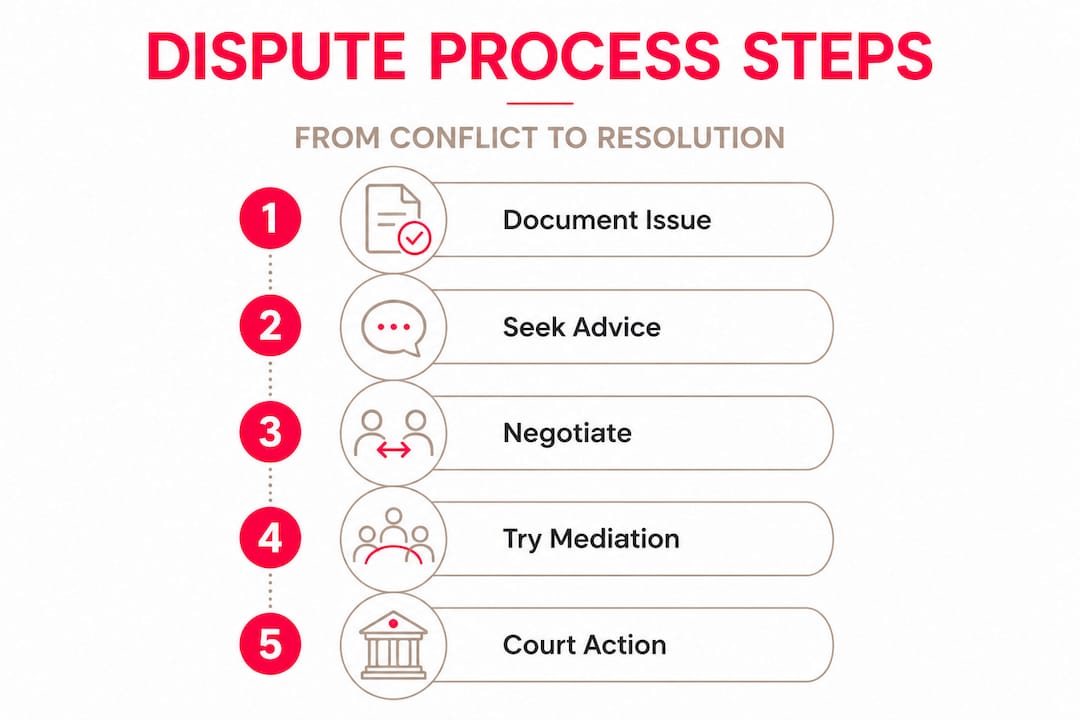
The practical resolution path for most UK homeowners is structured: evidence first, then negotiation, then ADR (particularly mediation), and only then specialist tribunal or court proceedings as a genuine last resort.
Having set the scene for the scope of property disputes, the next section examines how to move through the resolution pathway, step by step.
Step-by-step: How the property dispute process works
There is a clear sequence to property dispute resolution. Jumping ahead to litigation without working through earlier stages is expensive, damaging to relationships, and increasingly frowned upon by the courts themselves.
- Document the issue thoroughly. Write down dates, what was said, what you observed, and by whom. Begin this log immediately, even before you have spoken to a solicitor.
- Gather your evidence. Collect title documents, Land Registry records, old conveyances, photographs, letters, and any previous surveys. The more complete your evidence at the outset, the stronger your negotiating position.
- Attempt direct negotiation. Write a clear, civil letter to the other party setting out your position and what you would like to happen. Keep the tone factual. Avoid threats. Many disputes settle at this stage, particularly where both parties prefer a quiet resolution.
- Instruct a solicitor. If direct negotiation stalls, professional legal advice helps you understand your actual legal position (not just what you believe it to be), draft correspondence that protects your position, and advise on the most proportionate next step.
- Enter mediation or ADR. Alternative dispute resolution, known as ADR, covers mediation, early neutral evaluation, and similar processes. Courts expect parties to attempt this before commencing formal proceedings.
- Proceed to tribunal or court if necessary. For leasehold and service charge disputes, the First-tier Tribunal (Property Chamber) is the specialist route. For boundary and other civil property matters, the county court is the usual forum.
The following table gives you a quick comparison of resolution methods.
| Method | Typical cost | Timescale | Binding outcome | Relationship impact |
|---|---|---|---|---|
| Direct negotiation | Low | Weeks | No (unless formalised) | Minimal if civil |
| Mediation/ADR | Moderate | Weeks to months | No (unless agreed) | Generally preserved |
| First-tier Tribunal | Moderate | Several months | Yes | Moderate |
| County court | High | 9 to 57 weeks+ | Yes | Often damaged |
It is worth noting that pre-action steps and ADR engagement can materially affect both cost exposure and outcomes. Courts have the power to penalise parties who refuse to engage in appropriate dispute resolution without good reason, including by limiting their ability to recover legal costs even if they ultimately win.
For homeowners unsure about what the legal steps in home disputes look like in practice, reviewing the conveyancing process alongside dispute procedures gives a more complete picture of how property rights are established and defended.
Pro Tip: Keep every communication with the other party in writing, even if you have also spoken by phone. A written record shows courts and mediators that you acted reasonably and in good faith throughout.
Evidence and expert input: Why documentation and professional advice matter
In property disputes, the quality of your evidence often matters more than the strength of your conviction. You may be absolutely certain that the boundary has always run along the old stone wall. But certainty without documentation does not move a negotiation or persuade a tribunal.
The most useful types of evidence include:
- Title deeds and Land Registry plans, which establish the legal boundary (though note that Land Registry plans show general boundaries only, not precise legal lines)
- Historic conveyances, which may contain more specific boundary descriptions than modern title documents
- Physical markers, such as old walls, hedges, fences, and ditches, and evidence of how long they have been in place
- Photographs, dated and time-stamped where possible, showing the position of structures and the condition of boundaries over time
- Correspondence, including any letters, emails, or texts in which the other party acknowledges the boundary or makes relevant admissions
- Expert reports, particularly from a chartered surveyor who specialises in boundary matters
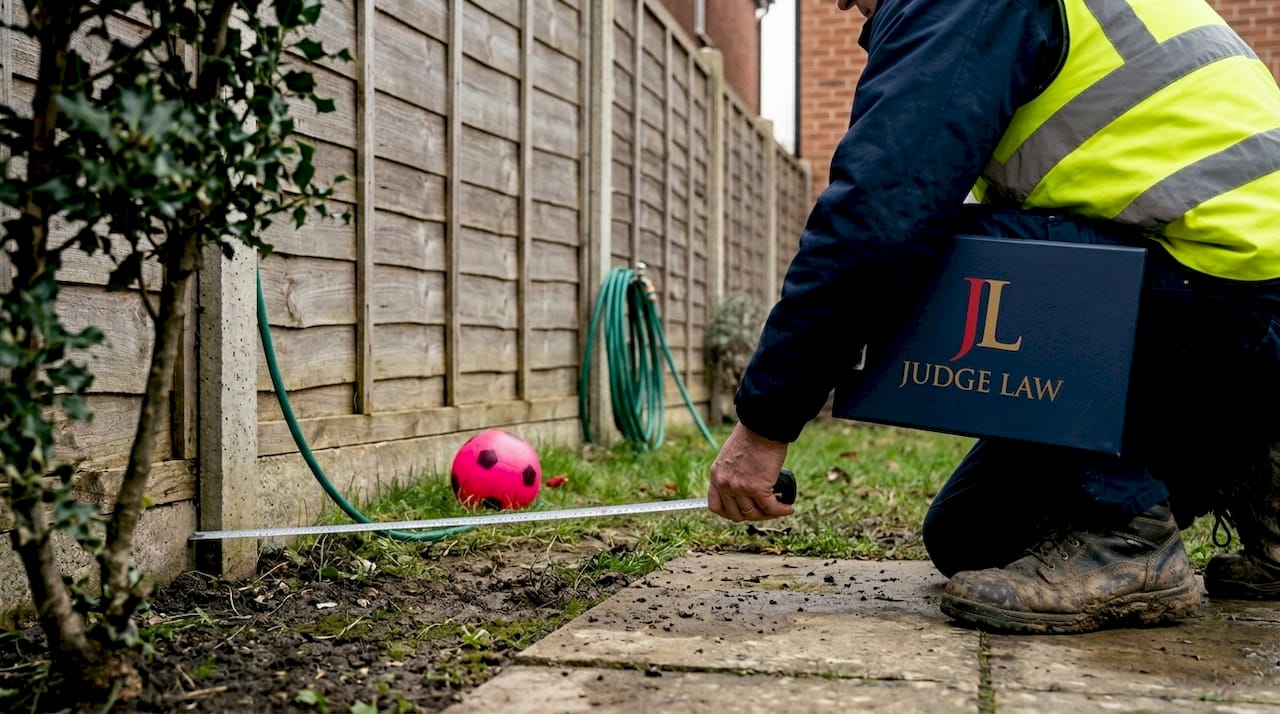
The point about chartered surveyors deserves emphasis. Boundary disputes often turn less on what the Land Registry title plan shows and more on historic conveyances, physical markers, and how the boundary has been treated over time. An independent surveyor’s report can shift the dynamic in negotiation considerably, because it introduces objective professional analysis where previously both parties were simply asserting their own account.
The same principle applies to financial and legal analysis in cases involving co-ownership or inheritance. Evidence of contribution, intention, and conduct becomes admissible in determining beneficial interests. This is explored further in guidance on evidence in asset disputes.
Pro Tip: Instruct an independent surveyor before entering formal negotiations. Their report does not just inform your legal team. It signals to the other party that you are serious, prepared, and willing to rely on objective evidence rather than personal assertion.
Once best practice for preparation is established, the next step is understanding how mediation and alternative dispute resolution can offer solutions before matters reach court.
Mediation and ADR: Why most property disputes settle before court
The majority of property disputes in the UK do not end in a courtroom. That is not wishful thinking. Mediation shows an aggregate settlement rate of 87% across property dispute categories, with a significant proportion resolving on the day of mediation itself.
The reasons for this are practical rather than idealistic. Mediation offers several genuine advantages over formal proceedings:
- Speed. A mediation session can be arranged within weeks. Court proceedings may take over a year to reach trial.
- Cost. Mediation fees, split between the parties, are a fraction of the combined legal costs generated by contested litigation.
- Confidentiality. What is said in mediation stays in mediation. Nothing disclosed during the process can be used against you in court.
- Control. In court, a judge imposes a decision. In mediation, any agreement is one both parties have actively chosen to accept.
- Relationship preservation. If you share a boundary with someone and intend to remain neighbours, preserving a workable relationship has real long-term value.
That said, mediation requires both parties to engage genuinely. It is not suitable where one party flatly refuses to participate, where the dispute involves conduct that requires a definitive legal ruling (fraud, for example), or where one party is so entrenched that no realistic compromise exists. In those situations, escalating to the First-tier Tribunal or county court is the appropriate step.
The trade-off between flexibility and finality is the honest framing here. Mediation gives flexibility; courts give finality. For many homeowners, flexibility and a faster resolution are the more valuable outcomes, especially when the alternative is eighteen months of litigation at significant personal and financial cost.
For an overview of settlement outcomes in civil disputes, or to understand how the benefits of family mediation translate across different legal contexts, those resources provide useful context.
Timelines, financial impact, and emotional support
Being realistic about how long a property dispute can take is not defeatism. It is sensible planning.
Official statistics for England and Wales show that the median time to trial for small claims is 36.1 weeks, while fast-track and multi-track cases take a median of 57.4 weeks. Those figures cover cases from issue to trial. Add pre-action correspondence, mediation attempts, and court listing delays, and the practical timeline from first formal step to final resolution can easily stretch beyond a year.
The financial picture is similarly sobering. Legal costs are substantial, and understanding the breakdown of solicitor costs before you commit to a course of action is essential. The Law Society’s benchmarking data shows that legal work carries significant overhead costs, which is why solicitor fees in contested disputes can accumulate quickly. Building a realistic financial reserve and agreeing a clear fee structure with your solicitor at the outset is not optional. It is protective. See Judge Law’s fee transparency page for how we approach costs.
The emotional dimension is real and frequently underestimated. A property dispute with a neighbour is not just a legal matter. It can affect your sense of security at home, your sleep, and your relationships. Practical tactics that help include:
- Planning your finances early so that unexpected legal costs do not cause panic
- Limiting your exposure to the dispute outside formal steps. Repeatedly discussing it with others rarely helps and sometimes worsens your stress
- Seeking emotional support from counselling services or trusted advisers, particularly if the dispute involves family members
- Using a McKenzie Friend if you attend any hearing without legal representation, as emotional and practical courtroom support is available even outside formal legal aid
For those experiencing the psychological weight of prolonged legal proceedings, dedicated guidance on coping with legal stress is worth reading before things escalate further.
Our perspective: What most guides overlook about property disputes
Most articles about property disputes focus on the legal steps. Fewer address the pattern that actually causes disputes to become painful and expensive. People escalate too quickly.
A solicitor’s letter before a genuine conversation has been attempted, a tribunal application before mediation has been offered, court proceedings before either party has clearly stated what they actually want. Each of those early escalations costs money, hardens positions, and makes a negotiated settlement less likely. Not impossible. Just harder.
The structured approach that consistently produces better outcomes is deceptively simple. Document everything from the start. Keep communications factual and civil. Escalate one step at a time, from direct conversation to solicitor involvement to mediation to formal proceedings, only moving to the next stage when the current one is genuinely exhausted.
What this approach protects is not just your money. It is the possibility of a workable outcome. Courts are binary. You win or you lose, and the losing party often feels aggrieved regardless of the legal merits. Mediation can produce arrangements that neither party would have thought of at the outset, creative solutions tailored to the actual relationship between the parties rather than the blunt instrument of a judicial determination.
Even if you are confident your legal position is strong, and even if you expect to win, mediation offers options that courts simply cannot provide. It is worth the time. It is almost always worth the money. And it preserves something that a court order cannot restore: the ability to live or work alongside the person you have been in dispute with, without residual bitterness hanging over every interaction.
For further guidance on how professional legal support fits into this approach, our property dispute guidance sets out the practical options at each stage.
Expert support for your property dispute journey
Property disputes rarely feel straightforward, and the earlier you get the right advice, the more options you have. At Judge Law, we work with homeowners at every stage of the process, whether that means reviewing your title documents before a conversation with your neighbour, advising on mediation strategy, or representing your interests in tribunal or court proceedings. Our conveyancing specialists can help establish your legal position from the outset, and our civil dispute resolution team handles the full range of property and boundary matters. If you are ready to understand your options clearly, get in touch with us for straightforward legal advice without the jargon.
Frequently asked questions
What is the difference between mediation and court in property disputes?
Mediation helps parties reach a mutually agreed settlement and is generally faster and more cost-effective, while a court or tribunal delivers a binding legal decision when agreement cannot be reached.
How long do property disputes usually take to resolve?
Mediation or direct negotiation can often resolve matters within weeks or a few months, but court cases may take between 36 and 57 weeks to reach trial in England and Wales.
What does ADR stand for and when should I consider it?
ADR stands for alternative dispute resolution, encompassing mediation and negotiation, and you should pursue it before issuing formal proceedings since courts expect it and refusing ADR without reason can affect cost recovery.
Are legal costs recoverable if I win my property dispute?
Cost recovery is not automatic, and courts may limit or refuse to award costs against the losing party if you bypassed mediation or acted unreasonably, making early ADR engagement a financially prudent step even when your position is strong.
What emotional support is available during property disputes?
You can access counselling, community support services, and practical courtroom assistance such as McKenzie Friends, with emotional and practical support available to help you manage the personal toll of prolonged legal proceedings.