
TL;DR:
- Employers in the UK must follow a fair reason, procedure, and notice to lawfully dismiss staff. Failure to do so exposes them to unfair dismissal claims at tribunal.
To lawfully terminate employment in the UK, you need a fair reason, a fair procedure that follows the Acas Code of Practice on disciplinary and grievance procedures, and the correct notice or payment in lieu. Get any one of those wrong and you are exposed to an unfair dismissal claim at the Employment Tribunal.
This employment termination guide covers every stage of the process, from identifying a lawful reason to issuing the final outcome letter, with statutory references, practical checklists, and the Employment Rights Act 2025 changes every employer needs to watch before January 2027.
Non-negotiable elements of a lawful dismissal:
- A valid, documented reason falling within the five fair categories
- A reasonable investigation before any decision is made
- A formal meeting at which the employee can respond
- The right to be accompanied and the right to appeal
- Correct statutory or contractual notice, or a valid payment in lieu
Pro Tip: Keep a contemporaneous written record of every decision point, including why you chose not to take a particular step. Tribunals look at the reasoning behind the process, not just the outcome. A well-documented “we considered X and decided Y because Z” is far more defensible than a clean outcome letter with no paper trail behind it.
Table of Contents
- What counts as a dismissal and what are the lawful reasons?
- What are the notice period rules and how is notice pay calculated?
- When is summary dismissal lawful?
- How do you run a fair redundancy process?
- Written reasons, settlement agreements and what records to keep
- What is the difference between unfair, wrongful and constructive dismissal?
- Practical HR checklist to reduce tribunal risk
- What do the Employment Rights Act 2025 changes mean for you?
- When should you instruct a solicitor?
- How Judgelaw can help with employment terminations
- Authoritative sources and further reading
- FAQ
What counts as a dismissal and what are the lawful reasons?
A dismissal occurs when an employer terminates a contract of employment, with or without notice, or when a fixed-term contract expires without renewal. It also arises in constructive dismissal, where an employee resigns in response to a fundamental breach of contract by the employer. The legal framework for all three sits primarily in the Employment Rights Act 1996.
GOV.UK’s guidance on fair dismissals sets out the five potentially fair reasons a tribunal will recognise.
| Fair reason | What it covers |
|---|---|
| Capability | Poor performance or ill health preventing the employee from doing the job |
| Conduct | Misconduct, including repeated minor breaches or a single act of gross misconduct |
| Redundancy | The role genuinely ceases to exist or the need for it diminishes |
| Statutory restriction | Continuing employment would break the law, such as a driver losing their licence |
| Some other substantial reason (SOSR) | A catch-all for genuine business reasons not covered above, such as a business reorganisation |
Having a reason in one of these categories is necessary, but not sufficient. Tribunals apply a two-stage test: first, did the employer genuinely believe the reason existed? Second, did the employer act reasonably in treating it as sufficient to justify dismissal? The second question is where most employers lose cases. Reasonableness is assessed against the range of responses open to a reasonable employer, not against what a tribunal would have done itself.
A dismissal may be for a potentially fair reason and still be unfair if the employer’s procedure was inadequate, the investigation was superficial, or the sanction was disproportionate to the conduct found proved.
A capability dismissal for long-term sickness absence, for example, requires medical evidence, a genuine attempt to accommodate the employee, and a clear warning that dismissal is being considered before any decision is taken. A conduct dismissal for a single incident of dishonesty requires an investigation that establishes the facts, a disciplinary hearing, and a proportionate response. The reason alone does not carry the case.
What are the notice period rules and how is notice pay calculated?
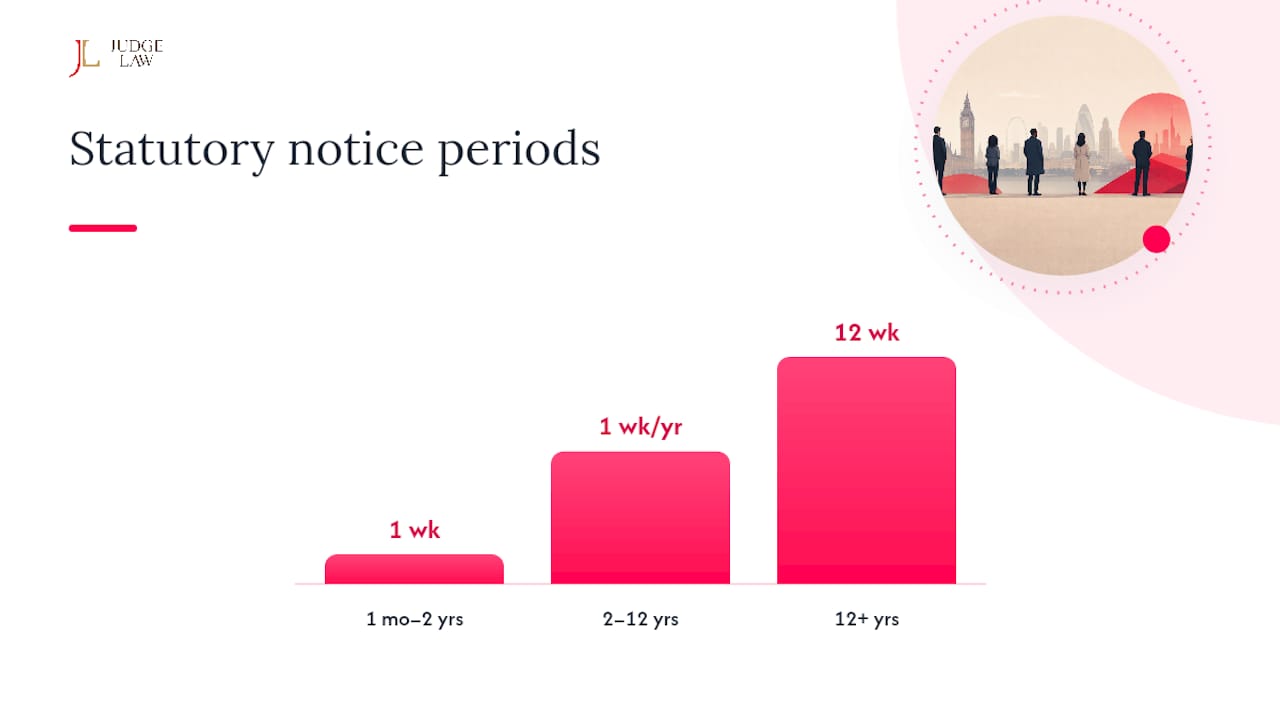
Check the employment contract first. If the contract gives a longer notice period than the statutory minimum, the contractual period applies. The statutory minimums under section 86 of the Employment Rights Act 1996 are the floor, not the ceiling.
Statutory minimum notice periods:
| Length of continuous employment | Minimum notice |
|---|---|
| One month to two years | One week |
| Two years to twelve years | One week per complete year of service |
| Twelve years or more | Twelve weeks |
Notice pay is calculated on the employee’s average weekly pay, including regular overtime and contractual allowances, based on the 12 weeks immediately before the notice period begins. Where pay varies, take the average over those 12 weeks.
Payment in lieu of notice (PILON) allows you to end employment immediately by paying the employee the wages they would have earned during the notice period, rather than requiring them to work it. PILON is only contractually valid if the contract contains a PILON clause. Without one, paying in lieu is technically a breach of contract, though it is a breach the employee will usually accept. Acas guidance on notice periods explains how contractual and statutory notice interact and when exceptions apply.
Worked example. An employee with several years’ service earning a fixed weekly amount is entitled to statutory notice pay calculated by multiplying their weekly pay by their statutory notice period. If the contract provides for a longer notice period, the contractual entitlement applies instead.
Post-April 2018, all PILON payments are subject to income tax and National Insurance regardless of whether a PILON clause exists in the contract.
When is summary dismissal lawful?
Summary dismissal, meaning dismissal without notice, is only lawful where the employee has committed an act of gross misconduct. Even then, you must still follow a fair procedure before dismissing. The absence of notice does not mean the absence of process.
Common examples of gross misconduct:
- Theft, fraud or deliberate falsification of records
- Physical violence or serious threats of violence
- Serious harassment or discrimination
- Deliberate destruction of company property
- Serious breach of confidentiality
- Being under the influence of alcohol or drugs at work where safety is at risk
The edge cases are where employers get into trouble. An employee arriving slightly late after a work social event is not the same as an employee operating machinery while intoxicated. The label “gross misconduct” in a policy does not automatically make a dismissal fair. Tribunals look at whether the conduct genuinely fell within that category and whether dismissal was within the band of reasonable responses.
Gross misconduct justifies dismissal without notice, but it does not justify dismissal without an investigation. Skipping the disciplinary process because the conduct seems obvious is one of the most reliable ways to convert a defensible dismissal into an unfair one.
If you dismiss without following procedure, the employee can bring a wrongful dismissal claim for the notice pay they lost, regardless of length of service. Unfair dismissal requires qualifying service, but wrongful dismissal does not.
Pro Tip: Preserve evidence immediately. Secure CCTV footage, system access logs, emails, and witness statements before they are overwritten or memories fade. A well-evidenced investigation file is your strongest protection if the dismissal is challenged.
How do you run a fair redundancy process?
Redundancy must be genuine. The role must genuinely cease to exist or reduce in requirement. Using redundancy as a pretext to remove a specific individual is automatically unfair dismissal.
Step-by-step redundancy process:
- Identify the pool for selection. Define which roles or functions are affected. The pool must be logical and defensible.
- Establish objective selection criteria. Use measurable, documented criteria applied consistently across the pool.
- Consult individually. Meaningful consultation must happen before any final decision. Employees must have a genuine opportunity to challenge the selection and propose alternatives.
- Collective consultation. Where 20 or more redundancies are proposed within 90 days at one establishment, collective consultation with elected representatives is required under the Trade Union and Labour Relations (Consolidation) Act 1992, with a minimum 30-day consultation period (45 days for 100 or more).
- Consider alternative roles. You must make reasonable efforts to redeploy affected employees into suitable alternative positions before confirming redundancy.
- Confirm in writing. Issue a redundancy notice with the reason, notice period, redundancy pay calculation, and appeal rights.
Selection matrix: generic scoring categories
| Criterion | Weighting | Notes |
|---|---|---|
| Skills and qualifications | High | Objectively assessed against role requirements |
| Performance record | High | Based on documented appraisals and output |
| Attendance record | Medium | Exclude disability-related absences to avoid discrimination |
| Disciplinary record | Medium | Live warnings only; spent warnings should not count |
| Length of service | Low | Can be used but should not dominate to avoid age discrimination |
Statutory redundancy pay is calculated using a formula based on age, weekly pay (capped at the statutory weekly pay cap, which GOV.UK updates annually), and length of service. Use the GOV.UK redundancy pay calculator to produce an accurate figure for each affected employee.
Key records to keep throughout the process:
- Pool definition and rationale
- Selection scoring sheets for each individual
- Consultation meeting notes
- Written offers of alternative employment and responses
- Final redundancy notices
Written reasons, settlement agreements and what records to keep
Employees who meet the current qualifying period can request a written statement of reasons for their dismissal, and you must provide it within 14 days. Pregnant employees and those on maternity, adoption or shared parental leave are entitled to written reasons automatically, regardless of service length. The Employment Rights Act 2025 will change the qualifying period for written reasons in line with the broader qualifying period reforms, so watch for commencement regulations.
Written reasons should be clear, honest, and consistent with the reason you relied on at the disciplinary hearing. Inconsistency between the verbal explanation at the meeting and the written reasons is a red flag tribunals notice.
When to use a settlement agreement. A settlement agreement is a legally binding contract under which an employee agrees to waive employment claims in exchange for a financial payment and, usually, an agreed reference. It is appropriate where the relationship has broken down, where a dismissal carries litigation risk, or where both parties want a clean exit. The employee must receive independent legal advice before signing, and the agreement must be in writing.
Documents to retain after every dismissal:
- The original investigation notes and evidence gathered
- Invitation letters to disciplinary and appeal hearings
- Minutes or notes of every meeting
- The outcome letter and any appeal outcome
- The written statement of reasons (if requested)
- Payroll records showing notice pay or PILON calculation
- The signed settlement agreement, if applicable
Guidance on garden leave, PILON and settlement agreements covers the practical interaction between these elements in more detail.
Pro Tip: Use version-controlled document templates for outcome letters and keep all dismissal-related correspondence in a single, secure HR file. If a claim is brought two years later, you need to be able to reconstruct the entire process from the file alone. Verbal recollections are unreliable and carry no weight at tribunal.
Employees with the qualifying period can request written reasons for dismissal; employers who fail to provide them without a reasonable excuse risk a tribunal awarding two weeks’ pay as a penalty.
What is the difference between unfair, wrongful and constructive dismissal?
These three claims are distinct, and confusing them is a common and costly mistake.
Unfair dismissal arises where an employer dismisses without a fair reason or without following a fair procedure. It requires qualifying service, currently two years. Under the Employment Rights Act 2025 reforms, that qualifying period will reduce to six months, with commencement intended from 1 January 2027. The same reforms remove the cap on compensatory awards, which currently stands at the lower of one year’s pay or the statutory cap. Removing the cap materially increases the financial exposure for employers who dismiss unfairly.
Wrongful dismissal is a breach of contract claim. It arises where an employer dismisses without giving the contractual or statutory notice period, or without a PILON clause to justify immediate termination. It does not require qualifying service and can be brought from day one of employment. The remedy is the wages lost during the notice period.
Constructive dismissal occurs when an employee resigns in response to a fundamental breach of contract by the employer, such as a unilateral pay cut, persistent bullying, or a significant change to duties without agreement. The employee must resign promptly after the breach; delay can be treated as acceptance of the new terms. Constructive dismissal claims require the same qualifying service as ordinary unfair dismissal.
Automatically unfair dismissal applies where the reason relates to a protected characteristic, pregnancy, whistleblowing, trade union activities, or asserting a statutory right. No qualifying service is required for these claims, which means an employee dismissed on their first day can bring a claim if the reason falls within an automatically unfair category.
Acas guidance on unfair dismissal lists the full range of automatically unfair reasons and explains the appeal process available to employees.
Tribunal time limits and key stages:
- The employee must submit an Early Conciliation notification to Acas before issuing a tribunal claim. This pauses the time limit.
- The standard time limit for unfair and constructive dismissal claims is three months less one day from the effective date of termination.
- Wrongful dismissal claims in the Employment Tribunal carry the same three-month time limit.
- Following Early Conciliation, the tribunal claim must be submitted within the extended window Acas provides.
- Tribunal hearings for straightforward unfair dismissal cases typically take place six to twelve months after the claim is submitted, though complex cases take longer.
For a fuller explanation of how the tribunal process works, the UK tribunals explained guide sets out the stages and evidence standards in plain terms.
Practical HR checklist to reduce tribunal risk
Follow this checklist for every dismissal, regardless of the reason. Skipping steps because a case seems clear-cut is where employers create avoidable exposure.
Dismissal process checklist:
- Confirm the reason for dismissal falls within a recognised fair category.
- Carry out a reasonable investigation proportionate to the seriousness of the allegation.
- If suspending, confirm it is on full pay and issue a suspension letter the same day.
- Send a written invitation to the disciplinary hearing with at least 48 hours’ notice, stating the allegation, potential outcomes, and the right to be accompanied.
- Hold the hearing, allow the employee to respond, and take notes or arrange for a note-taker.
- Adjourn before deciding. Do not announce the outcome at the hearing.
- Issue the outcome letter in writing, including the reason, the sanction, and the appeal procedure.
- Hear any appeal within a reasonable timeframe, using a different decision-maker where possible.
- Calculate and pay the correct notice pay or PILON, and issue a P45.
- Retain the complete HR file securely for a minimum of six years.
Document retention guide:
| Document | Minimum retention period |
|---|---|
| Investigation notes and evidence | 6 years from dismissal date |
| Disciplinary hearing minutes | 6 years from dismissal date |
| Outcome and appeal letters | 6 years from dismissal date |
| Payroll and notice pay records | 6 years (HMRC requirement) |
| Settlement agreements | 6 years from date of signing |
| Written reasons for dismissal | 6 years from dismissal date |

Pro Tip: Assign a named HR lead to every dismissal process and log every action with a date and the name of the person who took it. If the case reaches tribunal, you need to show not just what was done but who decided it and when. A digital HR system with an audit trail is far more reliable than a shared folder of undated Word documents.
What do the Employment Rights Act 2025 changes mean for you?
The Employment Rights Act 2025 represents the most significant shift in UK employment law for a generation. For employers managing terminations, three changes matter most.
First, the qualifying period for ordinary unfair dismissal will fall from two years to six months. From 1 January 2027, an employee dismissed after just six months of service will be able to bring an unfair dismissal claim. That means the window during which you can dismiss without procedural risk shrinks dramatically.
Second, the cap on compensatory awards in unfair dismissal cases will be removed. Currently, the compensatory element is capped at the lower of one year’s gross pay or the statutory cap. Removing that ceiling means high-earning employees dismissed unfairly could recover substantially more than under the current regime.
Third, the qualifying period for the right to receive written reasons for dismissal will also change in line with the broader reforms.
The Employment Rights Act 2025 will reduce the qualifying period for unfair dismissal to six months and remove the cap on compensatory awards, with commencement intended from 1 January 2027. Employers who rely on the two-year qualifying period as a safety net need to change their approach before that date.
Practical actions to take now:
- Review and update your disciplinary and capability policies to reflect the shorter qualifying period.
- Introduce structured probationary review processes with documented assessments at one, three, and five months.
- Train line managers on fair procedure from the start of employment, not just after the two-year mark.
- Audit your settlement agreement templates to ensure they reflect the updated compensatory award position.
- Review your HR file management to confirm you can reconstruct any dismissal process from documentation alone.
The GOV.UK unfair dismissal factsheet sets out the full scope of the reforms and the intended commencement timetable. Commencement regulations have not yet been made, so monitor GOV.UK for updates.
When should you instruct a solicitor?
Most straightforward dismissals, a single employee, a clear conduct reason, a documented process, can be managed competently in-house with the Acas Code as your guide. The cases where legal input pays for itself are the ones where the stakes are higher or the facts are less clean.
Instruct a solicitor when:
- The employee has raised a grievance alleging discrimination, harassment, or whistleblowing, whether before or during the disciplinary process
- The dismissal involves a protected characteristic, pregnancy, or maternity leave
- You are proposing collective redundancies involving 20 or more employees
- The employee is a senior executive with a high-value contract and significant notice entitlements
- A settlement agreement is being used and you want to ensure it is watertight
- You have received a tribunal claim or an Early Conciliation notification from Acas
- The disciplinary process has been running for several months and the facts are disputed
Early instruction is almost always cheaper than late instruction. A solicitor reviewing your process before the outcome letter is issued can identify procedural gaps that, left uncorrected, become the grounds for a successful tribunal claim. By the time a claim is issued, the process is fixed and the options narrow.
What to have ready when you call: the employment contract, the investigation file, all correspondence with the employee, the disciplinary hearing notes, and a clear timeline of events. The more organised your file, the faster and more cost-effective the advice.
Judgelaw’s employment law solicitors for businesses team advises employers on dismissal procedures, settlement negotiations, and tribunal representation. The firm is regulated by the Solicitors Regulation Authority (SRA 634380).
How Judgelaw can help with employment terminations
Terminating employment carries real legal and financial risk, particularly with the Employment Rights Act 2025 changes approaching. Judgelaw’s employment law team works with employers to review disciplinary processes before decisions are made, draft settlement agreements that hold up, and represent businesses at the Employment Tribunal when claims are brought.
The firm is SRA-regulated (registration number 634380) and advises on a fixed-fee or hourly basis depending on the scope of the matter. There are no no-win-no-fee arrangements and no Legal Aid for employer-side work.
If you are managing a dismissal, facing a tribunal claim, or preparing your policies for the 2027 changes, get in touch to discuss your situation.
Authoritative sources and further reading
The guidance in this article draws on the following primary and statutory sources. Each is worth bookmarking if you manage employment terminations regularly.
- Acas code of practice on disciplinary and grievance procedures
- Dismissing staff: Fair dismissals – GOV.UK
- Factsheet: Unfair Dismissal
- Employment Rights Act 1996, section 86
- Dismissal or redundancy – Notice periods – Acas
- Dismissal: your rights: What to do if you’re dismissed – GOV.UK
- Step 2: Following a fair procedure – Disciplinary procedure – Acas
- Unfair dismissal – Dismissals – Acas
Judgelaw is regulated by the Solicitors Regulation Authority (SRA 634380). This article provides general legal information, not advice tailored to your specific situation. Employment law turns on the precise facts of each case, and you should take professional advice before making any dismissal decision where the circumstances are complex or the risk is significant.
FAQ
What are the rules for terminating employment in the UK?
A lawful termination requires a fair reason within the five statutory categories (conduct, capability, redundancy, statutory restriction, or some other substantial reason), a fair procedure consistent with the Acas Code, and the correct statutory or contractual notice. Failure on any of these grounds can result in an unfair dismissal claim at the Employment Tribunal.
What are the five fair reasons for dismissal?
The Employment Rights Act 1996 recognises five potentially fair reasons: capability (including performance and ill health), conduct, redundancy, statutory restriction, and some other substantial reason. Having a reason in one of these categories is necessary but not sufficient; the employer must also have acted reasonably in treating it as grounds for dismissal.
How do you terminate a difficult employee fairly?
Follow the Acas Code regardless of how clear-cut the situation appears. Investigate the facts, invite the employee to a formal meeting with the right to be accompanied, allow them to respond, consider the response before deciding, and offer a right of appeal. Document every step. The process protects you if the dismissal is challenged, and skipping steps because the conduct seems obvious is one of the most common causes of avoidable tribunal claims.
What is the time limit for bringing an unfair dismissal claim?
An employee must notify Acas for Early Conciliation within three months less one day of the effective date of termination. The clock pauses during the Early Conciliation period. If conciliation does not resolve the matter, the employee has a further window to submit a tribunal claim. Under the Employment Rights Act 2025, the qualifying period for unfair dismissal will reduce from two years to six months, with commencement intended from 1 January 2027.
Do you always have to give notice when dismissing an employee?
Not in every case. Summary dismissal without notice is lawful where an employee has committed an act of gross misconduct, but a fair disciplinary procedure must still be followed before the decision is made. In all other dismissals, the employee is entitled to their contractual notice period or the statutory minimum under the Employment Rights Act 1996, whichever is greater. Payment in lieu of notice is valid where the contract contains a PILON clause, or where the employee accepts it.
Recommended
- UK employment rights: Know your protections from day one
- UK Sponsor Licence for Employers: 2026 Hiring Guide
- Exercising Your Break Clause in 2026: A Survival Guide for UK Retail Tenants | Judge Law
- Side Hustles & Second Jobs: UK Employment Law Guide 2026
Need Advice on Employment Termination?
Dismissing an employee carries significant legal and reputational risk. Our employment law team can review your process, advise on compliance, and help you navigate tribunal claims if they arise.