
TL;DR
- Under the Late Payment of Commercial Debts (Interest) Act 1998 you can claim statutory interest at 8% above Bank of England base rate (11.75% a year at present) on overdue business invoices.
- You can also claim fixed compensation of £40, £70 or £100 per invoice, depending on its size.
- Send a Letter Before Action before issuing a claim, allowing 30 days to reply if the debtor is an individual or sole trader.
- Claims up to £10,000 usually go through the small claims track, with court fees from £35 to £455.
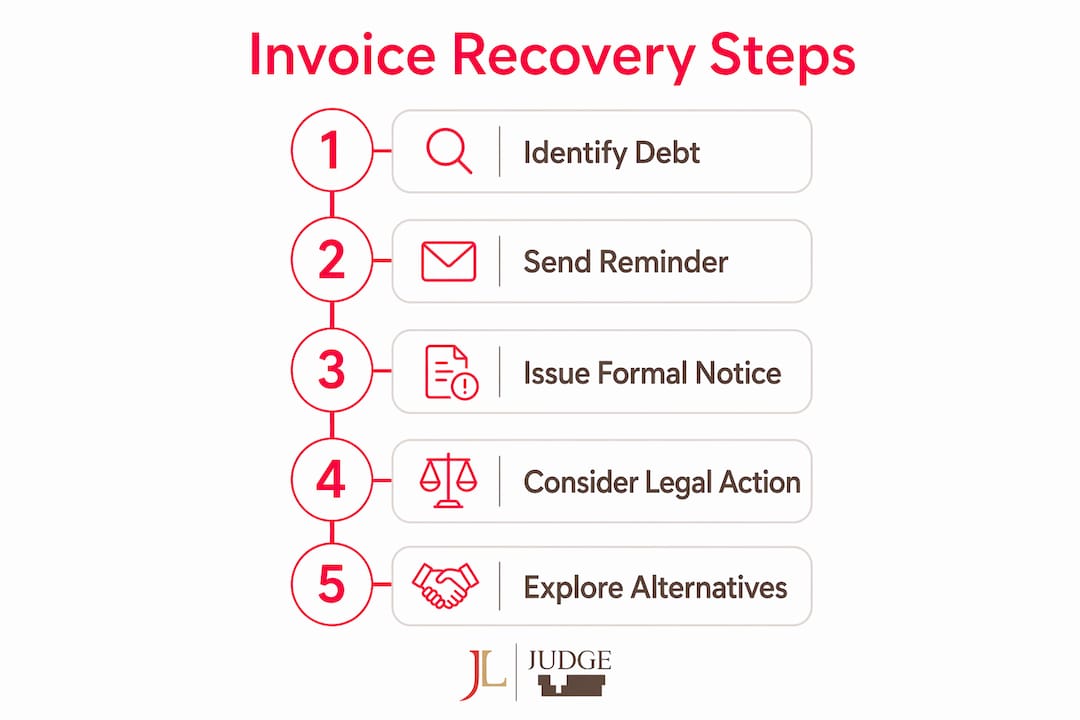
Recovering unpaid invoices in the UK is a legal right, not a favour you are asking for. Under the Late Payment of Commercial Debts (Interest) Act 1998, UK businesses can claim statutory interest and fixed recovery costs on overdue invoices without going to court. The process of debt recovery, as solicitors term it, follows a clear sequence: structured reminders, a formal Letter Before Action, and if necessary, proceedings through the Small Claims Court for debts under £10,000. This guide sets out each step so you know exactly where you stand and what to do next.
What legal rights do UK businesses have to recover unpaid invoices?
UK law gives you more leverage than most small business owners realise. The Late Payment of Commercial Debts (Interest) Act 1998 entitles you to claim statutory interest at 8% plus the Bank of England base rate, which is 11.75% a year (simple interest) for debts that fall overdue between 1 July and 31 December 2026, on any overdue commercial invoice. That is not a penalty you need to justify. It is a legal entitlement, and claiming it is increasingly viewed as a professional standard in UK business payments.
Beyond interest, you can recover fixed compensation costs ranging from £40 to £100 depending on the invoice amount, again without a court order. These rights apply to invoices up to six years old in England, Wales, and Northern Ireland. The table below summarises what you can claim.
| Invoice Amount | Fixed Compensation | Statutory Interest Rate |
|---|---|---|
| Up to £999 | £40 | 8% + Bank of England base rate |
| £1,000 to £9,999 | £70 | 8% + Bank of England base rate |
| £10,000 and above | £100 | 8% + Bank of England base rate |
Before issuing court proceedings, you must send a Letter Before Action. This is a formal written notice giving the debtor a final opportunity to pay, typically within 14 days where the debtor is a business. If the debtor is an individual or sole trader, the Pre-Action Protocol for Debt Claims applies and you must allow 30 days for a reply. Courts expect to see one. Skipping it can result in cost penalties against you, even if you win. For debts under £10,000, the Small Claims Court is the appropriate venue, with court fees starting at £35 and rising to £455 depending on the claim size. Those fees are usually recoverable as part of the judgment debt.
Key rights at a glance:
- Statutory interest at 8% above base rate (11.75% a year at present) on overdue commercial invoices
- Fixed compensation of £40 to £100 per invoice
- Letter Before Action as a legal prerequisite before court
- Small Claims Court for debts under £10,000 via the Money Claims Online portal
- Claims on invoices up to six years old
How should you chase unpaid invoices without damaging the relationship?
The most effective approach treats a missed payment as an oversight until the evidence says otherwise. Polite first reminders with the invoice attached tend to work better than vague check-ins. Clients are more likely to act when you make it easy, not when you make them feel accused.
A structured escalation timeline removes the guesswork and keeps you in control.
- Day 1 (due date passed). Send a polite email confirming the invoice is now due. Attach the invoice and include a direct payment link if you use one. Keep the tone friendly and assume the delay is an oversight.
- Day 7. Follow up by phone. A brief, professional call is far more effective than a second email at this stage.
- Day 14. Send a firmer written reminder. Reference the original invoice number, the amount outstanding, and the date it was due. Mention that statutory interest is accruing.
- Day 30. Issue a formal notice of intent to claim statutory interest and fixed costs. Keep the language factual, not personal.
- Day 45. Send the Letter Before Action. State clearly that court proceedings will follow within 14 days if payment is not received.
Pro Tip: Keep every reminder, reply, and payment promise within a single email thread. A continuous thread prevents the debtor from claiming they missed a message and gives you a clean, chronological record if the matter reaches court.
It helps to set out clear escalation policies in your contracts from the outset. When clients know in advance that late fees apply as standard, the conversation shifts from personal to procedural. That framing preserves the relationship far better than an ad hoc demand ever will.

When and how to escalate to legal action for unpaid invoices
Legal action is appropriate when a debtor has ignored your Letter Before Action or has disputed the debt without reasonable grounds. Before you file anything, pause and verify the debt. Missing purchase orders or delivery disputes can cause court claims to be dismissed or stalled, wasting both time and court fees. Confirm the invoice is accurate, the goods or services were delivered, and no genuine dispute exists.
Once you are satisfied the debt is valid, the process runs as follows.
- File your claim online. Use the Money Claims Online portal at gov.uk. You will need the debtor’s full name and address, the amount owed, and a brief description of the debt.
- Pay the court fee. Fees range from £35 for claims of £300 or less to £455 for claims between £5,000.01 and £10,000. These are added to the judgment debt if you win.
- Serve the claim. The court serves the claim form on the defendant. They have 14 days to respond.
- Await the response. If the defendant does not respond, you can apply for a default judgment. If they dispute a claim of £10,000 or less, you will both be told to attend a free telephone mediation appointment with the Small Claims Mediation Service, and if that does not settle the dispute, the court will list a hearing.
- Attend the hearing. Small claims hearings are informal. Bring all correspondence, the original contract or agreement, the invoice, and proof of delivery.
If judgment is granted and the debtor still does not pay, enforcement options include a warrant of control (bailiffs), a charging order on property, or an attachment of earnings order. For a full breakdown of the small claims process and enforcement steps, Judge Law’s dedicated guide covers each stage in detail.
Evidence to prepare before filing:
- The original invoice and any supporting contract or purchase order
- All email correspondence and call records
- Proof of delivery or completion of services
- Your Letter Before Action and any response received
- A record of any payment promises made and broken
What are the alternatives when invoices remain unpaid?
Court is not always the right answer, particularly when cash flow is the immediate problem. Spot invoice factoring lets you sell a single unpaid invoice to a specialist provider, receiving an advance of a large part of the invoice value, often within days. The provider then collects the debt directly from your client. You receive the remaining balance, minus the provider’s fee, once the client pays.
Factoring works best in specific circumstances. It suits invoices over £5,000 where the client is likely to pay eventually but slowly, and where preserving the commercial relationship matters. It is less suited to disputed invoices or clients with a history of non-payment, since providers assess the creditworthiness of your debtor before agreeing to purchase.
| Option | Speed | Cost | Best For |
|---|---|---|---|
| Spot factoring | Usually days | Provider fee (varies) | Invoices over £5,000, relationship worth keeping |
| Small Claims Court | Weeks to months | £35 to £455 court fee | Debts under £10,000, clear liability |
| Solicitor-led recovery | Variable | Legal fees apply | Complex disputes, larger debts |
| Debt sale | Fast | Discounted invoice value | Writing off difficult debts quickly |
Trade credit insurance is worth considering if late payment is a recurring problem in your sector. It covers a percentage of the invoice value if a client becomes insolvent or defaults. The premium is typically a small percentage of your annual insured turnover. It will not recover an existing unpaid invoice, but it protects future ones.
Practical points from our work on invoice recovery
In our work, the most common mistake we see is businesses rushing to send a formal demand before they have checked the basics. Is the invoice addressed to the right entity? Was a purchase order required and not obtained? Was the work signed off? These are not minor details. A court will ask all of them, and a defendant’s solicitor will raise every one if the answer is no.
The second mistake is softening the tone after a client promises to pay. If a client gives you a confirmed payment date and misses it, restart escalation immediately at the next firm step. Do not revert to a friendly reminder. That pattern teaches the client that promises carry no consequence, and the cycle repeats. Predictability on your part creates predictability on theirs.
Documentation is not bureaucracy. It is protection. Every phone call should be followed by a brief email confirming what was discussed. Every payment promise should be recorded in writing. Businesses that keep clean records are in a much stronger position if a debt is disputed or reaches court.
The UK debt collection law framework gives you real tools. Use them methodically, not reactively.
FAQ
What is the statutory interest rate on unpaid invoices in the UK?
The statutory interest rate is 8% plus the Bank of England base rate, which is 11.75% a year for debts falling overdue between 1 July and 31 December 2026, under the Late Payment of Commercial Debts (Interest) Act 1998. You can claim this without a court order.
How much does it cost to take an unpaid invoice to the small claims court?
Court fees start at £35 for claims of £300 or less and rise to £455 for claims between £5,000.01 and £10,000. These fees are usually added to the judgment debt if the court finds in your favour.
Do I need a solicitor to recover an unpaid invoice?
Not always. For straightforward debts under £10,000, you can file through the Money Claims Online portal without legal representation. A solicitor becomes valuable when the debt is disputed, the amount is significant, or enforcement action is needed after judgment.
What is a letter before action and is it required?
A Letter Before Action is a formal written notice giving the debtor a final opportunity to pay, typically within 14 days (30 days if the debtor is an individual or sole trader), before court proceedings begin. Courts expect to see one, and failing to send it can result in cost penalties against you even if you win the case.
How long do I have to claim an unpaid invoice in England?
You have up to six years from the date the debt became due to bring a claim in England and Wales. Statutory interest and fixed compensation costs can also be claimed on invoices within this period.