

Your solicitor orders the searches. That is the first thing to know. For a standard mortgage purchase, the searches you cannot skip are the local authority search (forms LLC1 and CON29), the environmental search covering flood risk and contaminated land, the water and drainage search, and a land registry title check. According to MoneySuperMarket, searches typically take some weeks to complete and your lender will require them before releasing funds. Budget roughly a few hundred pounds for a standard search pack, though costs vary by council and provider.
The single most effective step you can take right now is to tell your solicitor to order the local authority and drainage searches as soon as your mortgage offer is confirmed. Delays at the council are the most common reason searches hold up exchange.
To get started, your solicitor will need:
- The full property address or, preferably, the title number from HM Land Registry
- Your mortgage offer details and lender’s name
- Confirmation of the agreed purchase price
What is a conveyancing search, and how does it differ from a survey?
Conveyancing
Get an instant conveyancing quote
See your fixed-fee legal costs and Stamp Duty on screen in about a minute, with the full breakdown emailed to you. No obligation.
A conveyancing search is a formal enquiry made to a public authority or regulated data provider. It produces a written report on legal, environmental, or infrastructure matters that affect the property but are invisible to the naked eye. Your solicitor requests these reports on your behalf; the results come from councils, utility companies, and HM Land Registry rather than from a physical inspection of the building.
A survey, by contrast, is a physical assessment of the structure. A surveyor visits the property and reports on its condition, defects, and value. The two serve entirely different purposes and neither replaces the other.
| Conveyancing search | Survey | |
|---|---|---|
| Purpose | Legal, environmental and infrastructure risks | Structural condition and valuation |
| Who orders it | Your solicitor or licensed conveyancer | You, directly or via your lender |
| Required by lenders | Yes, for mortgage buyers | Lenders require a basic valuation; a full survey is your choice |
| Typical turnaround | 2–6 weeks | 1–2 weeks |
Mortgage lenders insist on searches before they will release funds. Cash buyers can legally complete without them, but doing so means accepting the risk that planning restrictions, contaminated land, or private drainage issues remain undisclosed and could affect the property’s future value or usability.
The main searches you will be asked to complete and what each covers
Your solicitor will recommend a core set of searches for almost every purchase, plus additional searches depending on the property’s location and history.
-
Local authority search (LLC1 and CON29). The LLC1 reveals entries on the local land charges register: financial charges, tree preservation orders, conservation area designations, and listed building status. The CON29 covers planning decisions, road adoption, and proposed schemes affecting the property. Gov confirms that your legal representative organises this search. Order it for every purchase.
-
Environmental search. Checks flood risk, proximity to contaminated land, ground stability, and radon levels. Particularly relevant if the property is near a river, on former industrial land, or in an area flagged by the Environment Agency’s flood maps. Required by most mortgage lenders.
-
Water and drainage search. Confirms whether the property is connected to the public sewer, whether any public sewer runs beneath the land (which can restrict building works), and who is responsible for maintenance. Order this for every purchase.
-
Land registry title check. Verifies ownership, existing charges, and any restrictions or covenants registered against the title. You can view basic title information via HM Land Registry’s property search service. Your solicitor will obtain official copies of the register and title plan.
-
Mining search. Relevant in areas with a history of coal, tin, or brine extraction. Your solicitor will advise whether the property’s location warrants one.
-
Chancel repair search. Checks whether the property sits within a historic parish boundary that could make the owner liable to contribute to church repairs. The risk is low but the liability can be significant; indemnity insurance is the usual remedy.
Lenders typically insist on the local authority, environmental, and drainage searches as a minimum. Mining and chancel searches are location-specific and your solicitor will advise based on the property’s postcode.
Official searches, personal searches, and what the difference means for you
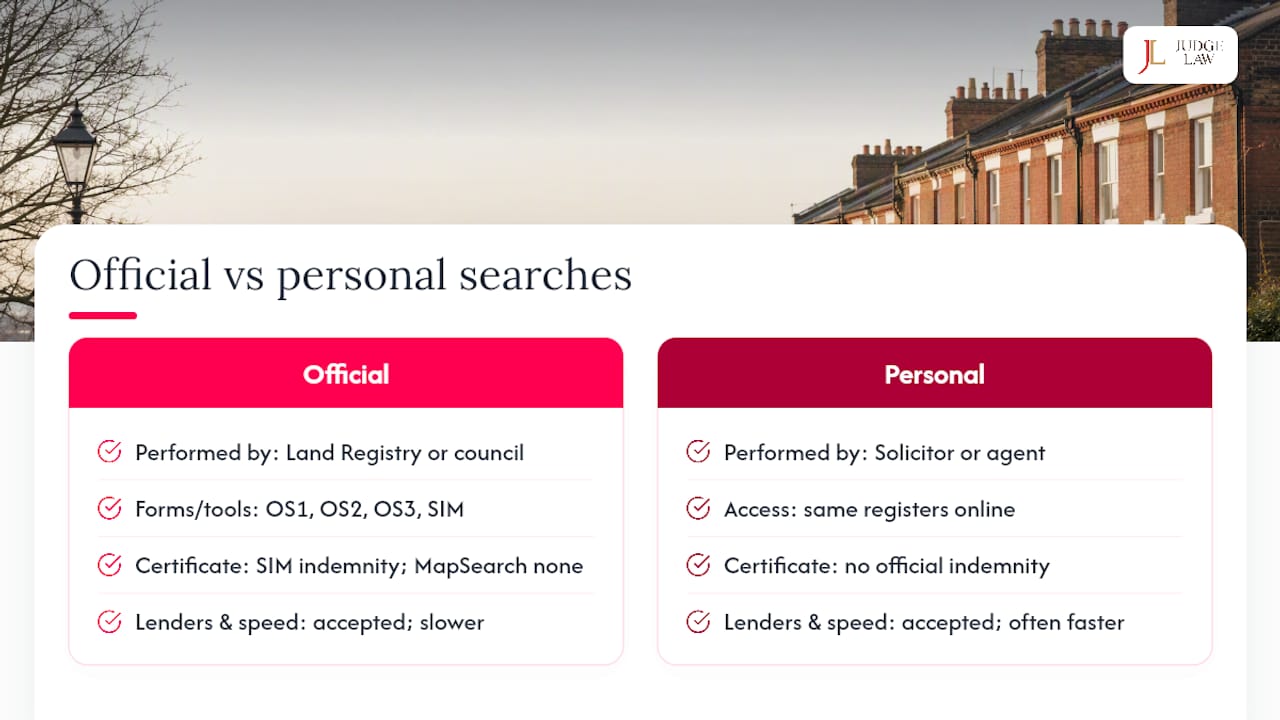
The distinction between official and personal searches confuses many buyers. The core public records consulted are broadly the same; what differs is who carries out the search, how results are issued, and the legal protection that comes with the certificate.
An official search is carried out by the relevant authority itself, whether that is HM Land Registry or the local council. For land registry purposes, the main official search forms are OS1 (registered land), OS2 (part of registered land), and OS3 (pending first registration). There is also the official search of the index map, known as a SIM. As HM Land Registry’s practice guide 10 explains, a SIM carries a fee and can provide certificate protection, whereas the free MapSearch tool is for on-screen viewing only and offers no indemnity.
A personal search is carried out by your solicitor or a regulated search agent who accesses the same public registers, often online. Practice guide 79 on Local Land Charges sets out how both official and personal searches can be made via the Local Land Charges service on GOV.UK. Most mortgage lenders accept regulated personal searches, and they can sometimes be returned faster than official council searches.
Callout. HM Land Registry practice guide 12 recommends applying for an official search with priority at least five business days before completion. This secures a priority period during which no new entries can be registered against the title without your solicitor being alerted, protecting you between exchange and completion.
Pro Tip: Ask your solicitor whether they plan to apply for official search priority with HM Land Registry before exchange. If they have not built this into their timeline, raise it early.
When to order searches and a realistic timeline for a typical purchase
Timing searches correctly is one of the most practical things you can do to prevent delays. GOV.UK’s home buying guidance notes that some advisers recommend waiting for a mortgage offer before ordering, to avoid wasted fees if the mortgage falls through. Others recommend ordering immediately after offer acceptance to keep the chain moving. Your solicitor will weigh this with you.
- Offer accepted. Instruct your solicitor immediately. Provide the full property address and title number if you have it.
- Solicitor instructed. Your solicitor carries out initial title checks and raises preliminary enquiries with the seller’s solicitor.
- Mortgage offer received. This is the trigger most solicitors use to order the full search pack. See the legal steps involved in buying a home for how searches sit within the wider conveyancing process.
- Searches ordered. Local authority searches can take from a few days to several weeks depending on the council. Environmental and drainage searches are usually returned more quickly.
- Search results received. Your solicitor reviews the reports and raises any further enquiries with the seller.
- Enquiries resolved. Once searches are clear and enquiries are answered, your solicitor can advise on exchange of contracts.
- Exchange of contracts. Apply for official search priority with HM Land Registry sufficiently before the planned completion date.
- Completion. Funds transfer, keys released.
Local authority turnaround is the variable that most often stalls a chain. Some councils return results within five working days; others take four weeks or more. Your solicitor should be able to tell you the current turnaround time for the specific council before you instruct.
How much do property searches cost in the UK?
Searches are paid up front, usually as a disbursement on your solicitor’s invoice. If the sale falls through after searches have been submitted, the fees are generally not refundable, though some regulated search providers offer partial protection. Fees paid to the local council are non-refundable once the search has been lodged.
Third-party regulated search providers often charge less than the local authority’s own official fee, and their turnaround can be faster. Your solicitor will advise which route is appropriate for your lender. Fast-track or priority options are available from some providers for an additional fee, typically £50–£100 on top of the standard rate.
What to do if a search reveals a problem
A search result that flags an issue is not automatically a reason to withdraw. Most problems have a practical resolution; the right response depends on the nature and severity of the finding.
- Raise enquiries with the seller. Your solicitor can ask the seller’s solicitor to explain or provide documentation. This is the first step for most issues, including planning conditions or drainage anomalies.
- Request remedial works or a price reduction. If the problem is physical, such as a public sewer crossing the garden, you can negotiate a reduction to reflect the restriction on future development.
- Take out indemnity insurance. For historic planning breaches, chancel repair liability, or missing building regulations certificates, indemnity insurance is often the fastest and most cost-effective solution. The seller typically pays the premium, though this is negotiable.
- Withdraw from the purchase. If a search reveals contaminated land, a major flood risk, or a restriction that fundamentally affects the property’s use or value, withdrawal may be the right decision. You will lose your search fees but avoid a much larger problem.
Indemnity insurance does not fix the underlying issue; it protects you financially if the issue is ever enforced. Some lenders will not accept indemnity insurance as a substitute for a resolved defect, so check with your mortgage broker before assuming it will satisfy your lender. Search results that reveal serious flood risk or structural ground instability may block mortgage approval entirely.
If a search raises a boundary or title dispute, the boundary dispute guide from Judgelaw sets out your options in plain terms. For broader property disputes arising from search discoveries, the property disputes guide covers the range of remedies available.
Pro Tip: Document every decision you make in response to a search finding, in writing, via your solicitor. If a dispute arises later, a clear paper trail of what you knew and when protects your position.
Practical steps to avoid delays and speed up your searches
Most search delays are avoidable. The actions below are within your control and your solicitor’s.
- Provide the full property address and title number at the point of instruction. Incomplete information causes searches to be rejected or returned for clarification.
- Instruct your solicitor to order searches as soon as your mortgage offer is confirmed, not after enquiries are resolved.
- Pay search disbursements promptly. Searches are not submitted until fees are received.
- Request electronic delivery of results where the council and provider support it.
- Ask your solicitor to use a regulated private search provider if the local council has a known backlog.
- Use the property purchase checklist to track which searches have been ordered, received, and cleared.
Pro Tip: If your transaction is time-sensitive, ask your solicitor to apply for official search priority with HM Land Registry as early as possible and to confirm the current turnaround time for the local council before instructing. Some councils publish live turnaround data on their websites.
Accepting a regulated personal search rather than an official council search can save one to two weeks in areas with slow councils. Confirm with your mortgage lender first that they will accept a regulated search; most do, but some specialist lenders have specific requirements.

Exact questions to ask your solicitor about your searches
These questions are designed to be used directly in conversation or by email with your conveyancer. The answers will tell you whether your searches are on track.
- Which searches will you order for this property, and are there any location-specific searches you recommend?
- When will you submit the search applications, and what triggers that decision?
- Will you apply for official search priority with HM Land Registry before completion, and when?
- What is the current turnaround time for the local authority search at this council?
- Are you using an official council search or a regulated private search provider, and will my lender accept either?
- What are the total search fees, and when do you need payment?
- If a search reveals a problem, how will you communicate that to me and what options will we have?
- Can I receive search results electronically as soon as they arrive?
If your solicitor cannot answer the turnaround time question or is vague about when searches will be submitted, that is worth following up. Slow search ordering is one of the most common causes of avoidable delays to exchange. The conveyancing tips guide covers additional questions worth raising at the outset of your instruction.
Why working with an SRA-regulated solicitor matters for your searches
Judgelaw is regulated by the Solicitors Regulation Authority (SRA number 634380). That regulation is not a formality. It means the firm is bound by professional conduct rules that govern how searches are ordered, how results are interpreted, and how advice is given when a search reveals a problem.
Interpreting a search result requires legal judgement. An environmental report that flags a former industrial use within 250 metres of the property does not automatically mean the property is contaminated, but it does require a solicitor to assess the risk, advise on whether further investigation is warranted, and consider whether your lender will be satisfied. A regulated solicitor carries professional indemnity insurance and is accountable to the SRA if that advice falls short.
Judgelaw publishes practical resources including a property purchase checklist and a guide to UK property legal terms to help buyers follow the process and understand what search reports are actually saying. On fees, the firm is transparent about what searches cost and when payment is required, so there are no surprises when disbursements fall due.
Judgelaw’s conveyancing service and how to get in touch
Judgelaw handles residential conveyancing for buyers who want searches ordered correctly, results explained clearly, and problems resolved without delay. The firm’s conveyancing solicitors manage the full search process, from instructing the right providers for your property’s location to applying for HM Land Registry priority before completion.
SRA-regulated (634380), with offices in Windsor and London and national availability for non-geographic matters. If you are ready to instruct or want to understand what the process involves for your specific purchase, get in touch to discuss your situation.
This article is general information, not a substitute for advice from a qualified lawyer. Consult a qualified legal professional about your own circumstances before acting on anything here.
Sources
- Practice guide 10: official search of the index map
- How to buy a home
- What are property searches?
FAQ
Can I do a property search myself?
You can access some public records directly, including basic title information via HM Land Registry and flood zone data via the Environment Agency, but the formal conveyancing searches required by mortgage lenders must be submitted by your solicitor or licensed conveyancer. Personal searches are available via the Local Land Charges service on GOV.UK, though most buyers rely on their solicitor to manage the full search pack.
How much does it cost to have searches done on a property?
A standard search pack covering the local authority, environmental, and water and drainage searches typically costs between £250 and £450 in total, depending on the council and whether a regulated private provider is used. Search fees are paid up front and are generally non-refundable once submitted.
How long after property searches does it take to complete?
Searches typically take two to six weeks to return, after which your solicitor needs to review results, resolve any enquiries, and advise on exchange. Completion usually follows exchange by one to four weeks, so from the point searches are ordered, the realistic minimum to completion is around six to ten weeks in a straightforward transaction.
How long before completion should the official search priority be applied for?
HM Land Registry recommends applying for an official search with priority at least five business days before the planned completion date. This secures a priority period protecting you against new entries being registered against the title between exchange and completion.
Recommended
- First-time buyer guide: Navigate your UK home purchase
- What Legal Steps Are Involved in Buying a Home? | Judge Law
- UK property legal terms explained: make better home decisions