

TL;DR
- Contract review is usually charged by the hour or as a flat fee, and the scope of work matters more than the contract’s label.
- Length, complexity, urgency and the number of negotiation rounds all push the cost up.
- Flat fees give cost certainty for standard contracts; hourly billing suits complex or negotiation-heavy work.
- AI tools can give a low-cost first pass, but they do not replace legal judgement on high-value or high-risk contracts.
- Planning ahead and agreeing the scope before work starts are the simplest ways to control the cost.
Commercial contract review cost is defined by the pricing model your solicitor applies, the complexity of the contract in question, and any additional charges for urgency or negotiation rounds. For most UK businesses, legal contract review prices fall somewhere between £100 and £500 per hour for solicitor time, or a flat fee ranging from a few hundred to several thousand pounds depending on the contract type. Understanding how those figures are reached, and what drives them up or down, is the difference between budgeting confidently and being caught out by an invoice you did not expect. This article sets out the pricing structures, cost drivers, and practical strategies that matter most when you are deciding how much to spend on commercial contract analysis.
What factors influence the commercial contract review cost?
The single biggest variable in any commercial contract review is scope. A solicitor reviewing a two-page non-disclosure agreement for a straightforward supplier relationship is doing a fundamentally different job from one reviewing a 60-page commercial lease with break clauses, service charge provisions, and landlord consent requirements. Length matters, but complexity matters more. A short contract with unusual indemnity structures or unfamiliar governing law can take longer to review than a lengthy but standard-form agreement.

The solicitor’s experience and specialisation also shape the fee significantly. A generalist commercial solicitor and a specialist in, say, technology licensing or commercial property will charge differently, and the difference is not arbitrary. Specialist knowledge reduces the time needed to identify risk, which can actually make a specialist cheaper overall even if their hourly rate is higher. Location plays a role too, with London-based firms typically charging more than regional practices, though many matters can now be handled nationally without geographic constraint.
Several other factors push costs up in ways that are easy to overlook at the outset.
- Urgency. Many firms charge a premium for urgent or same-day work, so a tight deadline can add noticeably to the base cost. This is one of the most avoidable cost increases a business faces.
- Negotiation rounds. A review that includes redlining and counter-proposals across multiple rounds will cost considerably more than a single read-through with a written report. Pricing depends far more on negotiation depth and iteration than on the contract label alone.
- Scope of service. Issue spotting, where the solicitor identifies risks and flags them, is less expensive than full negotiation support, where they draft alternative clauses and correspond with the other side.
- Contract type. An NDA sits at the lower end of the cost spectrum. A partnership agreement or commercial lease sits at the higher end, reflecting the legal complexity and the financial stakes involved.
Pro Tip: Before instructing a solicitor, ask specifically what their fee covers. A quote for “contract review” can mean anything from a verbal summary to a full written report with redlined amendments. Knowing the scope upfront prevents misunderstandings and helps you compare quotes accurately.
How do different pricing structures compare for contract reviews?
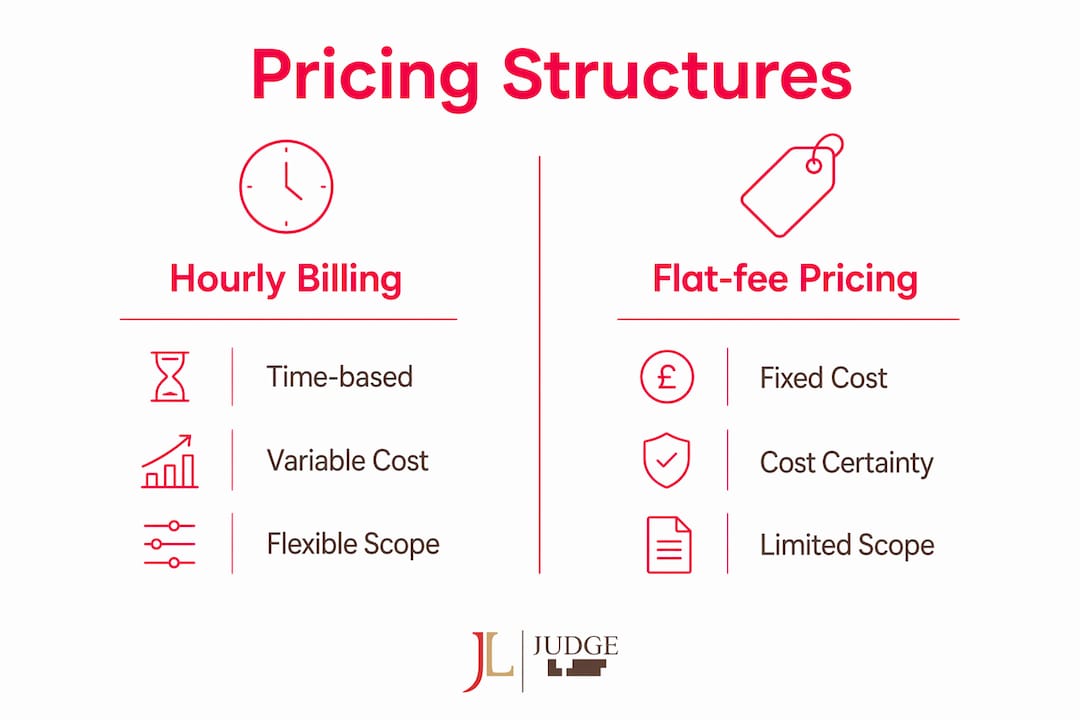
The choice between hourly billing and flat fees is not just a matter of preference. It reflects the predictability of the work involved, and flat fees suit standardised contracts while hourly billing better fits complex or negotiation-heavy reviews where the scope cannot be fixed in advance.
Hourly billing
Under hourly billing, you pay for the solicitor’s time at an agreed rate. For UK commercial solicitors, rates vary considerably by firm size, seniority, and location. A junior solicitor at a regional firm might charge £150 to £250 per hour. A senior partner at a City firm can exceed £500 per hour. A typical first-pass review takes one to three billable hours, placing the initial cost somewhere between £150 and £1,500 before any negotiation work begins. The risk with hourly billing is that the final invoice can exceed your initial estimate if the contract turns out to be more complex than anticipated.
Flat-fee pricing
Flat fees offer cost certainty, which most business owners prefer. The trade-off is that the solicitor prices in a margin for uncertainty, so you may pay slightly more than the actual time taken on a straightforward contract. The table below gives broad, indicative flat-fee ranges for common contract types. They are a guide only, not a quote, and fees vary between firms, so ask for a written quote before instructing.
| Contract type | Typical flat-fee range |
|---|---|
| Non-disclosure agreement (NDA) | £250 to £650 |
| Employment contract | £400 to £1,200 |
| Commercial lease | £800 to £2,500 |
| Partnership agreement | £1,200 to £3,200 |
| Complex commercial agreement | £1,500 upwards |
These figures reflect review and report only. Where negotiation and redlining are included, expect the upper end of each range or an additional charge on top.
AI-assisted review
AI contract review tools have entered the market as a low-cost first-pass option. They can process a document in minutes, at a fraction of the cost of manual solicitor review. The practical limitation is that AI tools identify standard clause patterns and flag deviations from templates; they do not apply legal judgement, advise on commercial risk, or negotiate on your behalf. For high-value or high-risk contracts, AI review is a useful starting point, not a substitute for qualified legal advice.
Here is a practical way to think about which approach fits your situation.
- Use AI review for routine, low-value contracts where the primary need is a quick sense-check against standard terms.
- Instruct a solicitor on a flat-fee basis for standard commercial contracts where the scope is predictable and negotiation is unlikely.
- Use hourly billing for complex contracts, multi-party agreements, or any situation where negotiation rounds are expected.
- Consider a hybrid approach for mid-range contracts, where AI handles the initial review and a solicitor addresses the flagged issues only.
Pro Tip: When requesting a flat-fee quote, ask whether the fee covers one round of amendments or multiple. Many firms include a single redline pass in their flat fee and charge hourly for subsequent rounds. Knowing this before you sign off on the instruction avoids a surprise bill mid-negotiation.
What practical steps can business owners take to manage contract review costs?
Cost management in contract review is largely about planning and scope discipline. The businesses that consistently overspend on legal contract review prices are those that instruct solicitors reactively, under time pressure, without a clear brief.
The most effective steps are straightforward.
- Plan ahead. Scheduling reviews in advance eliminates rush fees, which are one of the most significant and avoidable cost increases. If you know a contract is coming, instruct your solicitor before the deadline is pressing.
- Define the scope before instructing. Tell your solicitor exactly what you need. Issue spotting only? A full redline? Negotiation support through to signature? The answer changes the fee materially. Understanding what your fee covers before work begins is not just good practice; it is the clearest way to control spend.
- Use AI tools for initial screening. For contracts where you simply want to know whether anything unusual is present before deciding whether to instruct a solicitor, AI tools offer a cost-effective first filter. Hybrid workflows combining AI with human escalation can reduce legal spend, but require clear rules about when to escalate to avoid missing genuine risks.
- Calibrate the level of review to the stakes. A £5,000 supplier contract does not warrant the same depth of review as a £500,000 commercial lease. Matching the investment in legal review to the financial and legal risk of the contract is a discipline that saves money over time.
- Negotiate the fee structure upfront. Many solicitors will agree a capped fee or a fixed scope for straightforward work if asked directly. It is a reasonable request and many commercial solicitors will consider it.
The pitfall to avoid is treating contract review as a binary choice between doing nothing and instructing a solicitor for a full review. There is a spectrum of options, and the right one depends on the contract’s value, complexity, and the consequences of getting it wrong. Understanding key contract terms before a review begins also helps you brief your solicitor more precisely, which reduces the time they spend on orientation and keeps costs down.
How does turnaround time affect the overall cost?
Speed and cost are directly linked in commercial contract review. Standard professional review takes three to ten business days, depending on the solicitor’s workload and the contract’s complexity. That range matters for budgeting because it defines the window within which you can instruct without incurring a premium.
| Turnaround type | Typical timeframe | Cost impact |
|---|---|---|
| Standard review | 3 to 10 business days | Base rate applies |
| Priority review | 1 to 2 business days | Surcharge usually applies |
| Same-day review | Within 24 hours | Higher surcharge likely |
| AI-assisted review | Minutes | Low per-document cost |
Multiple review rounds extend the timeline and the cost simultaneously. If a contract goes through three rounds of negotiation, each requiring solicitor input, the total time from instruction to signature can stretch to several weeks, and the fee accumulates accordingly. Businesses that plan for this at the outset, by building review time into their contract timelines rather than treating it as a last-minute task, consistently pay less for the same quality of legal work.
The relationship between duration and cost is also shaped by the number of parties involved. A bilateral contract between two businesses is simpler to negotiate than a multi-party agreement where each side has its own solicitor and its own set of amendments. Budgeting for at least two to three rounds of review on any contract where negotiation is expected is a sensible baseline.
Practical points from our work: balancing cost and risk in contract review
In our work with business clients on commercial matters, the most common misunderstanding we see is the assumption that a cheaper review is a proportionate one. It is not always. The cost of a contract review should be measured against the value and duration of the obligation being entered into, not against the invoice in isolation.
A business owner who spends £300 on a superficial review of a three-year commercial lease is not saving money. They are deferring risk. If that lease contains an onerous repair obligation or a break clause that requires strict compliance, the cost of getting it wrong will far exceed what a thorough review would have cost. The same logic applies to partnership agreements and long-term supply contracts, where the consequences of a poorly reviewed clause can run for years.
In our work, a tiered approach tends to work well in practice. Routine, low-value contracts get an AI-assisted review with a brief solicitor sense-check. Mid-range contracts get a flat-fee review with a written report. High-value or high-risk contracts get full solicitor involvement from the outset, including negotiation support. That structure keeps overall legal spend proportionate without leaving material risks unaddressed.
The question is not whether you can afford a proper contract review. It is whether you can afford not to have one on the contracts that matter most.
FAQ
How much does commercial contract review cost in the UK?
As a broad guide, commercial contract review costs in the UK can range from around £250 to £3,000 or more, depending on the contract type, the solicitor’s hourly rate, and whether negotiation is included. Simple NDAs sit at the lower end; commercial leases and partnership agreements sit considerably higher.
What is the difference between hourly and flat-fee contract review pricing?
Hourly billing charges for the solicitor’s actual time and suits complex or negotiation-heavy contracts where the scope cannot be fixed in advance. Flat fees offer cost certainty for standard contracts with predictable scope, though they may include a margin for the solicitor’s uncertainty about the work involved.
Can AI tools replace a solicitor for contract review?
AI contract review tools can process documents quickly and cheaply, but they identify clause patterns rather than applying legal judgement. For routine, low-value contracts they offer a useful first filter; for high-value or complex commercial agreements, qualified solicitor review remains necessary to assess risk and advise on commercial implications.
Why do rush fees increase contract review costs so significantly?
Urgency requires a solicitor to reprioritise existing work and allocate time outside their normal schedule. Many firms charge a premium for urgent work, and same-day turnaround usually costs the most. Planning reviews in advance is the most straightforward way to avoid this surcharge.
What is included in a standard commercial contract review fee?
A standard fee typically covers reading the contract, identifying legal and commercial risks, and providing a written report or verbal summary. It does not automatically include redlining, drafting alternative clauses, or managing negotiation with the other side. Always confirm the scope of service before instructing.