
TL;DR
- The UK inheritance tax thresholds are frozen until at least 2031, increasing the likelihood of estates exceeding the limits. The nil-rate band is £325,000, with an additional residence nil-rate band of £175,000 for direct descendants, allowing most families to pass up to £500,000 tax-free. Larger estates face higher tax rates and reduced reliefs, especially due to recent caps on business and agricultural property relief.
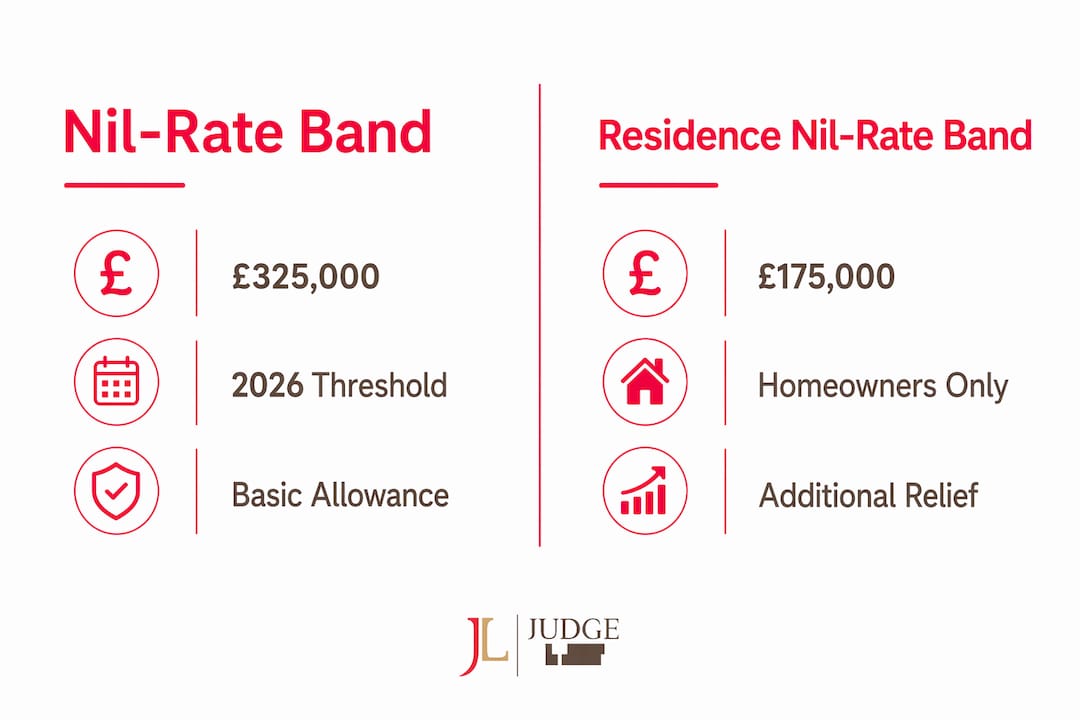
The inheritance tax threshold in the UK for 2026 is £325,000 per person, known as the nil-rate band (NRB), with an additional residence nil-rate band (RNRB) of £175,000 available when a qualifying main residence passes to direct descendants. Together, these allowances let most individuals pass up to £500,000 free of inheritance tax, and married couples or civil partners can combine their allowances to shelter up to £1 million. The rate above those thresholds is 40% on estates that exceed available allowances, reduced to 36% if at least 10% of the net estate goes to charity. Both bands are frozen until at least April 2031, a decision with real consequences for ordinary families as property values continue to rise.
What are the nil-rate band and residence nil-rate band?
The nil-rate band is the foundation of every inheritance tax calculation in England and Wales. The NRB sits at £325,000 for 2026/27 and has been frozen at that level since 2009. Any estate value up to that figure passes free of inheritance tax. Everything above it is taxed at 40%, unless reliefs or exemptions apply.

The residence nil-rate band adds a further £175,000 on top, but it comes with conditions. The deceased must have owned a qualifying residential property, and it must pass to a direct descendant, meaning children, grandchildren, or stepchildren. It cannot be used for estates passing to siblings, friends, or charities.
How the two bands combine
For a single individual who owns a home and leaves it to their children, the combined tax-free allowance reaches £500,000. For a married couple or civil partners, the picture is more generous still. Unused allowances transfer between spouses on the first death, meaning the surviving partner can hold up to £650,000 in NRB and £350,000 in RNRB, sheltering a combined estate of up to £1 million from inheritance tax.
| Scenario | NRB available | RNRB available | Total tax-free |
|---|---|---|---|
| Single individual, no property | £325,000 | £0 | £325,000 |
| Single individual with qualifying home | £325,000 | £175,000 | £500,000 |
| Married couple, full transfer | £650,000 | £350,000 | £1,000,000 |
The RNRB taper for larger estates
The residence nil-rate band does not apply in full to every estate. The RNRB tapers by £1 for every £2 the net estate exceeds £2 million, and it disappears entirely at £2.35 million for a single person or £2.7 million for a couple using both allowances. Estates in that range face a steeper effective tax rate than the headline 40% figure suggests, because they lose the RNRB at the same time as paying tax on the excess.
Pro Tip: The RNRB taper is calculated against the net estate after debts but before reliefs such as Business Property Relief or Agricultural Property Relief. Getting this calculation wrong is one of the most common errors in estate planning, and it can result in an unexpected tax bill.
What recent changes affect inheritance tax in 2026?
Three developments make 2026 a particularly significant year for inheritance tax planning in the UK. Understanding each one is worth your time before you make any decisions about your estate.
-
Threshold freeze extended to 2031. The nil-rate band and residence nil-rate band remain frozen until at least April 2031. The NRB has not moved since 2009. As property prices and general wealth levels rise, more estates cross the threshold each year without any change in the law. This is fiscal drag in practice, and it pulls ordinary families into a tax that was once associated primarily with large inherited wealth.
-
New cap on Business Property Relief and Agricultural Property Relief from April 2026. From April 2026, 100% relief on business and agricultural assets is capped at the first £1 million combined. Assets above that figure attract only 50% relief. Previously, qualifying business and farm assets could pass entirely free of inheritance tax regardless of value. This is the biggest change to IHT relief in over a decade and will affect farming families and business owners significantly.
-
Charitable donation rate reduction. Leaving at least 10% of your net estate to a qualifying charity reduces the inheritance tax rate from 40% to 36%. This is not new for 2026, but it remains underused. For larger estates, the saving can be substantial.
Executors must pay any inheritance tax due within six months of the date of death and must first obtain an HMRC reference number. Interest accrues on unpaid tax after that deadline, so prompt action matters.
Pro Tip: If your estate includes a farm or business, the April 2026 relief cap changes your planning position materially. A professional review of your current structure is worth arranging before the value of those assets grows further beyond the £1 million threshold.
How do inheritance tax thresholds affect estate planning in 2026?
Good estate planning is not about avoiding tax at any cost. It is about making sure your estate is structured so that your family receives what you intend, with as little unnecessary tax liability as possible.
The most powerful tool available is the spouse exemption. Transfers between spouses and civil partners are entirely free of inheritance tax, regardless of value. That means the first death in a couple can be structured to pass assets to the surviving partner without triggering any tax, while preserving both sets of allowances for the second death. The unlimited spouse exemption is the single most effective planning mechanism for most UK families.
Gifts and lifetime planning
Lifetime giving reduces the value of your estate and, done correctly, removes assets from the inheritance tax calculation entirely.
- Annual gift exemption. You can give away £3,000 per tax year free of inheritance tax. Unused allowance carries forward one year, meaning you could give £6,000 in a single year if you did not use the previous year’s allowance.
- Small gifts. Gifts of up to £250 to any number of individuals per year are immediately exempt, with no waiting period.
- Gifts out of surplus income. This exemption has no upper limit and no waiting period. If you can demonstrate that gifts are made from regular income and do not reduce your standard of living, they fall outside your estate immediately. Detailed records are required to support this exemption, but it is one of the most valuable and least used tools in estate planning.
The 7-year rule and common misconceptions
The 7-year rule applies to larger gifts that do not fall within an exemption. If you survive seven years after making such a gift, it falls outside your estate entirely. If you die within seven years, it may be brought back into the calculation on a sliding scale known as taper relief. What many people do not realise is that some gifts are immediately exempt without any need to survive seven years. Small gifts, annual exemptions, and gifts from surplus income all fall into this category. Planning should start with these before relying on the 7-year rule.
Pro Tip: Downsizing your home does not mean losing the RNRB. A downsizing addition allows you to claim the RNRB you would have received on a former property, provided the proceeds remain in the estate and pass to direct descendants. This is frequently overlooked in later-life planning.
How do inheritance tax thresholds apply in different scenarios?
Abstract rules become clearer with concrete examples. The table below shows how the 2026 thresholds and reliefs apply across four common situations.
| Scenario | Estate value | Thresholds available | Taxable amount | Tax at 40% |
|---|---|---|---|---|
| Single person, no property | £400,000 | £325,000 NRB | £75,000 | £30,000 |
| Single person with qualifying home to children | £600,000 | £500,000 (NRB + RNRB) | £100,000 | £40,000 |
| Married couple, full allowances, home to children | £1,200,000 | £1,000,000 | £200,000 | £80,000 |
| Estate at £2.5m, RNRB tapered away | £2,500,000 | £650,000 (NRB only for couple) | £1,850,000 | £740,000 |
The fourth scenario illustrates the taper effect sharply. At £2.5 million, the RNRB has been lost entirely for a single person, and the estate pays tax on a much larger proportion than the headline threshold figures suggest. Business owners face an additional layer of complexity from April 2026. An estate containing £3 million in qualifying business assets previously attracted no inheritance tax on those assets. Under the new cap, the first £1 million remains fully relieved, but the remaining £2 million attracts 50% relief, leaving £1 million exposed to tax at 40%. That is a £400,000 liability that did not exist before April 2026.
For guidance on how trusts can form part of a broader estate structure, the Judge Law article on types of trusts in the UK sets out the options clearly.
Why the frozen thresholds matter more than most families realise
The nil-rate band has been frozen since 2009. In that time, average UK house prices have roughly doubled. That is not a coincidence to be noted and moved on from. It is the mechanism by which inheritance tax has quietly expanded from a tax on large estates to one that catches middle-income families who happen to own property in areas where values have risen sharply.
The freeze to 2031 extends that effect for another five years. A family home worth £400,000 today may be worth considerably more by the time it passes to the next generation, and the threshold against which it is measured will not have moved. The fiscal drag this creates is real and cumulative.
What I find most striking in practice is how many people assume the RNRB solves the problem. It helps, but it is conditional, tapered for larger estates, and lost entirely if the property does not pass to a direct descendant. Families with more complex structures, second marriages, or estates approaching £2 million need to think carefully about whether the RNRB will actually be available to them.
The other underestimated risk is the new Business Property Relief cap. Farming families in particular have historically structured their affairs on the assumption of full relief. That assumption no longer holds above £1 million in combined business and agricultural assets. Reviewing existing wills and structures in light of this change is not optional for anyone in that position. It is urgent.
The good news is that the planning tools available, spouse exemptions, annual gifts, surplus income exemptions, and downsizing additions, remain effective. They work best when used consistently over time, not as a last-minute exercise. If you want to explore the full range of strategies available in 2026, the Judge Law IHT planning guide covers the detail beyond the 7-year rule myths.
FAQ
What is the inheritance tax threshold in the UK for 2026?
The inheritance tax threshold for 2026/27 is £325,000 per person under the nil-rate band, rising to £500,000 for individuals who qualify for the residence nil-rate band of £175,000 when leaving a main home to direct descendants.
How much can a married couple pass on tax-free in 2026?
A married couple or civil partners can pass up to £1 million tax-free in 2026, by combining both nil-rate bands (£650,000) and both residence nil-rate bands (£350,000), provided the qualifying conditions for the RNRB are met.
What is the current UK inheritance tax rate?
The current UK inheritance tax rate is 40% on the value of an estate above the available thresholds. This reduces to 36% if at least 10% of the net estate is left to a qualifying charity.
How does the new Business Property Relief cap affect estates in 2026?
From April 2026, 100% relief on qualifying business and agricultural assets is capped at £1 million combined. Assets above that figure attract only 50% relief, meaning larger business or farming estates now face a tax liability that did not previously apply.
Are inheritance tax thresholds increasing in 2026?
No. Both the nil-rate band and the residence nil-rate band are frozen at their current levels until at least April 2031. The nil-rate band has remained at £325,000 since 2009, meaning rising property values push more estates into the inheritance tax net each year.