

A separation agreement will help you if you both want your finances, home and children’s arrangements written down clearly while you sort out your longer-term plans. It records who pays what, but it stays a private contract rather than a court order, so its strength depends entirely on free consent, full financial disclosure, independent legal advice and fair terms. The immediate step is straightforward. Get independent legal advice and start gathering your financial disclosure now, before you agree anything in principle.
TL;DR
- A separation agreement is a private contract that records financial and child arrangements while living apart, but it depends on full disclosure, independent legal advice, and fair terms to be effective.
- It is not automatically legally binding in the UK unless converted into a consent order during divorce proceedings, which requires court approval and a fair, fully disclosed agreement.
- Publicly available guidance advises detailing household expenses, asset schedules, property occupation, and child arrangements, with signed and dated disclosures to strengthen enforceability.
- Proper preparation, including gathering comprehensive financial documents and advising each party independently, is crucial for the agreement to hold up in court later.
What is a separation agreement and when should you use one?
A separation agreement is a written contract between two people who intend to live apart. It sets out who pays the mortgage or rent, how savings and debts are split, who stays in the family home, and how child arrangements will work while you’re separated but not yet divorced. MoneyHelper describes it plainly: it isn’t automatically legally binding, but it carries real weight when it’s drafted properly, with full disclosure on both sides.
That distinction between a separation agreement and other legal routes trips a lot of people up. A legal separation is a formal court process for married couples that doesn’t end the marriage. A consent order is what a separation agreement can become once divorce proceedings start, at which point a court approves it and it becomes enforceable. Divorce itself ends the marriage entirely. A separation agreement sits underneath all of these, a private document that can bridge the gap between separating and taking any of those formal steps.
People reach for one in several situations:
- Married couples who aren’t ready to divorce yet, whether for financial, religious, or personal reasons, but need clarity now.
- Civil partners going through the same interim period before dissolution.
- Cohabiting couples who were never married and have no automatic financial claims against each other, but still share a home, debts, or children.
- Anyone who wants a documented, fair record of contributions and arrangements in case things become contested later.
For unmarried couples, this is a genuinely different legal path. A cohabitation separation agreement is enforced through the civil courts as an ordinary contract, not through family law, because cohabitants don’t have the same statutory rights as married couples on separation.
What should a UK separation agreement include?
A separation agreement is only as good as its detail. Vague terms cause disputes six months later. Specific, dated, signed terms don’t. Work through these in order when you draft or review one.
- Household outgoings. Name who pays the mortgage or rent, council tax, utilities and any joint credit agreements, and from what date.
- Bank accounts and savings. Record how joint accounts will be split or frozen, and confirm each person’s responsibility for existing debts, including credit cards and loans taken out jointly.
- Property occupation and sale. State who lives in the family home, under what conditions it might be sold, and how any sale proceeds will be divided.
- Maintenance and child arrangements. Cover spousal maintenance if relevant, child maintenance, where children will live, contact schedules, and who covers childcare or school costs.
- Asset schedules and disclosure. Attach a dated list of assets, liabilities, and supporting documents, signed and ideally witnessed, so there’s no argument later about what was known at the time.
Pro Tip: Date every disclosure document you attach, even bank statements you think are obvious. A judge weighing up whether an agreement was fair will often look at what each person actually knew on the day they signed, not what became clear months afterwards.
Missing any of these doesn’t necessarily void the agreement, but it weakens it. An agreement that’s silent on child arrangements, for instance, leaves that entire question open to a fresh dispute exactly when you least want one.
Is a separation agreement legally binding in the UK?
Not automatically, and this is the single most misunderstood part of the process. A separation agreement is a private contract between two people. A consent order is a court order. Only the latter carries automatic legal enforceability, and only a family court can make binding decisions about children’s welfare regardless of what any private agreement says.
That doesn’t make a separation agreement toothless. Courts can give considerable weight to a properly made agreement, applying principles from the Supreme Court’s decision in Radmacher v Granatino [2010] UKSC 42 on nuptial agreements. The court should give effect to an agreement freely entered into by each party with a full appreciation of its implications, unless in the circumstances it would not be fair to hold them to it. In practice, full and frank financial disclosure and independent legal advice for each person are the strongest evidence that both of you understood what you agreed, and the needs of any children come first.
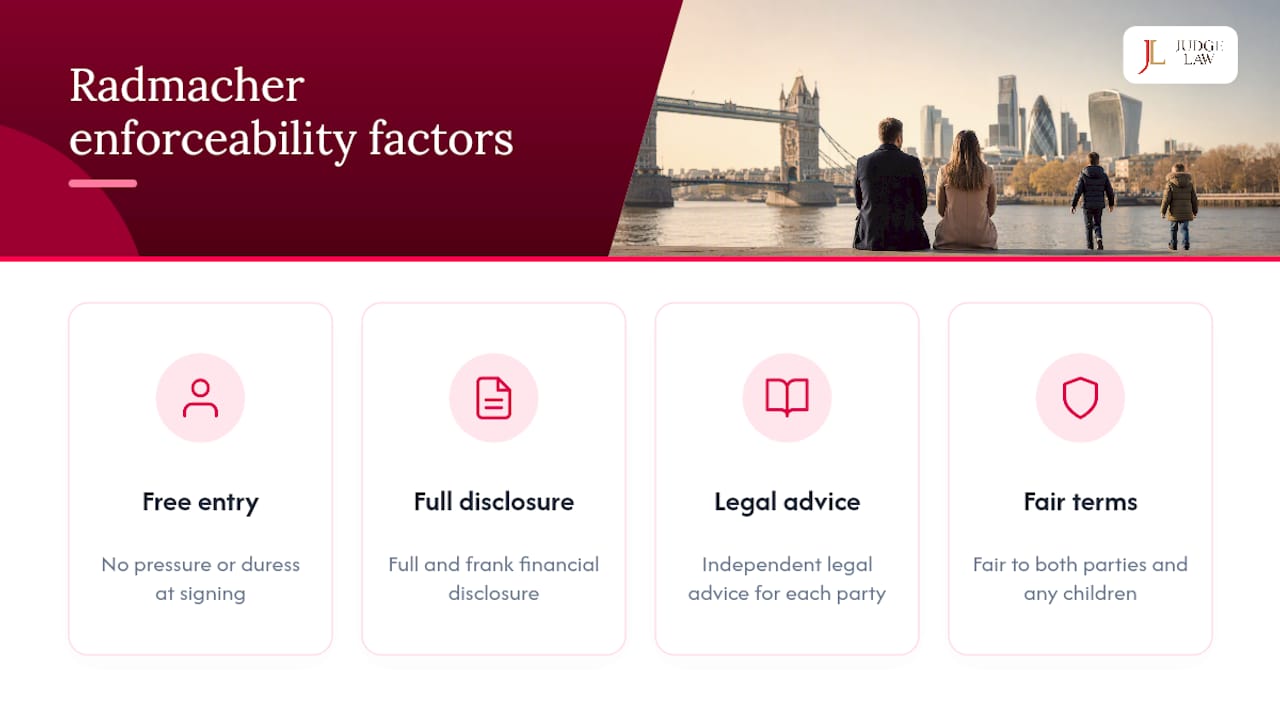
Those are the factors courts have focused on since the Supreme Court’s judgment on nuptial agreements. Get them right and a court is more likely to respect what you agreed. Miss one, and you’ve handed a judge a reason to depart from it.
A court can and will depart from a separation agreement where circumstances have changed significantly since signing, where the terms turn out to be unfair to any children, where one party didn’t disclose assets honestly, or where there’s evidence of pressure or duress at the time of signing. None of these are exotic scenarios. They’re the most common reasons separation agreements unravel.
How do you make a separation agreement carry real weight later?
The gap between a separation agreement that holds up and one that gets picked apart usually comes down to preparation, not drafting flair. Get the groundwork right and the wording almost writes itself.
Full financial disclosure means gathering, at minimum:
- Bank and savings account statements covering at least the past twelve months
- Mortgage deeds and current mortgage statements
- Pension statements from every scheme either of you holds
- Property valuations, ideally from an independent surveyor or estate agent
- Details of any business interests, shares, or other investments
Independent legal advice matters more than most people expect going in. LexisNexis’s client guidance notes that solicitors treat this step as far more than a formality. Each person needs their own solicitor, advising separately on what the terms mean and whether they’re fair, because a court will often ask precisely that question if the agreement is challenged later.
Converting the agreement into a consent order is the step that turns a persuasive document into an enforceable one. Once divorce proceedings begin, the terms you’ve already negotiated can be submitted to the court for approval as a court-enforceable outcome. The court checks the terms are fair before approving, but if your separation agreement was properly disclosed and independently advised on, this step is usually straightforward. It’s the point where private agreement becomes something a court can enforce directly if either of you later fails to comply. If you’re heading towards divorce, our guide on filing for divorce in England and Wales covers where the consent order fits into that timeline.
Can a separation agreement cover pensions and child maintenance?
It can record intentions, but it can’t finish the job on its own, and this catches people out more than almost anything else in the process.

Pensions are the clearest example. A separation agreement can note that one party will receive a share of the other’s pension, but it cannot actually transfer or divide pension rights. Only a pension sharing order, made by the court during divorce proceedings, can do that. LexisNexis’s glossary guidance is explicit on this point. Treat any pension clause in a separation agreement as a statement of intent that still needs a court order to become real.
Clauses that try to permanently bar future maintenance claims sit on shaky ground too. Any term that tries to stop a parent applying to the Child Maintenance Service is void under section 9(4) of the Child Support Act 1991, because child maintenance is for the child’s benefit, not the parent negotiating it away. Spousal maintenance waivers face similar scrutiny if circumstances change dramatically after signing.
The family court also keeps ultimate jurisdiction over children’s welfare regardless of what any private agreement says. You can agree contact schedules and living arrangements between yourselves, and courts generally welcome that. But if a dispute later reaches court, the welfare of the child is what the court decides on, not what two parents wrote down a year earlier.
How much does a separation agreement cost in the UK?
Costs vary widely, and the right option depends on how much you and your ex-partner already agree on, and how complex your finances are.
- DIY templates are free or low-cost and might suit a simple, fully agreed situation with no property, pensions, or children involved. The risk is that generic wording misses the specific disclosure and fairness elements courts look for later.
- Online services charge a fee for a drafted agreement based on information you provide, and prices vary between providers. These often include a basic review but rarely the tailored, independent advice each party genuinely needs.
- Solicitor-drafted agreements cost more, and the fee depends on complexity, whether there’s a property or business involved, and whether pensions and children’s arrangements need detailed drafting.
- Mediation combined with solicitor drafting often works out cost-effective for couples who broadly agree but want a neutral third party to help finalise terms before a solicitor turns them into a formal document.
Pro Tip: If you own property together, have pensions worth discussing, or have children, don’t start with a template. The cost difference between an online service and proper solicitor drafting is small next to what it costs to unpick a badly drafted agreement two years later.
A solicitor becomes close to essential once property, pensions, business assets, or children’s arrangements are involved, because these are exactly the areas where a court is most likely to scrutinise fairness and disclosure if the agreement is ever tested. Our guide to dividing property in divorce covers the specific issues that come up when a family home is part of the picture.
What if you and your partner can’t agree on the terms?
Mediation is usually the sensible next step when direct discussion stalls. A trained mediator helps both of you work through the practical issues, mortgage, savings, contact arrangements, without either side needing to instruct a solicitor for every conversation. Before applying to court for most financial or children orders, you will usually need to attend a Mediation Information and Assessment Meeting (MIAM), unless an exemption applies.
Where agreement still isn’t possible, the routes differ depending on your relationship status.
- Married couples or civil partners can apply for a financial order using Form A, which starts the court process for resolving finances as part of divorce.
- Unmarried couples generally need the Trusts of Land and Appointment of Trustees Act (TOLATA) for property disputes, or Schedule 1 of the Children Act 1989 where the dispute concerns financial provision for a child.
- In the meantime, keep dated records of every payment you make towards the mortgage, bills, or childcare, and save written communications about arrangements. These often become the deciding evidence in short-term disputes over who paid what.
Early legal advice at this stage, before positions harden, tends to save both time and money later.
Judge Law’s practical approach to separation agreements
We draft separation agreements in plain English, because a document neither of you fully understands isn’t going to hold up when it matters. Every client we advise gets a clear explanation of what their agreement can achieve now and what still needs a consent order later, and we’re upfront that each party needs their own independent legal advice for the agreement to carry real weight.
Fee expectations are set from the outset. An initial consultation is a paid appointment from £150, and you’ll know the likely cost of drafting or reviewing your agreement before any work begins. As with all our work, we’re regulated by the Solicitors Regulation Authority under number 634380, with offices in Windsor and London and clients across the Thames Valley, Berkshire, Surrey, and London.
If you want a solicitor to draft or review your separation agreement
Judge Law is the direct option if you want a separation agreement that’s built to withstand scrutiny later, not just a signed document that looks the part. We draft agreements, give you independent legal advice on the terms (your former partner will need their own solicitor), and guide you through converting the agreement into a consent order once divorce proceedings start. Where mediation would help first, we can point you towards that route too.
We’re regulated by the Solicitors Regulation Authority (634380), and an initial consultation is a paid appointment from £150, so you know what you’re paying for before anything progresses. If you’re ready to talk through your situation, visit our family law services page or get in touch directly to arrange a consultation and take the first proper step towards an agreement that holds up.
Official forms and guidance
- Gov sets out the official procedural steps and forms, including how financial orders fit into the divorce process.
- MoneyHelper’s separation agreements guide explains when a separation agreement is used instead of, or alongside, divorce or dissolution.
- Citizens Advice covers mediation options and practical steps for deciding what to do when you separate.
This article is general information, not a substitute for advice from a qualified lawyer. Consult a qualified legal professional about your own circumstances before acting on anything here.
Sources
- Separation agreements if you’re considering a divorce or dissolution | MoneyHelper
- Marital agreements, individual autonomy and fairness | Pump Court Chambers
- Gov
FAQ
How much does a solicitor charge for a separation agreement?
The cost of a solicitor-drafted agreement depends on its complexity, for example whether property, pensions or a business are involved. Judge Law’s initial consultation is a paid appointment from £150.
How do you separate from a partner in the UK?
Start with an honest conversation about finances, property, and children if applicable, then get independent legal advice and gather full financial disclosure before agreeing any terms in writing.
What is a wife entitled to in a separation?
There’s no automatic fixed entitlement during separation itself, since the marriage hasn’t legally ended. A fair separation agreement typically addresses housing, income, savings, debts, and child arrangements based on both parties’ needs and contributions, with pension sharing and final financial orders only becoming enforceable through a consent order on divorce.
What happens after five years of separation in the UK?
Separation is no longer a ground for divorce. Under the no-fault divorce system in force since 6 April 2022, either or both of you can apply once you have been married for at least a year, however long you have been separated. A separation agreement in place for several years can support the terms of a later consent order, provided it still meets the disclosure and fairness tests courts expect.
What is the difference between a separation agreement and a cohabitation agreement?
A separation agreement covers couples, married or not, who are ending their relationship and need to divide existing arrangements. A cohabitation agreement is typically made while a relationship is ongoing, setting out how finances and property would be handled if the couple later separates.
Recommended
- Property Division UK Divorce: Essential Tips
- High Net Worth Divorce in the UK: The 2026 Mega Guide to Financial Settlements
- How to Enforce a Child Arrangements Order
- Prenup, Postnup & Cohabitation Agreements in the UK: What Really Protects Your Assets