
A simple solicitor-drafted will commonly costs between £150 and £400, while a will involving trusts or overseas assets can run into the thousands, according to market data on UK will pricing. DIY kits start around £11, and charity schemes sometimes charge nothing at all. If cost is your main concern, ask any provider for a written fee quote before you commit, and check whether they’re regulated by the Solicitors Regulation Authority (SRA). Citizens Advice and Judge Law both recommend comparing at least two or three quotes before instructing anyone.
- DIY will kit or template: starting from around £11
- Charity will-writing scheme: generally free or low cost with a suggested donation
- Commercial will-writing company: often cheaper than solicitors but usually unregulated, with prices varying
- Online will service: available in a broad range of prices, typically covering simple to moderate wills
- SRA-regulated solicitor, simple will: £150 to £400
- Complex will with trusts or overseas assets: can cost significantly more, sometimes reaching into the thousands
What affects the cost of writing a will
Price moves with complexity, not with the number of pages your will runs to. A single person leaving everything to one beneficiary needs very little drafting work. Add a second marriage, stepchildren, a business, or a property abroad, and the picture changes considerably.
Trusts are one of the biggest cost drivers. A will that sets up a trust for a vulnerable beneficiary, or that uses a trust to manage inheritance tax exposure, requires drafting that goes well beyond a standard template. Multiple executors can also add time, particularly if you want detailed guidance on how they should act jointly.
Previous marriages and blended families often mean more clauses, more careful wording around who inherits what, and sometimes a deed of variation further down the line if something’s been missed. Business assets raise their own questions. Does the will need to address succession of shares, partnership interests, or a sole trader’s assets separately from the rest of the estate?
Tax planning adds another layer. If your estate is likely to exceed the inheritance tax nil rate band, a solicitor may need to build in reliefs or structure gifts carefully, which takes more time than a straightforward distribution of assets. None of this means you’re being overcharged for a complex estate. It means the fee reflects the actual legal work involved, not a flat rate for “a will” regardless of what’s inside it.
DIY forms, commercial will writers, or a solicitor: what’s the difference?
The three main routes to a written will sit on very different footing when it comes to legal protection, even though the end document might look similar on paper.
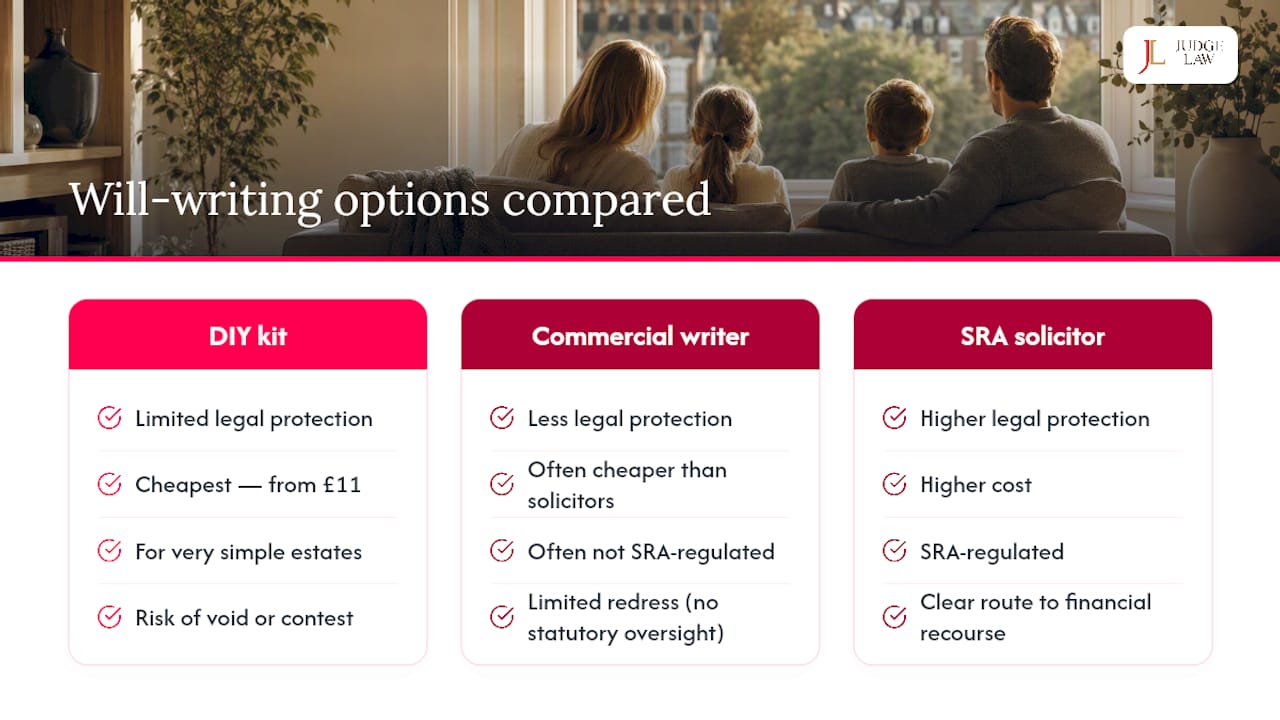
A DIY will kit is the cheapest option, sometimes as little as £11, but it only really works for very simple estates. Incorrect witnessing, ambiguous wording, or a missed signature can invalidate the whole document, and DIY wills are often described as a false economy once you weigh the risk of a contested or void will against the money saved.
Commercial will-writing companies often undercut solicitors on price. The catch is that most aren’t regulated by the SRA. Two voluntary bodies set standards for some will writers, but there’s no statutory oversight, which affects your ability to seek redress if something goes wrong, according to a comparison of DIY wills and solicitor-drafted wills.
SRA-regulated solicitors cost more, but that price includes compulsory professional indemnity insurance, a formal complaints process, and accountability to a statutory regulator. If a solicitor makes a drafting error, you have a clear route to financial recourse. That protection matters more the larger or more complicated your estate becomes, and it’s precisely why DIY wills can become an expensive mistake for anyone beyond the simplest cases.
How long does drafting a will take, and what else might cost extra?
A straightforward will can often be drafted within one to two weeks once a solicitor has taken your instructions, though turnaround varies by firm and how quickly you supply information. Complex wills involving trusts, business succession planning, or overseas assets can take several weeks, particularly if specialist tax advice needs to be built in alongside the drafting.
The initial quote you receive rarely covers everything you’ll eventually need. Common additional costs include storage fees for keeping the original document safe, charges for codicils if you want to amend the will later rather than rewrite it entirely, and separate fees for estate valuation work, according to cost breakdowns for UK will writing. Probate, the process of administering the estate after death, is almost always billed separately from the will itself. It’s a distinct piece of work carried out later, sometimes by a different solicitor entirely.
Pro Tip: Ask specifically whether your quote includes one free revision within a set period, such as 12 months. Circumstances change, marriages happen, children arrive, and a will that’s slightly out of date is often worse than no will at all.
None of these extras are hidden in a sinister sense. They’re simply separate pieces of work that a simple will quote does not need to include, but that many people end up needing at some point.
What to prepare before you get a will writing quote
Getting an accurate quote depends on how much information you can give a solicitor upfront. Vague instructions lead to vague fees, and vague fees tend to expand once the real complexity emerges.
Before you contact anyone, gather:
- A rough list of your assets, including property, savings, pensions, and any business interests
- Details of who you want as beneficiaries and in what proportions
- Your proposed executors and any backup executors
- Any specific wishes around guardianship, if you have children under 18
- Details of previous marriages, stepchildren, or dependants with particular needs
When you speak to a solicitor or will writer, ask direct questions. Is the fee fixed or hourly? Does VAT apply on top of the quoted price? Is storage included, or charged separately? What happens if you need to amend the will next year? Citizens Advice recommends getting written fees upfront precisely because verbal estimates can shift once the real scope of work becomes clear. Comparing two or three written quotes, side by side, on identical questions, gives you a genuine basis for comparison rather than a guess based on headline price alone.
How and when will you pay for your will?
Most solicitors ask for payment on completion of the will, once it’s been drafted, checked, and signed, rather than upfront before any work begins. Some firms request a deposit for more complex instructions, particularly where trust drafting or tax planning is involved and the work will run over several weeks.

Fixed-fee arrangements are the norm for straightforward wills. You agree a price at the outset, and that’s what you pay regardless of how many drafts it takes to get the wording right. Hourly billing is more common for complex estates where the scope isn’t fully known until the solicitor has reviewed your assets in detail. Ask which basis applies before you instruct anyone, because an hourly rate on a genuinely complicated estate can end up costing considerably more than a fixed quote for equivalent work.
Instalment arrangements aren’t standard practice across the industry, but some firms will discuss payment in stages for larger, bundled estate planning packages that include a will alongside trust deeds or lasting powers of attorney. If budgeting matters to you, raise it directly. Ask whether the firm splits invoices for multi-part instructions, and whether storage fees are billed annually or as a one-off charge at completion.
The extra costs that don’t show up in your first quote
The figure you’re first quoted for a will is usually the drafting fee alone. Several other costs sit outside that number, and they catch people out because nobody mentions them until later.
Legal advice on complex tax questions, such as structuring gifts to reduce inheritance tax exposure, is sometimes billed separately from the will itself, particularly if it requires input beyond standard drafting. Estate valuation, needed to understand whether your estate crosses inheritance tax thresholds, can involve fees from valuers or accountants that sit entirely outside your solicitor’s quote.
Storage of the original signed will is another cost some firms include and others charge annually. Codicils, the formal amendments you make to an existing will rather than starting again, usually carry a separate fee each time you use one. And if the same firm later handles probate for your estate, that’s billed as its own piece of work, worked out from the estate’s value and complexity, not folded into what you paid for the will years earlier.
None of this means the initial quote was misleading. It means a will quote covers the will, and estates rarely stay simple enough that nothing else is ever needed.
Should you buy a will as part of a bundled estate planning package?
Bundling a will with other estate planning tools, such as a lasting power of attorney or a trust deed, often costs less overall than commissioning each document separately over time. Firms that offer combined packages can price the whole set more efficiently because the fact-finding work, understanding your family situation, your assets, your wishes, overlaps across documents.
The trade-off is that bundled packages sometimes push people toward tools they don’t actually need. A trust makes sense for specific situations, protecting assets for a vulnerable beneficiary, or managing inheritance tax exposure on a larger estate. It’s not automatically useful for someone with a modest, straightforward estate and no dependants requiring special protection.
Standalone will writing suits people whose needs are genuinely simple and who don’t want to pay for structures they won’t use. Bundled planning tends to suit people with property, business interests, or family circumstances that would otherwise mean returning to a solicitor repeatedly over several years for separate instructions. Ask a solicitor to justify each element of a bundle against your actual circumstances, rather than accepting a package because it’s marketed as complete. A good solicitor should be able to explain plainly why each component applies to your situation, or tell you honestly if it doesn’t.
Cheapest isn’t always best value. Here’s how to judge that properly
The lowest quote on the table isn’t automatically the best deal, and treating it as such is how people end up with invalid or disputed wills. MoneySavingExpert makes the point plainly: the cheapest route can be a false economy if the will is later contested or turns out to be invalid, because the downstream legal costs of sorting that out almost always dwarf whatever was saved at the outset.
Value, properly understood, includes four things beyond the headline price. First, regulatory protection. Is the provider SRA-regulated, and do they carry professional indemnity insurance that protects you if something’s drafted incorrectly? Second, scope. Does the fee include witnessing guidance, storage, and at least one revision, or are those all extra? Third, expertise matched to your estate. A simple template suits a simple estate; a trust-literate solicitor suits a complicated one. Fourth, accountability. If a dispute arises after your death, can your executors actually challenge a poorly drafted document, or is the provider outside any formal complaints route?
Weigh these against price together, not price first and the rest as an afterthought. A £150 saving today means very little if it costs your estate several thousand pounds in contested probate later.
Judge Law’s view: price is only half the picture
At Judge Law, we think the real comparison isn’t lowest fee against highest fee. It’s total risk-adjusted cost, price weighed against regulation, indemnity insurance, and what’s actually included in the service. We’re SRA-regulated under number 634380, and that’s the credential we ask clients to check for any solicitor they’re considering.
A typical solicitor fee for a will covers taking your instructions, drafting the document, guidance on proper witnessing, storage or filing of the original, and a defined scope for revisions. Would you rather save £100 now, or know your estate is protected if something’s drafted wrong?
This article is general information, not a substitute for advice from a qualified lawyer. Consult a qualified legal professional about your own circumstances before acting on anything here.
Sources
- Making a will
- Free and cheap wills explained
- Solicitorcost
- DIY will vs solicitor in the UK cost, risk and which option suits you – AfterLoss Wiki
FAQ
How much does a simple will cost with a solicitor in the UK?
A simple, straightforward will drafted by an SRA-regulated solicitor commonly costs between £150 and £400, depending on the firm and your location.
Is it worth paying more for a solicitor instead of a DIY will?
For estates beyond the simplest cases, yes. Solicitors carry professional indemnity insurance and are SRA-regulated, which gives you recourse if drafting errors invalidate the will, a protection DIY kits don’t offer.
Are commercial will-writing companies regulated?
Most are not. They fall outside SRA regulation, and while some are covered by voluntary standards bodies, there’s no statutory route for redress if something goes wrong.
What’s usually included in a solicitor’s will writing fee?
A typical fee covers taking your instructions, drafting the will, guidance on correct witnessing, and storage of the signed original. Revisions, codicils, and probate are usually billed separately.
How long does it take to get a will drafted?
Simple wills are often completed within one to two weeks of giving instructions. Complex wills involving trusts or tax planning can take several weeks longer.
Can I get a free will in the UK?
Some charities offer free will-writing schemes in exchange for a suggested donation or a gift in the will, though these generally suit only straightforward estates without trusts or complex assets.