

TL;DR
- GOV.UK says you will usually get probate within 12 weeks of applying, but complex estates can take well over six months.
- Inheritance tax is due by the end of the sixth month after the month of death, and late payment interest is currently 7.75% a year.
- Where inheritance tax is due, the IHT400 must go to HMRC before you can apply for probate.
- From death to final distribution, a typical estate commonly takes 6 to 12 months, longer with property or disputes.
- Gather documents early and take advice if the estate is anything other than simple.
For straightforward applications, GOV.UK says you will usually get probate within 12 weeks of submitting your application, though complex estates involving inheritance tax, property, or disputed assets can extend well beyond six months. Paper applications take longer to process than online ones. If you are an executor trying to understand what lies ahead, the honest answer is that the UK probate timeline varies considerably, and far more cases now take over six months than a few years ago.
How long does the probate process take in the UK?
The Grant of Probate is the legal document that authorises executors to deal with a deceased person’s estate. Without it, banks, the Land Registry, and most financial institutions will not release assets. The time it takes to obtain that grant depends on several overlapping factors, and understanding them is the first step to managing your expectations.
The most significant variable is estate complexity. A straightforward estate with a valid will, no inheritance tax liability, and no property will move through the system far faster than one involving multiple properties, overseas assets, or a contested will. Digital applications introduced under the HMCTS Reform Programme have shortened average waiting times, but they have not eliminated long durations entirely.
Inheritance tax adds a particular layer of difficulty. HMRC requires that inheritance tax (IHT) is paid by the end of the sixth month following the month of death, regardless of where the probate application stands. The IHT payment deadline is fixed at six months after the month of death, with interest charged on late payments (7.75% a year from 9 January 2026). This creates a painful paradox for executors: you must pay tax before you have legal authority to access the assets needed to fund that payment.

What affects probate duration in the UK?
Several factors determine whether your estate administration takes weeks or stretches into years.
Estate complexity and asset type
- Estates with a single bank account and no property are the fastest to resolve.
- Estates involving residential or commercial property require Land Registry involvement and often a conveyancing process running in parallel.
- Overseas assets, business interests, or jointly held property each introduce additional legal steps.
- A contested will or disputed executor appointment can halt proceedings entirely until the dispute is resolved through the courts.
Inheritance tax and HMRC
Where IHT is due, HMRC must process the IHT400 form before probate can be granted. This adds weeks to the timeline. Executors often find themselves in the position of needing to arrange a loan or use the Direct Payment Scheme to release funds from the deceased’s bank accounts specifically to pay the tax bill. The payment before probate problem is one of the most exhausting aspects of estate administration for families who are already grieving.
Application method and accuracy
Applications with errors or incomplete information take significantly longer than target times, and no expedited service exists. A single missing document or an inconsistency in the will can trigger a requisition from HMCTS, adding weeks to the process. Digital applications are processed faster than paper ones, but accuracy matters regardless of the method.
Pro Tip: Start gathering documents, including the original will, death certificate, and asset valuations, before you submit the probate application. Incomplete submissions are the single most avoidable cause of delay.
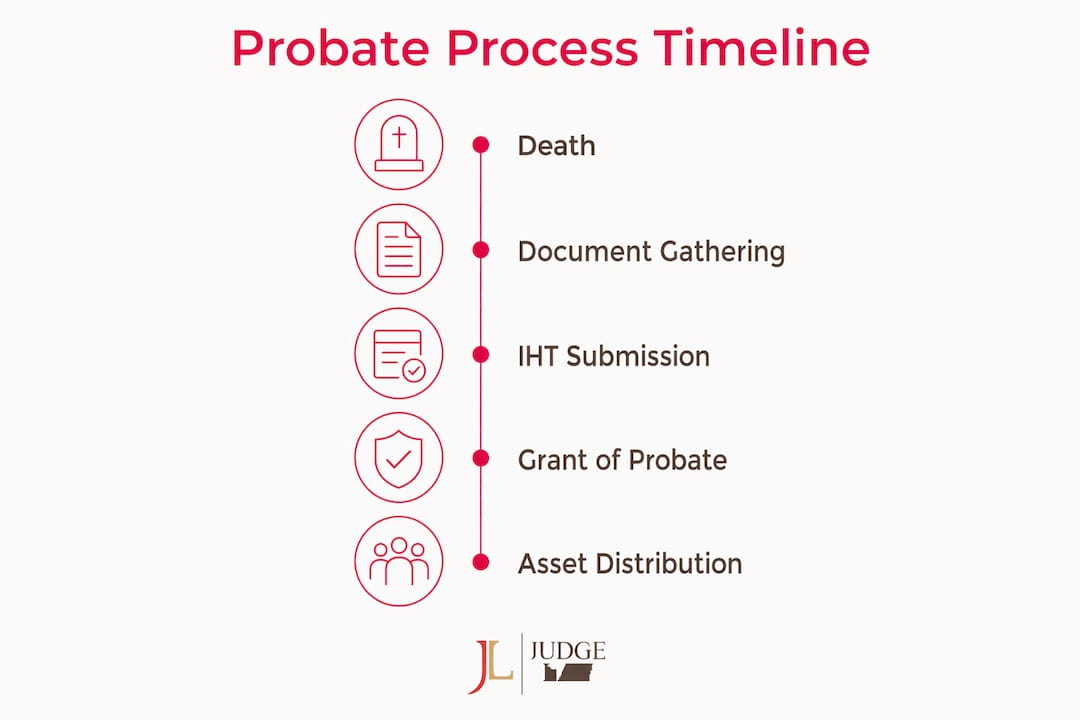
What are the typical stages of the UK probate timeline?
Understanding the sequence of events helps you anticipate where time is spent and where it is lost.
- Register the death and obtain the death certificate. This is usually completed within a few days of death and is required before any other step can proceed.
- Locate and verify the will. If no will exists, the estate is administered under the rules of intestacy, which can add complexity and time.
- Value the estate. This involves contacting banks, investment providers, pension administrators, and property valuers. For larger estates, professional valuations are required for IHT purposes.
- Submit the IHT return to HMRC. Where IHT is payable, the IHT400 form must be submitted and tax paid before probate is granted. This stage alone can take 4 to 8 weeks.
- Apply for the Grant of Probate. The application is submitted to HMCTS, either online or by post. GOV.UK says you will usually get probate within 12 weeks of submitting your application.
- Receive the Grant of Probate. Once issued, this document gives you legal authority to deal with the estate.
- Collect assets and settle debts. Banks, investment platforms, and pension providers each have their own processes for releasing funds. This stage can take several weeks after the grant is received.
- Distribute the estate. Final distributions to beneficiaries can only be made once all debts, taxes, and administration costs are settled.
The total time from death to final distribution commonly runs between 6 and 12 months for a typical estate. Where property is involved or disputes arise, 18 months to two years is not unusual. You can read more about the early stages in the first 30 days of probate guide on the Judge Law website.
Are probate delays getting worse in the UK?
For the longest cases, yes. Ministry of Justice figures obtained by Quilter through a Freedom of Information request show that the number of probate cases taking more than six months to be granted rose from 3,955 in 2020/21 to 9,480 in 2024/25 (down from a peak of 10,811 in 2023/24), around one in eight cases. Cases taking more than 18 months rose from 170 to 433 over the same period. Official statistics for April to June 2026 put the average time from application to grant at about 5 weeks for probate, but about 22 weeks for letters of administration with a will, and the open caseload was 19% higher than a year earlier. These figures reflect a system under pressure from growing caseloads and increasing estate complexity.
The table below illustrates the contrast between typical and extended probate durations.
| Estate type | Typical duration | Extended duration |
|---|---|---|
| Simple estate, no IHT, digital application | Up to 12 weeks | Longer if HMCTS needs more information |
| Estate with IHT liability | 4 to 6 months | 9 to 12 months |
| Estate with residential property | 6 to 9 months | 12 to 18 months |
| Complex or disputed estate | 12 to 18 months | 2 years or more |
Growing caseload and estate complexity contribute to unpredictable timelines, and executors are increasingly advised to plan for worst-case scenarios rather than optimistic ones. This matters practically. If you are managing cashflow for the estate, paying household bills on the deceased’s property, or maintaining a mortgage, a 12-month delay is not merely inconvenient. It is financially painful.
On the IHT front, at the current late payment interest rate of 7.75% a year, a £50,000 tax bill unpaid for six months beyond the deadline would accrue around £1,900 in interest. Staying on top of the IHT planning timeline is not optional.
Pro Tip: As executor, keep a running log of every document submitted, every call made, and every response received from HMCTS and HMRC. If your application is queried, a clear paper trail speeds up resolution considerably.
How does probate interact with property sales and asset distribution?
Receiving the Grant of Probate does not mean the estate is resolved. It means you now have legal authority to act. What follows is a separate administrative process that varies by asset type.
- Property sales. You can market a property and accept an offer before probate is granted, but exchange of contracts cannot take place until the grant is in hand. The conveyancing process then runs its own timeline, typically 10 to 14 weeks from offer to completion.
- Bank accounts. Most banks release funds within 2 to 4 weeks of receiving the Grant of Probate, though larger accounts or those with complex terms may take longer.
- Investment portfolios. Stockbrokers and investment platforms each have their own procedures. Expect 4 to 8 weeks for most accounts to be transferred or encashed.
- Land Registry. Where property is being transferred rather than sold, the Land Registry requires the Grant of Probate before updating the title register. Processing times at the Land Registry have themselves been subject to delays in recent years.
- Pension death benefits. These fall outside the estate in most cases and are dealt with separately by the pension provider, but they still require notification and documentation.
Asset release and estate distribution can add months to the overall timeline beyond the probate grant itself. Families who expect everything to be resolved the moment probate is granted often find the reality more drawn out.
Practical points from our work
The digitalisation of probate applications through the HMCTS Reform Programme was a genuine improvement. Before the online system, paper applications routinely sat in queues for months. The shift to digital processing brought real efficiency gains, and the data confirms it.
What we watch more closely is the direction of travel on complex cases. The rise in estates taking more than six months is not simply a backlog problem. It reflects the growing complexity of modern estates, more blended families, more digital assets, more property held in multiple names, and more people dying without having done any planning at all. The cases that take longest are almost always the ones where preparation was minimal.
In our work, the IHT paradox is the issue we most often see causing distress. Families are asked to pay a substantial tax bill before they can access the assets to pay it. That is not a flaw in the system that will be reformed away. It is the law. Understanding it early, and planning for it, makes an enormous difference to how the process feels.
Our advice is this: if the estate is anything other than very simple, get professional advice before you submit the application. A requisition from HMCTS or a query from HMRC adds weeks. A solicitor who knows the process can often prevent those delays before they happen. Patience is necessary, but it works best alongside preparation.
FAQ
How long does probate take in the UK on average?
GOV.UK says you will usually get probate within 12 weeks of submitting your application, although it can take longer if more information is needed. Complex estates, particularly those with inheritance tax or property, commonly take 6 to 12 months in total.
What causes probate to take longer than expected?
Incomplete applications, inheritance tax queries from HMRC, property involvement, and disputed wills are the most common causes of delay. No expedited service exists, so errors in the original application can add weeks to the process.
Can you sell a property before probate is granted?
You can market a property and accept an offer before probate is granted, but contracts cannot be exchanged until the Grant of Probate is in hand. The conveyancing process then proceeds separately.
What happens if inheritance tax is paid late?
Interest is charged on inheritance tax paid after the six-month deadline following the month of death, currently at 7.75% a year (the rate from 9 January 2026). This applies regardless of where the probate application stands at the time.
Is the probate process getting slower in the UK?
Long-duration cases have risen in recent years. Ministry of Justice figures obtained through a Freedom of Information request show that probate cases taking more than six months to be granted rose from 3,955 in 2020/21 to 9,480 in 2024/25, although that was down from 10,811 in 2023/24.