

TL;DR
- Instruct a solicitor before you sign heads of terms, so the deal structure, warranties and indemnities are negotiated with your interests in mind.
- Prepare corporate, employment, lease and financial documents early: good preparation shortens due diligence and keeps fees down.
- Legal fees vary widely with deal size and complexity, so ask for a written fee estimate broken down by stage.
- Business Asset Disposal Relief taxes qualifying gains at 18% for disposals from 6 April 2026 and must be claimed by the statutory deadline.
You’ve decided to sell. Maybe a buyer has approached you, maybe you’ve been planning this exit for years, or maybe circumstances have changed and the time is simply right. Whatever brought you to this point, one thing is consistent across almost every small business sale in the UK: the legal complexity arrives faster than sellers expect. Engaging the right solicitor early is not a formality. It is one of the most consequential decisions you will make in the entire process, directly affecting what you net from the sale, what liabilities follow you afterwards, and how smoothly the transaction concludes.
Why hiring a specialist solicitor matters
The most important document in any business sale is the Sale and Purchase Agreement. It governs every aspect of the transaction, from what is included in the sale to what happens if a problem surfaces two years later. A specialist small business sale lawyer does not just draft this document; they negotiate it with the buyer’s legal team to limit your exposure and allocate risk fairly between both parties.
Here is what a solicitor handles across a typical sale:
- Drafting, reviewing, and negotiating the Sale and Purchase Agreement
- Managing disclosure schedules to protect you against post-sale warranty claims
- Advising on commercial lease assignments or surrenders if your business occupies premises
- Handling employment law obligations under TUPE (Transfer of Undertakings) where staff transfer to the buyer
- Conducting legal due diligence responses and coordinating with your accountants and tax advisers
- Managing completion mechanics including the transfer of contracts, licences, and regulatory registrations
Solicitors managing legal compliance during a sale, including commercial lease transfers and employee-related matters, significantly reduce your risk of post-sale disputes. That alone justifies the cost. A buyer’s solicitor is working hard to protect the buyer. You need someone doing the same for you.
Pro Tip: Ask any solicitor you approach whether they specialise in business sales or mergers and acquisitions. A general high-street solicitor may be excellent at conveyancing but lack the commercial law experience to spot a problematic warranty clause or negotiate indemnity provisions effectively.
Engaging a specialist M&A solicitor reduces the risk of deal failure and costly errors that non-specialist lawyers frequently miss. The difference in outcome can be worth multiples of the fee difference.
Preparing your business for sale
Legal preparation is not something you do when the solicitor asks for documents. It is something you start months before you approach buyers. The businesses that sell smoothly and for the best terms are the ones where the seller has done the groundwork.
Here is a practical sequence for getting legally ready:
- Compile your corporate documents. Gather your certificate of incorporation, articles of association, shareholder agreements, and any existing contracts with customers, suppliers, and landlords.
- Audit your employment arrangements. Check that all contracts are signed, up to date, and reflect actual working arrangements. Undocumented or informal arrangements become expensive problems during due diligence.
- Resolve outstanding disputes. Any unresolved shareholder disputes or third-party claims will be disclosed to the buyer and can reduce the sale price or kill the deal entirely.
- Review intellectual property ownership. If your business relies on software, branding, or processes, confirm the company actually owns them rather than a founder personally.
- Clean up your accounts. Buyers and their accountants will scrutinise three years of financial records. Unexplained transactions or inconsistencies slow everything down and reduce confidence.
- Speak to your accountant early. Identify any tax exposures or structuring opportunities before the buyer’s advisers find them first.
The table below summarises the key document categories sellers should have ready before instructing a solicitor.
| Document category | Why it matters |
|---|---|
| Shareholder / partnership agreements | Governs how the sale proceeds are distributed and whether consent is needed |
| Customer and supplier contracts | Buyers need to assess whether contracts transfer and on what terms |
| Commercial leases | Lease assignment or surrender is a significant legal step requiring landlord consent |
| Employment contracts | Required for TUPE assessment and employee liability disclosures |
| Financial statements (3 years) | Forms the basis of buyer due diligence and price negotiations |
| IP ownership records | Confirms what the buyer is actually acquiring |
Poor preparation significantly increases the total cost of legal and professional fees because advisers spend more time on cleanup work rather than completing the transaction. A well-organised data room genuinely reduces your bill.

Pro Tip: Treat your pre-sale preparation as if you are already in due diligence. If a document would embarrass you in front of a buyer’s lawyer, resolve it now rather than during negotiations when your leverage is lower.
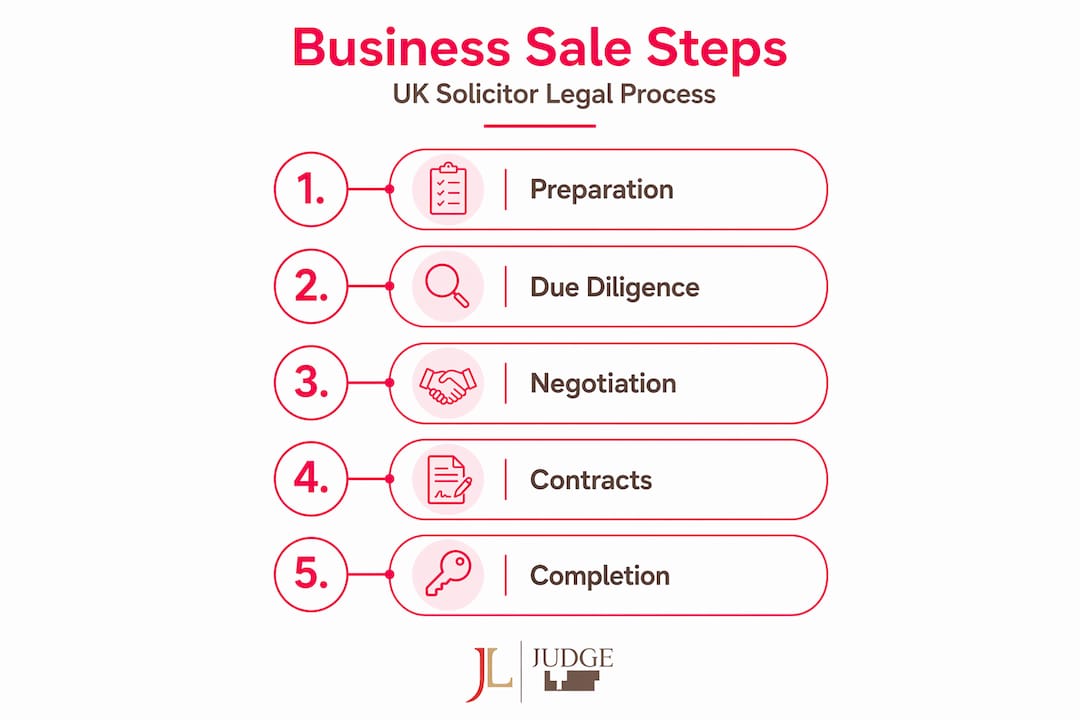
The legal process step by step
Understanding what your UK business transfer solicitor will actually do, and in what order, removes a lot of the anxiety from the process. Sales do not move in a perfectly linear way, but the broad sequence is predictable.
- Initial instructions and heads of terms. Your solicitor reviews any heads of terms agreed with the buyer. These are not usually legally binding but set the commercial framework. Getting legal input at this stage, before you sign anything, is strongly advised.
- Drafting or reviewing the Sale and Purchase Agreement. In most small business sales, the buyer’s solicitor drafts the agreement first. Your solicitor reviews it, identifies problematic clauses, and negotiates amendments.
- Disclosure process. You provide a disclosure letter and schedule, setting out anything that qualifies the warranties you give the buyer. This is your protection against post-sale claims.
- Due diligence responses. The buyer’s solicitors will raise detailed enquiries about your business. Your solicitor helps you respond accurately and in a way that limits future liability.
- Completion. Contracts are signed, consideration is transferred, and legal ownership of the business passes to the buyer.
- Post-completion formalities. Depending on the structure, this may include filing at Companies House, notifying HMRC, updating the register of members, and completing any property or lease transfers.
Common negotiation points to expect include:
- The scope and duration of restrictive covenants preventing you from competing after sale
- The quantum and time limits on warranty claims the buyer can bring
- Whether any element of the price is deferred or subject to earn-out conditions
- Indemnities relating to known issues such as tax disputes or environmental matters
The selling a business legal process is substantially more detailed than most sellers anticipate at the outset. Knowing this in advance means you will not be caught off guard when the process takes weeks, not days.
Understanding the costs involved
Let us be straightforward about what legal and professional fees look like for a small business sale in the UK.
Legal fees vary widely. They depend on the value of the deal, whether it is a share sale or an asset sale, how well prepared you are and how the buyer approaches negotiations. A straightforward sale costs considerably less than one involving earn-outs, deferred consideration or significant employee issues, so ask for a written estimate based on your own transaction.
The broader picture is more significant. Total professional costs, including any business broker, your accountants and your solicitors, can add up to a significant share of the sale price, particularly where a broker charges a percentage commission. Budget for all of them from the outset.
Key factors that push legal costs higher:
- Poor preparation. If your records are disorganised, your solicitor spends billable time finding and assessing information rather than progressing the sale.
- Employee issues. TUPE analysis, undocumented arrangements, or employment disputes significantly increase the legal work involved.
- Protracted negotiations. Buyers who are indecisive or who use prolonged negotiations as a tactic increase your legal bill with every exchange.
- Complex deal structures. Earn-outs, deferred consideration, and phased completions all require more legal documentation and negotiation.
| Fee type | What it covers | Typical model |
|---|---|---|
| Solicitor’s base fee | Drafting, advising, negotiating | Fixed fee or hourly rate |
| Success fee | Additional fee payable on completion | Percentage of deal value |
| VAT | Added to all legal fees | 20% on top of quoted fees |
| Disbursements | Searches, Companies House filings | Charged at cost |
Fixed-fee and success fee models offer greater cost predictability than traditional hourly billing. If you are given the option, a fixed fee arrangement removes the risk of costs spiralling during a protracted negotiation. Ask for it.
Pro Tip: Request a detailed fee estimate broken into transaction stages before instructing any solicitor. Understanding which stages carry the most cost allows you to prepare thoroughly and reduce time spent on administration.
You can find further detail on how solicitors structure their fees by reviewing Judge Law’s guide to legal costs before you begin approaching advisers.
Key tax considerations for 2026 sellers
Tax and legal matters in a business sale are inseparable. The structure of your sale, and the timing of your completion, can have a material effect on the amount you pay in capital gains tax.
Business Asset Disposal Relief (previously known as Entrepreneurs’ Relief) is the primary tax relief available to qualifying small business owners. The relief charges gains at 18% (for disposals on or after 6 April 2026, up from 14% in 2025/26) rather than standard capital gains tax rates, which is a substantial benefit. Critically, this relief is not automatic. You must make an active claim, and the deadline is the first anniversary of the 31 January following the tax year in which the disposal falls. For a sale completing in the 2025/26 tax year, the claim deadline is 31 January 2028; for a sale in the 2026/27 tax year, it is 31 January 2029.
Key tax points to discuss with your advisers:
- Business Asset Disposal Relief eligibility. On a share sale, for at least two years up to the date of sale you must have been an officer or employee of a trading company (or a member of a trading group) and held at least 5% of its shares and voting rights, with at least a 5% entitlement to its profits and assets or to the sale proceeds.
- Incorporation Relief. If you are transferring a business as a going concern to a company in exchange for shares, incorporation relief is given automatically where conditions are met, under HMRC Helpsheet HS276. You may elect out of this relief within statutory deadlines if it is not advantageous.
- Asset sale versus share sale. The tax treatment differs significantly depending on whether the buyer acquires the company’s shares or its underlying assets. Your accountant and solicitor need to align on this point early.
- Tax warranties and indemnities. In a share sale, the buyer takes on the company’s tax history. Expect robust tax warranties and potentially a tax deed, which your solicitor will need to negotiate carefully.
Missing a relief deadline costs you money that cannot be recovered. These administrative deadlines are not flexible, and late claims are refused.
My view on selling a business: what actually goes wrong
A perspective from Simarjot Singh Judge
I’ve worked with enough business owners going through a sale to see the same patterns repeat. The seller who is well-prepared moves through the process with relative ease. The seller who arrives without organised records, unresolved issues, or a clear understanding of what they are selling pays for that confusion in extra fees, delays, and sometimes a reduced price.
The most common mistake I see is treating the solicitor as someone to call once a deal is already agreed. By that point, you have lost significant leverage. A solicitor involved from the outset can shape how heads of terms are structured, flag issues before the buyer’s advisers find them, and advise on whether the deal structure actually serves your interests.
My honest advice: do not skimp on specialist experience to save on fees. A solicitor who regularly handles business sales will negotiate clauses a generalist would not even recognise as contentious. The fee difference between a specialist and a generalist is small relative to the deal value. The outcome difference is not.
View your legal adviser as a partner in the transaction, not a cost to be minimised. The best sales I have seen completed smoothly because the seller came prepared, engaged the right specialists, and treated legal advice as an investment in the result rather than a box to tick.
FAQ
What does a solicitor do when selling a small business?
A solicitor drafts and negotiates the Sale and Purchase Agreement, manages disclosure schedules, handles due diligence responses, and oversees completion mechanics to protect the seller from future liabilities.
How much do solicitors charge for selling a business in the UK?
Fees depend on the value, structure and complexity of the deal and on how well prepared the business is. Ask for a written estimate broken down by stage, and remember that VAT and disbursements are added.
Do I need a specialist solicitor to sell my small business?
Using a specialist is strongly advisable. Specialist M&A solicitors reduce the risk of deal failure and identify issues that general practitioners routinely miss in business sale negotiations.
What is Business Asset Disposal Relief and when must I claim it?
Business Asset Disposal Relief reduces capital gains tax on qualifying business disposals to 18% for disposals on or after 6 April 2026 (14% in 2025/26). The claim must be submitted by the first anniversary of the 31 January following the tax year in which the sale completes, for example 31 January 2028 for a 2025/26 sale.
What are the key takeaways for selling a small business in the UK?
| Point | Details |
|---|---|
| Engage a specialist early | Instruct a solicitor before heads of terms are signed to retain maximum leverage |
| Prepare your documents | A well-organised data room reduces professional fees and speeds due diligence |
| Budget for total costs | Professional fees across solicitors, brokers and accountants can be significant, so budget for them early |
| Claim tax reliefs on time | Business Asset Disposal Relief must be actively claimed before the statutory deadline |
| Negotiate fee structures | Fixed fees offer more cost predictability than hourly billing for business sale work |