
TL;DR
- The small claims limit is £10,000 in England and Wales, and £5,000 in both Scotland (simple procedure) and Northern Ireland.
- Personal injury claims have lower limits: £5,000 for road traffic injuries and £1,500 for most other injuries.
- Court issue fees in England and Wales range from £35 to £455, depending on the value of the claim.
- Most defended small claims must go to a free mediation appointment of up to one hour before any hearing.
- Exposure to the other side’s legal costs is limited on the small claims track, unlike the fast and intermediate tracks.
The small claims court UK limit is defined as the maximum monetary value of a dispute that qualifies for the simplified small claims track within the civil court system. In England and Wales, that ceiling sits at £10,000. Scotland and Northern Ireland both set their limits at £5,000. These figures are not arbitrary. They determine which procedural rules apply to your case, how much you pay in court fees, and whether you face significant legal cost exposure if things go wrong. If you are weighing whether to pursue a financial dispute through the courts, understanding where your claim sits relative to these thresholds is the most important calculation you will make.
What is the small claims court limit in England and Wales?

The monetary limit for small claims in England and Wales is £10,000, excluding interest and court fees. This figure represents the maximum value of the underlying dispute, not the total amount you submit to the court. If your claim is worth £9,800 and you are also seeking £400 in interest, the claim still qualifies for the small claims track because the principal sum falls below the threshold.
The types of disputes that typically fall within this limit include:
- Unpaid invoices and contract disputes between individuals or businesses
- Faulty goods or poor workmanship by a trader
- Disputes over deposits or refunds
- Minor property damage caused by a third party
- Disputes with landlords over deposits, provided they do not involve housing disrepair
Personal injury claims and housing disrepair claims are treated differently. Personal injury claims have lower small claims thresholds (£5,000 for road traffic accident injuries and £1,500 for most other injuries, measured by the damages for the injury itself), and a tenant’s housing disrepair claim is only a small claim where the estimated cost of the repairs and any other damages are each no more than £1,000. Filing a personal injury claim as a straightforward money claim without recognising this distinction is a procedural error that can carry real financial consequences.
Pro Tip: When calculating your claim amount, exclude interest and court fees from the total. The £10,000 limit applies to the core value of your dispute only.
How do small claims limits differ across Scotland and Northern Ireland?
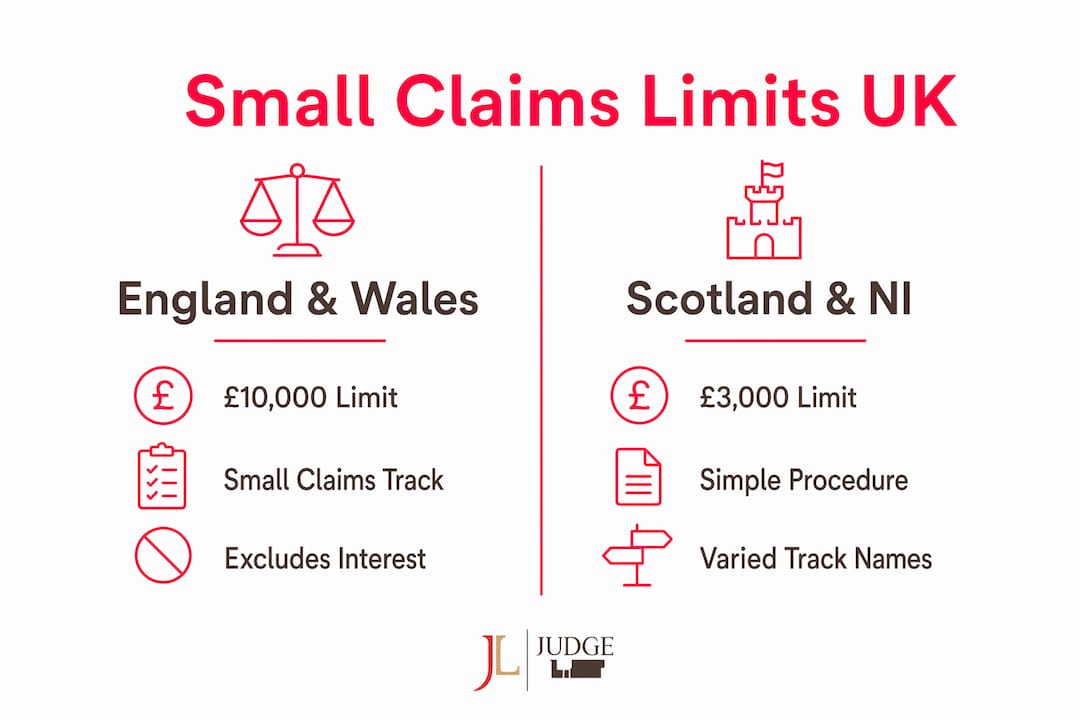
The small claims limits across UK jurisdictions vary significantly, and the procedural frameworks differ too. Scotland operates its own distinct legal system. Claims up to £5,000 are heard in the sheriff court under the simple procedure, which is the Scottish equivalent of the small claims track in England and Wales. Northern Ireland sets its limit at £5,000, with claims processed through the county court under a simplified procedure designed to be accessible without legal representation.
| Jurisdiction | Maximum claim amount | Court or track | Procedural name |
|---|---|---|---|
| England and Wales | £10,000 | County Court | Small claims track |
| Scotland | £5,000 | Sheriff Court | Simple procedure |
| Northern Ireland | £5,000 | County Court | Small claims procedure |
The practical implication of these differences is significant. A dispute worth £7,500 qualifies for the small claims track in England and Wales, but would exceed the £5,000 limits in Scotland and Northern Ireland. Before you file anything, confirm which jurisdiction applies to your dispute. This is usually determined by where the defendant is based or where the contract was performed, not where you live.
Pro Tip: If your dispute crosses borders within the UK, for example a contract agreed in Scotland but performed in England, take legal advice on jurisdiction before filing. Getting this wrong delays your case and may cost you the filing fee.
What are the court fees for small claims in England and Wales?
Court fees for small claims in England and Wales follow a sliding scale based on the value of your claim. The issue fee is the same whether you file online through Money Claim Online (MCOL) or on a paper form.
The issue fees are as follows:
| Claim value | Issue fee |
|---|---|
| Up to £300 | £35 |
| £300.01 to £500 | £50 |
| £500.01 to £1,000 | £70 |
| £1,000.01 to £1,500 | £80 |
| £1,500.01 to £3,000 | £115 |
| £3,000.01 to £5,000 | £205 |
| £5,000.01 to £10,000 | £455 |
A few points worth understanding about these fees:
- Fees are paid upfront at the point of filing and are non-refundable if you withdraw your claim
- Court fees are recoverable if you win, as the court will typically order the losing party to reimburse them
- If you lose, you bear your own filing fee and cannot recover it
- Fee remission is available for claimants on low incomes, through the Help with Fees scheme (form EX160)
The cost-benefit calculation matters here. A claim worth £600 costs £70 to file online. If the defendant pays up after receiving the claim form, you recover that fee. If the case goes to a full hearing and you lose, you are £70 out of pocket, plus the £85 hearing fee for a claim of that size, on top of whatever the original dispute cost you. For claims close to the £10,000 ceiling, the £455 filing fee is a meaningful sum to factor into your decision.
What is the small claims process and how does track allocation work?
The UK small claims process follows a defined sequence of steps, and the claim limit directly shapes which track your case is assigned to and what rules govern it.
-
Send a letter before action. Before filing, you are required to write to the other party setting out your claim and giving them a reasonable opportunity to respond. In a straightforward case, 14 days is usually a reasonable time to allow for a response. If a business is claiming a debt from an individual, including a sole trader, the Pre-Action Protocol for Debt Claims requires you to allow 30 days. This step is not optional. Courts expect it, and skipping it can count against you. A well-drafted letter before action also prompts many defendants to settle without any court involvement at all. Judge Law’s guide to recovering business debts covers this step in detail.
-
File your claim. If the defendant does not respond or disputes the debt, you file your claim through MCOL for straightforward money claims, or via a paper N1 claim form for more complex matters. MCOL is faster and generates an immediate claim number.
-
Await the defence. The defendant has 14 days to acknowledge the claim and a further 14 days to file a full defence. If they do neither, you can apply for a default judgment.
-
Attend mediation. For most defended claims worth £10,000 or less, both parties must attend a free telephone mediation appointment of up to one hour with the Small Claims Mediation Service before the case goes to a hearing. Agreeing a settlement is still voluntary, but failing to attend can lead to sanctions, including the claim being struck out. If the dispute settles, both parties are spared the time and stress of a court appearance.
-
Attend the hearing. If mediation fails, the case proceeds to a hearing. Small claims hearings are informal and are often held in a judge’s private room rather than a formal courtroom. You do not need a barrister or solicitor, and the rules of evidence are applied with flexibility. The judge will hear both sides and deliver a judgment, sometimes on the day.
Claims below £10,000 are allocated to the small claims track. Claims above that figure move to the fast track or the intermediate track, where the procedural rules are stricter, hearings are more formal, and crucially, the losing party faces exposure to the winner’s legal costs. That cost risk is largely absent in the small claims track, which is one of the most important protections the system offers.
Pro Tip: Use MCOL for straightforward money claims. It is faster, and the online portal guides you through the process step by step. Paper forms are slower.
What claim types and exceptions affect your eligibility for the small claims track?
Not every dispute below £10,000 automatically qualifies for the small claims track. The type of claim matters as much as the amount, and misclassifying a claim can expose you to costs and complexity you did not anticipate.
The key exceptions and special categories are:
- Personal injury claims. These carry a lower small claims threshold of £5,000 for road traffic accident injuries and £1,500 for most other personal injury claims. A personal injury claim (other than a road traffic claim) where the damages for the injury itself are worth £3,000 will not be treated as a small claim even though it falls below the general £10,000 limit. It will be allocated to the fast track, where costs rules are more demanding.
- Housing disrepair claims. Claims against landlords for disrepair are subject to their own allocation rules. Even where the financial value is modest, housing disrepair and personal injury claims are often treated as too complex for the small claims track and directed to higher tracks.
- Claims involving injunctions. If your dispute requires the court to order someone to do something or stop doing something, rather than simply pay a sum of money, the small claims track is unlikely to be appropriate regardless of the financial value involved.
- Harassment and unlawful eviction claims by tenants. A tenant’s claim against a landlord for harassment or unlawful eviction cannot be allocated to the small claims track under the Civil Procedure Rules.
The risk of incorrect categorisation is real and worth taking seriously. A claimant who files a personal injury matter as a general money claim may find their case reallocated mid-proceedings, with costs consequences that far outweigh the original dispute. If your claim touches on any of these categories, getting the classification right before you file is far more valuable than saving a few hours on the paperwork.
Practical points from our work
The small claims track is genuinely one of the more accessible parts of the English legal system, and in our work we find it is underused by individuals who assume the courts are too intimidating or expensive for disputes of this size. The informal hearing format, the absence of significant costs risk, and the availability of MCOL make it a realistic option for many people who would otherwise write off a legitimate claim.
That said, we often see two consistent mistakes. The first is filing a claim without sending a proper letter before action. A well-written letter, setting out the facts clearly and giving the other party a genuine opportunity to respond, resolves more disputes than people expect. It also demonstrates to the court that you acted reasonably, which matters if the case proceeds. Judge Law’s guidance on civil litigation outcomes explores this dynamic in more detail.
The second mistake is assuming that because a claim is below £10,000, it is automatically straightforward. Claims involving personal injury, housing disrepair, or any element of injunctive relief sit in a different category entirely. Filing them on the wrong track is not a minor administrative error. It can shift the entire costs position of the case. If your claim is close to the £10,000 ceiling, or involves any of the exception categories, a short conversation with a solicitor before you file is money well spent. The small claims system is designed for self-representation. It is not designed for cases that have been misclassified into it.
FAQ
What is the small claims court limit in England and Wales?
The small claims court limit in England and Wales is £10,000, excluding interest and court fees. Claims below this threshold are allocated to the small claims track under the Civil Procedure Rules.
How much does it cost to file a small claim online?
Online filing fees range from £35 for claims under £300 to £455 for claims between £5,000.01 and £10,000. Fees are paid upfront and are recoverable if you win your case.
Can I represent myself in the small claims court?
Yes. Small claims hearings are designed to be accessible to individuals without legal representation. Hearings are informal and are often held in a judge’s private room rather than a formal courtroom.
Do personal injury claims qualify for the small claims track?
Not at the standard £10,000 limit. Personal injury claims have a lower threshold: £5,000 for road traffic accident injuries and £1,500 for most other injuries. Claims above the relevant threshold are typically allocated to the fast track rather than the small claims track.
What happens if my claim exceeds the small claims limit?
Claims above £10,000 in England and Wales are allocated to the fast track or intermediate track. These tracks carry stricter procedural rules and greater exposure to the other party’s legal costs if you lose, making correct claim valuation and classification particularly important.