

TL;DR
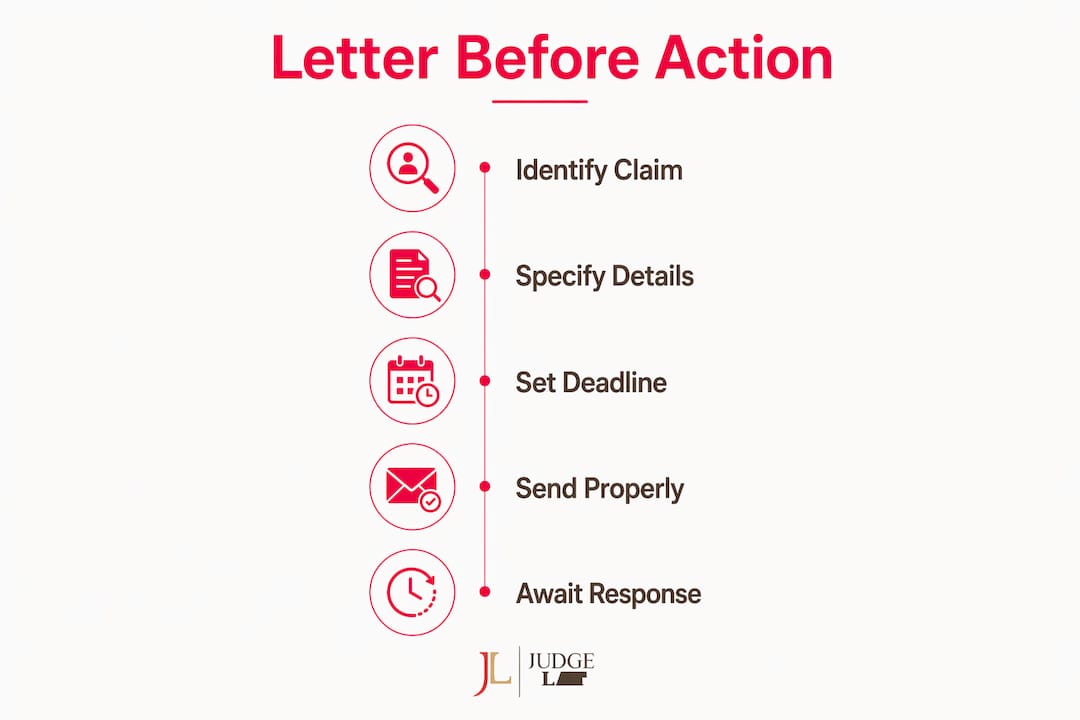
- A letter before action sets out your claim, the remedy you want and a deadline to respond before court proceedings start.
- It should include both parties’ details, the facts, the legal basis, the amount or remedy sought, key documents and a response deadline.
- Debt claims by a business against an individual follow the Pre-Action Protocol for Debt Claims, which gives the debtor 30 days to respond.
- Other disputes need a reasonable deadline; 14 days is common for a straightforward commercial debt.
- Send it by recorded delivery and email, and keep proof; ignoring pre-action rules can lead to costs penalties even if you win.
A letter before action in the UK is a formal pre-litigation notice sent to another party to set out your claim, state the remedy you seek, and warn that court proceedings will follow if the matter is not resolved. Also known as a letter of claim or pre-action letter, it is the recognised first step in UK civil dispute resolution and sits at the heart of the Practice Direction on Pre-Action Conduct and Protocols (PDPACP). Sending one is not merely good practice. Under UK Civil Procedure Rules, courts expect parties to attempt resolution before issuing proceedings, and failure to send a compliant letter can result in adverse cost orders even if you ultimately win your case. Whether you are pursuing an unpaid invoice, a breach of contract, or a consumer dispute, understanding this process is the first step toward resolving it.
What must a letter before action include to comply with UK legal standards?
A valid letter before action must contain specific elements to satisfy UK legal requirements and give the recipient a genuine opportunity to respond. Missing any of these components risks non-compliance with pre-action protocols, which courts take seriously when assessing conduct and awarding costs.
The core content requirements are as follows:
- Full contact details for both parties. Include the claimant’s name, address, and contact information, along with the full name and address of the recipient. For businesses, use the registered company name and address.
- A clear factual background. Set out a chronological summary of the dispute. Describe what happened, when it happened, and why you believe the other party is liable. Stick to facts and avoid emotional language.
- The legal basis of your claim. State whether you are claiming for breach of contract, an unpaid debt, negligence, or another legal cause of action. You do not need to cite case law, but the legal ground must be identifiable.
- The precise remedy or amount sought. Specify the exact sum claimed, including any interest calculated under the Late Payment of Commercial Debts (Interest) Act 1998 if applicable, and any costs you intend to recover.
- Supporting documents. List and attach copies of all relevant evidence, such as invoices, contracts, purchase orders, and prior correspondence. Courts expect you to have disclosed your key documents at this stage.
- A reasonable response deadline. State clearly how many days the recipient has to respond and from which date that period runs.
- A statement of intent. Confirm that if no satisfactory response is received, you will issue court proceedings without further notice.
- An offer of alternative dispute resolution (ADR). While not mandatory in all cases, courts look favourably on parties who invite ADR such as mediation. Refusing ADR without good reason can affect costs.
| Element | Required? | Notes |
|---|---|---|
| Parties’ full details | Yes | Include registered addresses for companies |
| Factual background | Yes | Chronological and factual only |
| Legal basis of claim | Yes | Identify cause of action clearly |
| Amount or remedy sought | Yes | Include interest and costs calculations |
| Supporting documents | Yes | Attach copies, list in the letter |
| Response deadline | Yes | State in clear days from a specified date |
| Intent to issue proceedings | Yes | Must be explicit |
| ADR offer | Recommended | Omission can affect cost awards |
Pro Tip: Always date your letter and keep a copy of the exact version sent. If the matter proceeds to court, the letter itself becomes a piece of evidence and the court will scrutinise its contents carefully.
Courts consider the letter as evidence of reasonable conduct, which directly affects how costs are awarded at the end of proceedings. A well-prepared letter signals to the court that you acted proportionately and in good faith.
How to calculate response deadlines and serve your letter correctly
Setting the right deadline is one of the most technically precise parts of the process, and getting it wrong carries real consequences. Using an incorrect deadline can be cited by defendants as evidence of non-compliance, which may complicate your position in court.

The concept of “clear days” is central here. Clear days means you do not count the day the letter is sent or the day the deadline expires. So if you send a letter on 1 June and give 14 clear days, the deadline falls on 16 June, not 15 June.
Pre-action protocols specify minimum timeframes depending on the type of claim. The key distinctions are:
- Debt claims against individuals. The Pre-Action Protocol for Debt Claims, which came into force in 2017, gives the debtor 30 days from the date of the letter of claim to respond. This is a firm requirement, not a guideline.
- Business-to-business disputes. There is no single fixed period, but the response time must be reasonable given the complexity and value of the claim. In practice, 14 clear days is common for straightforward commercial debts, while more complex disputes may warrant 28 days or more.
- Personal injury and clinical negligence claims. These have their own specific protocols with longer timeframes, often running to months rather than weeks.
- Construction and engineering disputes. The Pre-Action Protocol for Construction and Engineering Disputes requires a detailed letter of claim and allows the defendant 14 days to acknowledge and 28 days to respond in full, which can be extended by agreement for complex claims.
How you send the letter matters as much as what it contains. Sending by recorded delivery and email provides verifiable proof of service, which is critical if court proceedings follow. Retain your postal receipts, delivery confirmations, read receipts, and email headers. If the recipient later claims they never received the letter, this evidence becomes your defence against that argument.
Pro Tip: Send the letter by both first-class recorded delivery and email on the same day. This dual method maximises the chance of confirmed receipt and gives you two independent proofs of service.
Avoid sending letters by ordinary post alone. Without proof of delivery, a recipient can credibly deny receipt, and you will have no documentary evidence to counter that claim in court.
What to do if there is no response, or the response is unsatisfactory
Receiving silence after sending a pre-litigation letter is frustrating, but it does not leave you without options. The absence of a response is itself meaningful. It tells you the other party is either unwilling to engage or hoping you will not follow through.
Your next steps should be methodical:
- Send a brief reminder. A short, firm follow-up letter referencing your original letter, confirming the deadline has passed, and stating that you intend to issue proceedings is appropriate. Keep it factual and free of threats beyond the legal action you genuinely intend to take.
- Review any response you did receive. If the other party replied but their response is inadequate, consider whether it raises any new facts you need to address. Do not ignore partial responses; acknowledge them and explain why they do not satisfy your claim.
- Issue court proceedings. For specified money claims up to £100,000 against no more than two defendants, Money Claims Online (MCOL) is the standard online route. You can file your claim through the MCOL portal, which is administered by His Majesty’s Courts and Tribunals Service (HMCTS). For claims outside those limits, you will need to issue proceedings at the County Court or, for higher-value or complex claims, potentially the High Court.
- Preserve all correspondence. Every letter, email, text message, and delivery receipt should be saved and organised chronologically. Courts expect claimants to produce a clear evidence bundle, and gaps in the record weaken your position.
- Understand your enforcement options. Winning a judgment is not the end of the process if the defendant still does not pay. Enforcement options include warrants of control, attachment of earnings orders, and charging orders over property. Each has different costs and timescales, and the right choice depends on what assets the defendant holds.
You can also review civil litigation outcomes in the UK to understand realistic settlement rates and what the litigation process typically involves before committing to court proceedings.
When to seek professional legal advice for your letter before action
Not every dispute requires a solicitor to draft the initial letter. A straightforward unpaid invoice between two businesses, where the facts are clear and the amount is modest, is something many people handle themselves. But there are situations where professional input is not just helpful. It is the difference between recovering what you are owed and losing your costs position entirely.
Consider taking legal advice when:
- The claim is high value or legally complex. Generic templates lack the nuanced legal positioning needed in commercial disputes involving multiple parties, contested liability, or significant sums. A solicitor will tailor the letter to the specific facts and legal arguments in play.
- The dispute is contested. If the other party has already denied liability or raised a counterclaim, your letter needs to address those arguments directly. A poorly worded response to a contested position can inadvertently concede points you did not intend to give up.
- You are unsure which pre-action protocol applies. Applying the wrong protocol, or none at all, can result in the court penalising you on costs even if you win on the merits.
- ADR strategy needs careful thought. A solicitor can advise on whether to propose mediation, what form of ADR is appropriate, and how to frame that offer in a way that protects your costs position if the other party refuses.
- You are dealing with a regulated debt. Consumer credit agreements and regulated financial products carry additional compliance requirements under the Financial Conduct Authority (FCA) framework, and the letter must reflect those obligations.
Pro Tip: Even if you draft the letter yourself, having a solicitor review it before sending costs far less than correcting a procedural error after proceedings have been issued.
Understanding UK debt collection law is also relevant here, particularly if your claim involves a consumer debtor, where the regulatory framework places additional obligations on creditors.
What I have learned about letters before action in practice
By Simarjot Singh Judge
The most common mistake I see is not the one people expect. It is not missing a legal element or getting the deadline wrong. It is tone. Letters that read as angry, threatening, or personal almost always make resolution harder, not easier. The recipient becomes defensive, and what could have been a straightforward payment becomes a contested dispute.
A well-crafted pre-action letter is, at its core, a business document. It states facts, identifies a legal position, and invites a response. That is all it needs to do. Clear, factual letters improve the chances of early settlement and preserve a positive costs position, which matters enormously if the matter does reach court.
The second thing I would say is this: documentation is everything. I have seen strong claims fail not because the legal argument was weak, but because the claimant could not produce a coherent evidence trail. Keep every invoice, every email, every delivery note. Organise them before you write the letter, not after.
Finally, do not underestimate how often a well-drafted letter resolves the dispute entirely. Many recipients, when faced with a clear, professional notice that court proceedings are imminent, choose to pay or negotiate rather than incur the cost and disruption of litigation. The letter is not just a procedural formality. It is often the most effective tool you have.
FAQ
What is a letter before action in the UK?
A letter before action is a formal written notice sent before issuing court proceedings, setting out the claimant’s legal position, the remedy sought, and a deadline for response. It is required or strongly expected under the Practice Direction on Pre-Action Conduct and Protocols.
How long should I give the recipient to respond?
The required period depends on the claim type. Debt claims by a business against an individual allow the debtor 30 days to respond under the 2017 Pre-Action Protocol for Debt Claims, while business-to-business disputes allow flexible but reasonable timeframes, typically 14 to 28 days.
Does a letter before action have to be sent by a solicitor?
No. Anyone can send a letter before action, but a solicitor should draft or review it when the claim is high value, legally complex, or contested, as generic templates often lack the tailored legal positioning needed to protect your costs position.
What happens if I do not send a letter before action before going to court?
Courts can impose adverse cost orders on parties who issue proceedings without first following pre-action protocols, even if the claimant wins the case. The PDPACP guidance makes clear that non-compliance carries procedural and financial consequences.
Can a letter before action be sent by email?
Yes. Email is an acceptable method of service, but you should also send the letter by recorded delivery to establish dual proof of receipt. Retain email headers, read receipts, and postal delivery confirmations in case the recipient disputes having received the letter.