

TL;DR
- Unmarried couples in England and Wales have no automatic rights over each other’s property, income or pension when they separate, however long they have lived together.
- A cohabitation agreement records how property, bills, debts and savings will be handled during the relationship and on separation.
- To give it the best chance of being upheld, put it in writing, sign it as a deed, take separate legal advice and make full financial disclosure.
- If you later marry, the agreement is usually superseded, so a prenuptial or postnuptial agreement is needed.
- The Government consulted on cohabitation reform in 2026, but the proposals are not law.
A cohabitation agreement in the UK is a legally binding contract between two unmarried people living together that sets out how property, finances, and other shared arrangements will be managed during the relationship and upon separation. Without one, you have no automatic legal rights over your partner’s assets, income, or pension, regardless of how long you have lived together. The ONS estimates there were around 3.5 million cohabiting couple families in the UK in 2025, and many cohabitants may be unaware of the exposure they carry. The idea of “common law marriage” granting automatic rights after a period of cohabitation is a legal myth officially debunked by UK government guidance. A living together agreement, as it is sometimes called, is the practical tool that fills this gap right now, before any future reform arrives.
What rights do cohabiting couples currently lack under UK law?
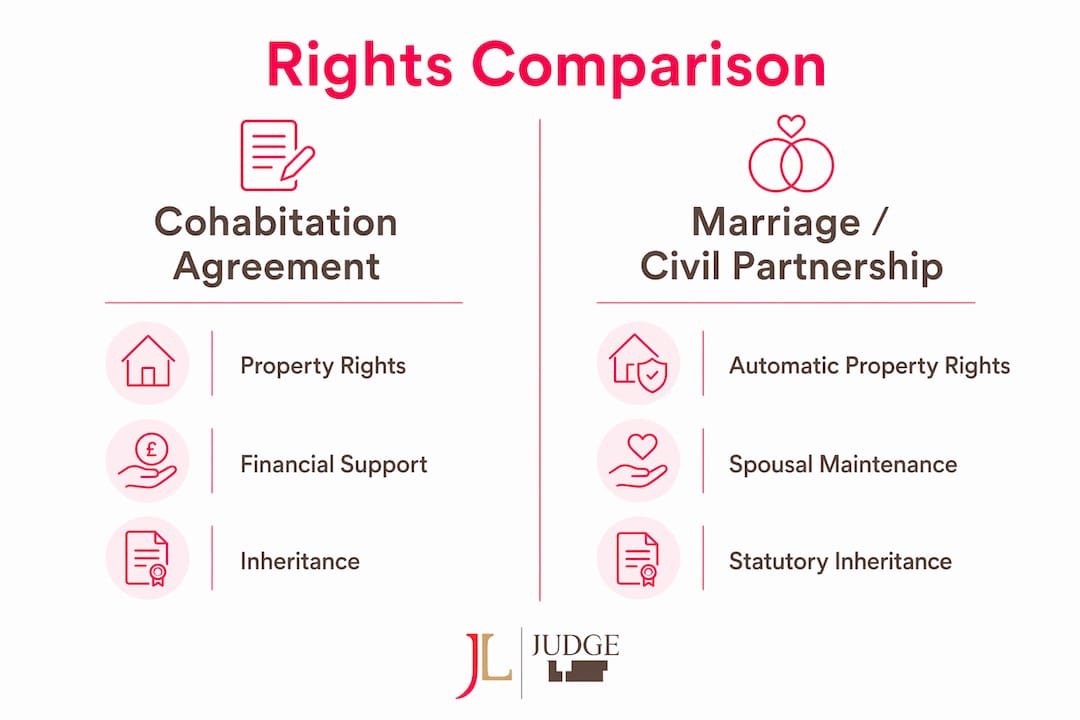
The legal position for unmarried couples in England and Wales is stark. Marriage and civil partnership confer automatic rights over property, pensions, and financial support on separation. Cohabitation confers none of those things. You could share a home, raise children, and pool finances for twenty years, and the law would still treat you largely as strangers when the relationship ends.
The specific gaps are significant:
- Property. If your name is not on the title deeds or mortgage, you have no automatic entitlement to a share of the property, even if you contributed to the deposit or mortgage payments.
- Financial maintenance. Unlike divorcing spouses, separating cohabitants cannot claim ongoing financial support from each other.
- Pension sharing. There is no mechanism for cohabitants to share pension assets on separation, regardless of the financial sacrifices one partner may have made.
- Inheritance. Without a valid will, a cohabiting partner inherits nothing under the intestacy rules in England and Wales.
The legal remedies that do exist are limited and costly. TOLATA claims (under the Trusts of Land and Appointment of Trustees Act 1996) allow a cohabitant to argue for a beneficial interest in property, but the litigation is expensive, slow, and deeply uncertain in outcome. Claims under the Children Act 1989 can provide some financial relief where children are involved, but they are focused on the child’s needs rather than the financial position of the adult partner. Both routes are reactive, painful, and far more costly than putting a proper agreement in place beforehand.
The UK Government has set out plans for cohabitation law reform. Its consultation, “A fairer end to relationships”, ran from 5 June to 14 August 2026 and proposed new rights for eligible cohabitants on separation and where a partner dies without a will. These are proposals only: any change would need legislation to pass through Parliament. Reform may come, but it will not come quickly, and it does not change the law today. The couples who are unprotected today will remain unprotected until they take action themselves.
What does a cohabitation agreement typically include?
A cohabitation agreement, sometimes called a cohabitation contract in UK legal practice, is more flexible than many couples expect. It is not a document that anticipates the worst. It is a document that records what you have both agreed, clearly and in writing, so that neither of you is left guessing if circumstances change.
A well-drafted agreement typically covers the following areas:
- Property ownership. Whether the property is owned jointly or by one partner, what share each person holds, and how any increase in value will be treated on sale or separation.
- Financial contributions. How mortgage payments, rent, household bills, and day-to-day expenses are divided, and what happens if one partner’s income changes significantly.
- Debt allocation. Which debts belong to which partner, and how joint debts will be managed or divided.
- Separation arrangements. What happens to the property if you separate, including the right to buy out the other partner’s share, timescales for sale, and how proceeds are split.
- Support obligations. Whether either partner will provide financial support to the other during or after separation, particularly where one partner has reduced their working hours to care for children.
- Personal property. How significant items such as vehicles, savings accounts, and investments are treated.
The agreement should also sit alongside a properly drafted will. A cohabitation agreement does not automatically give your partner inheritance rights. Without a will, the intestacy rules apply regardless of what your agreement says about your intentions. Treating the two documents as a package gives you the most complete protection available under current UK cohabitation laws.
Pro Tip: Frame the process of creating a living together agreement as a financial planning conversation, not a legal precaution against the relationship failing. Couples who approach it that way tend to engage more openly, disclose more fully, and produce agreements that actually reflect their intentions.

How does a cohabitation agreement compare to a marriage contract?
The differences between a cohabitation agreement and the legal framework that applies on marriage are worth understanding clearly, particularly if marriage is something you are considering in the future.
| Feature | Cohabitation agreement | Marriage / civil partnership |
|---|---|---|
| Who it applies to | Unmarried cohabiting couples | Married couples or civil partners |
| Automatic property rights | No. Defined by the agreement and legal ownership | Yes, subject to court discretion on divorce |
| Financial maintenance on separation | Only if included in the agreement | Available through court order on divorce |
| Pension sharing | Not available | Available through pension sharing order |
| Inheritance without a will | Not provided | Spouse inherits under intestacy rules |
| Effect of marriage | Usually superseded on marriage; a prenuptial or postnuptial agreement is needed | Governed by matrimonial law |
The table above illustrates why a cohabitation agreement is not a substitute for the protections that come with marriage. It is, however, the best available protection for couples who are not married, and it remains relevant even if marriage is planned. The period between moving in together and getting married can span years, and a great deal can change financially during that time. Relying on the intention to marry as a reason to delay the agreement is a risk that courts cannot remedy after the fact.
For couples who do marry, the cohabitation agreement does not automatically carry over. A prenuptial agreement or postnuptial agreement would be needed to address financial arrangements within the marriage. You can read more about how these different agreements protect assets and how they interact with one another.
How do you create a valid cohabitation agreement in the UK?
The enforceability of a cohabitation agreement depends on how carefully it is prepared. A document that is vague, one-sided, or signed without proper process is unlikely to carry weight if it is ever challenged. The steps below reflect what is required to give an agreement the best prospect of being upheld.
- Put it in writing. A verbal understanding between cohabitants is hard to prove and may not be enforceable, particularly where it concerns land, which generally needs to be dealt with in writing. The agreement should be a written document.
- Sign and witness it correctly. Both parties must sign the agreement, and those signatures should be witnessed. The agreement is typically executed as a deed to give it greater legal weight.
- Seek independent legal advice. Each partner should take advice from a separate solicitor before signing. This is not a formality. It demonstrates that both parties understood what they were agreeing to and were not pressured into signing.
- Make full financial disclosure. Both partners should disclose their assets, income, debts, and liabilities before the agreement is finalised. An agreement reached without proper financial transparency is vulnerable to challenge on the grounds that one party did not have the full picture.
- Avoid unfair terms. Courts will scrutinise agreements that appear heavily weighted in favour of one party. The agreement does not need to be equal, but it must be fair in the context of the relationship and the circumstances at the time of signing.
- Review it when circumstances change. A significant change, such as the birth of a child, a major property purchase, or a substantial shift in either partner’s financial position, is a signal to revisit and update the agreement.
Pro Tip: Do not wait until you are about to move in together to start the conversation. The earlier you begin, the less pressure there is on the process, and the more time both of you have to take proper advice and consider the terms carefully.
One point that catches couples off guard: if you subsequently marry, your cohabitation agreement will usually be superseded. Many agreements say they end on marriage, and on any divorce the court decides finances under matrimonial law, treating an earlier agreement as one factor at most. You would need a postnuptial agreement to carry any of those arrangements forward into the marriage. Understanding how separation and financial disputes are handled differently for married and unmarried couples helps clarify why the timing of any agreement matters.
Practical points from our work: why waiting for reform is a risk
The Government’s 2026 consultation on cohabitation law reform is welcome. But reform, even if it produces legislation, is likely to take years to pass through Parliament and come into force. Cohabiting couples who are unprotected today will not be protected by a consultation paper.
In our work we often see the gap between what couples assume and what the law actually provides. People move in together, buy property together, have children together, and build entire financial lives together on the assumption that the law will treat them fairly if things go wrong. It will not. The law as it stands is not cruel, but it is indifferent to the length or depth of a relationship that was never formalised.
The framing matters too. Cohabitation agreements are best presented as empowerment tools, not as preparations for failure. Agreeing on financial arrangements while the relationship is strong and both parties are thinking clearly is not pessimistic. It is the most rational thing two people sharing a life can do.
Our advice is simple. Do not wait for the law to catch up. Do not assume that time together creates legal rights. Get the agreement in place, take proper advice, and review it when your circumstances change. The cost of doing it properly is a fraction of the cost of TOLATA litigation or a contested property dispute.
FAQ
What is a cohabitation agreement in the UK?
A cohabitation agreement is a legally binding contract between two unmarried people living together that sets out their respective rights and responsibilities over property, finances, and other shared arrangements. It provides protection that UK law does not automatically grant to cohabiting couples.
Does a cohabitation agreement hold up in court?
A well-drafted agreement that has been signed, witnessed, and prepared with independent legal advice and full financial disclosure from both parties carries significant legal weight. Courts will consider it, though they retain discretion to depart from its terms in exceptional circumstances.
What happens to a cohabitation agreement if we get married?
It is usually superseded. Many agreements say they end on marriage, and once you marry your financial arrangements are governed by matrimonial law. A prenuptial or postnuptial agreement is the way to address those matters within the marriage.
Do cohabiting couples have any legal rights without an agreement?
Without an agreement, cohabiting couples in England and Wales have no automatic rights over each other’s property, income, or pension. Property disputes can be pursued through TOLATA claims, but these are expensive and uncertain in outcome.
When is the best time to create a cohabitation agreement?
The best time is before or at the point of moving in together, when both parties can take advice without time pressure. Agreements can be created at any point during cohabitation, but earlier is always preferable to waiting until a dispute arises.