TL;DR
- If someone dies without a valid will, fixed statutory rules decide who inherits, and the rules differ between England and Wales, Scotland and Northern Ireland.
- In England and Wales a surviving spouse or civil partner takes the personal chattels, the first £322,000 and half of the rest; children share the other half.
- Unmarried partners, stepchildren who were not adopted, friends and charities inherit nothing under intestacy, although some can bring a court claim.
- In England and Wales the administrator applies for letters of administration, which typically takes 8 to 16 weeks.
- Making a will is the only reliable way to make sure your wishes are followed.
Intestacy is defined as the legal state of dying without a valid will, and in the UK it triggers a fixed statutory framework that determines who inherits your estate regardless of your personal wishes. The rules governing this process differ across England and Wales, Scotland, and Northern Ireland, each applying distinct thresholds, priority hierarchies, and administrative procedures. If you are trying to understand what happens to a loved one’s estate, or you are concerned about your own situation, this article explains the UK intestacy rules, from the first beneficiary in line to the final steps of estate administration.
How intestacy rules determine who inherits in England and Wales
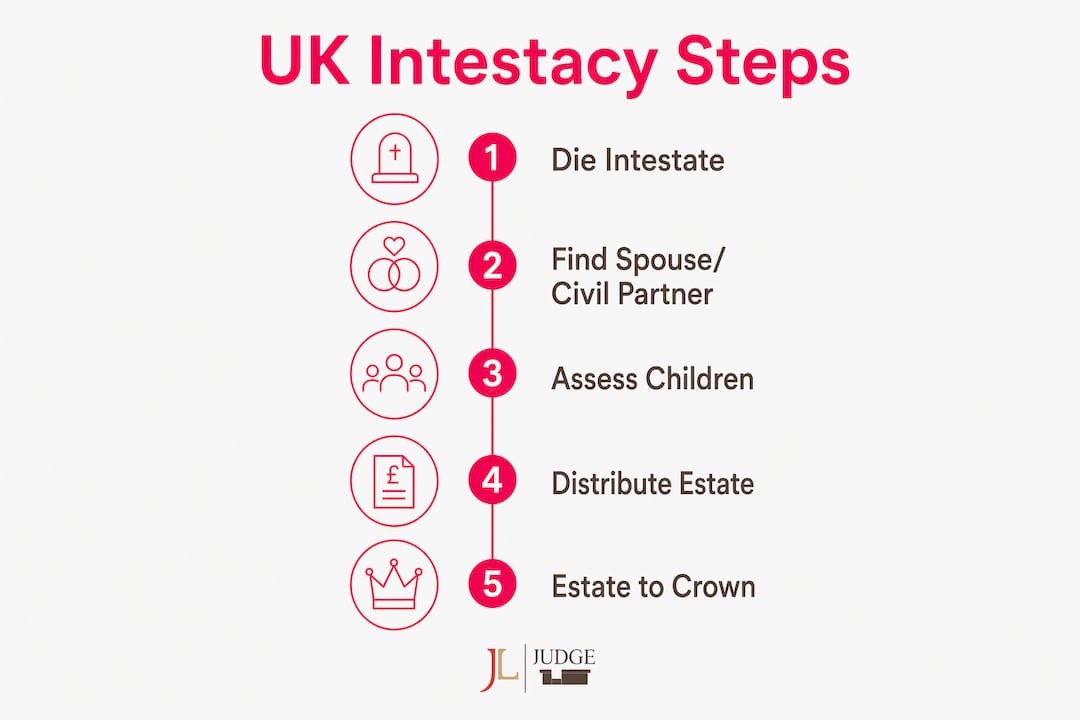
The Administration of Estates Act 1925 sets out the statutory rules for intestacy in England and Wales, establishing a fixed priority hierarchy that starts with the surviving spouse or civil partner and works downward through blood relatives. The law does not consider who the deceased intended to benefit. It applies the hierarchy mechanically, which is why the outcome can feel so disorienting for families who assumed things would be divided differently.
A surviving spouse or civil partner sits at the top of that hierarchy. Under the current rules, they receive all personal chattels, a statutory legacy of £322,000 (raised from £270,000 in July 2023 by the Fixed Net Sum Order 2023), and half of whatever remains above that threshold. The other half of the residue passes to the deceased’s children. This split only applies where children survive. If there are no children, the spouse inherits the entire estate.
Where there is no surviving spouse or civil partner but there are children, the entire estate passes equally to those children. If no spouse or children exist, the estate moves further down the hierarchy through parents, full siblings, half-siblings, grandparents, aunts and uncles, and eventually to the Crown as bona vacantia if no eligible relatives are found at all.
Priority order under intestacy in England and Wales:
- Surviving spouse or civil partner
- Children (including adopted children)
- Parents
- Full siblings (or their children if deceased)
- Half-siblings (or their children if deceased)
- Grandparents
- Aunts and uncles (full blood)
- Aunts and uncles (half blood)
- The Crown (bona vacantia)
Pro Tip: If you are a surviving spouse and the estate includes property held in joint tenancy, that property passes to you automatically by survivorship and sits outside the intestacy rules entirely. Only assets held in the deceased’s sole name fall into the intestate estate.
The fixed-share model under intestacy removes what lawyers call testamentary freedom. You cannot leave more to one child than another, cannot skip a generation, and cannot favour a close friend over a distant relative. That rigidity is precisely why making a will matters so much.
How do intestacy rules differ in Scotland and Northern Ireland?
Scotland operates a fundamentally different system from England and Wales, built on three distinct layers rather than a single hierarchy.
The first layer is prior rights, which protect a surviving spouse or civil partner’s access to the family home (up to £473,000), furniture (up to £29,000), and a cash sum of either £50,000 (where children survive) or £89,000 (where no children survive). These rights are satisfied before anything else is distributed. The second layer is legal rights, known as ius relictae for a surviving spouse and legitim for children, which protect a fixed share of the deceased’s moveable estate regardless of what the free estate contains. The third layer, the free estate, is then distributed according to a statutory hierarchy broadly similar in structure to England and Wales.
The practical effect is that a surviving spouse in Scotland has considerably stronger automatic protections than their counterpart in England and Wales, particularly where the family home is involved. However, cohabiting partners in Scotland have no automatic right to inherit. They must apply to court under section 29 of the Family Law (Scotland) Act 2006 within six months of the death, and any award is discretionary.
Northern Ireland applies its own statutory legacy threshold. Where children survive, the statutory legacy is £250,000, lower than the England and Wales figure of £322,000. The distribution structure follows a similar fixed hierarchy, but the financial thresholds and shares differ in ways that can produce meaningfully different outcomes for families.
| Jurisdiction | Statutory legacy (spouse with children) | Cohabitant rights | Governing legislation |
|---|---|---|---|
| England and Wales | £322,000 | None (court claim only) | Administration of Estates Act 1925 |
| Scotland | Prior rights system (up to £473,000 for home) | Court application required | Succession (Scotland) Act 1964 |
| Northern Ireland | £250,000 | None (court claim only) | Administration of Estates Act (NI) 1955 |
The differences between jurisdictions are not minor administrative variations. They can determine whether a surviving partner keeps the family home or loses it entirely. If the deceased owned property in more than one jurisdiction, the rules that apply can become genuinely complex, and professional advice is not optional in those circumstances.
Who cannot inherit under intestacy rules, and common misconceptions
Unmarried and cohabiting partners have no automatic right to inherit under intestacy rules in any UK jurisdiction. This is the single most painful consequence of dying without a will, and it catches families off guard with alarming regularity. A couple who lived together for twenty years, shared a home, and raised children together will find that the surviving partner inherits nothing from the intestate estate if they were never married or in a civil partnership.
Stepchildren face a similar exclusion. A stepchild only inherits if legally adopted by the deceased. Living in the same household, being raised as a child of the family, or being financially dependent does not confer intestacy rights. Friends, carers, and charities are also entirely excluded, regardless of how close the relationship was or how clear the deceased’s intentions may have been.
In England and Wales, there is one alternative route available to those excluded by intestacy. The Inheritance (Provision for Family and Dependants) Act 1975 allows certain categories of person, including a cohabiting partner who lived with the deceased as a couple for the two years before the death, a person treated as a child of the family, and financial dependants, to apply to court for reasonable financial provision from the estate. This route is discretionary. The court considers factors including the applicant’s financial needs, the size of the estate, and the conduct of the parties. It is not a guaranteed outcome, and it involves legal proceedings that add time, cost, and emotional strain to an already painful situation. A claim must normally be made within six months of the grant of letters of administration. Northern Ireland has an equivalent regime under the Inheritance (Provision for Family and Dependants) (Northern Ireland) Order 1979, while Scotland has its own cohabitant claim, described above.
Who is excluded from inheriting under intestacy:
- Unmarried or cohabiting partners
- Stepchildren (unless legally adopted)
- Friends and neighbours
- Carers (unless also a dependant)
- Charities named informally by the deceased
Pro Tip: If you are in a long-term relationship but not married or in a civil partnership, making a will is the only reliable way to protect your partner’s right to inherit. A claim under the 1975 Act is a last resort, not a substitute for a will.
How to administer an intestate estate in the UK
When someone dies without a will, there is no executor. Nobody has been appointed to manage the estate, collect assets, pay debts, or distribute what remains. That authority must be obtained formally through a legal process, and until it is granted, most financial institutions and the Land Registry will not act.
The document that grants this authority in England and Wales is called letters of administration. It is the functional equivalent of a grant of probate for an estate with a will. To obtain it, the administrator applies to the Probate Registry using form PA1A, submitting details of the estate, the death certificate, and the applicable fee. The priority order for applicants mirrors the intestacy hierarchy itself, with the surviving spouse or civil partner first, then children, then parents, and so on.
Steps to administer an intestate estate in England and Wales:
- Register the death and obtain the death certificate.
- Identify all assets and liabilities in the estate.
- Establish who has priority to apply for letters of administration.
- Complete form PA1A and submit to the Probate Registry with the required fee.
- Await the grant of letters of administration (typically 8 to 16 weeks).
- Use the grant to access bank accounts, transfer property, and collect assets.
- Pay outstanding debts, taxes, and administration costs.
- Distribute the remaining estate according to the intestacy rules.
The letters of administration act as a legal gatekeeper. Banks, building societies, and the Land Registry require sight of the grant before releasing funds or registering a property transfer. Without it, the estate is effectively frozen. Delays in applying, or errors in the application, extend that freeze and can cause real hardship for dependants who need access to funds.
In Scotland, the equivalent process is called confirmation, obtained through the Sheriff Court rather than a probate registry. The process differs procedurally but serves the same purpose. A useful starting point for understanding the broader probate administration process is to seek legal advice early, particularly where the estate includes property, business interests, or assets in multiple jurisdictions.
| Stage | England and Wales | Scotland |
|---|---|---|
| Authority document | Letters of administration | Confirmation |
| Application body | Probate Registry (HMCTS) | Sheriff Court |
| Application form | PA1A | C1 (inventory) |
| Typical timeline | 8 to 16 weeks | Variable |
For a detailed walkthrough of the early stages, the first 30 days of probate guide covers the practical steps in plain terms.
Why intestacy rules matter more than most people realise
What we see most often, working through intestacy cases with families in real distress, is not the complexity of the rules themselves. It is the gap between what people assume will happen and what the law actually does.
Most people believe that a long-term partner will inherit automatically. Most people assume that a child they raised as their own will be treated as their own. Most people think that their wishes, however clearly expressed to family members, carry some legal weight. Under intestacy, none of that is true. The law applies its fixed hierarchy without sentiment, and the results can be frightening for those left behind.
The administration process compounds this. An intestate estate with property, multiple beneficiaries, or any complexity can take many months to resolve. During that period, a surviving partner may be unable to access joint accounts held solely in the deceased’s name, unable to sell or remortgage a property, and unable to pay bills from estate funds. That is an exhausting position to be in while also grieving.
The practical answer is straightforward. Make a will. Review it when your circumstances change. If you are already dealing with an intestate estate, get legal advice before you apply for letters of administration, because errors in the application or misunderstandings about the hierarchy can create disputes that are far harder to resolve later.
FAQ
What are the intestacy rules in the UK?
Intestacy rules are the statutory provisions that determine how a deceased person’s estate is distributed when they die without a valid will. The rules differ between England and Wales, Scotland, and Northern Ireland, each applying a fixed priority hierarchy starting with the surviving spouse or civil partner.
What happens if you die intestate in the UK with no relatives?
If no eligible relatives are found under the intestacy hierarchy, the estate passes to the Crown as bona vacantia. This applies in England and Wales when no relatives exist within the statutory categories, from spouse and children down to half-blood aunts and uncles.
Do cohabiting partners inherit under UK intestacy rules?
No. Unmarried and cohabiting partners have no automatic right to inherit under intestacy rules in any UK jurisdiction. In England and Wales they may be able to apply to court under the Inheritance (Provision for Family and Dependants) Act 1975 (Northern Ireland has an equivalent 1979 Order, and in Scotland a claim is made under the Family Law (Scotland) Act 2006 within six months of the death), but any award is discretionary and not guaranteed.
How long does it take to administer an intestate estate?
Obtaining letters of administration in England and Wales typically takes 8 to 16 weeks from the date of application, though complexity, disputes over who has priority to apply, and estate size can all extend that timeline significantly.
Can stepchildren inherit under intestacy rules?
Stepchildren only inherit under intestacy if they were legally adopted by the deceased. A stepchild who was not formally adopted has no automatic intestacy rights, though in England and Wales they may be able to make a claim under the Inheritance (Provision for Family and Dependants) Act 1975 if they were treated as a child of the family or were financially dependent on the deceased.