

TL;DR
- Check the remaining lease length, the ground rent terms and the service charge history before you exchange contracts.
- Ask for the management pack (LPE1) early: it is a common source of delay.
- Below 80 years, marriage value makes a statutory lease extension noticeably more expensive.
- The two-year ownership rule for lease extensions has gone, but the 990-year extension and the new valuation rules in the 2024 Act are not yet in force.
- Instruct a conveyancer with leasehold experience and, for an extension, a specialist valuer.
You can buy a leasehold property in England and Wales, and millions of people do. The critical discipline is front-loading your due diligence before you exchange contracts, not after. Three actions matter most at the outset.
Start here:
- Check the length of time remaining on the lease, and if it is close to or below a threshold that may affect costs or mortgage options.
- Ask the seller or their solicitor to request the management pack from the freeholder or managing agent immediately.
- Instruct a conveyancer with specific leasehold experience before you make a formal offer.
A typical leasehold purchase takes a few months from offer to completion, though it often runs longer than a freehold transaction because of the additional documentation involved. GOV.UK’s How to Lease guide recommends agreeing a realistic timescale with your solicitor from the outset, particularly if your mortgage offer has a fixed expiry date.
Pro Tip: If the lease has fewer than 80 years remaining, ask the seller to start a statutory lease extension before completion and assign the benefit of that claim to you. A buyer cannot initiate a statutory extension until they are registered at HM Land Registry as the legal owner, so this arrangement protects you from an immediate and costly gap after purchase.
What does leasehold mean compared with freehold?
When you buy a leasehold property, you own the right to occupy it for a fixed number of years as set out in the lease. The freeholder retains ownership of the land and, in most cases, the building itself. GOV.UK explains that a long lease gives exclusive possession for that fixed term while the freeholder’s interest continues underneath it. Flats are almost always leasehold. Houses can be too. The Leasehold and Freehold Reform Act 2024 contains a ban on most new leasehold houses, but that part of the Act has not yet been brought into force.
Freehold ownership is simpler. You own the property and the land outright, with no fixed term and no landlord above you. The practical differences for a leaseholder are considerable.
What leasehold ownership means day to day:
- You pay ground rent to the freeholder if the lease requires it, though the Leasehold Reform (Ground Rent) Act 2022 banned ground rent on most new residential leases.
- You pay service charges towards the upkeep of communal areas, building insurance and repairs managed by the freeholder or a managing agent.
- You must comply with the lease’s restrictive covenants, which may prohibit pets, subletting, or alterations without written consent.
- You are responsible for internal repairs; the freeholder is typically responsible for the structure and exterior.
- When the lease expires, ownership of the property reverts to the freeholder unless you have extended it.
The lease length is the single most important variable. A lease with 999 years remaining is, for practical purposes, equivalent to freehold. A lease with 70 years remaining is a depreciating asset that will affect both your mortgage options and your eventual resale price. Understanding this distinction is the foundation of any sensible leasehold property buying guide.
What should you check before exchanging contracts?
The management pack and the lease document itself are the two most important sets of papers in a leasehold transaction. Your conveyancer will review both, but you should understand what they are looking for and why.
Critical lease checks:
- Lease length remaining. Confirm the exact figure. Below 80 years triggers marriage value on a statutory extension, which increases the premium significantly.
- Ground rent wording. Check the current amount, when it reviews, and the review mechanism. Doubling clauses and RPI-linked escalation clauses are red flags for both mortgageability and future cost.
- Service charge history. Ask for the last three years of accounts. Look for large year-on-year increases or unexplained reserves.
- Sinking fund balance. A healthy sinking fund means major works are less likely to produce a sudden large bill. An empty or absent fund is a warning sign.
- Permission and restriction clauses. Note what requires the freeholder’s written consent: subletting, pets, alterations, running a business from the property.
- Repair and insurance obligations. Confirm who insures the building and on what basis, and what the leaseholder is responsible for internally.
- Planned major works. Ask the seller and the managing agent whether any section 20 consultation has begun or is anticipated.
What to request in the management pack:
The seller’s solicitor should provide an LPE1 form (Leasehold Property Enquiries form) along with supporting documents. This form covers ground rent, service charges, building insurance, planned works and any disputes. Do not proceed to exchange without it.

Pro Tip: Ask the managing agent directly whether any section 20 major works notices have been issued or are planned. GOV.UK notes that buyers are liable for planned major works once they own the property, even if those works were initiated before they completed. A verbal assurance from the seller is not sufficient. Get it in writing through the LPE1 process.
What costs should you budget for?
Leasehold purchases carry several cost layers that freehold buyers do not face. Some are fixed and predictable; others depend on lease length and the freeholder’s conduct.
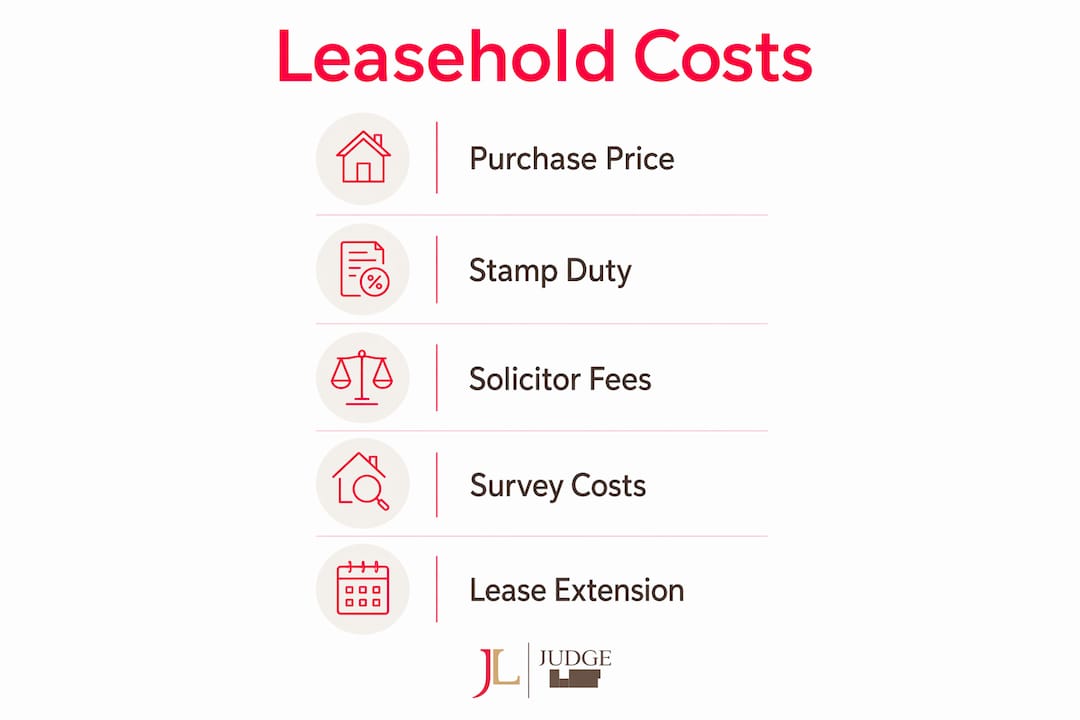
Upfront purchase costs:
- Purchase price
- Stamp Duty Land Tax (SDLT), calculated on the purchase price in the usual way
- Solicitor’s conveyancing fees, which are typically higher for leasehold than freehold due to the additional work involved
- Surveyor or valuation fees
- Management pack fee, charged by the freeholder or managing agent for providing the LPE1 and supporting documents. This is usually paid by the seller (see the table below), so check whether any part is being passed to you
Ongoing and conditional leasehold costs:
- Ground rent (where the lease requires it and it predates the 2022 ground rent ban)
- Annual service charges, which vary year to year
- Contributions to major works under section 20 consultation
- Sinking fund contributions
Lease extension and enfranchisement costs:
The premium you pay to extend a lease or buy the freehold depends on the lease length, the ground rent, and the property value. Once a lease falls below 80 years, marriage value becomes payable on a statutory extension, significantly increasing the premium. The Leasehold and Freehold Reform Act 2024 proposes to remove marriage value from the statutory calculation, though the relevant provisions depend on secondary legislation and have not yet been brought into force. Until they are, marriage value still applies.
| Cost category | Who typically pays | Notes |
|---|---|---|
| Purchase price | Buyer | Negotiated with seller |
| SDLT | Buyer | Calculated on purchase price |
| Conveyancing fees | Buyer | Higher for leasehold than freehold |
| Management pack (LPE1) | Seller (requested by seller’s solicitor) | Charged by freeholder or managing agent |
| Valuation / survey | Buyer | Additional specialist valuation needed for extension |
| Ground rent | Buyer (ongoing) | Only where lease pre-dates 2022 ban |
| Service charges | Buyer (ongoing) | Varies annually |
| Lease extension premium | Buyer | Rises sharply below 80 years |
| Enfranchisement premium | Participating leaseholders | Collective for flats; individual for houses |
| Freeholder’s legal costs | Buyer (statutory route) | The 2024 Act will remove this in most cases once the provision is in force (not yet in force) |
Pro Tip: Instruct a specialist leasehold valuer, not just a general surveyor, when assessing a lease extension or enfranchisement premium. The calculation is technical and the difference between a well-prepared and a poorly prepared valuation can run to thousands of pounds.
How do you extend a lease or buy the freehold?
There are two broad routes: voluntary negotiation with the freeholder, or the statutory procedure under the Leasehold Reform Act 1967 (for houses) and the Leasehold Reform, Housing and Urban Development Act 1993 (for flats). The Leasehold and Freehold Reform Act 2024 amends both. The removal of the two-year ownership requirement is already in force, but its main changes to price and lease length (including the 990-year extension and the removal of marriage value) have not yet been brought into force.
Voluntary negotiation is quicker and less formal. You approach the freeholder directly and agree a price. There is no prescribed process, but you should still instruct a solicitor and a specialist valuer to ensure the premium is reasonable.
Statutory lease extension (flats) currently gives qualifying leaseholders the right to a new lease adding 90 years to the remaining term, at a peppercorn (nil) ground rent. The 2024 Act will increase the extension to 990 years once the relevant section is brought into force, which has not yet happened. The key eligibility points are:
- You must be the registered legal owner at HM Land Registry.
- The 2024 Act removed the previous two-year ownership requirement from 31 January 2025, so you can act as soon as you are registered.
- The property must be a long residential lease (originally granted for more than 21 years).
Collective enfranchisement (flats) allows leaseholders in a building to purchase the freehold collectively. At least half the qualifying leaseholders in the building must participate.
House freehold purchase follows a separate statutory route under the 1967 Act, as amended by the 2024 Act.
Typical steps for a statutory lease extension:
- Confirm eligibility and instruct a specialist leasehold solicitor and valuer.
- Obtain a valuation of the premium you should offer.
- Serve a tenant’s notice on the freeholder specifying the proposed premium and terms.
- The freeholder has two months to serve a counter-notice.
- Negotiate the premium, with both parties’ valuers exchanging evidence.
- If agreement is not reached within a set period, either party may apply to the First-tier Tribunal (Property Chamber) to determine the premium.
- Once agreed or determined, the solicitor prepares and registers the new lease.
Full guidance on the statutory procedures is available on GOV.UK’s leasehold property pages and from the Leasehold Advisory Service (LEASE) at lease-advice.org.
What does leasehold conveyancing involve and how long does it take?
Leasehold conveyancing follows the same broad stages as freehold, but with additional layers of enquiry that routinely add time. The How to Lease guide is clear that leasehold purchases often require more documentation and can take longer than freehold transactions, and recommends building that into your planning from the start.
Typical conveyancing stages for a leasehold purchase:
- Instruct a conveyancer and provide identification and source of funds evidence.
- Conveyancer reviews the draft contract, title documents and the lease.
- Management pack requested from the freeholder or managing agent via the LPE1 form.
- Conveyancer raises additional enquiries with the seller’s solicitor and, where necessary, with the freeholder directly.
- Mortgage lender’s requirements reviewed, including minimum lease length and service charge evidence.
- Search results received and reviewed.
- Report on title prepared and sent to you for approval.
- Exchange of contracts with deposit paid.
- Completion and registration at HM Land Registry.
Timeline and common delays:
A straightforward leasehold purchase often takes 14 to 20 weeks from instruction to completion, and complex cases or slow freeholders can extend this further. The management pack is a frequent source of delay. Freeholders and managing agents have no statutory obligation to respond within a set time. The Leasehold and Freehold Reform Act 2024 allows maximum response times and fee caps to be set, but those provisions have not yet been brought into force.
What lenders check on leasehold properties:
- Most mortgage lenders require a minimum unexpired lease term at the point of completion, often 70 years or more, though many require significantly longer.
- Lenders will scrutinise ground rent clauses. Doubling ground rent provisions can make a property unmortgageable with many high street lenders.
- Evidence that service charges are paid up to date is usually required before funds are released.
If the lease is short, discuss this with your conveyancer before proceeding. A conveyancing solicitor can advise on whether the lease needs extending before or simultaneously with the purchase, and how to structure that with the seller.

What are the red flags in a leasehold purchase and what can you do about them?
Some issues are negotiable. Others are serious enough to walk away from. Knowing the difference before exchange is what a good conveyancer is there to help you with.
Red flags to watch for:
- Lease under 80 years. Marriage value applies on a statutory extension, raising the premium. The shorter the lease, the more urgent and expensive the extension.
- Escalating ground rent clauses. Doubling clauses or RPI-linked escalation can make the property difficult to mortgage and harder to sell.
- Large or unexplained planned works. A section 20 notice already issued, or works anticipated but not yet notified, can result in a substantial bill landing shortly after you complete.
- Missing or incomplete service charge accounts. If the managing agent cannot produce three years of audited accounts, that is a serious warning about how the building is managed.
- Poor managing agent records. Persistent arrears among other leaseholders, unresolved disputes or a history of tribunal applications all suggest a building that will be expensive and frustrating to own in.
- No sinking fund. Without a reserve, major works costs fall entirely on current leaseholders as they arise.
Before you exchange: If you identify any of the above, do not rely on the seller’s assurances. Require written confirmation through the LPE1 process, request copies of any section 20 notices, and ask your conveyancer to raise formal enquiries with the freeholder. If the answers are unsatisfactory, you have the right to renegotiate the price or withdraw before exchange without losing your deposit.
After completion, if disputes arise:
Leaseholders have the right to challenge unreasonable service charges and to apply to the First-tier Tribunal (Property Chamber) for a determination. The tribunal can rule on whether charges are reasonable and whether major works were properly consulted on. The Leasehold Advisory Service provides free, independent guidance on exercising these rights.
How does a solicitor help with a leasehold purchase?
A conveyancer handling a leasehold transaction does considerably more than review the title and draft the transfer. The lease itself is a long-form legal document, often running to dozens of pages, and the obligations it creates run for the full term of ownership.
What your solicitor should do on a leasehold purchase:
- Read the lease in full and report on its key terms, including ground rent, service charges, repair obligations, and any unusual or onerous covenants.
- Raise enquiries with the freeholder or managing agent about planned works, outstanding service charges and building insurance.
- Verify that all historic service charges have been paid by the seller and obtain a receipt or written confirmation.
- Advise on the prospects and likely cost of a lease extension or collective enfranchisement, and whether to pursue this before or after completion.
- Check the lease against your lender’s requirements and flag any terms that may affect your mortgage offer.
- Review the management pack and LPE1 form and raise any follow-up questions before exchange.
The interplay between solicitor and valuer work matters particularly on lease extensions. Your solicitor advises on the legal process and drafts the notices and new lease; your specialist leasehold valuer calculates and negotiates the premium. Both are needed, and instructing them early avoids delays.
Pro Tip: When you first speak to a conveyancer, ask specifically whether they have handled leasehold transactions with short leases or lease extension assignments. Not all conveyancers have this experience, and the statutory process has procedural steps that require specialist knowledge. The Law Society advises buyers never to rely on verbal assurances about the lease and to have the document examined by a solicitor.
Judge Law is regulated by the Solicitors Regulation Authority (SRA number 634380). When instructing any solicitor, ask for their SRA number and confirm they are on your lender’s approved panel before you commit.
Practical points from our work
Leasehold gets a bad press, and some of it is deserved. Escalating ground rents, unresponsive managing agents and surprise major works bills have caused real financial harm to buyers who did not know what to look for. But the tenure itself is not inherently flawed. The problem, almost always, is a lease that was poorly drafted or a freeholder who has not been held to account.
The 2024 Act is a genuine improvement. Since the two-year ownership requirement for statutory extensions was removed in January 2025, buyers can act as soon as they are registered, closing a gap that previously left people exposed. The proposed removal of marriage value from the statutory calculation, if it comes into force, will make short-lease purchases considerably less punishing. These are meaningful changes, not cosmetic ones.
What has not changed is the need for proper advice before exchange. The lease is a contract that will govern your ownership for decades. Reading it carefully, understanding the service charge history, and knowing whether the freeholder is well-managed are not optional extras. They are the work. A buyer who skips this stage and relies on the seller’s word is taking a risk that no amount of post-completion tribunal applications will fully undo.
Useful sources and further reading
The following primary sources are the most reliable starting points for verifying the law and understanding your rights as a leaseholder.
- Buying or owning a leasehold home, GOV.UK: the government’s main guidance covering lease checks, ground rent, service charges and your rights.
- How to Lease guide (July 2022 PDF), GOV.UK: practical step-by-step guidance on the leasehold purchase process, including timeline advice.
- Leasehold Advisory Service (LEASE), lease-advice.org: free, independent advice on leaseholder rights, lease extensions and enfranchisement.
- Leaseholder rights and responsibilities, GOV.UK: covers service charge challenges, section 20 consultation and the First-tier Tribunal (Property Chamber).
- Buying the freehold, GOV.UK: statutory procedure for house freehold purchase and collective enfranchisement for flats.
- Leasehold and Freehold Reform Act 2024, plain English explainer, GOV.UK: summary of the 2024 reforms including the removal of marriage value and the 990-year extension right.
- Buying and owning a leasehold home, The Law Society: guidance on instructing a solicitor and what they should check.
- First-tier Tribunal (Property Chamber): the route for challenging service charges and resolving disputes with freeholders.
FAQ
Is it a good idea to buy a leasehold property?
Yes, in many cases. Leasehold is the standard tenure for flats in England and Wales, and millions of people own leasehold homes without difficulty. The key is checking the lease length, ground rent terms and service charge history before you exchange, and instructing a solicitor with leasehold experience.
How much does it cost to buy a leasehold property?
The purchase costs are similar to freehold, covering the purchase price, SDLT, solicitor fees and a survey. Leasehold adds management pack fees and, depending on the lease, ongoing ground rent and service charges. If the lease needs extending, the premium varies with lease length and is significantly higher once the lease falls below 80 years.
Is a 999-year lease as good as freehold?
For most practical purposes, yes. A 999-year lease gives you security of tenure well beyond any realistic ownership period, and mortgage lenders treat it as equivalent to freehold. You will still pay service charges and comply with lease covenants, but the lease length itself is not a concern.
Can I convert leasehold to freehold?
Yes. Qualifying leaseholders of houses can purchase the freehold individually under the Leasehold Reform Act 1967. Flat owners can participate in collective enfranchisement with fellow leaseholders under the Leasehold Reform, Housing and Urban Development Act 1993, as amended by the Leasehold and Freehold Reform Act 2024. Both routes require a solicitor and a specialist leasehold valuer.