

Conveyancing searches are formal enquiries made to public bodies and specialist data providers that surface third-party, public-record information about a property before you exchange contracts. They sit alongside the title register and your survey, but they cover entirely different ground. Where a survey assesses the physical condition of the building, searches reveal what the law, the local authority, and the environment say about the land itself.
The three functions searches perform are worth stating plainly:
- Reveal legal restrictions and charges. Registered restrictions, financial charges, and planning conditions that bind the land are uncovered through the local authority search and the HM Land Registry local land charges programme.
- Check environmental and drainage risks. Flood risk, contaminated land history, and the location of public sewers are reported through the environmental and water searches, drawing on data held by the Environment Agency and water authorities.
- Confirm third-party proposals and charges. Road adoption schemes, compulsory purchase proposals, and financial charges registered against the land are disclosed before you commit.
The Law Society’s buying a home guidance is clear that searches report only what is held on official records. They are not a physical inspection, and they do not guarantee that no other issues exist.
What is the role of searches in conveyancing?
Conveyancing
Get an instant conveyancing quote
See your fixed-fee legal costs and Stamp Duty on screen in about a minute, with the full breakdown emailed to you. No obligation.
Searches are the formal due diligence layer that sits between reviewing the title and exchanging contracts. LexisNexis practice guidance on pre-contract searches frames them as part of the buyer’s duty under the principle of caveat emptor, meaning the buyer bears responsibility for discovering what can be discovered before they are bound. A solicitor cannot simply rely on what the seller discloses.
The title register held by HM Land Registry tells you who owns the property and what charges or restrictions are already registered against it. A survey tells you about the roof, the walls, and the drains inside the building. Searches tell you about the land’s legal and environmental context, things that would not be visible on a site visit and would not appear in the title deeds.
Mortgage lenders typically insist on the core searches before they will release funds. Cash buyers are not legally required to commission them, but most solicitors advise doing so regardless. Buying without searches means accepting risks that are, in most cases, entirely avoidable. The Law Society’s conveyancing guidance supports this position, noting that searches protect both the buyer and the lender’s security.
Understanding UK property legal terms alongside the search process helps you read the results with more confidence when they arrive.
What are the main types of conveyancing searches?
Most buyers encounter three core searches, sometimes called a search pack. HomeBuyerCheck notes that solicitors commonly order the local authority search (LLC1 plus CON29), the drainage and water search (CON29DW), and an environmental report as standard.
Local authority search (LLC1 and CON29). The LLC1 queries the local land charges register, which records financial charges, planning conditions, listed building status, conservation area designations, and tree preservation orders. The CON29 covers road adoption, planning history, and proposals such as new roads or compulsory purchase schemes. The HM Land Registry local land charges programme explains that each local authority maintains this register as the primary source for LLC1 results.
Drainage and water search (CON29DW). This search queries the water authority’s records to confirm whether the property is connected to the public sewer and water mains, whether any public sewer runs within the boundary, and whether the property is at risk of internal sewer flooding. A public sewer crossing the garden is a common finding; it usually means the water authority holds a right of access and there is a restriction on building over the pipe, not a fatal title defect.

Environmental search. This report draws on data from the Environment Agency and other sources to flag potential contaminated land, flood risk, ground stability issues, and proximity to landfill sites. PropertyPassport’s guidance on conveyancing searches is clear that an environmental search flags potential risk rather than confirming contamination. Where a flag appears, a Phase 1 or Phase 2 ground investigation survey may follow.
HM Land Registry title checks. Your solicitor also reviews the official title register and title plan to confirm ownership, boundaries, and any registered charges or covenants. This is distinct from the local authority search, though both draw on public records.
Beyond the core three, certain properties or locations call for additional searches.
- Coal mining search. Relevant in areas with a history of underground mining, covering subsidence risk and mine entry locations.
- Chancel repair search. Checks whether the property falls within a historic parish boundary that could give the local church a right to demand contributions to chancel repairs.
- Tin mining, limestone, or brine searches. Location-specific ground stability checks for Cornwall, parts of the Midlands, and Cheshire respectively.
- Search insurance. An alternative to ordering individual searches where speed is critical, though lenders do not always accept it.
Who orders searches, who pays, and when does it happen?
Your solicitor orders the searches, and you pay for them as disbursements. They appear on your solicitor’s bill as third-party costs passed through to you, not as the firm’s own fee. The Law Society Conveyancing Protocol sets out the profession’s preferred practice on which searches are standard and when they should be commissioned.
The typical sequence runs as follows:
- Offer accepted. You instruct a solicitor and pay an initial sum on account, which usually covers search costs.
- Draft contract received. The seller’s solicitor sends the draft contract, title documents, and property information forms.
- Searches ordered. Your solicitor orders the core search pack, and any additional searches appropriate to the property’s location or type.
- Results received and reviewed. The solicitor reads the raw results against the title and flags anything that needs attention.
- Enquiries raised. Where a search reveals an issue, the solicitor raises formal enquiries of the seller’s solicitor or seeks specialist advice.
- Responses received and satisfied. Once all enquiries are answered to your solicitor’s satisfaction, the transaction can progress toward exchange.
- Exchange of contracts. You become legally committed to the purchase.
There are exceptions worth knowing. If the seller has already commissioned up-to-date searches and the results are recent enough to satisfy your lender, your solicitor may be able to rely on them rather than re-ordering. Cash buyers have more flexibility on timing, though most solicitors still recommend ordering searches before exchange. Where a mortgage lender has specific requirements, your solicitor will check those requirements against the search results before reporting to the lender.
For a fuller picture of how the overall timeline fits together, the conveyancing process timeline guide sets out each stage in detail.
How long do searches take and how long do results stay valid?
Turnaround times vary considerably. Environmental and drainage searches typically come back within one to three working days because they are produced by automated data providers. Local authority searches are the variable element. Some councils respond within a few days; others take several weeks, particularly during busy periods or where the council has not yet migrated to the HM Land Registry digital system.
As a general guide:
- Local authority search. One to ten working days, though some councils take longer.
- Drainage and water search. One to five working days.
- Environmental report. One to three working days.
- Coal mining or chancel repair. One to three working days.
Lenders and conveyancers commonly treat search results as valid for six months, though some lenders apply a shorter window. If exchange has not taken place by the time results approach that threshold, your solicitor will advise whether to re-order or whether search insurance is an appropriate alternative.
Pro Tip: If your transaction has been running for several months and exchange is still some weeks away, ask your solicitor to check the date on each search result. Re-ordering a local authority search costs less than having a lender reject results at the last moment.
What happens when searches flag a problem?
Most findings do not kill a sale. ValuQ’s analysis of collapsed UK property sales reports that most search findings are facts about the surrounding area rather than deal-breakers, and that legal complexity accounted for a small percentage of collapsed UK sales in early 2026. That figure puts the risk in perspective: the vast majority of transactions proceed.
When a search does flag something, findings tend to fall into three categories, and the category drives the response.
- Information only. The finding is noted but requires no action. A nearby listed building or a historical planning permission that has already been implemented falls here.
- Insurable. The risk is real but quantifiable, and indemnity insurance can cover it. Chancel repair liability is the classic example. The HomeOwners Alliance explains that indemnity insurance is typically a one-off policy that resolves historic liabilities of this kind, and that keeping the policy document on file protects future buyers too.
- Requiring a fix. The issue needs a practical resolution before exchange. A public sewer running under a proposed extension, for instance, may require a build-over agreement with the water authority.
The realistic remedies available to you are:
- Solicitor enquiries of the seller seeking clarification or a warranty.
- Price negotiation where the finding reduces the property’s value or creates a future cost.
- Indemnity insurance, arranged by either party, to cover an insurable risk.
- A specialist survey or investigation, such as a Phase 1 environmental survey, to quantify a flagged risk before deciding whether to proceed.
- Withdrawal before exchange, which is rare but sometimes the right outcome.
Pro Tip: Search reports are often jargon-heavy. Ask your solicitor for the exact paragraph from the search result, not a summary relayed through the estate agent, and ask them to classify the finding as information only, insurable, or requiring remedial action. That classification tells you immediately how seriously to take it.
What do searches typically cost?
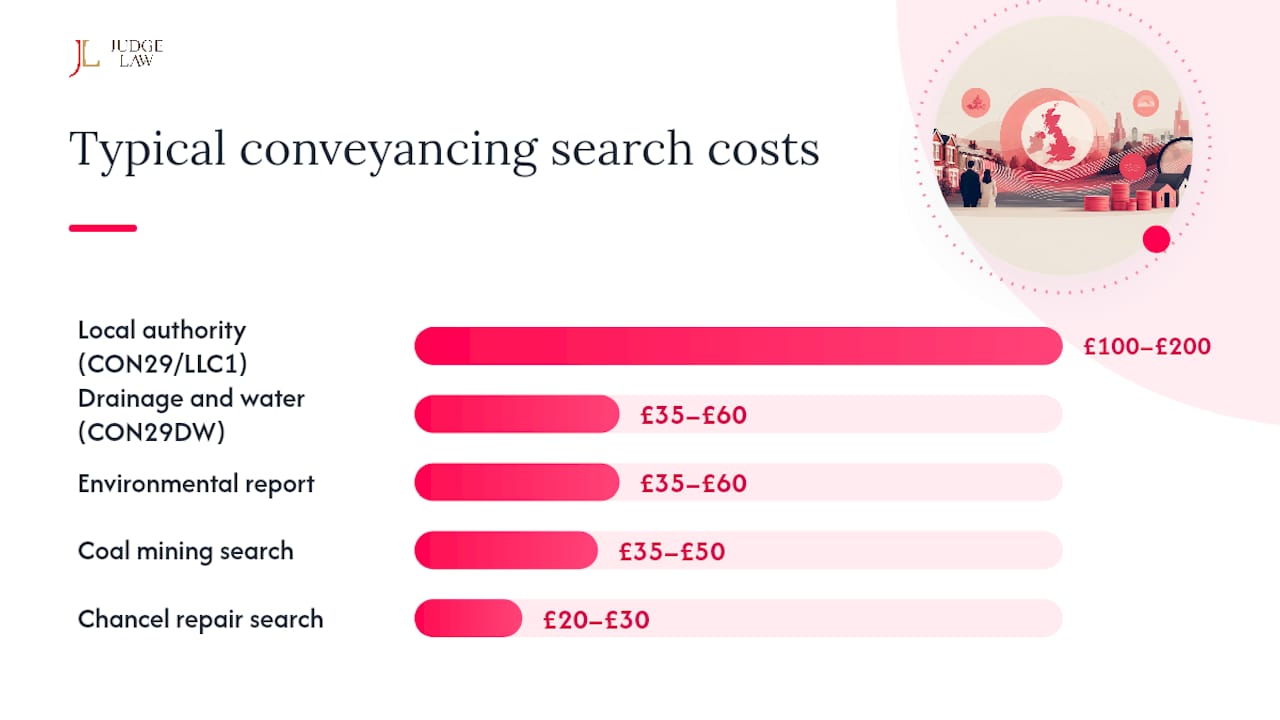
A standard search pack commonly costs between £250 and £450, according to HomeBuyerCheck’s guidance on solicitor searches. That range covers the three core searches. Optional searches add to the total, and local authority fees vary by council.
| Search | Typical cost range |
|---|---|
| Local authority (LLC1 + CON29) | £100 to £200 |
| Drainage and water (CON29DW) | £35 to £60 |
| Environmental report | £35 to £60 |
| Coal mining search | £35 to £50 |
| Chancel repair search | £20 to £30 |
Your solicitor will also charge a handling fee for ordering, reviewing, and reporting on the searches. This is part of their professional fee rather than a disbursement, and it varies by firm. You can find an overview of how legal fees and disbursements are structured on the Judgelaw fees page.
One point worth knowing before you commit: search costs are normally non-refundable if the purchase falls through after searches have been ordered. They are paid to third-party providers and cannot be recovered from the seller. Budget for them as a sunk cost from the point you instruct your solicitor.
How does your solicitor handle search results and what should you ask?
Your solicitor orders the searches, receives the raw reports, reads them against the title and the contract, and then advises you on what the results mean and what, if anything, needs to happen next. The process is not simply a matter of passing documents to you; the solicitor’s job is to interpret the findings in the context of your specific transaction.
The workflow typically runs as follows:
- Searches ordered once draft contract and title documents are received.
- Results received and logged in the conveyancing file.
- Each result reviewed against the title register, the property information forms, and the contract.
- Any findings of concern flagged to you with a clear explanation and a recommended response.
- Formal enquiries raised with the seller’s solicitor where a search reveals a discrepancy or an issue needing clarification.
- Specialist quotes obtained where a physical investigation or remedial work is needed.
- Indemnity insurance arranged, if appropriate, with the policy placed on the conveyancing file.
- All matters resolved to the solicitor’s satisfaction before exchange is recommended.
When your solicitor reports to you on the search results, these are the questions worth asking:
- Which findings, if any, require action before exchange?
- Is each flagged issue classified as information only, insurable, or requiring a fix?
- Can you see the exact wording from the search result rather than a summary?
- What is the estimated cost and timescale for resolving any outstanding matters?
- Will the lender require anything further before they are satisfied?
Common misconceptions about searches, and what actually matters
Most findings are manageable. The instinct to panic when a search flags something is understandable, but a prioritised, methodical response is almost always faster and less costly than alarm.
A few practical points that tend to get lost in the noise:
- A public sewer crossing the garden is one of the most common search findings in the country. It normally means the water authority holds a right of access and there is a restriction on building over the pipe. It is not a title defect and it does not prevent the sale.
- A high flood risk finding is more material, particularly to a mortgage lender. The Environment Agency’s flood maps are publicly available, and your solicitor will check whether the lender’s criteria are met. Flood risk can affect insurability and mortgage terms, so it warrants a careful response rather than a quick fix.
- Indemnity insurance resolves a wide range of historic liabilities, but the policy must be kept on file and passed to future buyers. A policy that cannot be located at the point of a later sale creates the same problem all over again. Good record-keeping is part of the resolution, not an afterthought.
- The Law Society Conveyancing Protocol sets professional limits on additional enquiries. A solicitor who raises enquiries indiscriminately, beyond what the searches and title actually warrant, can slow a transaction without adding value. Proportionate, targeted enquiries are the mark of a competent conveyancer.
When a search reveals an issue, the immediate actions that move things forward are:
- Ask your solicitor to classify the finding and confirm whether it affects exchange.
- Request the exact search paragraph, not a verbal summary.
- Obtain any specialist quotes or surveys needed to quantify the risk.
- Confirm whether indemnity insurance is available and at what cost.
- Keep all resolutions, policies, and correspondence in the conveyancing file.
Pro Tip: PropertyPassport’s explanation of environmental searches notes that an environmental flag is a prompt for further investigation, not a confirmed finding of contamination. A Phase 1 desktop study often resolves the question quickly and at modest cost.
A perspective on searches from the Judge Law team
We see searches misread more often than any other part of the conveyancing process. A buyer receives a report, spots a highlighted entry, and assumes the worst before their solicitor has had a chance to explain what it actually means. The result is unnecessary anxiety and, sometimes, a decision to withdraw from a purchase that was perfectly sound.
Our approach is to send buyers the relevant paragraph from the search result alongside a plain English explanation of what it means for their transaction. We classify every finding before we report it, so you know from the outset whether something needs action, can be insured, or is simply a recorded fact about the area. That clarity tends to resolve most concerns within a single conversation.
Judgelaw can guide you through your conveyancing searches
Judgelaw’s conveyancing solicitors order, review, and report on the full search pack for residential buyers, explaining every finding in plain English and advising on the most proportionate response. We are SRA-regulated (registration number 634380) and we work with buyers at every stage, from instructing searches through to exchange and completion. If you have received search results and are unsure what they mean, or if you are about to instruct a solicitor and want to understand what the process involves, get in touch to discuss your situation.
Sources
- HM Land Registry local land charges programme
- Buying a home | The Law Society
- Pre-contract searches in property transactions: required searches, procedures and liability (England and Wales) | LexisNexis
- What Searches Does a Solicitor Do When Buying a House? | HomeBuyerCheck
- My buyer’s searches flagged a problem. What now? | ValuQ
- Conveyancing searches explained | PropertyPassport
- The Law Society’s Conveyancing Protocol | LexisNexis
FAQ
Why do conveyancers carry out searches?
Searches give buyers third-party, public-record information about a property that the seller cannot provide and that a survey does not cover. Under the principle of caveat emptor, the buyer is responsible for discovering what can be discovered before exchange, and searches are the primary tool for doing so.
Who is responsible for ordering searches when buying a house?
The buyer’s solicitor orders the searches and the buyer pays for them as disbursements. Where a mortgage lender is involved, the lender may specify which searches are required, but the solicitor manages the process on the buyer’s behalf.
At what stage does a solicitor order searches?
Searches are typically ordered after the draft contract and title documents have been received from the seller’s solicitor, which is usually a few weeks after the offer is accepted and the solicitor is instructed.
How long after searches come back can you complete?
There is no fixed period, but completion normally follows exchange by one to four weeks. Before exchange can take place, all search results must be received, reviewed, and any issues resolved to the solicitor’s and lender’s satisfaction.
Do cash buyers need to commission searches?
Cash buyers are not legally required to commission searches, but most solicitors recommend doing so. Buying without searches means accepting risks that are, in most cases, straightforward to identify and address before you are committed to the purchase.
Recommended
- UK property legal terms explained: make better home decisions
- What Legal Steps Are Involved in Buying a Home? | Judge Law
- Buying a New Build? | Expert Conveyancing Solicitors
- The Best Conveyancing Solicitor for the UK’s New Online Home Buying System