

Buying property with someone else involves two distinct legal concepts that most buyers never separate clearly enough. The legal estate in England and Wales must always be held as joint tenants, regardless of how much each person contributes. The beneficial interest, which determines who actually owns what share of the value, can be held either as joint tenants or as tenants in common. That distinction, established under the Law of Property Act 1925 and governed in disputes by the Trusts of Land and Appointment of Trustees Act 1996 (TOLATA 1996), shapes everything from what happens when one owner dies to how a sale is handled decades later. This property co-ownership guide, prepared by the Judgelaw team, sets out the law in plain English and gives you the practical steps to protect your position before you sign anything.
Three immediate actions matter most:
- Confirm how the beneficial interest will be held before exchange. Joint tenants or tenants in common is not a default you can revisit painlessly later.
- Prepare a declaration of trust if contributions are unequal, if you are buying with friends or investors, or if you want to control what happens to your share on death.
- Get independent legal advice. Each co-owner’s interests can diverge. A solicitor acting for all of you cannot always protect each of you equally.
What the legal estate and beneficial interest actually mean
HM Land Registry records the names of legal proprietors on the title register. That is all it records. The register tells you who holds the legal estate; it says nothing about the size of each person’s financial share in the property.
The beneficial interest sits beneath the legal title. It determines who receives what proportion of the sale proceeds, who can occupy the property, and whose share passes under a will. Two people can appear on the register as equal legal owners while holding the beneficial interest in a 70/30 split, provided that split is properly documented.
This separation matters in conveyancing because of a mechanism called overreaching. When a purchaser buys from two or more trustees and pays the purchase money to both, the beneficial interests are overreached and attach to the proceeds rather than the land itself, as Practice Guide 24 explains. The purchaser takes free of those interests. That is why the law requires at least two trustees on a sale, and why co-owners must document their beneficial shares separately rather than relying on the register to protect them.
Pro Tip: Ask your conveyancer to check the transfer panel on the TR1 form. The panel that records whether the transferees hold as joint tenants or tenants in common is where the beneficial interest is first formally declared. If it is left blank, you may have a dispute waiting to happen.
A Form A restriction may appear on the register to signal that a trust exists and that a sole surviving proprietor cannot give a valid receipt for capital money. Its presence is a useful indicator, but it is not conclusive proof of tenancy in common. The HM Land Registry blog notes that Form A can arise for reasons other than tenancy in common, so checking the underlying transfer documents is always necessary.
Joint tenants versus tenants in common: what each means for you
The choice between joint tenancy and tenancy in common is one of the most consequential decisions co-owners make, yet it is often treated as a formality. The GOV.UK joint ownership guidance sets out the core distinction plainly: joint tenants hold the whole property together with a right of survivorship, while tenants in common hold defined shares that can be left by will.

| Dimension | Joint tenants | Tenants in common |
|---|---|---|
| What happens on death | Surviving owner(s) inherit automatically by survivorship; a will cannot override this | Share passes under the deceased’s will or intestacy rules |
| Unequal shares | Not possible; each owner holds an equal undivided interest | Shares can be any proportion and must be recorded in a declaration of trust |
| Leaving a share in a will | Cannot be done while joint tenancy remains intact | Each owner can leave their share to whoever they choose |
| Mortgage and sale | All legal owners must consent; lenders require all proprietors to sign | Same requirement for legal owners; beneficial shares can differ from mortgage liability |
| Typical use | Married couples or civil partners who want automatic inheritance | Friends, investors, or couples with unequal contributions or different estate plans |
| Inheritance tax planning | Whole property passes outside the estate on first death, which can limit planning options | Share forms part of the deceased’s estate, allowing use of nil-rate band and other reliefs |
A married couple buying their first home together often chooses joint tenancy precisely because survivorship is the outcome they want. Two friends pooling deposits of different sizes, or a parent contributing a larger sum, will almost always need tenancy in common to reflect those unequal contributions accurately.
One point that catches people out: a Form A restriction on the register suggests tenancy in common, but its absence does not confirm joint tenancy. The HM Land Registry blog advises checking the transfer panel and any accompanying declaration of trust rather than relying on the register entry alone.
Declarations of trust: what to include and why they matter
A declaration of trust, sometimes called a deed of trust, is the document that records the beneficial interest in writing. Without one, disputes about contributions and shares are resolved by the courts applying constructive trust principles, which is a slow, expensive, and uncertain process. With a properly drafted declaration, the position is clear from day one.
A declaration of trust is particularly important when:
- Contributions to the deposit or purchase price are unequal
- One owner is contributing more to the mortgage than the other
- A parent or third party has gifted or lent money towards the purchase
- The co-owners are friends or business partners rather than a couple
- Any owner wants to control what happens to their share on death
The document should cover the following at a minimum:
- Deposit and contribution record. State precisely what each person paid and whether any sum is a gift, a loan, or an equity contribution.
- Percentage shares. Express the beneficial interest as a fixed percentage or as a formula that adjusts with contributions over time.
- Sale triggers. Set out the circumstances in which any owner can require a sale, including relationship breakdown, insolvency, or a specified date.
- Rights to occupy. Clarify whether one owner can live in the property to the exclusion of the other and on what terms.
- Responsibility for outgoings. Allocate mortgage payments, service charges, ground rent, and repair costs between the owners.
- Buyout formula. Agree how a departing owner’s share will be valued and the timescale for completing a buyout.
- Dispute resolution. Include a mediation or arbitration clause to reduce the risk of immediate court proceedings.
- Mortgage liability apportionment. Record how the mortgage debt is shared between owners for the purposes of any internal accounting.
Once signed, the declaration should be kept safely by each owner’s solicitor. Depending on the circumstances, a Form A restriction may also be entered at HM Land Registry to protect the beneficial interests against a future sale by a sole surviving proprietor.
Pro Tip: Draft the declaration to cover what happens if one owner becomes unable to pay their share of the mortgage. Silence on this point is one of the most common causes of co-ownership disputes. A short clause requiring the non-paying owner to give notice and allowing the other to buy them out at a set valuation can prevent months of litigation.
Mortgages, liabilities, tax and the financial realities of co-ownership
Lenders treat a joint mortgage as a single obligation. All legal owners are jointly and severally liable for the full debt, meaning a lender can pursue any one of them for the entire outstanding balance if the others default. Which? notes that co-owners frequently underestimate the long-term credit and inheritance consequences of joint borrowing, particularly when circumstances change years after purchase.
A missed payment by one owner affects every owner’s credit file. If the relationship breaks down and one person stops contributing, the other remains fully liable to the lender regardless of what the declaration of trust says about internal allocation. The lender’s position and the co-owners’ internal agreement operate on separate tracks.
Tax considerations that deserve attention before purchase:
- Stamp Duty Land Tax (SDLT). The purchase price is assessed in full, not split between buyers. If any co-owner already owns property, the higher rates for additional dwellings may apply to the whole transaction.
- Capital Gains Tax (CGT). On disposal, each owner is assessed on their share of the gain. Tenants in common with unequal shares will have different CGT exposures. The annual exempt amount applies individually, which can be an advantage with careful planning.
- Inheritance Tax (IHT). A tenancy in common allows each owner’s share to pass under their will, enabling use of the nil-rate band and, where applicable, the residence nil-rate band. Joint tenancy passes the whole property by survivorship, which can reduce IHT planning flexibility on the first death.
For properties that are rented out, rental income should be split in line with the beneficial shares recorded in the declaration of trust and reported accordingly to HMRC. Buildings insurance should be arranged in the names of all legal owners. Contents insurance and landlord liability cover are separate considerations that co-owners sometimes overlook when the property is let.
How to change ownership: severance, transfers and registration
Changing how a property is held is straightforward in principle but requires careful execution to be legally effective. The most common change is severing a joint tenancy to convert it to tenancy in common, usually because one owner wants to leave their share by will or because the relationship between the owners has changed.
Severance can be achieved in three main ways, as summarised in LexisNexis UK’s guidance on beneficial interests: by written notice served on the other joint tenant(s), by an act operating on one owner’s share (such as a mortgage or bankruptcy), or by mutual agreement. A written notice of severance is the most common and most straightforward route.
Steps to sever a joint tenancy and register the change:
- Prepare a written notice of severance and serve it on all other joint tenants. Keep proof of service.
- Prepare a statutory declaration or declaration of trust recording the shares each owner now holds.
- Apply to HM Land Registry to enter a Form A restriction if one is not already registered. This prevents a sole surviving proprietor from overreaching the beneficial interests without a second trustee.
- Update your will to reflect the new position. Severance alone does not direct where your share goes; your will does that.
Transferring a whole or partial interest requires a TR1 form (or TP1 for a part of the registered title) and registration with HM Land Registry. Stamp Duty Land Tax may be triggered depending on the consideration paid and whether any mortgage is assumed. The GOV.UK check your ownership details page notes that selling on behalf of someone who lacks mental capacity may require the Court of Protection, which adds time and cost to any transaction.
Instructing a conveyancer for severance and transfer is advisable. The registration steps are technical, and an error in the notice or the restriction application can leave the position unclear.
When things go wrong: disputes, TOLATA 1996 and orders for sale
Disputes between co-owners tend to follow a familiar pattern. One owner wants to sell; the other does not. Or contributions have been made that were never formally recorded, and now each person remembers the arrangement differently. The law provides a route to resolution, but it is rarely quick or inexpensive.
TOLATA 1996 gives the court wide powers to make orders relating to co-owned land, including orders for sale, orders for possession, and orders declaring the extent of each person’s beneficial interest. A co-owner who cannot agree with the others can apply to court under TOLATA 1996 for an order that the property be sold. The court will consider all the circumstances, including the purpose for which the property was acquired, the welfare of any children living there, and the interests of any secured creditor.
Before reaching court, the practical options are:
- Negotiation. A direct agreement between the owners, ideally documented in writing and signed by all parties.
- Mediation. A neutral third party facilitates a settlement. Faster and cheaper than litigation, and courts increasingly expect parties to have attempted it.
- Arbitration. If the declaration of trust contains an arbitration clause, the dispute goes to an arbitrator whose decision is binding.
Courts examining beneficial interest claims look for evidence of express declarations, the parties’ conduct, financial contributions, and any representations made about ownership. LexisNexis UK identifies the main causes of action as express trusts, constructive trusts, proprietary estoppel, and severance disputes. The strength of your position in any of these depends heavily on the documents you kept.
Documents worth preserving if a dispute is foreseeable:
- The original declaration of trust or TR1 transfer panel
- Bank statements showing deposit payments and mortgage contributions
- Correspondence about the purchase and any agreements reached
- Records of repair costs, improvements, and outgoings paid by each owner
- Any written communications about a proposed sale or buyout
Pro Tip: If a dispute is developing, get an early case assessment from a solicitor before positions harden. The cost of a short advisory meeting is a fraction of the cost of a TOLATA claim, and it often clarifies whether the other party’s position has any legal merit.
What happens on death: survivorship, wills and estate planning
The type of co-ownership you choose determines what happens to the property when one owner dies, and the consequences can be irreversible.
For joint tenants, the right of survivorship operates automatically. The deceased’s interest does not form part of their estate and cannot be redirected by a will. The surviving owner or owners simply become the sole legal and beneficial owners. This is clean and certain, but it removes any flexibility to direct the share elsewhere, whether to children from a previous relationship, a charity, or any other beneficiary.
For tenants in common, the deceased’s share passes under their will or, if there is no will, under the intestacy rules. That share forms part of the estate for probate purposes, and the executor must deal with it accordingly. This gives each owner genuine control over their share’s destination, which is why tenancy in common is often the right structure for wills and estate planning purposes, particularly where owners have children from different relationships or want to use their nil-rate band.
Practical steps to take now:
- Check whether your current will reflects the form of ownership you actually hold. A will that leaves “my share of the property” to a named beneficiary is ineffective if you hold as a joint tenant.
- If you hold as tenants in common, confirm that your will is up to date and that the executor knows where the declaration of trust is held.
- Consider whether a life interest trust in your will would allow a surviving partner to remain in the property while preserving the capital for your children. The types of trusts available under English law include bare trusts, discretionary trusts, and life interest trusts, each with different tax and practical consequences.
- Take specialist estate advice if the property forms a significant part of your estate or if inheritance tax is a concern.
Pre-purchase checklist: what to do before you exchange
Most co-ownership problems are created at the point of purchase, when everyone is focused on completing the transaction and no one wants to raise uncomfortable questions. The checklist below is designed to be used before exchange of contracts.
- Verify the title. Obtain official copies of the register from HM Land Registry and check whether a Form A restriction is already entered.
- Agree the beneficial shares in writing. Do not rely on a verbal understanding. Record the agreed split before you commit to the purchase.
- Draft and sign a declaration of trust. Have it prepared by a solicitor and signed by all co-owners before or at completion.
- Check mortgage requirements. Confirm with the lender how joint liability will work and what happens if one owner wants to be removed from the mortgage later.
- Check SDLT implications. If any co-owner already owns property, take advice on whether the higher rates apply.
- Arrange buildings insurance in the names of all legal owners from the date of exchange.
- Plan for exit. Agree and document the buyout formula and sale triggers before purchase, not after a dispute arises.
- Document all payments. Keep bank statements and transfer records showing who paid what towards the deposit and purchase costs.
Additional points to consider:
- If a parent or family member is contributing funds, clarify in writing whether the money is a gift or a loan and document it accordingly.
- If any owner is self-employed or has a variable income, consider how mortgage payments will be managed during a period of reduced earnings.
- Pause the purchase and seek legal advice if any co-owner is reluctant to sign a declaration of trust. That reluctance is itself a signal worth taking seriously.
Pro Tip: Ask your conveyancer to complete the TR1 transfer panel clearly, recording the beneficial interest as joint tenants or tenants in common with the agreed shares. A blank or ambiguous panel is one of the most common sources of later dispute, and correcting it after completion requires a separate application to HM Land Registry.
A practitioner’s view: the mistakes we see most often
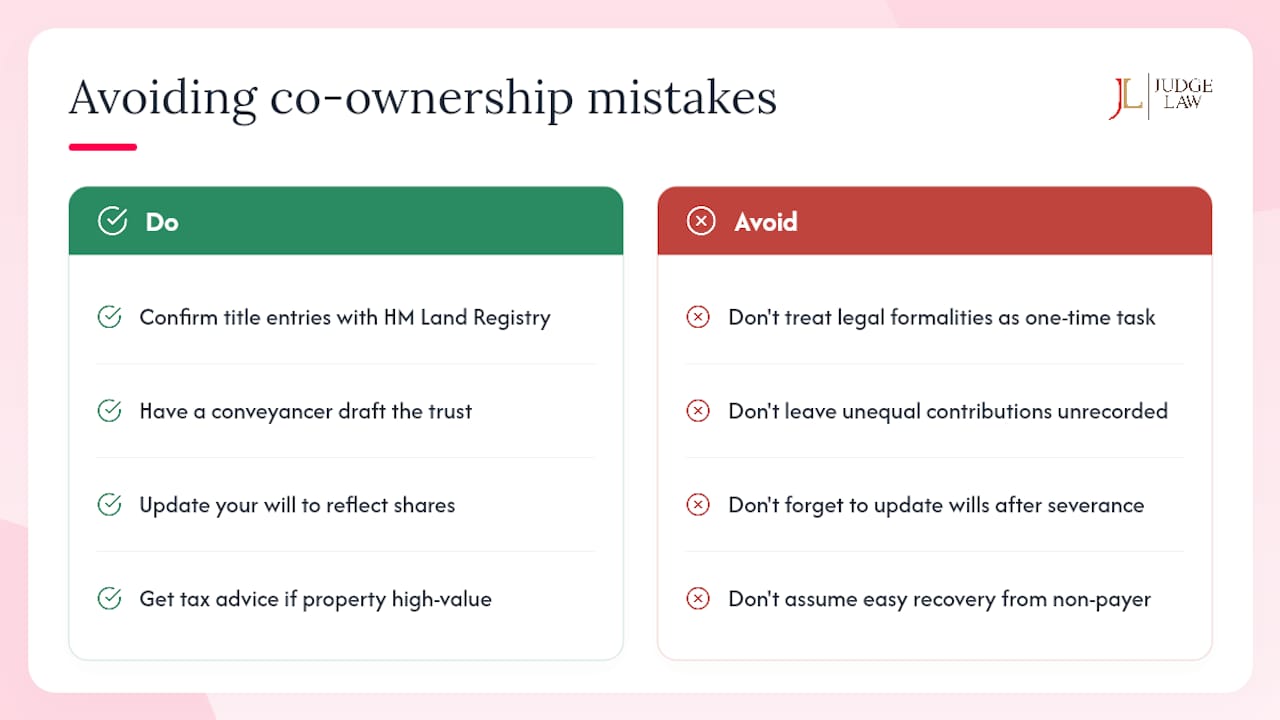
The most persistent mistake in co-ownership is treating the legal formalities as a one-time task rather than something that needs to stay aligned with the owners’ actual circumstances. People buy together, life changes, and the documents are never updated.
Unequal contributions that are never formally recorded are the single most common source of dispute. One owner pays a larger deposit, or funds a significant renovation, and assumes the declaration of trust or the court will recognise that contribution without any written evidence. Courts can and do find constructive trusts in the right circumstances, but the process is costly and the outcome uncertain. A properly drafted declaration of trust, prepared at the outset, removes that uncertainty entirely.
Wills are the second failure point. Tenants in common who want their share to pass to a specific beneficiary must have a will that says so clearly. A surprising number of people sever a joint tenancy, correctly, but then fail to update their will to direct the newly severable share. The intestacy rules then apply to that share, which may produce an outcome no one intended.
The third recurring problem is mortgage liability. Co-owners sometimes separate or fall out and one stops paying. The other continues to pay the full mortgage to protect their credit, assuming they can recover the excess from the non-paying owner later. That recovery is possible in principle, but it requires either a clear clause in the declaration of trust or a TOLATA claim, neither of which is free or fast.
Sensible first steps for anyone in this position: confirm the title entries with HM Land Registry, instruct a conveyancer to review or prepare the declaration of trust, update your will, and take independent tax advice if the property is significant in value. Judgelaw is SRA-regulated (registration number 634380) and approaches every co-ownership matter with the same plain English discipline this guide reflects.
How Judgelaw can help with your co-ownership matter
Co-ownership transactions and disputes call for solicitors who understand both the conveyancing mechanics and the trust law that sits beneath them. Judgelaw’s conveyancing solicitors handle the full range of co-ownership work: drafting declarations of trust, advising on beneficial share structures, registering Form A restrictions, and guiding clients through severance and transfer. Where a dispute has already developed, the firm’s civil disputes team can advise on TOLATA 1996 claims, trust disputes, and mediation options. Wills and estate planning services are available for co-owners who need their ownership structure to align with their broader estate plan.
If you are buying with others, or if you already own property jointly and want to review your position, get in touch to discuss your situation. Judgelaw is SRA-regulated (634380) and explains every step in plain English, without jargon or unnecessary delay.
Sources
Before instructing a solicitor, it is worth reading the primary sources that underpin this guide. The following are the most useful:
When you instruct a solicitor, bring the original transfer deed or TR1, any existing declaration of trust, official copies of the register, and any correspondence that records the agreed ownership arrangement. Those documents give your solicitor the clearest possible starting point.
FAQ
What is the difference between joint tenants and tenants in common?
Joint tenants hold the whole property together with a right of survivorship, so the surviving owner inherits automatically on death. Tenants in common hold defined shares that can be left by will to any chosen beneficiary, as set out in the GOV.UK joint ownership guidance.
Does HM Land Registry record who owns what share?
No. HM Land Registry records the legal proprietors only. The beneficial interest, including the size of each person’s share, must be documented separately in a declaration of trust and is not shown on the title register.
Can I change from joint tenants to tenants in common after purchase?
Yes. You can sever a joint tenancy at any time by serving a written notice of severance on the other owner(s) and applying to HM Land Registry to enter a Form A restriction. You should also update your will to direct your newly severable share to the intended beneficiary.
What does TOLATA 1996 allow a court to do in a co-ownership dispute?
Under TOLATA 1996, a court can make an order for sale, an order for possession, or a declaration of the parties’ beneficial interests. The court considers the purpose of the trust, the welfare of any children in the property, and the interests of secured creditors before making an order.
Do I need a declaration of trust if contributions are equal?
A declaration of trust is advisable even with equal contributions, because it records the agreed position clearly and sets out what happens on a sale, a relationship breakdown, or the death of one owner. Without it, any dispute about the arrangement must be resolved by the court applying constructive trust principles, which is uncertain and costly.
This article provides general legal information about property co-ownership in England and Wales. It is not a substitute for legal advice tailored to your specific circumstances. You should confirm the current legal position and its application to your situation with a qualified solicitor.
Recommended
- Property Purchase Checklist UK: Complete Guide | Judge Law
- Resolving property disputes: A UK homeowner’s guide
- Resolving property disputes: A UK homeowner’s guide
- Resolving property disputes: A UK homeowner’s guide