

An occupation order is a court order made under Part IV of the Family Law Act 1996 (ss.33-38) that decides who can live in, return to, or be excluded from a family home. It applies to you if you are an associated person under the Act, meaning a spouse, civil partner, cohabitant, former cohabitant, or a parent sharing a child with the other party, and you have a genuine connection to the property in question.
The order works in one of two directions. It can require someone to leave the home, restrict them to certain rooms or areas, or bar them from re-entering. Alternatively, it can secure your own right to return to or remain in a home you have been shut out of, whether through fear, force, or a partner changing the locks.
Common situations where this applies include:
- You and your partner are married or in a civil partnership and one of you wants the other to leave.
- You cohabit or previously cohabited and need to establish or protect a right to stay in the property.
- You share a child with someone but were never married or cohabiting, and the property connection test still needs to be met.
- You have been excluded from your home by threats, violence, or a change of locks and need a court order to get back in safely.
TL;DR
- An occupation order under the Family Law Act 1996 decides who can live in, return to, or be excluded from a family home.
- You must be an associated person and have a genuine connection to the property to apply.
- There is no court fee to apply using form FL401, and you should not serve the papers yourself: form D89 asks the court to do it.
- The court applies a balance of harm test and can attach a power of arrest where there is a history of violence or threats.
- Orders are short-term and do not decide who owns the home or who the children live with.
Key Takeaways
An occupation order under the Family Law Act 1996 regulates who lives in a family home on a short-term basis, decided against a balance of harm test rather than long-term property ownership.
| Point | Details |
|---|---|
| Eligibility needs two tests | You must be an associated person and have a genuine connection to the property, such as ownership, tenancy, or an intended shared home. |
| No court fee to apply | Form FL401 and the FL401T witness statement template are free to submit, but copies and correct service still matter. |
| Do not serve the application yourself | Use form D89 to have the court arrange service, especially for urgent, without-notice applications. |
| Orders are time-limited | Courts commonly grant orders for weeks or months, tied to events like related financial proceedings, not as a permanent settlement. |
What is an occupation order and what powers does it give the court?
Section 33 of the Family Law Act 1996 gives the court a broad toolkit once it establishes that you are entitled to apply. Courts distinguish between two functions an order can serve, and understanding the difference matters when you are deciding what to ask for.
A declaratory order confirms or clarifies a legal right you already hold, such as confirming your entitlement to occupy under existing home rights or a beneficial interest in the property. It does not remove anyone. It simply states, formally, that your right to be there is real and enforceable.
A regulatory order goes further. It actively controls who occupies the property and how. This is the type most people mean when they talk about “getting an occupation order” against a partner.
Under section 33 of the Family Law Act 1996, the court’s regulatory powers commonly include the ability to:
- Require the respondent to leave the home, or part of it, by a specified date.
- Restrict the respondent’s right to enter or remain in a defined part of the property.
- Exclude the respondent from a wider area around the home, sometimes called an exclusion zone.
- Regulate the occupation of either party, including who uses which rooms.
Alongside an occupation order, section 40 of the Act also lets the court require either party to pay rent, mortgage payments or other outgoings, to repair and maintain the home, or to take reasonable care of its furniture and contents.
Occupation orders are short-term regulatory tools aimed at settling occupation while the underlying relationship or safety issue is resolved elsewhere, not a permanent verdict on who owns the house.
Who can apply and what does the eligibility checklist look like?
Not everyone can apply. The Family Law Act 1996 restricts occupation orders to people who fall within the “associated person” definition and who also have a connection to the property itself. Both tests need to be satisfied, not just one.
You are likely to qualify as an associated person if any of the following describe your relationship to the respondent:
- You are or were married to them, or in a civil partnership with them.
- You cohabit or have cohabited with them as if you were a couple, regardless of gender.
- You are the parent of a child together, whether or not you ever lived together.
- You have had an intimate personal relationship of significant duration, even without cohabiting.
- You are relatives by blood or marriage, or you have both had parental responsibility for the same child.
The GOV.UK eligibility guidance sets these categories out in detail, along with the second requirement: a connection to the property. This means you own it, rent it, have a beneficial interest in it, or it was intended as a shared home even if your name is not on the title deeds or tenancy.
That second limb catches people who assume they have no case because the house is in their partner’s sole name. If it was your home, or was intended to be, you may still have grounds. Former cohabitants often have weaker rights than married couples or civil partners, because home rights under the Act attach automatically to marriage and civil partnership but not to cohabitation. This does not mean you cannot apply. It means the court will look more closely at whether you have an estate, interest, or contractual right in the property before deciding what kind of order it can make.
What can an occupation order do, and what are its practical limits?
Once the court is satisfied you qualify, its remedies are wide-ranging. It can:
- Exclude the respondent entirely from the home, or from specific rooms within it.
- Create an exclusion zone around the property, stopping the respondent from coming within a set distance.
- Regulate who uses which parts of the house, if both parties are to remain under one roof for a period.
- Order who pays rent, mortgage instalments, utility bills, or repair costs while the order is in force.
- Suspend or restrict a respondent’s home rights, and, in some cases, terminate them.
- Attach a power of arrest, meaning the police can arrest the respondent immediately for breach, without needing a separate warrant.
Pro Tip: An occupation order is not a property settlement. It settles who lives where right now, often for a matter of weeks or months, while separation, divorce, or a financial remedy application deals with long-term ownership.
What it will not do is resolve who ultimately owns the house or how equity gets divided. That is a job for financial remedy proceedings, or for a separate application dealing with property division after divorce. Courts are also cautious about ordering someone out of their only home unless the harm to the applicant clearly outweighs the hardship this causes. An occupation order buys safety and breathing space. It rarely settles the bigger financial picture on its own.
How do you apply, and what does an urgent application involve?
You apply using form FL401, supported by a witness statement setting out the facts, the relationship, the property connection, and the harm or risk involved. GOV.UK provides both the application form and a template supporting statement, known as FL401T, to help you structure that evidence properly.
The practical steps look like this:
- Complete form FL401. Set out your relationship to the respondent, the property details, and exactly what order you are asking for.
- Draft a witness statement using the FL401T template. Describe specific incidents with dates, not general impressions. Courts respond to detail, not adjectives.
- Gather supporting evidence. Photographs of injuries or damage, messages, police reference numbers, medical records, and anything showing your housing needs and those of any children.
- File the application. There is no court fee for applying for an occupation order, according to GOV.UK’s application guidance, though you will need to provide the correct number of copies for the court, the respondent, and yourself.
- Consider whether you need a without-notice application. If there is an immediate risk to your safety, you can ask the court to make an order before the respondent is told, based on your written evidence alone.
- Arrange service through the court, not yourself. You should never serve a without-notice or urgent application personally. Use form D89 to have a court official or bailiff serve the respondent instead.
Good to know: There is no court fee to apply for an occupation order in England and Wales, though correct filing and service procedure, including the use of D89 for court service, is essential for the order to take effect properly, as set out in the FL401 guidance notes.
Frame your witness statement around the balance of harm the court will apply later. Describe specific hardship. Where will you and any children stay if the order is refused? What has already happened, and when? Vague accounts of “difficulties” carry far less weight than a dated account of an incident, a message, or a call to the police.
What does the court weigh before granting an order?
The central legal test is the balance of harm. The court compares the harm you or any relevant child would suffer if the order is not made against the harm the respondent would suffer if it is. Where the applicant or a relevant child is likely to suffer significant harm attributable to the respondent’s conduct if no order is made, the court must make the order under section 33(7), unless the respondent or a relevant child is likely to suffer significant harm if the order is made that is as great as, or greater than, that harm.
Beyond that core test, judges also weigh:
- Each party’s housing needs and financial resources, including whether either can reasonably find alternative accommodation.
- The likely effect of any order, or of not making one, on the health, safety, and wellbeing of the parties and any children.
- The conduct of both parties in relation to each other and the property.
- For former spouses and cohabitants, the length and nature of the relationship and whether other proceedings between the parties are already underway (sections 35 and 36 of the Act).
Where there is a documented history of violence, threats, or a real risk of harm, the court is more likely to attach a power of arrest to the order, under section 47. This turns any breach into a matter for immediate police action rather than a return to court weeks later.
How long does an occupation order last, and what happens if it is breached?
Occupation orders are deliberately time-limited. Courts commonly grant them for a set period, sometimes a matter of weeks, sometimes up to six or twelve months, and orders can also be tied to a specific event, such as the conclusion of related financial remedy proceedings.
You can apply to the court to:
- Vary the order, if circumstances change and the terms need adjusting.
- Discharge the order early, if the reason for it no longer applies.
- Extend the order, before it expires, if the risk or housing dispute has not resolved.
Enforcement depends heavily on whether a power of arrest was attached. If it was, the police can arrest the respondent immediately on breach, without a warrant, and bring them before the court. Where no power of arrest exists, breach is usually pursued as contempt of court, which can result in a fine, or in serious cases, committal to prison. If you believe an order has been breached, contact the police and keep a written record, including times, dates, and any messages or witnesses, since this evidence often decides whether the court acts quickly.
How does an occupation order interact with other proceedings?
Occupation orders rarely stand alone. They are frequently applied for alongside a non-molestation order, which restricts contact, threats, or harassment rather than occupation itself. Where there is a pattern of controlling or violent behaviour, solicitors often pursue both together, since one protects your safety generally and the other resolves who lives where.
If you rent, an occupation order can sit uneasily alongside a landlord’s separate possession proceedings, and a solicitor needs to check how the two interact before advising you. Where divorce or financial remedy proceedings are already running, the occupation order usually deals only with the immediate occupation question, while the divorce settlement or a related child arrangements process resolves the longer-term picture, including eventual property division.
Practical next steps: what a solicitor will do
If you are in immediate danger, contact the police first by calling 999. Where you can do so safely, preserve evidence as it happens: screenshots, photographs and dated notes, before memory fades or messages get deleted.
A solicitor’s role at this stage typically includes:
- Checking your eligibility against the associated person and property connection tests.
- Drafting the FL401 application and witness statement so it addresses the balance of harm test directly.
- Advising on whether a without-notice application is appropriate, and arranging service correctly through form D89 rather than risking personal service invalidating the application.
- Preparing you for an urgent hearing and presenting supporting evidence, including police reports, effectively.
Pro Tip: If a power of arrest is being requested, gather anything that documents past incidents, police call logs, medical notes, or witness accounts, before your first meeting with a solicitor. Courts look for concrete evidence of risk before attaching that power.
If matters are urgent, local domestic abuse services and the police remain the fastest route to immediate safety, alongside any legal steps.
How does an occupation order affect children and existing arrangements?
Where children live in the property, their welfare sits close to the centre of the court’s decision, even though an occupation order is not technically a children’s order in the way a child arrangements order is. The court must consider the likely effect on any relevant child’s health, safety, and stability, both if the order is made and if it is refused.

In practice, a judge weighing whether to exclude a respondent will usually give real weight to a child witnessing conflict, feeling unsafe at home, or facing repeated disruption to school and routine. Housing stability for children frequently tips the balance of harm test towards granting the order, particularly where the alternative is a parent and children sleeping in a car or a refuge.
That said, an occupation order does not decide who a child lives with, or how much contact the excluded parent has going forward. Those questions belong to a separate child arrangements process, and the two sometimes run in parallel, particularly where one parent’s behaviour has affected both the home situation and the children directly. A solicitor handling your occupation order application will usually flag early on whether a linked child arrangements application makes sense, so the two pieces of the picture do not contradict each other. Courts are generally alert to the risk of one parent using an occupation order tactically to gain an advantage in a later contact dispute, and will scrutinise the underlying evidence accordingly rather than accepting assertions at face value.
Do occupation orders work differently for married couples than for cohabitants?
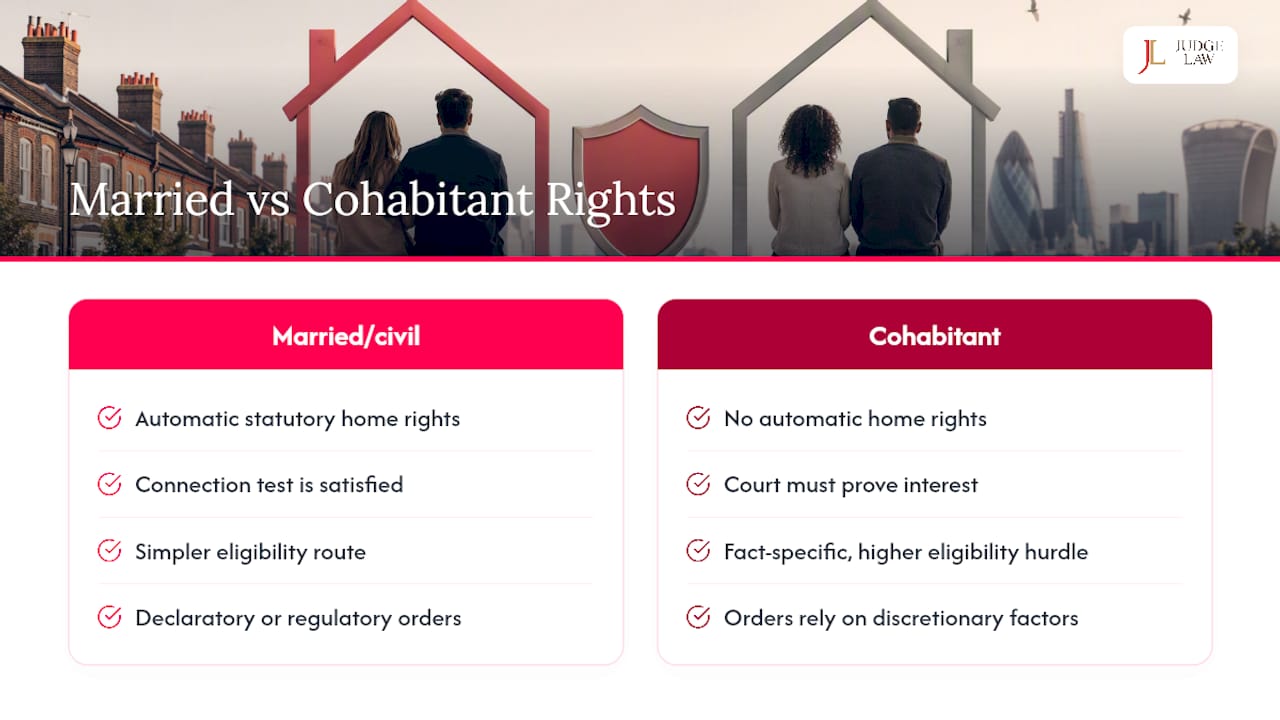
Yes, and the difference matters more than most people expect. Married couples and civil partners benefit from statutory home rights under the Family Law Act 1996, which attach automatically regardless of whose name is on the title deeds or tenancy. This gives a non-owning spouse a straightforward route into an occupation order application, because the property connection test is effectively already satisfied by the marriage itself.
Cohabitants and former cohabitants do not get that automatic protection. The court has to examine whether the applicant has an actual legal or equitable interest in the property, such as a beneficial interest arising from financial contributions, or whether the home was clearly intended as a shared home even without formal ownership. This is a more fact-specific enquiry, and it means cohabitants sometimes face a harder eligibility hurdle before the court even reaches the balance of harm test.
The type of order available can also differ. Where the applicant already has a legal or beneficial interest, the court can make a declaratory order confirming that interest alongside any regulatory order. Where they do not, the court’s powers are still real but rest more heavily on discretionary factors, including the length of the relationship, whether children are involved, and the respondent’s own housing needs. Anyone in a cohabiting relationship without their name on the property should treat this as a reason to seek advice early, not a reason to assume an application is pointless. The eligibility categories set out by GOV.UK still capture most cohabiting relationships, current and former.
What happens if an occupation order is refused or later revoked?
A refusal does not automatically end your options. Courts sometimes decline to make an order because the evidence submitted did not clearly establish the balance of harm in your favour, not because the underlying situation lacks merit. In that scenario, strengthening the witness statement with more specific, dated evidence and reapplying is often realistic, particularly if circumstances have changed or new incidents have occurred since the first hearing.
Other outcomes are also common. The court might grant a shorter or narrower order than requested, for instance regulating occupation within the property rather than excluding the respondent entirely, if the evidence supports coexistence with restrictions rather than a full exclusion. It might also make a non-molestation order instead of, or alongside, an occupation order, where the primary risk is harassment or contact rather than a dispute over who lives in the property.
If an order is later revoked or discharged, this usually reflects a change in circumstances: the underlying risk reducing, the parties separating permanently and one moving out voluntarily, or related proceedings resolving the housing question by another route. Discharge is not a judgment that the original order was wrong. It simply means the court no longer sees a continuing need for that specific regulatory tool. Where safety concerns persist despite a discharge, a fresh application remains available if new evidence supports it.
Can you appeal an occupation order decision?
Yes. Either party can appeal a decision on an occupation order application, whether that is a refusal to grant one, the terms of an order actually made, or a decision to attach or withhold a power of arrest. An appeal generally needs to be lodged within a strict time limit, and it must identify a genuine error in how the judge applied the law or exercised their discretion, not simply dissatisfaction with the outcome.
Appeals in this area are not won on the basis that the losing party would have preferred a different result. The appellate court will look at whether the balance of harm test was applied correctly, whether relevant factors under section 33 were properly weighed, and whether the evidence before the original court reasonably supported the decision reached. This is a difficult threshold to meet, given how much discretion the first instance judge holds in weighing housing needs, conduct, and risk.
Given the tight deadlines involved and the technical grounds required, anyone considering an appeal should seek advice promptly rather than assuming there is time to reflect. A missed deadline generally closes off the route entirely, regardless of how strong the underlying argument might have been.
Frequently asked questions
How difficult is it to get an occupation order?
It depends on the strength of your evidence against the balance of harm test. Applications supported by specific, dated incidents and clear housing need succeed more often than vague or general accounts.
How much does it cost to get an occupation order in the UK?
There is no court fee to apply for an occupation order using form FL401. Solicitor fees vary by case, and Judge Law offers a paid initial consultation for family law matters.
Can an occupation order be overturned?
Yes. Either party can apply to vary or discharge it if circumstances change, and either party can appeal the original decision within strict time limits if they believe the court made a legal error.
How long can an occupation order last?
Orders are typically granted for a limited period, often weeks to around six or twelve months, and can be tied to a specific event such as the conclusion of related proceedings, with the option to extend before expiry.
Do I need a solicitor to apply for an occupation order?
You can apply yourself using form FL401, but a solicitor helps ensure the witness statement addresses the balance of harm test properly and that service is arranged correctly through form D89.
Sources
- Family Law Act 1996, section 33 – Occupation orders where applicant has estate or interest etc. or has home rights
- FL401 Apply for a non-molestation or occupation order (02.23) – PDF
This article is general information, not a substitute for advice from a qualified lawyer. Consult a qualified legal professional about your own circumstances before acting on anything here.