

TL;DR
- A financial order is a court-issued document that legally settles financial claims between divorcing spouses, covering assets and debts. Without it, claims can remain open indefinitely, risking future disputes and enforcement issues even after divorce. Properly applying, drafting, and sealing a financial order is essential to protect your financial interests and ensure enforceability.
You have your conditional order. You might even have a verbal agreement with your spouse about who gets what. But here is the thing most people do not realise until it is too late: your divorce and your finances are two entirely separate legal matters. Getting divorced in England or Wales does not automatically settle your financial claims. Without a proper financial order divorce UK courts can recognise and enforce, either party can bring financial claims against the other years, sometimes decades, after the divorce is finalised. This guide sets out exactly what financial orders are, how to obtain one, and what you need to protect yourself.
What is a financial order in UK divorce law?
A financial order is a court order that legally resolves the financial relationship between divorcing spouses. It can cover the family home, pensions, savings, investments, business interests, and debts. There are two main types. A consent order is made by agreement between both parties and submitted to the court for approval. A contested financial order is made by a judge after formal proceedings where the parties cannot agree.
The critical point is this: financial claims remain open indefinitely without a sealed court order, even after you are divorced. A verbal agreement, a signed letter, or a solicitor’s exchange of correspondence does not extinguish those claims. Only a court-sealed order achieves that. The relief many people feel once a consent order is in place is real, and it is earned. You have formally closed the financial chapter of your marriage.
Enforcement is another reason financial orders matter. Once sealed, a court can compel compliance through a range of legal mechanisms, including court execution of property transfers, attachment of earnings for lump sum payments, and pension sharing orders directed at pension providers. These are not options available for informal agreements.
Key protections a financial order provides:
- Legally extinguishes further financial claims between spouses
- Creates an enforceable obligation the court can act on
- Covers property, pensions, savings, maintenance, and debts in a single binding document
- Provides certainty for both parties going forward
Pro Tip: Even when both parties are on good terms and have agreed everything informally, you still need a consent order. Circumstances change. People remarry, inherit wealth, or start successful businesses. Without a sealed order, those changes can expose you to future claims.
When and how to apply for a financial order
Timing matters, and getting it wrong can cost you. The process ties into the divorce procedure itself, so understanding the divorce timeline helps you plan financial proceedings alongside it.
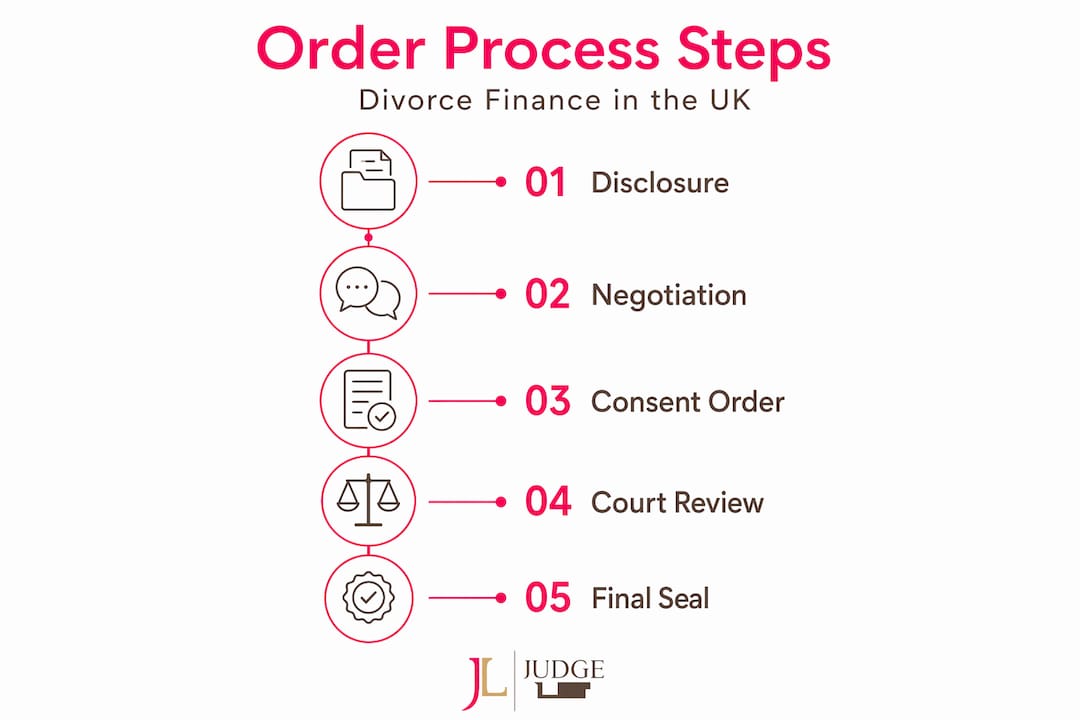
Here is the sequence you need to follow:
- Apply for your divorce. The divorce application starts the clock. You must wait 20 weeks before you can apply for the conditional order (previously called decree nisi).
- Obtain the conditional order. You must wait until the conditional order is granted before submitting your consent order application to the court.
- Prepare and submit Form D81. This is the statement of information accompanying a consent order application. Both parties complete it, setting out their financial positions. The form runs to 23 pages and must be submitted alongside your draft consent order. The court fee is £60 and, in most cases, neither party needs to attend court.
- Judicial review. A judge reviews the application on paper. If the terms appear fair and the paperwork is complete, the order is sealed and returned. If the judge has queries or concerns, you may receive a request for further information or, in rare cases, a hearing may be listed.
- Apply for the final order. You can apply for the final divorce order six weeks and one day after the conditional order. Most solicitors advise completing the financial order process before applying for the final order, because once you are divorced and have not yet secured a financial order, your rights are more vulnerable.
- The consent order is sealed. Once sealed by the court, the order is legally binding on both parties.
The reason step five matters so much is remarriage. If you remarry before obtaining a financial order, you lose the right to make certain financial claims against your former spouse. This is a painful and entirely avoidable situation.
Assets, maintenance, and what judges consider
Courts in England and Wales do not apply a rigid formula when dividing assets. Instead, judges apply the Section 25 factors under the Matrimonial Causes Act 1973 to determine what is fair in the specific circumstances of each marriage. Understanding these factors helps you approach negotiations and disclosure with realistic expectations.

| Factor | What it means in practice |
|---|---|
| Welfare of any children | Children’s needs take priority above all other considerations |
| Income and earning capacity | Both current income and realistic future earning potential |
| Financial needs and obligations | Housing, living costs, and financial responsibilities of each party |
| Standard of living during marriage | The lifestyle the parties maintained together |
| Age and length of marriage | Longer marriages generally produce more equal divisions |
| Physical or mental disability | Any conditions affecting a party’s ability to be financially self-sufficient |
| Contributions to the marriage | Financial and non-financial, including homemaking and child-rearing |
| Conduct | Rarely relevant; courts set a very high bar for conduct to affect outcomes |
Understanding how assets are divided in practice requires looking beyond the table above. The starting point in long marriages is often an equal split, but the court will depart from equality where the factors above justify it. Short marriages, pre-marital assets, and inheritances can all shift outcomes significantly.
Pensions are one of the most commonly overlooked and undervalued assets in divorce settlements. A pension sharing order, a pension attachment order, or offsetting pension value against other assets are all options available to the court. If your marriage is long or there is a significant disparity in pension values, you should understand your pension entitlements before agreeing to any settlement.
On spousal maintenance, the position in England and Wales has shifted. Spousal maintenance is conditional, time-limited, and only payable where one party genuinely cannot meet their reasonable needs from their own income and the other party has the means to pay. Typical awards last two to five years, intended to allow the receiving party to become financially independent. Permanent maintenance orders are becoming increasingly rare, reserved for cases involving long marriages, significant age gaps, or serious health conditions preventing employment.
Drafting consent orders and avoiding delays
Reaching an agreement is one thing. Having it properly drafted and approved is another. Poorly prepared consent orders are one of the most common causes of delay in financial proceedings, and fixing them after the fact is both frustrating and costly.
A consent order must cover every financial matter between the parties, including the matrimonial home, any other properties, bank accounts, investments, pensions, business interests, and any maintenance arrangements. Gaps in the order can leave claims open or create disputes later about what was intended.
Common reasons a judge may query or reject a consent order:
- Significant disparity between the parties’ financial positions without clear justification
- Missing information on Form D81, particularly regarding pensions or debts
- Terms that appear heavily weighted in favour of one party without explanation
- Inconsistencies between the draft order and the figures stated in Form D81
- Absence of a clean break clause where one would ordinarily be appropriate
Judges scrutinise consent orders for both fairness and completeness before sealing them. An order that looks fine to the parties involved may raise red flags to a judge reviewing it without the full context of negotiations.
There are limited grounds to set aside a consent order once it has been approved by the court, typically involving misrepresentation, material non-disclosure, or undue influence. This is precisely why full and honest financial disclosure matters so much. If your former spouse later discovers you withheld assets, the order can be challenged and set aside, with serious cost consequences for you.
Pro Tip: Even if you and your spouse agree on everything, having a solicitor draft or review the consent order is money well spent. An agreement that appears fair to both of you may not reflect your legal entitlements, and a judge may reject poorly drafted terms regardless of the parties’ intentions.
When agreement is not possible
Not every couple can reach agreement on finances. If negotiations break down, the formal route is an application for a contested financial order, known as a financial remedy application.
- File Form A. This is the application to the court to determine financial matters. Filing Form A puts the matter before a judge and triggers the formal process.
- Complete Form E. Both parties must provide full financial disclosure using Form E. This is a detailed document covering all income, assets, liabilities, pensions, and outgoings. Incomplete or inaccurate disclosure has serious consequences, including adverse inferences being drawn by the court.
- First Appointment. The court sets directions for the case, identifies issues in dispute, and considers whether further information or expert evidence is needed.
- Financial Dispute Resolution hearing. A judge gives a non-binding evaluation of the likely outcome, designed to encourage settlement. Most contested cases settle at or around this stage, typically nine to twelve months after Form A is filed.
- Final hearing. If the matter is not resolved, a final hearing takes place at which a judge makes binding decisions on all outstanding financial issues.
The risks of contested proceedings are real. Costs accumulate quickly and can consume a meaningful portion of the assets being divided. Courts also look unfavourably on parties who refuse to negotiate reasonably. Mediation before or during proceedings is worth considering where there is any realistic prospect of agreement, though it is not appropriate in every situation.
My perspective on what people get wrong
In my experience, the two mistakes that cause the most harm in divorce finances are leaving things informal and leaving them too late. People often assume that because the divorce itself is proceeding smoothly, the finances will fall into place. They sometimes do, but without a court-sealed order, you have not actually resolved anything. You have simply agreed.
What I have seen is that informal arrangements can unravel years later when circumstances change: when one party receives an inheritance, sells a business, or remarries. The financial claims that were never formally extinguished suddenly become very live again. The distress that causes, not to mention the legal costs, is entirely preventable.
I would also push back on the idea that financial disclosure is just a formality. Early legal advice helps avoid the hostility and surprises that emerge from undisclosed assets or unclear arrangements. When parties are transparent and get proper advice early, settlements tend to be fairer, faster, and more durable. That is the outcome worth working towards.
Frequently asked questions
What is a financial order in divorce?
A financial order is a court order that formally resolves all financial matters between divorcing spouses, covering property, pensions, savings, debts, and maintenance. Without one, financial claims between the parties remain open even after the divorce is finalised.
Can I be made to pay my ex-spouse money years after divorce?
Yes. Without a sealed financial order, financial claims can be brought years or even decades after the divorce. This risk is removed only when a court-sealed consent order or contested financial order formally extinguishes those claims.
How long does it take to get a consent order?
Once submitted, the court typically reviews a consent order application within four to eight weeks, provided Form D81 and the draft order are correctly completed. Errors or missing information can cause significant delays.
Do I need to go to court for a consent order?
In most cases, no. The judge reviews the consent order application on paper. Attendance is only required if the judge has concerns about the terms or the information provided.
What happens if we cannot agree on a financial settlement?
If you cannot reach agreement, you can apply to the court using Form A to begin contested financial remedy proceedings. The process typically takes nine to twelve months and involves full financial disclosure, court appointments, and potentially a final hearing before a judge.