

Moving your child within England and Wales does not automatically require the other parent’s written consent, but taking a child out of the UK does, and doing it without consent or a court order can expose you to criminal liability. Internal relocations sit under general parental responsibility rules; removals from the UK are governed by the Child Abduction Act 1984 and, where a child arrangements order is in force, by Section 13 of the Children Act 1989. Crossing that line without consent can lead to an urgent court application against you, or a police investigation.
TL;DR
- Internal relocations within England and Wales generally do not require parental consent unless the move could impact the child’s welfare or contact arrangements.
- Moving a child out of the UK legally requires written consent from all guardians with parental responsibility or a court order, with breach risking criminal child abduction charges.
- Parental responsibility depends on factors like the parent’s marital status at birth or court grants, not solely on who the child resides with, and those without responsibility cannot block relocations legally.
- Court orders such as prohibited steps, specific issue, or leave to remove address different disputes, with urgent applications possible in cases of imminent removal.
- Evidence of realistic housing, stable income, detailed contact and schooling plans, along with proper documentation, is critical for a relocation or opposition case.
Internal moves versus removing a child from the UK: what the law actually says
The distinction that trips up most parents is not fairness, it is geography. Section 13 of the Children Act 1989 applies where a child arrangements order is in force, and the Child Abduction Act 1984 applies more generally: taking a child out of the United Kingdom needs the consent of everyone with parental responsibility or the permission of the court. Move to Manchester from Windsor, and that section has nothing to say about it. Move to Marbella, and those rules govern everything.
Internal relocations are not automatically caught by any equivalent statutory brake. A parent with a child arrangements order naming the child as living with them can generally move house, change schools, and relocate within England and Wales without asking permission first. The statutory restrictions on removal concern taking a child out of the United Kingdom; internal moves are treated on a different legal footing entirely.
That does not mean an internal move is risk free. The other parent can still bring the matter before the Family Court under Section 8 of the Act if they believe the move damages the child’s welfare, disrupts schooling, or makes contact impractical. A move from Windsor to Newcastle, for instance, might not need consent in principle, but it can still trigger an urgent application if it happens without warning.
The practical differences break down like this:
- Internal moves (England and Wales): no automatic consent requirement, but open to a Section 8 challenge if the other parent objects.
- Removal from the UK: the consent of everyone with parental responsibility, or the court’s permission, is required under the Child Abduction Act 1984, and under Section 13 of the Children Act 1989 where a child arrangements order is in force.
- Removal without consent or an order: can amount to child abduction under the Child Abduction Act 1984, a criminal matter, not just a civil dispute.
- Short trips abroad: a person named in a child arrangements order as someone the child lives with can take the child abroad for less than one month without the other parent’s consent, unless a court order says otherwise. Without such an order, consent is needed for any trip.
The safest approach, whichever category applies, is to treat consent as something you obtain in writing, not something you assume you have because nobody has objected yet.
Who has to agree: parental responsibility and who can go to court
Whether you need consent, and whose consent, depends entirely on who holds parental responsibility. This is not the same as who the child lives with, and it catches out more parents than any other point in relocation disputes.
Parental responsibility typically sits with:
- The child’s mother, automatically, from birth.
- The father, if married to the mother at the time of birth, named on the birth certificate with the mother’s agreement, subject to a parental responsibility agreement, or granted it by court order.
- Anyone granted parental responsibility through a court order, including some step-parents and guardians in specific circumstances.
GOV.UK guidance on parental rights and responsibilities sets out how to establish who holds it, and it is worth checking properly rather than assuming. Unmarried fathers without a birth certificate entry or agreement do not automatically hold parental responsibility, which surprises a fair number of separated parents who believed otherwise. Our guide to child arrangement orders for unmarried fathers covers how that status can be acquired.
Someone without parental responsibility cannot lawfully block a move by withholding consent, because their consent was never legally required. That said, any parent, including a father without parental responsibility, is entitled to apply to the court for a section 8 order such as a prohibited steps order without first needing the court’s permission.
Pro Tip: Before you plan around anyone’s objection, or their silence, check their parental responsibility status properly. Assuming consent is needed, or assuming it is not, based on who the child calls “dad” rather than what the paperwork says, is one of the most common and costly mistakes in relocation disputes.
What court orders can stop or allow a relocation?
Three orders do most of the work in relocation disputes, and each does a different job.
- Prohibited steps order. This stops a specific action, most commonly removing the child from the UK or from a defined geographic area. It is often sought urgently, sometimes without notice to the other parent, when removal appears imminent.
- Specific issue order. This resolves a particular disputed decision, such as which school the child attends after a move, without necessarily addressing where the child lives day to day.
- Leave to remove (permission to relocate). Where one parent wants to take the child abroad permanently, or for an extended period, and the other refuses consent, the court can grant “leave to remove” after weighing the welfare checklist. This is the order that effectively substitutes for consent when agreement cannot be reached.
Applications for any of these generally start with form C100, the standard application to the Family Court for orders relating to children, detailed on GOV.UK’s page on applying for a court order. Before filing, most applicants are expected to attend a Mediation Information and Assessment Meeting, known as a MIAM, unless an exemption applies. Domestic abuse and genuine urgency are the most common exemptions, and the court will want evidence supporting either.
Fees matter here, and they are not trivial for someone managing a house move on a tight budget. Citizens Advice sets out that the standard fee for a prohibited steps order application sits around £270, with fee remission available for applicants on a low income. If removal genuinely appears imminent, an application can be made urgently, sometimes on the same day, and the court can act without hearing from the other parent first if the risk is sufficiently clear. Our guide to emergency prohibited steps orders walks through what that urgent process looks like in practice.
How judges decide: the welfare checklist and the evidence that actually persuades them
Every relocation decision the Family Court makes runs through the welfare checklist set out in Section 1 of the Children Act 1989. The child’s welfare is the court’s paramount consideration, and the checklist requires the judge to weigh specific, named factors rather than a vague sense of what seems fair to the adults.
Those factors include the child’s own wishes and feelings, considered in light of their age and understanding, their physical and emotional needs, the likely effect of any change in circumstances, and the capability of each parent to meet those needs. None of this is abstract in a relocation case. A judge deciding whether to grant leave to remove wants to see how the move actually plays out for the child, not just why the relocating parent wants to go.
Evidence that strengthens an application typically covers:
- Confirmed housing arrangements at the destination, not a vague intention to “find somewhere.”
- Financial stability, whether through employment already secured or documented savings.
- A specific school place, or at minimum, realistic enrolment prospects.
- Medical and any additional needs provision at the new location.
- A detailed, costed contact proposal covering how the other parent will see the child.
Judges look for realism above all else. A relocating parent needs to show housing is affordable, income or funding is secure, schooling is arranged, and the travel and contact plan has actual costs and frequency attached to it, not aspirations. A proposal offering fortnightly video calls and two half-term visits, with flights costed and a shared contribution to travel expenses, lands very differently to a plan that simply says “we’ll sort out visits.”
Courts consistently weight practical, workable contact proposals, covering travel plans, cost sharing, and technology-based contact, as one of the most influential factors in relocation outcomes. A parent who has thought through exactly how the other parent stays involved gives the court far less reason to refuse.
Mediation and MIAMs: what you need to try before issuing proceedings
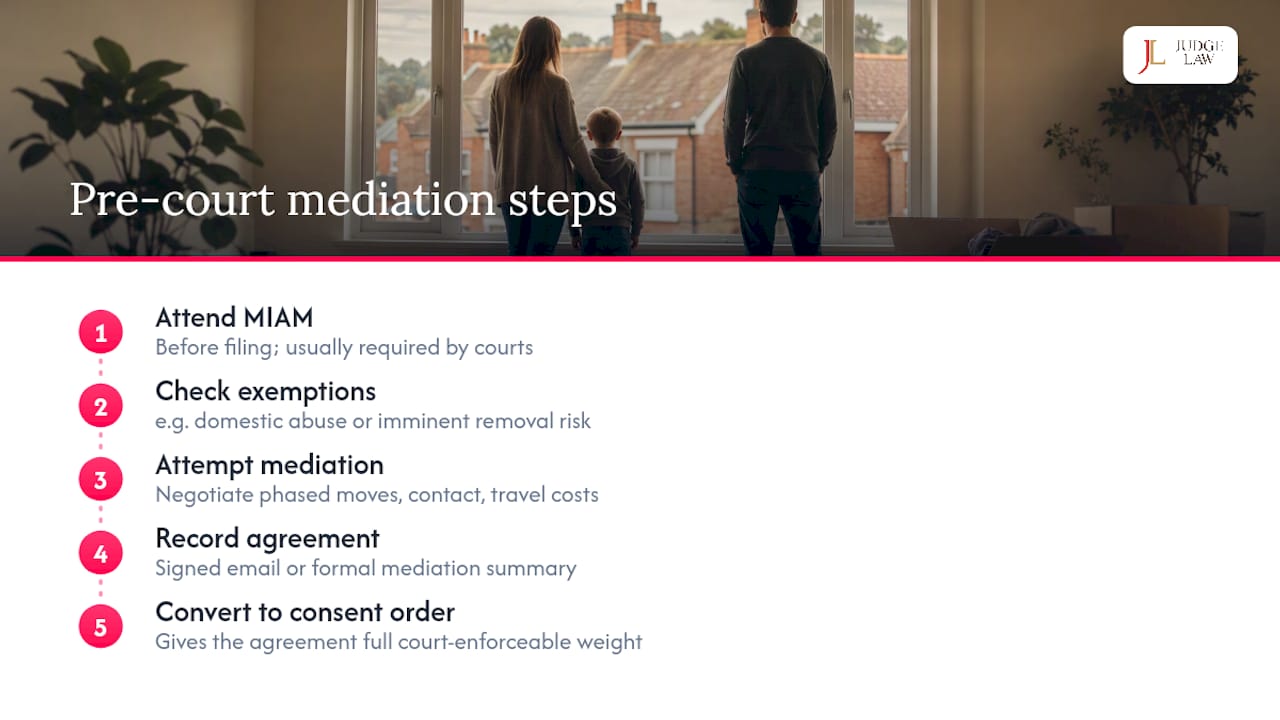
Before either parent files a court application in most relocation disputes, they are expected to attend a MIAM. This is not a formality to tick off. Courts genuinely expect parties to have explored whether the dispute can be resolved without a judge, and failure to attend one without a valid reason can delay or complicate an application.
Exemptions exist, most significantly where there is evidence of domestic abuse, or where the situation is urgent enough that mediation would defeat the purpose, such as a genuine risk of imminent removal.
Where mediation is appropriate, it can achieve outcomes a court order rarely captures with the same nuance: a phased move that lets a child finish a school term first, a detailed contact schedule built around actual term dates and holidays, or an agreement on how travel costs get split between two households.
Whatever gets agreed needs to be written down and signed, not left as a conversation both parties remember differently six months later. Verbal consent is hard to prove if a dispute later arises, so an email confirming the agreed terms, or a formal mediation summary, is worth far more than a phone call ever will be.
Pro Tip: If you reach an agreement through mediation, ask for it recorded in a Memorandum of Understanding, and consider whether it should be converted into a consent order. A consent order carries the same enforcement weight as any other court order, whereas a mediated agreement alone does not. Our guide to the benefits of family mediation covers how that process typically runs.
Getting ready to move, or getting ready to stop one
Whichever side of this you are on, preparation and documentation often matter as much as the merits of your argument.
If you are planning to relocate:
- Get consent in writing, by email or signed letter, from everyone with parental responsibility, even for moves that seem straightforward.
- Gather your housing evidence, tenancy agreement or mortgage offer, school place confirmation, and proof of income or funding, before you raise the move.
- Draft a specific contact proposal covering frequency, travel arrangements, and who bears the cost, before presenting the move as a fait accompli.
- If consent is refused, apply for leave to remove rather than proceeding regardless.
If you fear an unauthorised removal is imminent:
- Preserve messages, emails, or anything indicating an intention to remove the child, without deleting or editing them.
- Do not book or fund any travel yourself, and avoid actions that could be read as consent.
- Contact the police for a port alert if removal appears genuinely imminent. This flags the child’s details at ports and airports and can prevent departure.
- Apply urgently for a prohibited steps order, supported by a witness statement setting out dates, specific communications, and why you believe removal is imminent.
Witness statements carry weight in proportion to their specificity. A statement saying “I believe she plans to take him abroad” gives the court little to go on. A statement citing a screenshot of a one-way flight search, a message referencing “starting fresh in Spain,” and a school withdrawal enquiry gives the court something concrete to act on.
What relocation applications cost and how long they take
Court fees for these applications are modest compared to most civil litigation, but they add up alongside legal costs, and timing varies enormously depending on urgency.
- The standard fee for a prohibited steps order application is around £270, with fee remission available to applicants who meet the low income criteria.
- Non-urgent applications, including those for leave to remove, typically take several months from filing to final hearing once you factor in the MIAM requirement, a first hearing dispute resolution appointment, and possibly a fact-finding hearing before the final decision.
- Interim hearings can shorten the practical timeline by putting temporary arrangements in place while the full application proceeds, which matters when a school term or a job start date is approaching.
Genuinely urgent applications, where removal appears imminent, can be heard the same day or within days, particularly where a port alert has already been requested through the police. The court’s tolerance for delay drops sharply once there is credible evidence a child may be about to leave the jurisdiction without consent.
International relocation: does it matter if the other parent isn’t a UK citizen?
Nationality itself is rarely the deciding factor, but it changes the practical landscape considerably. Where a child is removed to, or from, a country that has signed the Hague Convention on the Civil Aspects of International Child Abduction, there is an established mechanism for securing a swift return.
The central authority for England and Wales is the International Child Abduction and Contact Unit, known as ICACU, part of the Office of the Official Solicitor, which liaises with the equivalent authority in the other Hague country to process return applications., which liaises with the equivalent authority in the other Hague country to process return applications. Hague return proceedings are designed to move quickly, with summary return decisions usually expected within six weeks of an application being made, reflecting the Convention’s underlying principle that children should generally be returned to their habitual residence for welfare decisions to be made there, not wherever they were taken.
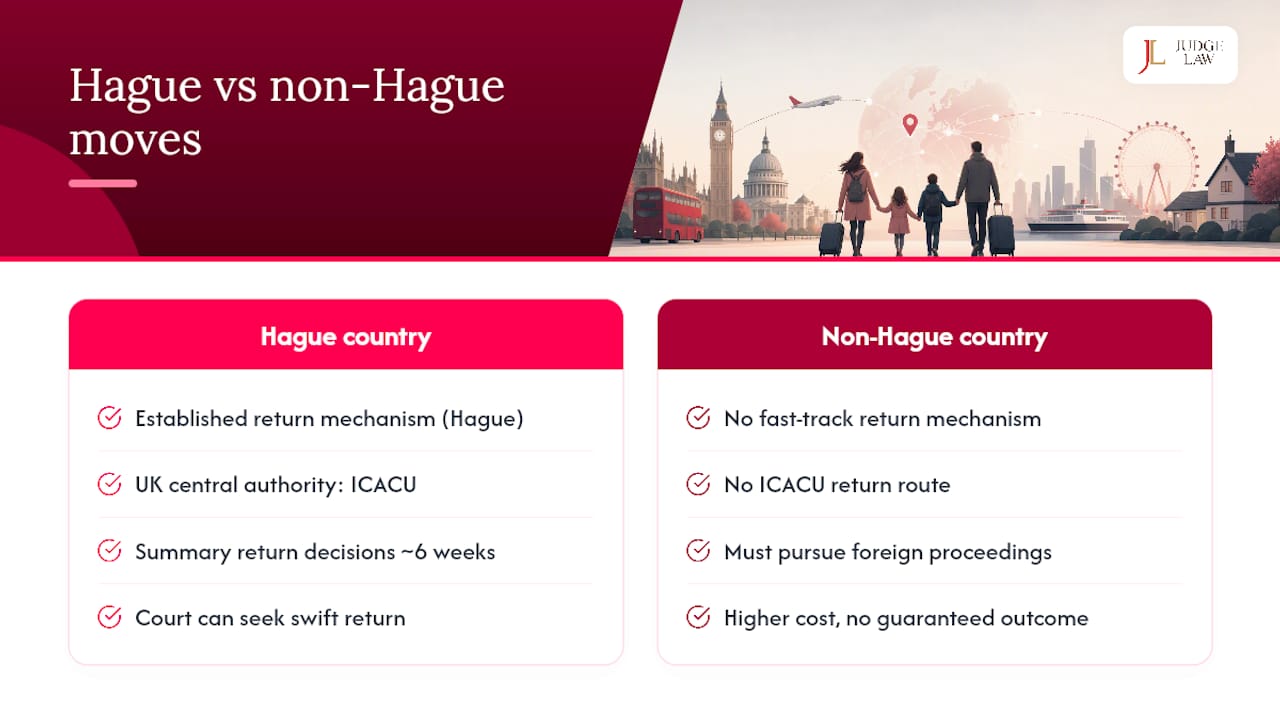
Where the destination country has not signed the Hague Convention, the position is considerably harder. There is no fast-track mechanism, and a parent may need to pursue proceedings in the foreign jurisdiction directly, often at significant cost and with no certainty of a swift outcome, or any outcome at all. This is why courts in England and Wales scrutinise leave to remove applications involving non-Hague countries especially carefully. A judge granting permission to relocate to a country with no return mechanism is, in effect, accepting that enforcement options narrow considerably if things go wrong.
Dual nationality complicates things further, since a child holding both UK and another country’s citizenship may be subject to that other country’s own domestic child welfare rules once physically present there, regardless of what an English court has ordered.
Drafting a relocation proposal the other parent might actually agree to
A relocation proposal that reads like a decision already made rarely gets a good reception. One built to show the other parent exactly how their relationship with the child continues tends to fare far better, both in negotiation and, if it comes to it, in court.
Effective proposals typically set out the reason for the move in concrete terms, whether that is a job offer, family support, or affordability, rather than vague dissatisfaction with the current arrangement. They specify exact contact arrangements: how often, by what method, who travels, and who pays. They address schooling and holidays explicitly, particularly how the child will spend school breaks with the parent who is not relocating.
Presenting this proposal before announcing the move, rather than after tickets are booked, changes the tone of the entire conversation. A parent who feels consulted is far less likely to escalate straight to a court application than one who feels the decision has been made around them.
Where direct conversation has broken down, putting the proposal in writing, calmly and factually, still matters. Email exchanges setting out proposed terms create a record that mediators and, if necessary, judges can review. Avoid emotive language in these communications. Courts pay close attention to how parents conduct themselves in correspondence, and a written proposal that reads as reasonable and child focused carries far more weight than one that reads as an ultimatum.
What happens if someone relocates without consent or a court order
Removing a child from the UK without the necessary consent or court permission is not simply a breach of family court expectations, it can constitute an offence under the Child Abduction Act 1984. That statute makes it a criminal offence for a parent to remove a child under sixteen from the UK without the appropriate consent or court leave, and the police can and do investigate reports of this nature.
Civil enforcement runs alongside any criminal dimension. If a child is removed within the UK in breach of an existing order, or is taken abroad in breach of Section 13, the left behind parent can apply to the court for orders requiring the child’s return, and for enforcement action against the parent who removed them. Our guide on enforcing a child arrangements order sets out what enforcement can involve, including the court’s power to impose penalties for breach.
For international removals to Hague Convention countries, the return mechanism through ICACU gives the left behind parent a genuine route to bring the child back, generally faster than starting fresh proceedings abroad. For non-Hague destinations, options narrow considerably, and this is often where families face the longest, most expensive disputes.
None of this changes if the removing parent believed their reasons were justified. Genuine safety concerns exist as a separate legal question, addressed through the court, not through unilateral removal.
If the other parent objects: rights of the parent staying behind
A parent who is not relocating retains full parental responsibility rights regardless of who the child currently lives with day to day, provided they hold parental responsibility in the first place. That means their consent is legally required for any removal from the UK, and their objection carries real weight in any internal relocation dispute that reaches the Family Court.
Raising an objection effectively starts with communication, not litigation. Setting out specific, welfare focused concerns in writing, rather than a blanket refusal, gives the objection more credibility if it later needs to go before a judge. Concerns about schooling continuity, loss of established support networks, or a contact proposal that looks impractical on paper all carry more weight than an objection rooted purely in not wanting the other parent to move.
Where discussion does not resolve things, a MIAM followed by mediation is the expected next step, unless there are safety grounds to bypass it. If mediation fails or is inappropriate, the objecting parent can apply for a prohibited steps order to prevent the move, or oppose a leave to remove application if the other parent has already filed one.
What happens if the court says no to relocation
A refusal does not necessarily mean the relocating parent’s circumstances or wishes were disregarded. It usually means the court concluded the proposed arrangements did not adequately protect the child’s welfare, most commonly around contact continuity, financial stability, or the realism of the plan presented.
The immediate practical effect is that the child remains within the existing jurisdiction, or existing area, and current arrangements continue unless varied by further agreement or a fresh application. A refusal on international relocation does not usually prevent a parent from moving alone. It prevents them from taking the child.
Refused applications are not always final in the sense of being unappealable, but overturning a decision requires showing a genuine legal error or a significant change in circumstances, not simply a renewed wish to relocate. In practice, most parents who face refusal are better served by revisiting the proposal itself. A more detailed contact plan, firmer housing evidence, or addressing whatever specific concern the judge raised can make a fresh application stronger than repeating the same case.
Frequently asked questions
Can I relocate with my child within the UK without permission?
Generally yes, if you hold parental responsibility and there is no existing court order restricting the move, though the other parent can still apply to court under Section 8 of the Children Act 1989 if they object.
Can my ex take my child out of the country without my permission?
No, not lawfully. Taking a child out of the UK needs the consent of everyone with parental responsibility, or the court’s permission, under the Child Abduction Act 1984 (and Section 13 of the Children Act 1989 where a child arrangements order is in force). Doing so without it can amount to child abduction.
What can I do if I’m struggling with my child moving away or growing more independent?
If a court process is involved, focus on securing a firm, workable contact schedule rather than the move itself. A detailed plan covering frequency, technology-based contact, and visits tends to ease the transition far more than contesting a decision the court has already made.
How long does a child relocation case take?
Non-urgent applications typically take several months from filing to a final hearing, once a MIAM, dispute resolution appointment, and any fact-finding hearing are factored in, though genuinely urgent applications involving imminent removal can be heard within days.
Sources
The rules covering relocation sit across several pieces of legislation and official guidance, and it is worth going to the primary sources directly rather than relying on secondhand summaries.
- Your ex-partner is taking your children without consent – Citizens Advice
- Children Act 1989 – legislation.gov.uk
This article is general information, not a substitute for advice from a qualified lawyer. Consult a qualified legal professional about your own circumstances before acting on anything here.