

TL;DR
- ILR is permanent residence in the UK, letting you live, work and study without visa time limits.
- Most routes need five years’ continuous lawful residence; Long Residence needs ten years.
- Most work routes limit absences to 180 days in any 12-month period, measured across every 12-month window, not calendar years.
- You usually need to pass the Life in the UK test and show English at B1 or above, unless exempt.
- The fee is £3,226 per applicant from 8 April 2026, and applying too early leads to refusal.
Indefinite leave to remain (ILR) is defined as permanent residency status in the United Kingdom, granting you the right to live, work, and study without any visa restrictions or time limits. You qualify by meeting a set of requirements that typically include a continuous lawful residence period, compliance with the 180-day absence rule, passing the Life in the UK test, and demonstrating English language proficiency at CEFR B1 level or above. The main qualifying routes include the Skilled Worker visa, Spouse or Partner visa, Global Talent visa, and the Long Residence route. Getting these requirements right before you apply is the single most important thing you can do.
What are the ILR eligibility requirements and how do they vary by route?
Most applicants must complete five years of continuous lawful residence in the UK before they can apply. The exceptions are notable. The Global Talent route can qualify you in as little as three years, while the Long Residence route requires ten years of continuous residence under any combination of lawful leave. The qualifying period differs by route, and the Home Office applies the immigration rules current at the time of your ILR application, not the rules that were in force when your original visa was granted. That means you must monitor rule changes throughout your entire qualifying period, not just at the end.

The absence rule is where many applicants come unstuck. For most five-year work routes, you must not exceed 180 days absence in any 12-month period during your qualifying residence. The same 180-day test applies to the Long Residence route for absences from 11 April 2024; for absences before that date, the older limits of 548 days in total and 184 days for any single absence still apply. The five-year partner route under Appendix FM does not use this 180-day rule. The critical point is that UKVI does not check calendar years. It applies a sliding 12-month window across every possible period within your qualifying residence, which means a cluster of absences that looks acceptable on a calendar can still breach the rule when measured correctly.
The table below summarises the key differences across the main routes.
| Visa route | Qualifying period | Absence limit | Key evidence required |
|---|---|---|---|
| Skilled Worker | 5 years | 180 days per rolling 12 months | Employer letter, payslips, P60 |
| Spouse or Partner | 5 years | No 180-day rule under Appendix FM | Cohabitation evidence, relationship proof |
| Global Talent | 3 or 5 years | 180 days per rolling 12 months | Endorsing body confirmation |
| Long Residence | 10 years | 180 days in any 12 months (548 days total and 184 days single absence for absences before 11 April 2024) | Full visa history, absence record |
Beyond residence and absences, you must pass the Life in the UK test, which costs £50 per sitting, contains 24 multiple-choice questions, and requires a 75% pass mark. The certificate is valid indefinitely once you pass, so there is no need to retake it if you already hold one. English language proficiency is demonstrated through a Secure English Language Test (SELT) certificate at B1 or higher, though exemptions apply for nationals of majority English-speaking countries and applicants over 65.
Financial and salary requirements apply primarily to the Skilled Worker and family routes. For Skilled Worker applicants, your salary when you apply for ILR must meet the settlement salary threshold that applies to your occupation code. For spouse or partner applicants, the financial requirement is assessed against a minimum income threshold, using evidence covering the period before you apply. Both routes need clear documentary evidence, so keep payslips and bank statements in order.
Pro Tip: If you are on the Skilled Worker route, check your occupation code’s current salary threshold well before your application date. Thresholds were revised in April 2024 and again in July 2025, and the Home Office applies the rules in force at the time you apply, not when your visa was granted.
How to prepare your documents for a successful ILR application
Document preparation is where applications succeed or fail. A well-organised bundle tells a clear story. A disorganised or incomplete one raises questions that caseworkers are not obliged to resolve in your favour.
The evidence required differs depending on which SET form you are using, but the following steps apply across all routes.
-
Gather all passports and biometric residence permits. You need documents covering your entire qualifying period, including expired passports. If you have travelled on more than one passport, include all of them. Gaps in your travel document history will prompt questions about your absences.
-
Compile your employment or relationship evidence. For the Skilled Worker route, this means an employer letter confirming your current role, salary, and start date, alongside payslips and P60 documents covering the qualifying period. For the spouse or partner route, you need cohabitation evidence such as joint utility bills, bank statements, and correspondence addressed to both parties at the same address.
-
Obtain your Life in the UK test certificate and English language evidence. If you sat the test years ago, locate the original certificate. UKVI does not accept screenshots or photocopies without the original reference number.
-
Produce a complete travel history. List every trip outside the UK during your qualifying period, including dates of departure and return. Cross-reference this against your passport stamps and any airline booking records you can retrieve. Accuracy here is non-negotiable.
-
Organise documents chronologically. Caseworkers process large volumes of applications. A bundle ordered by date and clearly labelled by category is far easier to assess than a collection of unsorted files. For online applications submitted through UKVCAS, label each uploaded document clearly before submission.
-
Check for gaps in your payslip or bank statement record. Missing months prompt queries. If you changed employer during the qualifying period, obtain a letter from your previous employer confirming your employment dates and salary.
Pro Tip: Request your travel history from the Home Office using a Subject Access Request before you compile your application. It takes up to 30 days but gives you the official record UKVI holds, which you can then verify against your own records.
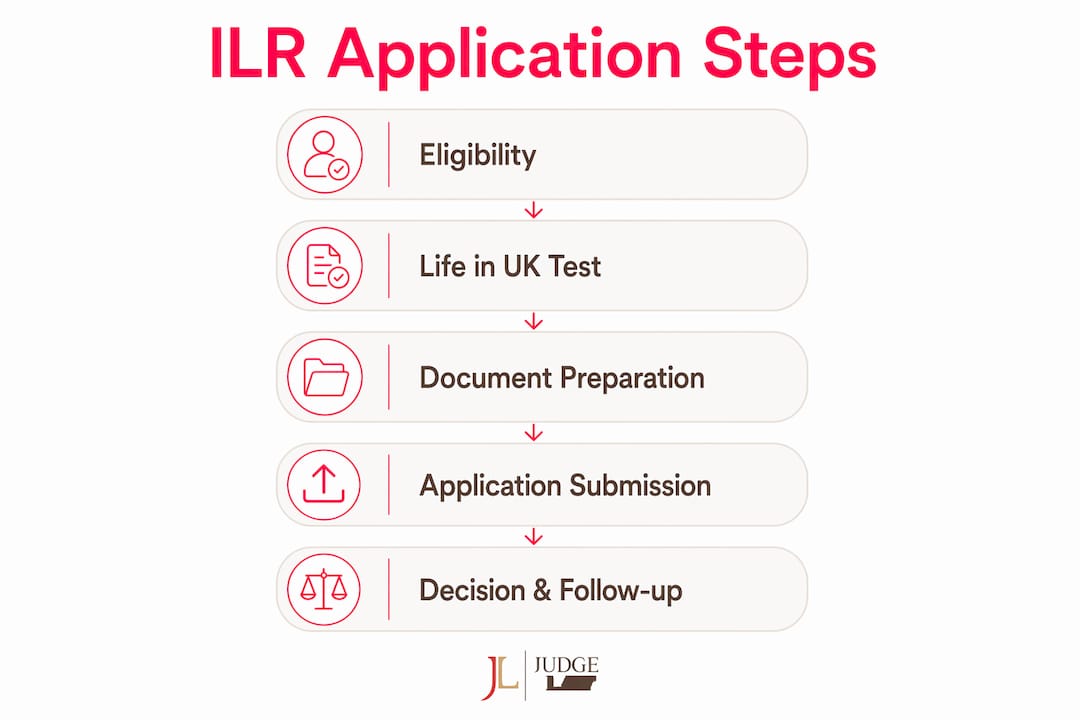
What is the step-by-step process to submit your ILR application online?
The indefinite leave application process is completed online through the UKVI portal, with a biometrics appointment at a UKVCAS service point. The process is structured but unforgiving of errors.
-
Calculate your earliest application date. You can submit up to 28 days before your qualifying period is complete. The start date of your qualifying period is calculated from the date your first qualifying visa was granted, not the date it was issued or the date you entered the UK. Miscalculating this date is one of the most common causes of outright refusal.
-
Select the correct SET form. SET(O) covers most work routes including Skilled Worker. SET(M) applies to spouse and partner applicants. SET(LR) is for Long Residence applicants. Using the wrong form results in an invalid application.
-
Complete the online form accurately. The online application requires a full account of your UK history, covering employment, travel, addresses, and character. Every answer must be consistent with your previous visa applications. Discrepancies across applications are treated seriously by caseworkers and can result in refusal on grounds of deception.
-
Pay the application fee. The ILR fee is £3,226 per applicant, which applies from 8 April 2026. If you need a faster decision, the Super Priority service costs an additional £1,000 and aims to give a decision by the end of the next working day after your biometrics appointment (two working days if the appointment is at a weekend). Standard processing takes around six months.
-
Book and attend your UKVCAS biometrics appointment. After submitting your application and fee, you will be directed to book an appointment to provide fingerprints and a photograph. You will also upload your supporting documents at this stage or through the online portal beforehand.
-
Await the decision. Standard decisions take up to six months. If your application is refused, you may have a right of appeal to the First-tier Tribunal (Immigration and Asylum Chamber) or be eligible for an administrative review, depending on the grounds of refusal. The appeals process has strict time limits, so act quickly if you receive a refusal.
Bear in mind that ILR status lapses if you spend two or more continuous years outside the UK after it is granted. Permanent residency is not unconditional once you hold it.
What are the most common mistakes in ILR applications?
Refusals are rarely random. They cluster around a predictable set of errors that applicants make repeatedly.
-
Miscalculating the 180-day absence rule. Because UKVI applies a sliding 12-month window rather than calendar years, absences that appear compliant can breach the rule when measured correctly. Calculate every possible 12-month window across your qualifying period, not just the obvious ones.
-
Applying too early. Submitting before the 28-day window opens results in outright refusal with no refund of the application fee. The qualifying period runs from visa grant date, not entry date. These are not always the same.
-
Incomplete supporting documents. Missing payslips, gaps in address history, or absent relationship evidence give caseworkers grounds to refuse without seeking clarification. The burden of proof rests entirely with you.
-
Inconsistencies across applications. If your current application states a different employer start date or address history than a previous visa application, that inconsistency will be noted. The online form is effectively an interrogation of your full UK history, and it is cross-referenced against everything UKVI already holds.
-
Failing to meet updated salary thresholds. Salary requirements for the Skilled Worker route changed significantly in 2024 and again in 2025. Check that your salary when you apply meets the settlement threshold that applies to you, because the rules in force on the date you apply are the ones used.
-
Gaps in lawful residence. A period without permission can break your continuous residence, although the Immigration Rules allow some limited exceptions. Breaches of visa conditions can also lead to refusal, so check your history carefully.
Pro Tip: Use a spreadsheet to map every absence against every possible 12-month window in your qualifying period. It takes time, but it is the only reliable way to confirm compliance before you apply.
Practical points from our work
The applications that go wrong are almost never the result of genuine ineligibility. They go wrong because of preparation failures that could have been caught weeks or months earlier.
The 180-day absence rule is the most misunderstood requirement in the entire process. People calculate their absences against calendar years and feel confident, then receive a refusal because UKVI measured a different 12-month window. The sliding window calculation is not intuitive, and it catches people who have been genuinely careful about their travel.
Timing is the second area where we see avoidable errors. The qualifying period starts from visa grant date, not entry date, and not visa expiry. These dates are often different, sometimes by weeks. Applying a day too early costs you the entire fee and delays your settlement by months.
The government consulted from November 2025 to February 2026 on an ‘earned settlement’ model that would make ten years the default qualifying period for many routes. No rule changes to qualifying periods had been made at the time of writing, but applicants should monitor Home Office announcements carefully. Separately, the English language requirement for settlement is due to rise from B1 to B2 for applications made from March 2027. Rules can change between visa grant and ILR application, and the rules that apply are those in force when you submit, not when you started.
Our practical advice is to begin your document preparation at least six months before your earliest application date. If your situation involves any complexity, whether that is a period of self-employment, a gap in lawful leave, or absences close to the limit, get legal advice before you submit. A refusal is not just a setback. It goes on your immigration record and can affect future applications, including British citizenship.
FAQ
What is the qualifying period for ILR in the UK?
Most applicants need five years of continuous lawful residence. The Global Talent route qualifies in three years, while the Long Residence route requires ten years under any combination of lawful leave.
How does the 180-day absence rule work for ILR?
UKVI applies the 180-day limit as a sliding 12-month window across your entire qualifying period, not calendar years. Any single 12-month window that contains more than 180 days outside the UK can result in refusal.
How much does an ILR application cost in the UK?
The standard fee is £3,226 per applicant. The optional Super Priority service costs an additional £1,000 and aims to give a decision by the end of the next working day after your biometrics appointment.
Can ILR be lost after it is granted?
Yes. ILR lapses automatically if you spend two or more continuous years outside the UK after it is granted. You would then need to apply for a returning resident visa to re-enter.
What happens if my ILR application is refused?
Depending on the grounds of refusal, you may have a right of appeal to the First-tier Tribunal (Immigration and Asylum Chamber) or be eligible for an administrative review. Time limits apply, so you should seek legal advice promptly after receiving a refusal decision.