

TL;DR
- You must notify ACAS and go through early conciliation before you can submit an ET1 claim form.
- For acts on or after 1 October 2026, most claims must be brought within six months less one day; earlier acts keep the three-month limit.
- Submitting a claim is free, and the employer has 28 days to respond on an ET3 form.
- Many claims settle through ACAS conciliation before a hearing, but waits for a final hearing can be long.
You have been dismissed, underpaid, or treated in a way that feels unlawful, and now you are weighing whether to take your employer to a tribunal. That decision matters, and so does understanding exactly what lies ahead. The employment tribunal process UK has become significantly more complex in recent years. Official statistics show 52,000 single claims open at the end of September 2025, and waits for a final hearing can be long. Knowing the steps, deadlines, and likely outcomes before you begin gives you a genuine advantage.
Who can bring a claim and when
Before anything else, you need to establish whether your claim is valid and whether you are still within the time allowed to bring it. Getting this wrong is irreversible.
The most common types of employment tribunal claims include:
- Unfair dismissal. Generally requires two years of continuous employment, though certain dismissals are automatically unfair from day one. For dismissals from 1 January 2027, the qualifying period is due to fall to six months.
- Discrimination. Protected characteristics under the Equality Act 2010 include age, disability, race, religion, sex, and sexual orientation, among others. No qualifying period applies.
- Unpaid wages or holiday pay. No qualifying period required.
- Whistleblowing detriment. Protected from day one of employment.
- Constructive dismissal. Requires two years of continuous employment in most cases (due to fall to six months for dismissals from 1 January 2027).
Time limits are strict. For acts that happened before 1 October 2026, the deadline for most claims is three months less one day from the date of the act complained of. For acts on or after 1 October 2026, the Employment Rights Act 2025 has extended this to six months less one day for most claims, and the Employment Tribunal (Extension of Time Limits) Regulations 2026 make the same change for certain other complaints. Miss the deadline, and the tribunal will almost certainly refuse to hear your claim.
The GOV.UK eligibility checker is a useful starting point, but it does not replace legal advice. Act as early as possible. The clock is running from the moment the act you are complaining about took place, not from when you decided to do something about it.
Pro Tip: ACAS early conciliation pauses your tribunal time limit while conciliation is ongoing. Starting ACAS notification as soon as possible protects your position without rushing you into a formal claim immediately.
Submitting your ET1 claim form
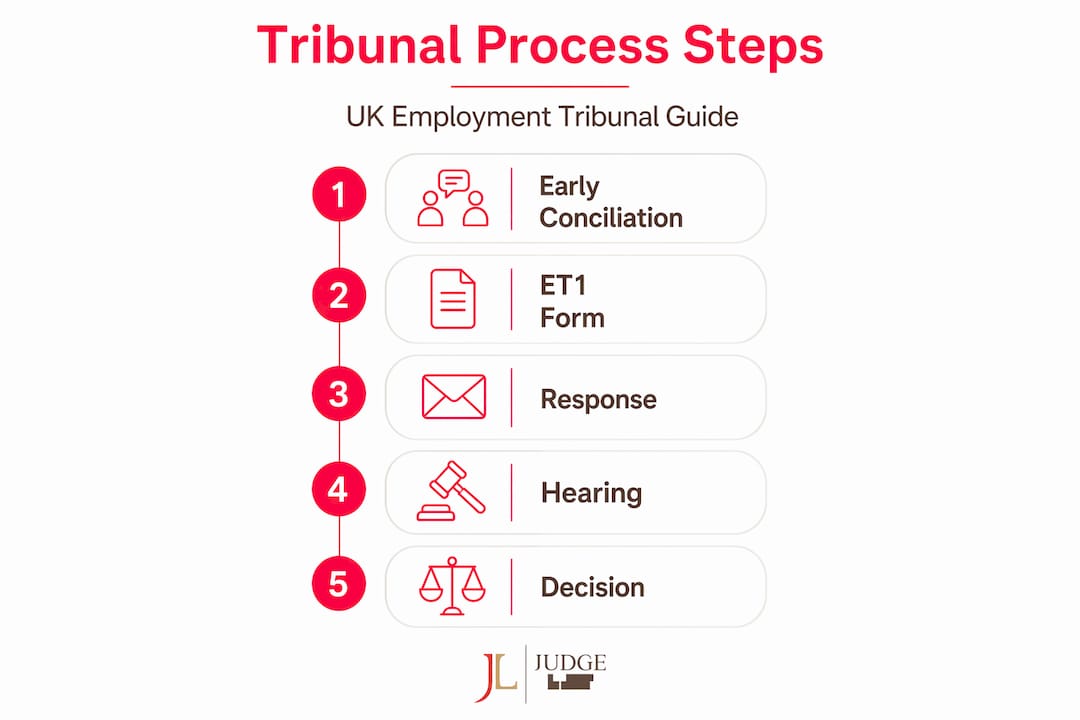
Once you have confirmed your eligibility, the process follows a clear sequence. Skipping or mishandling any step can cost you time or, in serious cases, your claim entirely.
-
Notify ACAS and complete early conciliation. Under section 18A of the Employment Tribunals Act 1996, ACAS notification is mandatory before you can submit a claim. You contact ACAS, they assign a conciliator, and the conciliation period begins. This pause on your time limit is automatic. If conciliation is unsuccessful, you receive an early conciliation certificate, which you will need to proceed.
-
Complete the ET1 form. This is the formal claim document submitted to the tribunal. You can complete it online via the GOV.UK employment tribunals service or on paper. Submitting a claim carries no fees. The form was made free when tribunal fees were abolished in 2017, and that remains the case today.
-
Write your ‘what happened’ narrative. The most important section of the ET1 is the factual account of events. Judges prioritise a concise, chronological account of what happened, linked directly to evidence. Aim for clarity and brevity, keeping your account under ten pages where possible. Emotional accounts carry less weight than precise, fact-based timelines.
-
Gather and reference your evidence. Attach relevant documents to the ET1 where the system allows, but always reference them in your narrative. Payslips, contracts, emails, grievance letters, and performance records all carry potential weight.
-
Submit and await confirmation. After submission, the tribunal sends an acknowledgement with a case number. Keep this. You will use it in all future correspondence.
Pro Tip: Do not leave your ET1 until the last day. Technical issues, unclear evidence, or gaps in your narrative are far harder to fix under pressure. Give yourself at least two weeks before the deadline to prepare a considered account.
The following table summarises the key submission requirements at a glance:
| Step | What is required | Deadline |
|---|---|---|
| ACAS early conciliation | Contact ACAS before submitting | Before the tribunal deadline |
| ET1 form | Complete accurately and fully | Within the time limit (extended by ACAS pause) |
| Supporting documents | Attach or reference key evidence | At submission or as directed |
| Early conciliation certificate | Obtained from ACAS after conciliation ends | Must be included with ET1 |
After you submit: what happens next
Submitting your claim is not the end of the procedural work. It is, in many ways, the beginning.
Once the tribunal accepts your claim, it serves the documents on your employer, known as the respondent. The respondent then has 28 days to file their response using an ET3 form. If they fail to do so within that window, the tribunal may issue a default judgment in your favour, though it may still hold a hearing to determine the appropriate remedy.
Several things may happen during this stage:
- Case management orders. The tribunal may issue directions setting out what both parties must do before the hearing, including exchanging documents and filing witness statements by specified dates.
- Preliminary hearings. These are separate hearings, often by telephone or video, to address procedural matters or preliminary legal issues such as whether your claim was brought in time.
- Ongoing ACAS conciliation. After a claim is accepted, many cases settle through ACAS conciliation before reaching a full hearing. This is worth taking seriously as a route to resolution that avoids the cost and uncertainty of a hearing.
- Settlement negotiations. Either party can make a settlement offer at any stage. A COT3 agreement brokered through ACAS is legally binding.
Attending a preliminary hearing unprepared can result in orders that disadvantage your case at the final hearing. Treat every tribunal contact as significant, not administrative.
Understanding your employment rights during this period matters. If your employer is also managing you out of a role or subjecting you to further detriment while the claim is live, you may have additional grounds worth recording carefully.
Preparing for and attending the tribunal hearing
The hearing is where your claim is tested. Preparation is everything.
-
Build your hearing bundle. This is a paginated, indexed folder of all documents both parties will refer to at the hearing. The tribunal will direct you on its contents. Both sides should agree the bundle in advance.
-
Prepare witness statements. Your written evidence is submitted in advance and stands as your oral evidence in chief. You will then be cross-examined by the respondent’s representative. Witness statements should be factual, clear, and directly relevant.
-
Understand the hearing format. Employment tribunals are less formal than civil courts but require the same basic standards of conduct. You will address the panel, answer questions directly, and listen without interruption when the other side speaks. The panel typically comprises an employment judge, and in discrimination cases, two lay members.
-
Know how remedies work. If you succeed, the tribunal decides your remedy. For unfair dismissal, the compensatory award is currently capped, although the cap is due to be removed from January 2027. Discrimination compensation is uncapped. Reinstatement is an available remedy but rarely ordered. Judgments are typically issued within four weeks of the final hearing.
-
Understand your appeal options. If you believe the tribunal made an error of law, you can appeal to the Employment Appeal Tribunal. You cannot appeal simply because you disagree with the outcome. The appeal must be based on a specific legal ground.
Pro Tip: If you are representing yourself, the judiciary publishes employment tribunal guidance videos explaining procedures. These are genuinely helpful for understanding format and etiquette, though they do not replace professional legal advice, particularly as procedures and law evolve rapidly.
| Key takeaway | Details |
|---|---|
| Time limits are strict | Six months less one day for most acts on or after 1 October 2026; three months less one day for earlier acts |
| ACAS is mandatory first | Early conciliation must be attempted before submitting an ET1 |
| Respondent has 28 days | Failure to respond can lead to default judgment |
| Most claims do not reach a hearing | Many resolve through ACAS conciliation or settlement |
| Compensation rules differ by claim type | Unfair dismissal is capped (cap due to be removed from January 2027); discrimination is uncapped |

Practical points from our work
In our work we see a clear pattern. Most people who come to this process are genuinely aggrieved. They have experienced something unfair, sometimes painfully so, and they want accountability. What they underestimate is how procedural and evidence-focused the tribunal system is. It is not a forum where the most compelling personal story wins. It is a legal process, and it rewards preparation over emotion.
The tribunal backlog means many claims take a long time to reach a final hearing. That is an exhausting wait. Going in without a clear strategy, or without understanding what you need to prove and how, makes that wait harder. People tend to fare better when they have realistic expectations from the outset.
Many of these disputes could also have been avoided. Poor management, unclear contracts and a failure to follow basic grievance procedures lie behind many claims, and better-trained managers who understand documentation and escalation steps could stop some cases becoming litigious at all. That is not a comfort to someone already in the process, but it is worth knowing: the problem you are dealing with often says more about your employer’s processes than about you.
Our practical advice to anyone at the start of this process is to treat every document, email and note as potentially relevant. Write things down when they happen. And do not assume the process will sort itself out.
FAQ
What is the first step in the UK employment tribunal process?
Before submitting any claim, you must notify ACAS and attempt early conciliation. This is a legal requirement under section 18A of the Employment Tribunals Act 1996, and the conciliation period pauses your time limit while it runs.
How long does an employment tribunal take in the UK?
Official statistics show 52,000 single claims open at the end of September 2025, and many claims wait a long time for a final hearing. The timeline varies depending on the complexity of the claim and the volume at your regional tribunal.
Can I appeal an employment tribunal decision?
You can appeal to the Employment Appeal Tribunal, but only on a point of law. Disagreeing with the outcome is not sufficient grounds. You must identify a specific legal error in the tribunal’s reasoning or procedure.
Do I need a solicitor for an employment tribunal claim?
You are not required to have legal representation, but professional advice significantly strengthens your preparation, particularly for complex discrimination claims or cases involving large compensation sums. Self-represented claimants often benefit from at least an initial advice session.
What compensation can I receive if I win?
For unfair dismissal, the compensatory award is currently capped, although the cap is due to be removed from January 2027. For discrimination claims, compensation is uncapped and can include awards for injury to feelings. The tribunal decides the appropriate remedy after judgment, typically within four weeks of the final hearing.