

Form E is the financial statement you must complete if you are involved in an application for a financial order on divorce or dissolution in England and Wales. If a financial claim is underway, you should confirm whether Form E applies to your case and begin gathering the documents on the official schedule now, since exchange and filing typically happen no later than 35 days before the first appointment.
TL;DR
- Both parties must exchange and file Form E no later than 35 days before the first court appointment, with potential for shorter deadlines in fast-track cases.
- Accurate property valuation, recent pension cash-equivalent figures, and two years of business accounts are crucial for a complete and credible disclosure.
- Missing or disputed figures should be clearly explained with supporting evidence and updated promptly if circumstances change before the final hearing.
- Overlooking overseas accounts, outdated valuations, or assets labelled as “not relevant” can lead to legal risks, including court orders being set aside.
- Guidance from a solicitor can help with accuracy, especially for complex assets, and with managing ongoing updates and disclosure obligations.
What Form E is, when to use it and how it differs from Form E1 and E2
Form E exists because the court needs a full picture of both parties’ finances before it can decide what a fair financial order looks like. The requirement sits within the framework set out under the Matrimonial Causes Act 1973 and the Civil Partnership Act 2004, and the procedural detail comes from the Family Procedure Rules and their practice directions. Practice Direction PD Part 09A confirms that Form E is the disclosure framework used for financial claims arising from divorce or civil partnership dissolution, and it sets out principles for disclosure before an application is even issued.
Form E is not the only form in this family, and using the wrong one causes delay. The distinction matters because each form supports a different kind of claim.
- Form E is used for the main financial remedy application between spouses or civil partners, covering assets, income, pensions and needs.
- Form E1 is used for other financial remedy applications, for example a claim for financial provision for a child under Schedule 1 to the Children Act 1989 or a claim for failure to maintain, rather than a financial order on divorce or dissolution.
- Form E2 is the shorter form used for most applications to vary an existing financial order.
Form E also has a role before proceedings begin. Judiciary guidance encourages voluntary pre-application disclosure using Form E, or E1 or E2 where appropriate, so that both parties negotiate or mediate from the same set of facts rather than guessing at each other’s finances.
Who must complete Form E and the filing timetable
Both the applicant and the respondent in a financial remedy application have to complete and file a Form E. There is no version of the process where only one party discloses. Once a financial order application is issued, the court will fix a first appointment, and Form E sits at the centre of preparing for it.
- Check the date of your first appointment on Form C, which the court issues once your application is processed.
- Work backwards from that date. Both parties should exchange and file Form E no later than 35 days before the first appointment, though the court can direct a different timetable, and some cases proceed on a fast-track basis with tighter deadlines.
- If you cannot meet the deadline, tell the court and the other party in writing before the date passes rather than after.
- Keep a written log of every request you make for a valuation, a pension figure or business accounts, since you may need to show the court you asked in good time.
Missing the 35-day deadline without explanation rarely goes unnoticed. Courts expect a good reason, and a paper trail showing you chased outstanding information is often what separates a short delay from a more serious problem.
How to complete Form E section by section
Form E asks for detail in a specific order, and each section carries its own evidential expectations. Section 2, covering property and capital, is usually where people spend the most time. For the matrimonial home, use a valuation that is current and be ready to support it with an estate agent’s assessment or a formal survey if the figure is disputed. Attach the most recent mortgage statement showing the outstanding balance, since the court needs net equity, not the headline value.
The income sections ask for a breakdown by source. Employed income is usually the simplest to evidence, but self-employed income and irregular earnings need more care. Where income varies month to month, show an average across a representative period and explain the pattern rather than picking a single favourable or unfavourable month.
Pensions often get underestimated. You need a cash-equivalent (CE) figure from the scheme trustees or administrators, not an estimate from memory, and where the Pension Protection Fund is relevant because a scheme has entered assessment, that should be noted too.
Business interests require more than a verbal description of turnover.
- Attach at least two years of accounts, or the most recent set if the business is newer.
- Where the business cannot easily be valued from accounts alone, a formal valuation letter from an accountant carries more weight with the court.
- Note any figures that are provisional or awaited, and attach evidence that you have requested them.
The standard of living and contributions section is where narrative matters. This is not simply an inventory of numbers. The court wants to understand how the household actually lived, who contributed what, financially and otherwise, and what ongoing needs look like for both parties and any children.
Pro Tip: Write the standard-of-living section in plain, factual sentences rather than broad claims, since specific detail (school fees, holiday patterns, who managed the household budget) carries far more weight with the court than general statements.
Documents checklist: what to attach and how to obtain missing items
Form E is only as strong as the paperwork behind it. The official notes to Form E set out a schedule of documents that should accompany the form, and gathering these early avoids a scramble close to the deadline.
- The last 12 months of bank and savings statements for every account you hold, sole or joint.
- Mortgage statements showing the current balance on any property you own or part own.
- A copy of any property valuation obtained within the last six months, or your own realistic estimate of the current market value if you do not have one.
- Your last three payslips and your most recent P60.
- A pension cash-equivalent statement for every pension you hold, requested directly from the scheme.
- Surrender values for any life insurance or investment policies with a cash value.
- Two years of business accounts where you own or part own a business.
If a valuation or pension figure has not arrived by the time you file, attach a copy of the letter or email requesting it. That single step shows the court you acted promptly rather than withholding information, and it is far better received than leaving a gap unexplained. Label every attachment to match the section of Form E it supports. This alone reduces the number of follow-up disclosure requests you receive from the other side.
Common mistakes, legal risks and how to correct errors
The most frequent problems with Form E are not deliberate concealment. They are undervalued property, forgotten overseas accounts, and business assets left out because someone assumed they were “not relevant” to the marriage. That assumption is usually the wrong one to make.
- Treating an asset as “non-matrimonial” and leaving it off the form entirely, rather than disclosing it and arguing about its treatment afterwards.
- Using an out-of-date property valuation instead of one within the six-month window the notes require.
- Omitting a pension because it feels small, when the court still expects it listed.
- Forgetting savings or accounts held overseas, which are just as disclosable as domestic ones.
A full, frank and clear disclosure is a formal requirement of Form E, confirmed by statement on the form itself, and a false statement verified by that statement of truth can expose you to proceedings for contempt of court or, in serious cases, fraud. An order obtained on the back of incomplete disclosure can later be set aside once the omission comes to light, which often costs both parties more time and money than getting it right the first time.
If you discover an error after filing, correct it as soon as you notice it. Tell the other party and the court in writing, file an amended Form E, and keep a clear record of when you found the mistake and what you did about it. The safer approach is always disclosure first, argument second: reveal an asset and label your position on it, rather than leaving it out and hoping it does not surface.
Practical points from our work: what a solicitor adds to Form E
In our work we often see that a solicitor’s role with Form E is largely about precision and pressure-testing. They check that valuations are current, chase pension administrators for cash-equivalent figures, and help translate a household’s actual pattern of living into the kind of clear narrative a court expects to see. Where assets are complex, a pension is difficult to value, or there is a risk the other party is not disclosing fully, professional input tends to matter more, not less.
How to update Form E if circumstances change before the final hearing
Form E is a snapshot, and snapshots go out of date. If your financial circumstances change materially between filing and the final hearing, you have an ongoing duty to keep disclosure current rather than relying on the figures you submitted at the outset.
A change in income, a new job, redundancy, an inheritance, a change in property value or a shift in pension provision should all be notified to the other party and, where relevant, to the court. In practice this usually means preparing a short update or supplementary statement rather than a fresh Form E from scratch, unless the change is significant enough that the original form no longer gives an accurate picture.
Keep the update factual and dated, and attach fresh evidence in the same way you did for the original form, whether that is a new bank statement, an updated valuation or a revised pension figure. Courts are generally more concerned with whether disclosure stayed current than with the fact that circumstances changed. What causes problems is silence, where one party knew about a change and said nothing until it emerged later, undermining the figures the other side had relied on.
If you are unsure whether a change is significant enough to disclose, the safer course is almost always to raise it. A minor update that turns out not to matter causes little harm. A significant change left undisclosed can unravel an otherwise sound financial settlement.
Who can see your completed Form E and how confidential is it
Form E contains detailed personal financial information, and it is not a public document in the way that some court filings are. It is filed with the court and served on the other party to the proceedings, and it will typically be seen by the judge dealing with the case, both parties’ legal representatives if they have them, and any expert instructed to value a pension or business.
Financial remedy proceedings are generally heard in private, which means the contents of Form E are not open to the public in the way a criminal trial or many civil hearings are. That said, “private” does not mean secret between you and the other party. Both sides see each other’s Form E in full, since the entire point of the process is mutual disclosure. There is no mechanism for filing Form E only for the court’s eyes and withholding it from your former spouse or civil partner.
If part of your Form E concerns particularly sensitive information, such as a medical condition or a business’s commercially sensitive figures, discuss with a solicitor whether any part of the proceedings should be dealt with more carefully. The default position, though, is that full disclosure means full disclosure to the other party, not a partial version.
Handling missing information or disputed figures in Form E
It is common for a figure to be genuinely unavailable by the filing deadline, most often a pension cash-equivalent statement that a scheme administrator has not yet issued, or a business valuation still in progress. The correct response is not to guess or leave a blank space. State clearly that the figure is outstanding, give your best estimate where one is possible, and attach evidence that you requested the missing information in good time.
Disputes over figures are different from missing figures, and they need a different approach. If you believe the other party has undervalued a property or understated income, the first step is usually a written request for clarification or supporting evidence, not an immediate application to the court. Many disputes resolve once a proper valuation or additional document is produced.
Where a dispute cannot be resolved this way, the court has mechanisms to address it, including directing a joint expert valuation or ordering further disclosure of specific documents. This is one of the purposes of the first appointment, which exists partly to identify exactly these gaps and disputes and to give directions for resolving them before the case moves further.
Whatever the disagreement, keep your own figures consistent and evidenced. A dispute is far easier to argue from a position where your own Form E is accurate and well-supported than from one where you are also defending gaps of your own.
Valuing property and other assets accurately
Getting valuations right matters more than almost any other part of Form E, because undervaluing or overvaluing an asset skews the entire financial picture the court works from. For the matrimonial home or any other property, use a written valuation from an estate agent or a RICS surveyor, and attach any valuation obtained within the last six months, as the Form E notes ask, or give your own realistic estimate if you do not have one.

Where a property’s value is contested, a single valuation from one party is rarely enough to resolve the disagreement. The court can direct a joint valuation, instructed by both parties and paid for jointly, which tends to be accepted more readily by both sides than one party’s own figure.
Other assets need the same discipline. Vehicles, valuable jewellery, art or shareholdings in private companies should be valued on a reasonable, current basis, not a guess based on what something cost years ago. For pensions, the cash-equivalent figure must come directly from the scheme, since a rough estimate of “what it’s probably worth” will not satisfy the court’s expectations.
Where you genuinely do not know a figure, say so on the form rather than inventing one. An honest “value to be confirmed, valuation requested on [date]” is far better received than a number that later turns out to be wrong.
Gathering and organising your financial documents
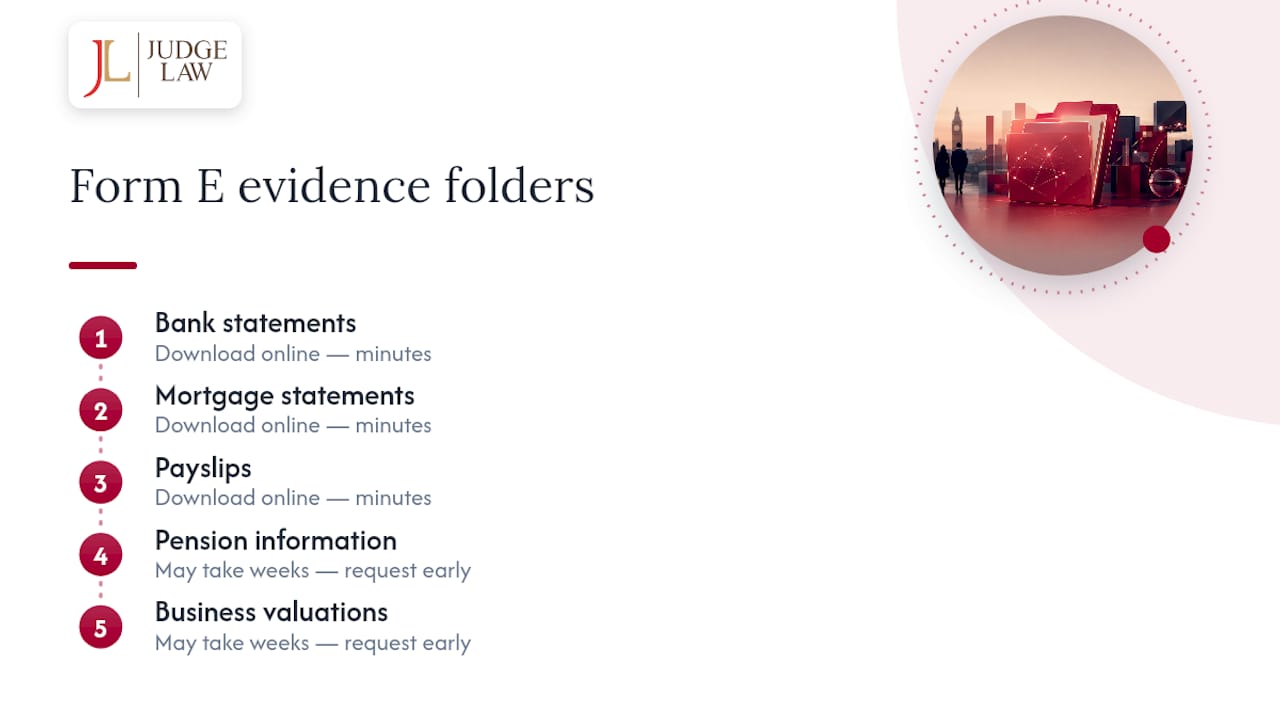
Form E asks for a lot of paperwork, and the process is far less stressful if you start collecting documents before you sit down to complete the form itself. Begin with the accounts you already have easy access to online, bank statements, mortgage statements and payslips, since these usually take minutes to download.
Pension cash-equivalent statements and business valuations take longer, sometimes several weeks, because they depend on a third party responding to a request. Send these requests as early as possible, and keep a copy of every letter or email you send, along with the date.
A simple folder structure, physical or digital, mirroring the order of Form E’s sections makes the drafting process considerably faster. When each document sits under the same heading it will appear under on the form, checking you have everything becomes a five-minute task rather than a search through months of paperwork the night before a deadline.
If a document genuinely cannot be traced, such as an old policy from a provider that no longer exists in the same form, note this clearly on the form and explain what steps you took to find it. Courts understand that some historical paperwork goes missing. What they do not tolerate well is no explanation at all.
Official forms, notes and practice directions to download
- The official Form E PDF and its accompanying notes set out every section and the required schedule of documents.
- Practice Direction PD Part 09A supplements Part 9 and contains the pre-application protocol, including guidance on voluntary disclosure before an application is issued.
This article is general information, not a substitute for advice from a qualified lawyer. Consult a qualified legal professional about your own circumstances before acting on anything here.
Sources
- GOV.UK: Form E financial statement and notes
- Part 9: Applications for a financial remedy (Family Procedure Rules)
- Practice Direction PD Part 09A (Family Procedure Rules)
Frequently asked questions
Do I need a solicitor to complete Form E?
You are not legally required to use a solicitor to complete Form E, and some people do it themselves. Where pensions, business interests or higher-value property are involved, professional review tends to catch valuation or disclosure gaps that are harder to spot alone.
How much does Form E cost?
Form E itself has no filing fee, though the wider financial remedy application carries its own court fee separate from the form. If you choose to instruct a solicitor for advice, their fees are separate from any court fee.
Is my spouse entitled to half of my savings if we divorce?
There is no automatic rule that savings, or any other asset, are split equally on divorce. The court considers the whole financial picture disclosed through Form E, including needs, contributions and standard of living, before deciding what division of assets is fair in your specific circumstances.
When should Form E be submitted?
Form E should normally be exchanged between the parties and filed with the court no later than 35 days before the first appointment, unless the court directs a different timetable. Check the date on your Form C as soon as it arrives so you can work backwards from it.