

TL;DR
- Courts in England and Wales aim for a fair outcome based on needs, resources and contributions, not a strict 50/50 split.
- The welfare of any child of the family under 18 is the court’s first consideration and often shapes what happens to the family home.
- Options for the home include a sale, a transfer, a buyout or a deferred sale (Mesher order).
- Savings, investments, pensions and debts are all considered, whoever’s name they are in.
- Experts such as forensic accountants or a pensions on divorce expert may be needed where finances are complex.
You have probably heard that divorce means splitting everything down the middle. Half for you, half for your spouse. It sounds neat. It is also wrong. English and Welsh courts do not apply a mechanical 50/50 formula, and if you have children and a family home, the reality is considerably more nuanced than that. What courts actually focus on is fairness, needs, and the welfare of any children involved. Understanding this distinction is not just academic. It has direct consequences for where you live, what you keep, and how financially secure your family will be for years ahead.
Key Takeaways
| Point | Details |
|---|---|
| Fairness over equality | Courts prioritise fairness and children’s needs, not automatic 50/50 asset splits. |
| Home options vary | Sale, transfer, buyout or Mesher orders may apply; children’s housing is crucial. |
| All assets reviewed | Savings, investments, pensions and debts are considered regardless of ownership name. |
| Expert advice matters | Financial experts prevent mistakes and clarify valuations in complex divorces. |
| Preparation is key | Careful documentation and transparency support better financial outcomes. |
Understanding financial settlements in UK divorce
A financial settlement in divorce covers considerably more ground than most people expect. It is not simply a question of dividing a bank account. As outlined in financial settlement guidance, a settlement typically covers the division of property, savings and investments, pensions, and debts. It is not limited to cash, and crucially it aims to produce fairness based on each party’s circumstances rather than a guaranteed equal split.
So what does fairness actually look like in practice? Courts in England and Wales apply the factors set out in the Matrimonial Causes Act 1973, which include the financial needs and resources of each party, the standard of living enjoyed during the marriage, the age of both parties, any physical or mental disabilities, contributions made to the family’s welfare (financial and otherwise), and the welfare of any children. The welfare of any child of the family under 18 is the first consideration; beyond that, no single factor automatically outweighs the others. That means who gets what in a divorce settlement depends on the specific constellation of your circumstances, not a formula.
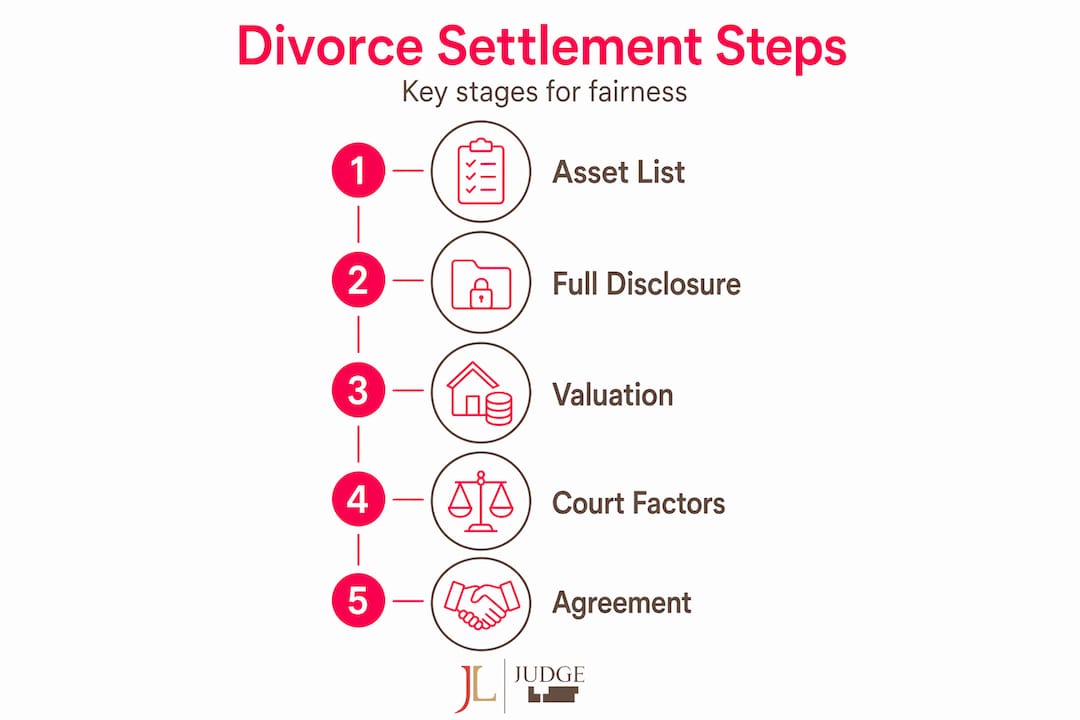
To understand what you are entitled to in divorce, it helps to think of the process in stages. First, both parties disclose their full financial picture. Then the court (or the parties, if settling by agreement) assesses needs and resources. Finally, an order is made that reflects what is fair given all those factors. Children’s needs, particularly housing stability and proximity to schools, carry significant weight in this assessment.
| Factor considered | Why it matters |
|---|---|
| Financial needs of each party | Determines minimum requirements post-divorce |
| Children’s welfare and housing | Often the primary consideration for the family home |
| Contributions to the marriage | Includes non-financial contributions such as childcare |
| Earning capacity | Affects how self-sufficient each party can become |
| Length of marriage | Longer marriages tend towards more equal sharing |
| Existing assets and debts | Forms the pool from which division is made |
The assets included in a settlement are broad. Property (including buy-to-let), savings, stocks and shares, pensions, business interests, and outstanding debts are all relevant. Pension entitlements in divorce are frequently underestimated. A pension can represent one of the most valuable assets in a marriage, yet it is easy to overlook because you cannot see it in a bank statement.
Pro Tip: Start building your asset list early. Write down every bank account, savings account, pension, property, investment, and debt you are aware of, including those in your spouse’s sole name. The fuller your picture, the better placed your solicitor will be to advise you accurately.
Dealing with the family home and children’s needs
For most families, the family home is the largest and most emotionally charged asset. It is also the one where children’s welfare carries the greatest legal weight.
Courts do not automatically split ownership of the family home 50/50. As the family home guidance makes clear, housing needs and children’s welfare can lead to the home being retained by one parent, sold, or sale being deferred. The outcome depends on what is actually needed, not on who holds the title deeds.
There are four main routes for dealing with the family home.
- Sale and division. The home is sold and the proceeds are split, usually in proportions that reflect the overall settlement rather than strict equality. This is the cleanest break but requires both parties to rehouse themselves.
- Transfer of ownership. One party transfers their share to the other, often in exchange for a payment or a reduction in their share of other assets. This works well where one party can afford to remortgage into their sole name.
- Buyout. One party pays the other a lump sum equivalent to their equity share. Similar to a transfer but involves a direct financial payment rather than an asset offset.
- Deferred sale (Mesher order). The sale of the home is postponed until a specified trigger event, most commonly the youngest child reaching 18 or completing full-time education. The parent caring for the children continues to live in the property, and the proceeds are divided when the trigger occurs.
A Mesher order is worth understanding in detail. It is used specifically to protect children’s housing stability during their formative years. The resident parent gets security of tenure; the non-resident parent retains a share of the equity that crystallises later. It is not without complexity. The non-resident parent remains financially tied to the property for potentially a decade or more, which can affect their ability to buy elsewhere. Both parties need to consider this carefully before agreeing to it.
| Option | Best suited to | Key consideration |
|---|---|---|
| Sale and division | Neither party can afford the mortgage alone | Both parties must rehouse |
| Transfer of ownership | One party can remortgage | May require offsetting against pensions or savings |
| Buyout | One party has liquid assets | Requires accurate property valuation |
| Mesher order (deferred sale) | Families with young children | Non-resident parent tied to property until trigger |
Pro Tip: Document your children’s current housing and schooling needs in writing before any negotiations begin. Note school catchment areas, proximity to extended family, and any support needs your children have. This evidence shapes the court’s view of what the family home arrangement should look like.
Understanding how assets are divided in divorce in England and Wales also helps you prepare for the negotiation itself. Courts expect both parties to have explored settlement options before litigation, and practical legal tips for families going through divorce can make that process considerably less frightening.
Safeguarding savings, pensions and debts during divorce
Once the question of the family home is addressed, attention turns to the broader financial picture. This is where many people make a critical mistake. They assume that an asset held in their sole name is protected. It is not.

Courts assess the entire pool of marital assets, regardless of whose name they are in. Savings accumulated during the marriage, a pension built up by one spouse while the other raised children, an investment portfolio held by one party, a share of a business. All of it is potentially within scope. The financial settlement overview confirms that settlements include property, savings and investments, pensions, debts such as mortgages, loans and credit, other assets, and ongoing support.
Debts are also part of the picture. Joint debts are an obvious concern. But sole-name debts incurred during the marriage can also form part of the settlement calculation, particularly where they were incurred for family purposes. A credit card used to fund household expenses or a loan taken out for a family holiday does not automatically stay with the person whose name is on the account.
Pensions deserve particular attention. The value of a defined benefit pension (one that pays a guaranteed income in retirement) can be very substantial, yet it is frequently offset or ignored in negotiations. Pension division on divorce is a specialist area. A pension sharing order allows a proportion of one party’s pension to be transferred to the other. A pension offsetting arrangement allows one party to keep the pension in exchange for a greater share of other assets. Getting this wrong can have consequences that last into retirement.
- Savings: All savings accumulated during the marriage are generally within scope, even if held in a sole-name account.
- Investments: Stocks, ISAs, and other investment vehicles are included in the matrimonial pool.
- Pensions: Both defined contribution and defined benefit pensions are assessed. Pensions are usually valued using a Cash Equivalent Transfer Value (CETV) provided by the pension scheme. For defined benefit pensions the CETV may not reflect the true value, so a report from a pensions on divorce expert is often needed.
- Business interests: A share in a business is an asset. Its valuation may require expert input.
- Debts: Joint and sole-name debts incurred during the marriage are reviewed as part of the overall financial settlement.
Protecting assets in high net worth divorce requires particular care where the financial picture is more complex, but the same principles apply regardless of the size of the estate.
Pro Tip: Before instructing a solicitor, compile a list of every account, pension, investment, and debt in both your name and your spouse’s name. Include account numbers, approximate values, and dates the accounts were opened. This preparatory work saves time and reduces costs.
When to use financial experts in complex divorces
Not every divorce requires expert witnesses. But where your finances are layered, getting the numbers wrong is expensive. In some cases, it is catastrophic.
The situations that most commonly require specialist input are:
- Business interests. Where one or both parties owns a stake in a business, valuing that interest accurately requires a forensic accountant. Book value and market value can differ significantly, and income drawn from the business may not reflect true financial capacity.
- Complex pension arrangements. Final salary schemes and public sector pensions can have enormous actuarial value. A pensions on divorce expert (sometimes called a PODE) provides the specialist report needed to negotiate or litigate on an accurate basis.
- Offshore assets. Assets held abroad, whether property, investments, or corporate structures, require specialist analysis to understand their accessibility and true value.
- Self-employment or variable income. Where income is irregular, drawn through dividends, or structured through a limited company, a forensic accountant can quantify a sustainable income figure for the purposes of spousal maintenance calculations.
Forensic accounting and tax experts may be used to quantify sustainable income, liquidity, tax impacts, and valuations, including business interests and offshore assets, to support the financial remedy outcome and protect net value. The goal is not to introduce unnecessary complexity. It is to ensure that what is being divided reflects reality.
| Situation | Expert needed | Purpose |
|---|---|---|
| Business ownership | Forensic accountant | Accurate valuation of business interests |
| Complex pension | Pensions on divorce expert | Correct CETV and pension sharing advice |
| Offshore or foreign assets | International tax/financial specialist | Accessibility and accurate value |
| Self-employment or dividends | Forensic accountant | Sustainable income quantification |
Pro Tip: Appoint experts early, not as a last resort before a hearing. Early expert input shapes negotiations and often prevents matters from escalating into contested litigation. It is considerably cheaper to agree on the basis of accurate numbers than to litigate on disputed ones.
The high net worth divorce guide covers how asset protection strategies work in more complex scenarios where multiple categories of expert input may be required simultaneously.
Our perspective: why asset fairness is more important than ownership
Here is the thing most people do not grasp until they are already deep in the process. Ownership is largely irrelevant. What matters is fairness, need, and the welfare of your children.
The family home might be in your spouse’s sole name. That does not mean you walk away with nothing. A pension might be in your sole name, accumulated over thirty years of employment while your spouse raised your children. The court will consider that pension as part of the shared picture. As the family home guidance makes clear, an asset in one spouse’s sole name does not automatically determine the split. The court focuses on needs, resources, contributions, and children’s housing and stability requirements.
Two mistakes repeatedly cause real harm in financial divorce proceedings. The first is attempting to conceal assets or understate income. Courts take this seriously. Adverse inferences can be drawn against a party who fails to provide full and frank disclosure, and the consequences extend beyond a worse financial outcome. The second mistake is framing every argument around what you believe you deserve rather than what the evidence shows is needed. Courts are not interested in moral accounting. They are interested in practical outcomes, particularly for any children involved.
The approach that produces the most sustainable outcomes is full disclosure combined with evidence-based preparation. Know what you have. Know what your children need. Know what a fair settlement looks like based on the facts, not on what feels right emotionally. That means understanding who actually gets what in a divorce settlement and preparing your case on that basis from the outset.
There is also something worth saying about the longer view. A settlement that feels like a loss in the short term may protect your financial stability for a decade. A settlement that feels like a win today may leave you exposed later. Working with solicitors who understand both the law and the practical realities of life after divorce is not a luxury. It is often a financially sensible decision.
Frequently asked questions
Do courts automatically split assets 50/50 in UK divorce?
No. Courts decide asset splits based on fairness, children’s needs, and both spouses’ circumstances. As the financial settlement guidance confirms, the aim is to produce fairness based on each party’s circumstances, not a guaranteed equal split.
What happens to the family home during divorce with children?
The court may allow one parent to remain in the home, defer the sale via a Mesher order, order a buyout, or direct a sale with divided proceeds. As the family home guidance confirms, courts do not automatically split ownership 50/50, and housing needs and children’s welfare directly shape the outcome.
Will assets in my sole name be protected from division?
Not automatically. Courts look at all assets regardless of ownership name, focusing on needs, contributions, and children’s requirements. The family home guidance is explicit that an asset in one spouse’s sole name does not determine the split.
When should I use forensic accountants during divorce?
If you have business interests, complex pensions, offshore assets, or variable income, forensic accountants help quantify income, value assets, and assess tax impacts. The expert witness guidance confirms their role in supporting accurate financial remedy outcomes in complex cases.
Are pensions and debts considered in divorce financial settlements?
Yes. Financial settlements include pensions, savings, investments, and debts such as mortgages, loans, and credit liabilities. No category of asset or liability is excluded simply because it is held in one party’s name.