

Family law mediation is a voluntary, confidential process in which a trained, neutral mediator helps separating or divorcing couples reach agreements on children, finances, and property without going to court. The mediator does not take sides, does not impose decisions, and cannot give legal advice. You and the other party stay in control of the outcome throughout.

The process tends to be quicker, less costly, and considerably less adversarial than litigation. Where court proceedings can stretch over many months, mediation often reaches workable agreements within a matter of weeks. For families with children, that speed and reduced conflict can make a real difference to everyone involved.
Here is what mediation can help you resolve:
- Child arrangements, including where children live and when they spend time with each parent
- Financial settlements, covering income, savings, pensions, and debts
- Property division, including the family home
- Ongoing co-parenting arrangements and how decisions about children will be made
- Disputes between separated couples who have been apart for some time and need to revisit earlier arrangements
Mediation is not relationship counselling, and it is not arbitration. A mediator facilitates dialogue; they do not adjudicate. That distinction matters practically, because family mediation leaves the decision-making power with you.
How does the family mediation process work, step by step?
The family mediation process follows a clear sequence, though the pace and number of sessions will vary depending on the complexity of your situation.
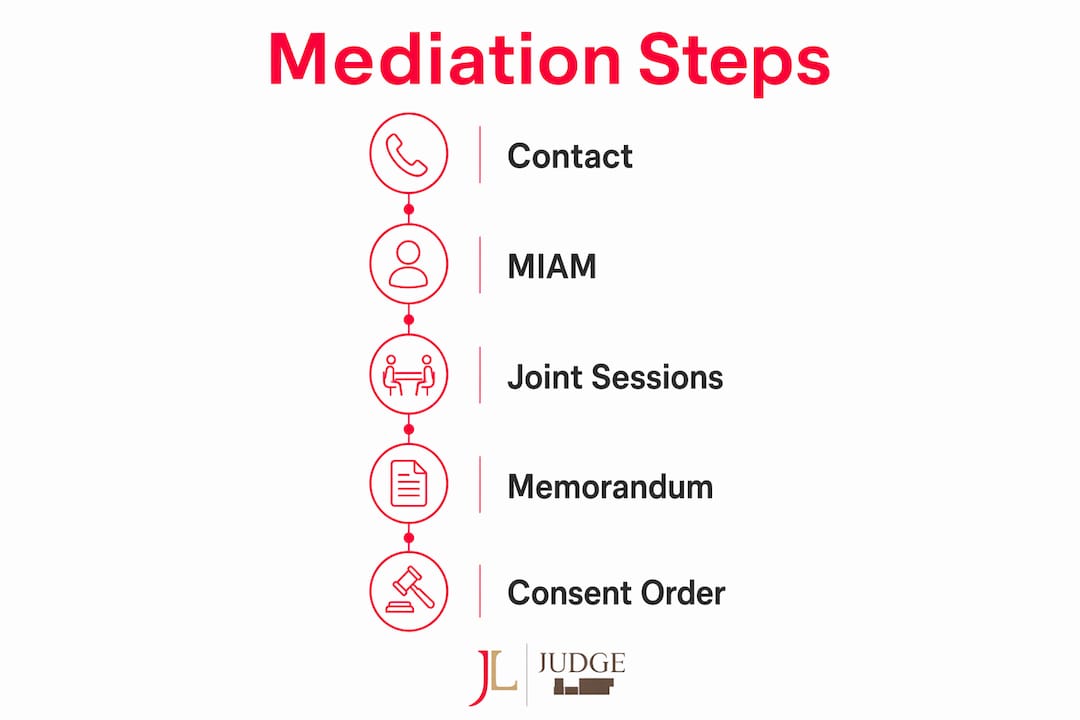
Step 1: Contact a mediator
You contact an accredited mediator directly. You do not need a solicitor’s referral, though your solicitor may recommend one. The mediator will arrange an initial meeting, usually within a few weeks.
Step 2: The Mediation Information and Assessment Meeting (MIAM)
The MIAM is the formal first step. It is a short individual meeting, typically lasting around one hour, in which the mediator explains the mediation process, discusses your situation, and assesses whether mediation is suitable. The MIAM also covers other non-court options such as collaborative law or solicitor negotiation. You may attend together with the other party or separately, depending on your circumstances.
Under section 10(1) of the Children and Families Act 2014, attending a MIAM is a legal requirement before making most family court applications. The MIAM should take place within 15 business days of contacting the mediator. A MIAM typically costs around £120 per person.
Step 3: Joint mediation sessions
If both parties agree to proceed, you attend joint sessions together. Shuttle mediation is available if you prefer not to be in the same room; the mediator moves between separate spaces, carrying proposals and responses between you. Sessions usually last about one to two hours each, and cases typically involve several sessions, though this depends on the issues involved.
During sessions, the mediator helps you:
- Share relevant information openly
- Identify the key issues to resolve
- Explore options and test proposals
- Work towards agreements that both parties can accept
Step 4: The Memorandum of Understanding
When you reach agreement, the mediator records it in a document called a Memorandum of Understanding. This sets out clearly what has been decided. It is not itself legally binding, but it forms the basis for a formal legal agreement.
Step 5: Making the agreement legally binding
To make your agreement enforceable, a solicitor converts the Memorandum of Understanding into a consent order, which a court then approves. Without that step, the agreement carries moral weight but not legal force. For arrangements involving child maintenance payments or property transfers, obtaining a consent order is strongly advisable.
What does the law require? MIAM, the Children and Families Act 2014, and your obligations
Mediation in England and Wales sits within a clear statutory framework, and understanding your legal position before you start is worth the time.
The Children and Families Act 2014 made attendance at a MIAM a prerequisite for most family court applications. Practice Direction 3A of the Family Procedure Rules supplements this requirement, setting out the conduct of MIAMs and the mediator’s obligations at that meeting. Under those rules, only a mediator accredited by the Family Mediation Council can conduct a statutory MIAM and sign the FM1 form you need to proceed with a court application.
Attendance at a MIAM is a legal requirement before applying to the family court, unless a valid exemption applies. At the MIAM, a trained family mediator will give you information about different options for non-court dispute resolution and consider with you whether that would be an appropriate way to resolve the dispute.
Exemptions from the MIAM requirement do exist. The most common include:
- Domestic abuse, where there is evidence of violence or a risk of harm
- Child protection concerns, where a child is subject to a child protection plan
- Urgency, where the application requires immediate court action
- Previous MIAM attendance within the last four months
- Bankruptcy or insolvency proceedings running alongside the family matter
The mediator at the MIAM is also required to assess whether domestic abuse or harm to a child is a risk. If mediation is not safe or suitable, the mediator will say so and can signpost you to other services. Attending a MIAM does not commit you to mediation; it is an evaluative step, not a binding one.
On confidentiality, what is said in mediation is generally inadmissible in court proceedings. There is an important exception. If a child’s safety is at risk, the mediator has an obligation to act on that information regardless of the confidential setting.
What does a mediator actually do during sessions?
A mediator is an impartial, trained professional whose role is to facilitate communication, not to decide outcomes. They do not represent either party, do not give legal advice, and do not tell you what to agree to.
In practice, a mediator’s work during sessions includes:
- Structuring the conversation so both parties have equal opportunity to speak
- Identifying the real issues beneath positions that may initially seem entrenched
- Managing emotional intensity when discussions become heated, without dismissing the feelings involved
- Generating and testing options that neither party may have considered independently
- Keeping the focus on practical, workable outcomes rather than relitigating past grievances
The voluntary nature of mediation is genuine. Either party can withdraw at any point. The mediator will not pressure you to reach an agreement, and no agreement will be recorded without your consent.
Where safety or comfort is a concern, shuttle mediation provides a controlled environment in which parties remain physically separate throughout. The mediator moves between rooms, or between separate video calls in remote sessions. Physical separation does not reduce the effectiveness of the process; many cases resolve successfully this way.
Child-inclusive mediation is also available in appropriate cases. With the child’s agreement and the mediator’s assessment that it is suitable, the mediator can speak with the child separately to understand their perspective. This is not the same as the child making decisions; it gives their voice a place in the process.
What does mediation cost, and how long does it take?
Costs vary between providers, but the general structure is consistent. A MIAM costs around £120 per person. Mediation sessions typically cost more per hour, with fees depending on the mediator and the complexity of the issues. Both parties usually pay their own costs, though some mediators offer a joint fee arrangement.
The timeline from MIAM to a finalised Memorandum of Understanding is typically a matter of weeks to a few months, depending on how quickly sessions can be scheduled and how many issues need resolving. Converting that document into a legally binding consent order adds further time, as it requires solicitor involvement and court approval.
Practical points to be aware of:
- Sessions can be held in person or remotely by video or telephone
- Scheduling is flexible and arranged between the parties and the mediator
- If one party refuses to attend mediation at all, the other can still attend the MIAM and proceed to court if necessary
- If no agreement is reached after several sessions, mediation can be concluded without prejudice to either party’s court position
- The cost of obtaining a consent order through a solicitor is separate from mediation fees
Compared to contested court proceedings, mediation is substantially less expensive and faster. Court proceedings in family matters can take many months, sometimes longer, and legal costs accumulate at every stage.
Benefits of family mediation compared to going to court
Mediation’s advantages over litigation are well established, but they are worth setting out plainly because the differences are significant in practice, not just in theory.
Control over outcomes. In court, a judge decides. In mediation, you and the other party decide. That distinction is particularly meaningful for child arrangements, where parents who reach their own agreement tend to adhere to it more consistently than those bound by an imposed order.
Confidentiality. Court proceedings are largely a matter of public record. Mediation is private. What is discussed stays between the parties and the mediator, subject to the safety exception noted above.
Reduced conflict. Litigation is adversarial by design. Mediation is structured around cooperation. For families who will continue to co-parent, the difference in tone can shape the relationship for years afterwards.
Flexibility. Agreements reached in mediation can be tailored to your specific circumstances in ways that court orders often cannot. They can also be reviewed and adjusted by consent if circumstances change.
Mediation does have limits. It is not suitable where there is a significant imbalance of power between the parties, where one party is unwilling to engage honestly, or where domestic abuse makes a safe process impossible. In those situations, court proceedings may be the appropriate route, and a solicitor can advise you on that assessment. You can read more about when court is the right path and how to weigh the options.
Mediation also shifts the focus from legal conflict to family responsibility, prioritising children’s long-term needs over adversarial positions. That reorientation is one of the reasons judicial guidance in England and Wales actively encourages mediation before court proceedings begin.
How to prepare for mediation and get the most from it
Preparation makes a genuine difference to how productive mediation sessions are. Arriving informed and emotionally ready shortens the process and improves the quality of the agreements reached.
Gather relevant information in advance. For financial matters, this means recent bank statements, pension valuations, mortgage statements, and details of any debts. For child arrangements, think through your current schedule, the children’s school and activity commitments, and what a realistic arrangement looks like day to day.
Take independent legal advice before and during mediation. A mediator cannot advise you on whether a proposed agreement is fair or legally sound. A solicitor can. Getting advice before sessions helps you understand your legal position; getting advice between sessions helps you evaluate proposals before you agree to them. The two processes work well in parallel.
Be clear about your priorities. Mediation works best when both parties come with a genuine willingness to reach a workable outcome. That does not mean accepting anything. It means distinguishing between what you need and what you would prefer, and being prepared to engage with the other party’s perspective.
Seek legal advice on the final agreement before signing. The Memorandum of Understanding is not binding until converted into a consent order, but it carries weight. Having a solicitor review it before you proceed to formalisation protects your position.
Pro Tip: If you find joint sessions too pressured, ask your mediator about shuttle mediation from the outset. Many people find the process significantly more manageable when they are not in the same room, and it does not reduce the likelihood of reaching agreement.
Our perspective on mediation and the value of legal support alongside it
Mediation is genuinely one of the better tools available to separating families in England and Wales. The process works. It resolves disputes that would otherwise spend months in court, and it does so in a way that leaves the parties with some ownership of the outcome rather than a ruling handed down to them.
What gets underestimated, though, is how much the quality of the legal advice running alongside mediation affects the result. A mediator cannot tell you whether the financial settlement being proposed is fair relative to your legal entitlements. They cannot advise you on pension sharing orders, or whether a proposed child arrangement is consistent with what a court would consider to be in the child’s best interests. That gap is real, and it matters.
The parties who get the most from mediation are those who treat it as one part of a broader process, not a substitute for legal advice. They attend sessions informed, they take proposals away and have them reviewed, and they do not sign a Memorandum of Understanding without understanding what they are agreeing to. Mediation is collaborative by design, but collaboration without information is not the same as a fair agreement.
There is also a practical point about enforceability that is worth stating plainly. A mediated agreement that has not been converted into a consent order is not legally binding. If circumstances change or the other party does not honour the arrangement, you have no court order to enforce. For anything involving property, pensions, or long-term child maintenance, formalising the agreement through a solicitor is not optional; it is the step that gives the agreement its teeth.
FAQ
What happens during family mediation?
A trained, neutral mediator facilitates structured discussions between you and the other party to help you reach agreements on children, finances, or property. Sessions typically last 1–2 hours and are confidential.
Who pays for mediation in family court?
Each party usually pays their own mediation costs. A MIAM typically costs around £120 per person.
What should you avoid saying in family mediation?
Avoid making threats, relitigating past grievances at length, or stating fixed positions without room for discussion. Mediation works best when both parties focus on practical outcomes rather than assigning blame.
How long are family mediation sessions?
Sessions typically last 1–2 hours each. Most cases require 3–5 sessions in total, though the number depends on the complexity of the issues involved.
Is a mediated agreement legally binding?
Not automatically. Agreements are recorded in a Memorandum of Understanding, which becomes legally binding only once a solicitor converts it into a consent order and a court approves it.