

TL;DR
- Prenuptial agreements in England and Wales are enforceable but subject to court discretion based on fairness. Courts prioritize proper process, including full disclosure, independent advice, and timing, over mere contractual terms. Properly drafted prenups reflecting genuine consent and fairness often hold weight in divorce proceedings.
You are getting married. You want to protect what you have built, what your family has given you, or simply what feels fair. A prenuptial agreement sounds like the answer. But someone has told you it is not worth the paper it is written on in England and Wales, and now you are not sure what to believe. The truth sits between those two positions. A prenuptial agreement enforceable in UK courts is absolutely possible, but the law does not treat a prenup the way it treats a commercial contract. Courts retain discretion. Fairness governs. What you sign matters far less than how and why you signed it.
Legal status of prenuptial agreements in England and Wales
Before 2010, the English courts treated prenuptial agreements with open scepticism. They were considered contrary to public policy on the grounds that they appeared to anticipate and even encourage the breakdown of marriage. Judges regularly set them aside entirely, regardless of what the parties had agreed.
That changed with the Supreme Court’s decision in Radmacher v Granatino, a landmark ruling that reshaped how English family law views prenuptial contracts. The court held that judges should give decisive weight to prenups freely entered into by parties who understood what they were agreeing to, unless it would be unfair to hold them to the agreement. That is a significant shift, but the conditions embedded in that principle matter enormously.
Prenuptial agreements in England and Wales are not statutes. They do not bind a court in the way a commercial agreement binds two businesses. What they do is provide a strong starting point that reflects the autonomy of the parties. Courts take that seriously. But fairness assessed at the time of divorce, not at the time of signing, remains the controlling principle. If your circumstances have changed dramatically, a court may depart from the terms of even a carefully drafted agreement.
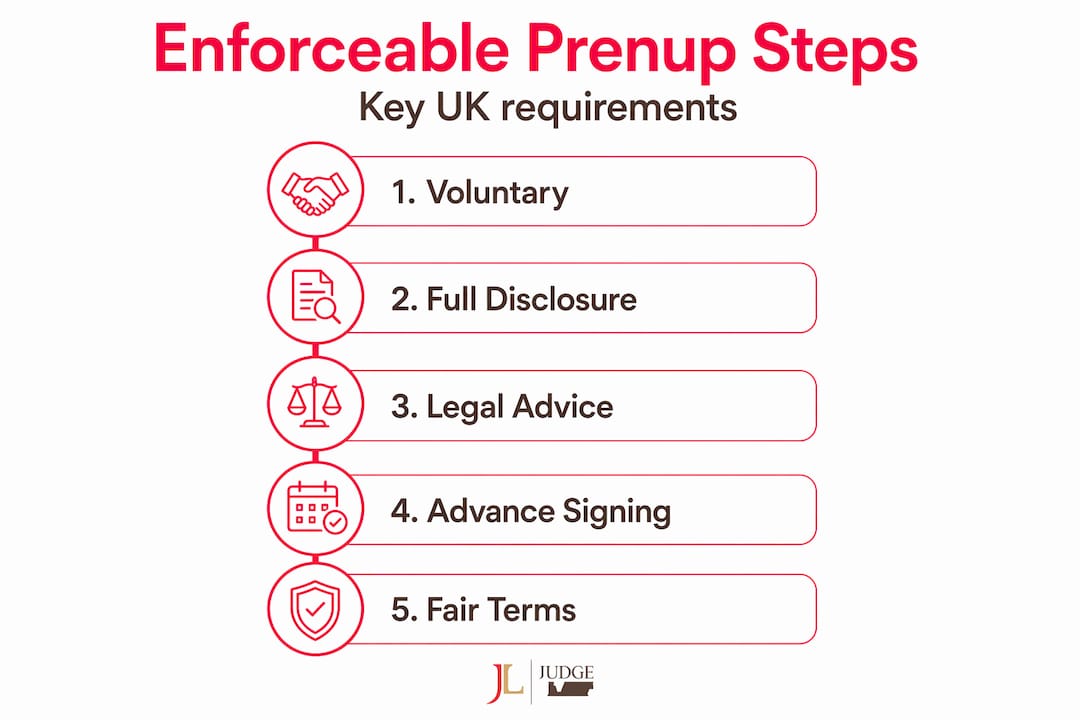
Several factors shape whether a prenup carries real weight in court proceedings:
- Whether both parties entered the agreement freely, without pressure or coercion
- Whether there was full and frank financial disclosure on both sides
- Whether each party understood the legal effect of what they were signing, preferably with independent legal advice
- Whether the agreement was signed well in advance of the wedding, not days before
- Whether enforcing the agreement would be unfair given the parties’ situation at the time of the divorce
Pro Tip: Prenuptial agreement advice UK-based solicitors consistently give is this: treat the agreement as a document you genuinely expect to stand up in court, not a formality. Courts can tell the difference.
Judicial discretion has not disappeared. What Radmacher did was add weight to the scales, not remove the judge’s hand from them entirely.
What courts look for in a persuasive prenup
The difference between a prenuptial agreement that holds firm and one that unravels under scrutiny often comes down to process, not just content. Courts are looking for evidence that the agreement was approached seriously and honestly by both parties.
Here are the key requirements courts consider when assessing UK prenup validity:
-
Full financial disclosure. Both parties must provide a clear and honest picture of their assets, income, and liabilities before signing. Courts will distrust or override a prenup where incomplete disclosure has occurred. This is not optional. It is the foundation of the entire agreement.
-
No coercion or undue pressure. If one party signed under duress, felt they had no real choice, or was presented with the agreement days before the wedding with no time to consider it properly, a court may give the prenup little or no weight. The voluntariness requirement is strict.
-
Independent legal advice. Both parties should take advice from their own separate solicitors before signing. Courts are far more confident that parties understood the implications of the agreement when each had the benefit of independent counsel.
-
Timing. The agreement should be signed at least 28 days before the wedding. Last-minute signing raises questions about whether the less economically powerful party had genuine freedom to walk away.
-
Fairness at the point of enforcement. Even a perfectly executed agreement can be partially or wholly overridden if holding the parties to its terms would leave one spouse in genuine financial hardship. This is particularly relevant when children, career breaks, or long-term dependency have changed the parties’ positions considerably since the agreement was signed.
Pro Tip: Review your prenup every few years after the wedding, particularly after major life changes such as having children or one partner reducing their working hours. An outdated agreement is more vulnerable to challenge.
One practical point worth understanding: courts consider the impact on children first. No prenuptial agreement can override the court’s duty to consider what the children of the marriage need. Any provision that would leave children inadequately provided for will be disregarded, regardless of what the parties agreed before the wedding.

Cross-border prenups and international complications
International couples face a particular set of complications that are often misunderstood. If you were married abroad, signed a prenuptial agreement in another country, or have significant assets overseas, you may assume that a valid foreign agreement automatically carries the same weight in England and Wales.
It does not.
UK courts apply English family law principles regardless of where the prenup was signed. Foreign prenups are considered but assessed against the same standards that apply to any agreement. The fact that a prenup is legally binding in France, Germany, or the United States provides no guarantee that an English court will treat it in the same way.
The key points to understand about cross-border prenuptial agreements include:
- The courts’ primary obligation is to apply English law if the divorce proceedings take place in England and Wales
- A foreign prenup will be weighed in the balance, but it must still meet the English requirements of voluntariness, honest disclosure, and fairness
- Choice-of-law clauses can assist. A clause naming English law as the governing law helps, but it does not bind an English court or remove its discretion to depart from the agreement on fairness grounds
- International couples should obtain UK-specific legal advice even where a foreign prenup exists, ideally before the marriage takes place in England or before assets become subject to English jurisdiction
The practical takeaway is this. If your life has significant cross-border elements, a foreign prenup is better than nothing, but it is not a substitute for an agreement that has been properly considered under English law.
Practical steps to strengthen your prenup
Knowing how courts think is one thing. Putting that into practice when drafting your own agreement is another. The following steps give your prenup the best chance of being given serious weight if it is ever tested.
- Start early. Begin the process at least three to six months before your wedding. Rushed agreements invite scrutiny and give courts reason to doubt that both parties genuinely consented.
- Disclose everything. Prepare a schedule of your assets, property, savings, pensions, debts, and likely inheritance. Honest disclosure from the outset protects the agreement from being challenged later.
- Instruct separate solicitors. Each party should have their own independent legal adviser. This is not about distrust. It is about demonstrating to any future court that both parties received proper guidance.
- Draft for your future, not just your present. Agreements that ignore changing circumstances risk being overridden to protect the more vulnerable party. Include provisions for what happens if you have children, if one of you takes a career break, or if one spouse becomes financially dependent on the other.
- Use clear, unambiguous language. Vague terms leave room for dispute. A court that cannot understand what you intended will not strain to uphold an unclear provision.
- Understand what a prenup cannot do. It cannot remove the court’s discretion entirely. It cannot override a child’s welfare needs. And it cannot bind a judge to an outcome that would be plainly unjust.
Understanding the statutory framework for dividing assets on divorce helps you draft a prenup that works within that framework rather than against it. The agreement shapes the court’s starting point. It does not replace it.
A perspective on prenups from legal practice
In my experience, the couples who get the most value from a prenuptial agreement are the ones who approach it as a genuine conversation rather than a one-sided financial defence. I have seen agreements collapse in court not because they were legally defective on their face, but because the process that produced them was tainted. One party had clearly driven the terms. The other had signed under pressure, or without real advice. A judge can read that in the history of an agreement, even years later.
The law on prenuptial contracts UK-wide has moved steadily towards respecting party autonomy. Carefully drafted agreements with full disclosure and proper legal process do get significant weight in court. That is real progress. But I would caution against thinking of a prenup as a rigid guarantee. Courts will always ask whether enforcing it would be fair given what has actually happened in the marriage, not just what you anticipated when you signed.
What I find reassuring about this approach, rather than frustrating, is that it reflects a genuinely just system. A prenup that was fair when signed and remains fair at divorce will almost certainly be respected. The goal for any couple is to draft an agreement they would both consider fair if the positions were reversed. That mindset produces better agreements and more durable ones.
FAQ
Are prenuptial agreements legally binding in the UK?
Prenuptial agreements are not automatically legally binding in England and Wales, but courts give them decisive weight if they were entered freely, with full financial disclosure and independent legal advice. The ruling in Radmacher v Granatino (2010) established this approach.
What makes a prenup enforceable in England and Wales?
For a prenup to carry significant weight, both parties must have signed it voluntarily, disclosed their finances honestly, received independent legal advice, and signed well in advance of the wedding. Courts also assess whether the agreement remains fair at the time of divorce.
Can a foreign prenup be enforced in the UK?
A foreign prenup will be considered by UK courts but is not automatically enforceable. Courts apply English family law principles, so the agreement must meet UK standards of voluntariness, disclosure, and fairness regardless of where it was signed.
Can a court override a prenuptial agreement?
Yes. Courts retain discretion to depart from a prenup’s terms if enforcing the agreement would be unfair given the parties’ circumstances at the time of divorce, particularly where children’s welfare or financial hardship is involved.
How far in advance should a prenup be signed?
Solicitors advise signing at least 28 days before the wedding, and ideally several months earlier. Last-minute agreements are more vulnerable to challenge on the grounds that one party lacked genuine freedom of choice.
| Key takeaway | Details |
|---|---|
| Prenups are not automatically binding | Courts exercise discretion; fairness at divorce is the controlling principle |
| Process is as important as content | Voluntariness, disclosure, and independent advice all affect how much weight a court gives the agreement |
| Foreign prenups carry no automatic weight | UK courts apply English family law principles regardless of where the agreement was signed |
| Timing matters | Agreements signed well before the wedding are far less vulnerable to challenge |
| Prenups should anticipate change | Provisions for children, career breaks, and dependency make an agreement more durable |