

TL;DR
- Redundancy means a business or site closure or a reduced need for a kind of work. It is not a route for dealing with performance.
- Proposing 20 or more redundancies at one establishment within 90 days triggers collective consultation and an HR1 notification: 30 days before the first dismissal for 20 to 99, 45 days for 100 or more.
- From 6 April 2026 the protective award for failing to consult can be up to 180 days’ pay per affected employee.
- Define the pool, score against objective criteria and offer suitable alternative roles before confirming any redundancy.
- Statutory redundancy pay needs two years’ service, with weekly pay capped at £751 from 6 April 2026.
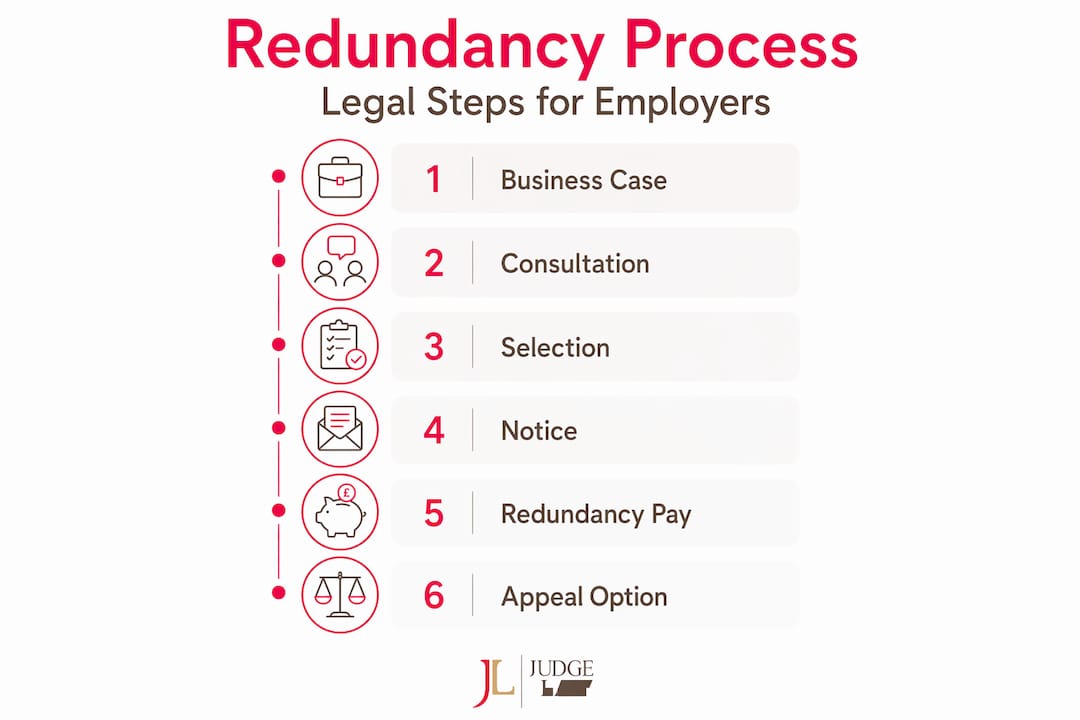
You are weighing a restructure that will cost people their jobs, and you need to know whether you are about to do it lawfully. The redundancy process as a UK employer is not simply about deciding who leaves and writing a cheque. It is a legally prescribed sequence governed by UK employment law redundancy protections, and getting any stage wrong can expose your organisation to employment tribunal claims, protective awards, and reputational damage. This guide walks you through every stage, from defining redundancy correctly through to issuing notice and handling appeals, so you can act with confidence and fairness.
When redundancy actually applies in UK employment law
Redundancy is a specific legal concept, not a catch-all label for getting rid of someone you no longer need. Under the Employment Rights Act 1996, a dismissal qualifies as redundancy when the employer has ceased or intends to cease business altogether, when a workplace location closes or relocates, or when the need for employees to carry out work of a particular kind has diminished or is expected to diminish. That last category is the most commonly misunderstood. If the work still exists but the person doing it has underperformed, that is a performance issue, not a redundancy situation. Conflating the two is one of the most frequent causes of unfair dismissal claims.
Before you begin any process, take a step back and ask yourself honestly whether the circumstances genuinely fit the legal definition. Common scenarios that do qualify include:
- A business unit closing entirely or a company site shutting down
- A merger or restructure that removes duplicate roles
- Automation or technology replacing functions previously carried out by staff
- A significant reduction in customer demand that makes current staffing levels unsustainable
- A change in location where employees cannot reasonably be expected to relocate
Critically, redundancy applies only to employees, not agency workers or independent contractors. Misclassifying a contractor as an employee and putting them through a redundancy process can create procedural defects that undermine the entire exercise. Confirm employment status early. If there is any doubt, seek legal advice before proceeding, because the wrong classification at the outset can invalidate everything that follows.
The redundancy consultation process: your legal obligations
Consultation is not a box-ticking formality. It is a genuine, two-way conversation with affected employees before any decision is finalised, and failing to conduct it properly carries serious financial consequences.

The legal framework distinguishes between two thresholds. When you are proposing 20 or more redundancies at one establishment within a 90-day window, collective consultation obligations apply. For fewer than 20, no statutory minimum period exists, but meaningful individual consultation with at least one private meeting is still legally expected and strongly recommended. The difference matters enormously in practice.
For collective redundancies, follow these steps in order:
- Notify the Secretary of State using form HR1 before consultation begins. The minimum consultation period is 30 days for 20 to 99 proposed redundancies and 45 days for 100 or more. Failing to notify the Secretary of State can result in an unlimited fine.
- Appoint or recognise employee representatives if there is no recognised trade union. Employees must be given the opportunity to elect representatives before consultation starts.
- Provide written information to those representatives covering the reasons for the proposed redundancies, the number and categories of roles affected, how selection will be carried out, redundancy pay calculations, and the number of any agency workers currently engaged.
- Consult genuinely and openly, considering any counter-proposals put forward by representatives before concluding your decision-making.
- Document every meeting, every written submission, and every response from representatives or affected employees.
For individual redundancies below the collective threshold, the process is less prescribed but no less serious. Meaningful consultation includes at minimum a private meeting where the employee understands the situation, can ask questions, and has a genuine opportunity to propose alternatives or challenge the process.
From 6 April 2026, protective awards for failed consultation can reach up to 180 days’ pay per affected employee. That figure concentrates the mind.
Pro Tip: Draft your consultation script and written information pack before approaching employees. Improvising in these meetings creates inconsistency, and inconsistency is exactly what tribunal judges look for.
Fair selection and considering alternatives to redundancy
Even when the business case for redundancy is sound, your process can still be unlawful if you select people unfairly or overlook alternatives. These two duties run in parallel throughout the consultation stage.
Fair selection begins before any individual is identified. Identify the redundancy pool first. This means defining the group of employees doing comparable or interchangeable work, from which selection will be made. Getting the pool wrong skews everything that follows.
Once the pool is defined, apply objective criteria to rank or score employees. Criteria you can justifiably use include:
- Skills, qualifications, and relevant experience
- Performance against measurable, documented standards
- Disciplinary and attendance records, where properly evidenced
- Breadth of role capability or flexibility across functions
What you cannot do is apply criteria that have a disproportionate impact on employees in a protected group, such as part-time workers or those on maternity leave, or that use subjective judgements without evidential support.
Before confirming any redundancy, you must also explore suitable alternative roles within your organisation. If a suitable alternative exists, you should offer it. The employee is entitled to a statutory four-week trial period in the new role. If they unreasonably refuse a genuinely suitable alternative, they may lose their entitlement to statutory redundancy pay. If you fail to offer an available alternative, the dismissal is likely to be unfair and you risk facing an unfair dismissal claim.
Calling for voluntary redundancy before moving to compulsory selection is good practice. It can reduce the number of compulsory selections needed and demonstrates to a tribunal that you looked for less disruptive routes first.
Pro Tip: Keep your selection matrix and all scoring sheets. If a claim goes to tribunal, you will need to show that criteria were applied consistently and that scores were not adjusted after names were already in mind.
Notice, redundancy pay, and the appeals process
Once consultation is complete and selection is confirmed, you move into the formal notification stage. Timing here is precise.
Redundancy notice must be issued after consultation has concluded, not during it. Issuing notice mid-consultation is a clear indicator to a tribunal that the outcome was predetermined. Your notice period will be either the contractual notice specified in the employment contract or the statutory minimum, whichever is longer.
Statutory notice periods based on length of service are as follows:
| Length of continuous service | Statutory minimum notice |
|---|---|
| 1 month to 2 years | 1 week |
| 2 years to 12 years | 1 week per year of service |
| 12 years or more | 12 weeks (maximum) |
Employees with at least two years of continuous service are entitled to statutory redundancy pay, calculated using a formula based on age, weekly pay (capped at £751 per week from 6 April 2026), and length of service. Your employment contract may provide for a higher contractual redundancy payment, so always check the contract before issuing figures.
An appeals process is not legally mandated in the same way it is for disciplinary dismissals, but running one is widely regarded as best practice and can be the difference between a successful tribunal defence and an adverse finding. The appeal should be heard by a manager who was not involved in the original selection decision, and the outcome communicated promptly in writing.
Key takeaways for a compliant redundancy process
| Point | Details |
|---|---|
| Define redundancy correctly | Only use the process where the statutory definition genuinely applies, not for performance issues |
| Consult meaningfully | Individual and collective consultation must be genuine, documented, and completed before notice is issued |
| Select objectively | Define the pool first, score against documented criteria, and keep all evidence |
| Explore alternatives | Offer suitable alternative roles before confirming redundancies |
| Get the administration right | HR1 notification, correct notice periods, and accurate pay calculations all reduce tribunal exposure |
Good record-keeping sits underneath every stage. The CIPD’s practitioner guidance treats collective redundancy compliance as an auditing exercise, requiring documented rationale, unbiased criteria defined before names are considered, and detailed consultation feedback records. Apply that same discipline to individual redundancies.
Watch for protected characteristics throughout selection. Employees on maternity leave, those with disabilities, and part-time workers have additional protections that can render otherwise objective criteria discriminatory in application. If your scoring produces a pool that is disproportionately made up of one protected group, investigate why before proceeding.
Pro Tip: Review your employment contracts and any collective agreements before the process begins. Some contracts contain enhanced consultation rights or longer notice requirements that sit on top of statutory minimums.
Check your internal policies too. A redundancy policy in your staff handbook may set out steps that are contractually binding, and departing from them without good reason creates additional legal exposure. The redundancy process steps in your documentation should mirror the legally required steps at every point.
Practical points from our work: what employers get wrong
In our work we often see employers approach redundancy with the right intentions and still end up in tribunal, and the reason is almost always procedural rather than substantive. The decision to restructure was commercially justified. The selection criteria were defensible. But the consultation was rushed, the records were thin, or notice was issued before the consultation had genuinely concluded.
Working with employers through these processes, we find that legal risk depends on process quality, not payment alone. An employer who pays every penny of entitlement but fails to consult properly can face a protective award that dwarfs the redundancy pay itself. The inverse is also true. An employer who cannot afford enhanced payments but runs a meticulous, respectful process gives themselves a far stronger defence.
The tension between speed and fairness is real. Businesses under financial pressure want decisions made quickly. But accelerating a redundancy process beyond what the law permits is one of the most expensive mistakes we see. A few extra weeks of consultation costs far less than 180 days of protective awards per head.
Treat the people affected with clarity and respect. That is not just a legal point. It is the difference between a process that employees understand, even when they are hurt by it, and one that festers into claims and grievances. Clear communication, honest conversations about the business position, and genuine consideration of alternatives do not just reduce legal risk. They reflect the kind of employer you want to be.
FAQ
What is the legal definition of redundancy in the UK?
Redundancy under the Employment Rights Act 1996 applies where an employer closes a business or site, or where the need for employees to carry out work of a particular kind has diminished. It does not apply to situations driven by an employee’s conduct or performance.
How long must a redundancy consultation last?
For collective redundancies involving 20 to 99 employees, consultation must last at least 30 days. For 100 or more, the minimum is 45 days. For fewer than 20 redundancies, no fixed period applies, but meaningful individual consultation is still legally required.
Who is entitled to statutory redundancy pay?
Employees with at least two years of continuous service are entitled to statutory redundancy pay. The amount depends on age, length of service, and weekly pay up to the statutory cap.
What happens if an employer fails to consult properly?
A tribunal can award a protective award of up to 180 days’ pay per affected employee for failure to comply with collective consultation obligations, as updated from April 2026.
Do employers have to offer alternative roles before making redundancies?
Yes. Employers must consider suitable alternative employment before confirming redundancies. Employees are entitled to a statutory four-week trial period in any alternative role offered.