
The residence nil rate band applies when a qualifying home passes to your children or grandchildren on death, adding up to £175,000 to your tax-free allowance on top of the standard nil-rate band. Combine the two and an individual estate can shelter up to £500,000 from inheritance tax. Married couples and civil partners who leave everything to each other first can pass on up to £1,000,000 between them once transferable bands are applied.
That is the headline. Whether your estate actually gets the full amount depends on who inherits the property, how large the estate is, and whether any of it has been given away or downsized before death.
TL;DR
- The residence nil rate band adds up to £175,000 to the £325,000 standard nil-rate band when a qualifying home passes to direct descendants.
- Direct descendants include children, stepchildren, adopted and fostered children, their spouses or civil partners, and grandchildren, but not siblings, nieces or nephews.
- The allowance tapers away by £1 for every £2 the net estate exceeds £2,000,000.
- Selling or downsizing after 8 July 2015 does not automatically lose the allowance.
- Executors claim it on Form IHT435 alongside the IHT400 account.
- RNRB maximum: £175,000 (fixed until 5 April 2031)
- Standard nil-rate band: £325,000
- Combined per individual: up to £500,000
- Combined for a couple: up to £1,000,000
The rules sit in the Inheritance Tax Act 1984, sections 8, 8D and 8G, and executors claim the allowance using Form IHT435 alongside the main IHT400 account.
£175,000. That is the maximum residence nil rate band available against an estate for deaths up to 5 April 2031, fixed alongside the £325,000 standard nil-rate band.
How does the residence nil rate band work in an estate calculation?
The RNRB does not exempt your house from inheritance tax. It raises the threshold at which tax starts to bite on the whole estate. Think of it as a second, property-linked slice of nil-rate band that sits alongside the £325,000 standard allowance rather than replacing it.
Can unused residence nil rate band transfer to a spouse or civil partner?
Any unused portion of either band can transfer to a surviving spouse or civil partner, which is why the £1,000,000 figure for couples gets quoted so often. The mechanism traces back to the Finance (No.2) Act 2015 and was amended by the Finance Act 2016, with the operative rules now sitting in sections 8D to 8M of the 1984 Act. Crucially, RNRB does not apply to lifetime gifts in the way the standard nil-rate band can interact with the seven-year rule. It only becomes relevant on death, applied once, to the estate as a whole.
Pro Tip: If you’re the executor of an estate with a surviving spouse who died decades ago, check whether that first estate used any nil-rate band or RNRB at all. Unused percentages from a much earlier death can still be claimed today, and executors frequently miss this because the paperwork is old or was never formally recorded.
Who qualifies for the residence nil rate band?
Two things have to line up. First, the property itself has to be a qualifying residence, meaning the deceased owned it and lived in it at some point, even if it was not their home at the moment of death. A buy-to-let flat that was never lived in by the deceased does not qualify, however close the tenant relationship or however clearly the will names a child as beneficiary.
Second, the property has to pass to a direct descendant. GOV.UK’s guidance defines this as children (including adopted, fostered, and stepchildren), their spouses or civil partners, and grandchildren. It does not include siblings, nieces, nephews, or unmarried partners of your children, which catches out more families than you might expect.
- A home owned jointly with a sibling, where only your share passes to your children
- A residence sold shortly before death, with proceeds later inherited by a child
- A UK property owned by someone who was not a long-term UK resident
- Multiple properties, where only one can be nominated for RNRB
If you sold or downsized after 8 July 2015, you are not automatically penalised. The downsizing addition preserves an amount based on the value of the former home, provided assets of equivalent value pass to direct descendants. Where a home is held in certain types of trust, or ownership is split unusually, the rules get considerably more technical.
Pro Tip: If you own more than one residence, your executors will need to nominate which one qualifies for RNRB. Leaving a written note of your intentions alongside your will can save real argument and delay later.
What is the RNRB taper and how is it calculated?
Large estates lose the allowance gradually rather than all at once. For every £2 that your net estate exceeds £2,000,000, RNRB drops by £1. Run the maths through and the allowance disappears entirely once the net estate reaches roughly £2,350,000, a threshold confirmed in HMRC’s published thresholds.
The headline figures worth memorising: £325,000 standard nil-rate band, £175,000 RNRB, £2,000,000 taper start. All three are fixed until 5 April 2031. From 6 April 2027 most unused pension funds and death benefits will also count towards the value of an estate for inheritance tax (GOV.UK), which will push more estates over the £2,000,000 taper threshold.
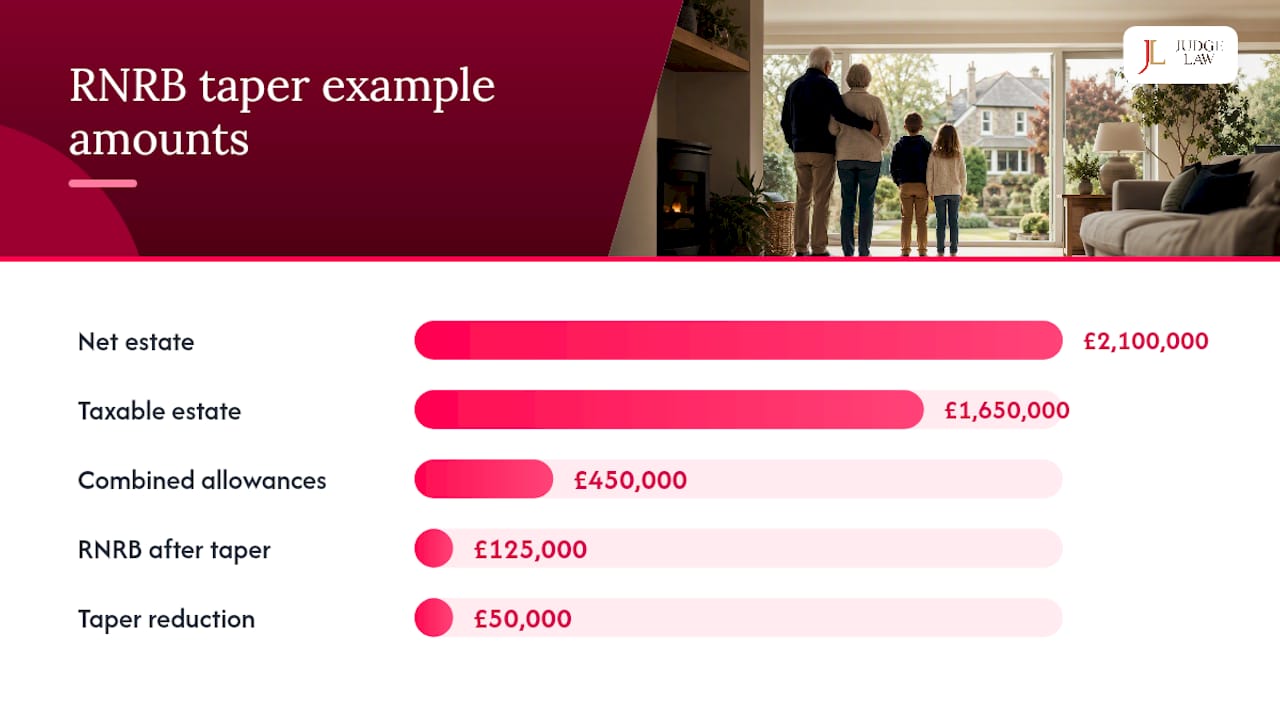
Here is how the calculation actually runs for an estate worth £2,100,000, leaving a qualifying home to two children:
- Net estate value: £2,100,000
- Amount over the £2,000,000 taper threshold: £100,000
- Taper reduction: £100,000 ÷ 2 = £50,000
- RNRB after taper: £175,000 minus £50,000 = £125,000
- Combined nil-rate band available: £325,000 + £125,000 = £450,000
- Taxable estate: £2,100,000 minus £450,000 = £1,650,000, taxed at 40%
That last step produces a tax bill of £660,000 rather than the £840,000 it would be with no allowances at all. If this same estate had a surviving spouse with unused bands to transfer, the calculation changes substantially, which is exactly why estates near the taper deserve a proper professional check rather than a rough guess.
How do executors claim the residence nil rate band?
You claim RNRB by completing Form IHT435, submitted alongside the main IHT400 account of the estate, both of which are available on GOV.UK. The form asks for specifics, not estimates, so gathering the right figures before you start saves several rounds of amendments.
You will typically need:
- The value of the residence at date of death
- Any outstanding mortgage or secured debt against it
- The percentage of the property passing to direct descendants
- Dates and values for any downsizing disposal after 8 July 2015
- Details of any unused RNRB or nil-rate band from a late spouse or civil partner
The practical sequence for most estates runs as follows.
- Value the estate and identify the qualifying residence
- Confirm which beneficiaries count as direct descendants under the will or intestacy rules
- Run the figures through the GOV.UK RNRB calculator to sense-check the claim before submission
- Complete IHT435 and attach it to IHT400
- Claim any transferable RNRB from a previously deceased spouse using the relevant supplementary pages
Timing matters here. RNRB information has to sit inside the same estate account as the rest of the inheritance tax calculation, not filed separately or after the event.
What mistakes cause executors to lose the residence nil rate band?
The most common error is assuming the family home is simply ring-fenced from tax because it is “the house”. It is not. RNRB is conditional, and estates lose part or all of it when executors misidentify who counts as a direct descendant, overlook the downsizing addition entirely, or fail to nominate a single residence when the deceased owned more than one property.
Other pitfalls worth flagging before you file:
- Forgetting to check for unused RNRB or nil-rate band from an earlier spouse’s estate
- Treating a gifted or sold home as automatically disqualifying, when a downsizing addition may still apply
- Overlooking that trusts holding the residence can change the RNRB position significantly
- Failing to keep valuation evidence current, which slows HMRC’s processing of the claim
A short checklist before submission: confirm the property valuation is recent, gather proof of the deceased’s residence there, check the will’s beneficiary wording matches the legal definition of direct descendants, and set aside time to complete IHT435 properly rather than rushing it alongside IHT400.
Pro Tip: Where an estate also claims Agricultural Relief or Business Relief, remember that the taper test uses the estate’s value after debts but before those reliefs, so an estate can lose RNRB to the taper even where reliefs reduce the tax., and getting the order wrong can understate the tax-free amount you’re entitled to.
Estates that sit close to the £2,000,000 taper threshold, those involving trusts holding the family home, or estates with complicated lifetime giving history are the ones where professional advice earns its keep. The maths is mechanical once the facts are settled, but establishing the facts correctly is where most claims go wrong.
When does RNRB planning need a closer look?
RNRB planning earns its value most clearly for homeowners whose estate sits anywhere near the £2,000,000 taper threshold, or where the family structure includes stepchildren, second marriages, or a home held in trust. In those cases, a solicitor’s input is not just about form-filling, it is about making sure the will’s wording actually delivers the allowance you expect it to.
For most other homeowners, three simple steps preserve entitlement: checking that your will names direct descendants clearly, keeping property valuations reasonably current, and recording which residence should be nominated if you own more than one.
This article is general information, not a substitute for advice from a qualified lawyer. Consult a qualified legal professional about your own circumstances before acting on anything here.
Sources
- Claim for residence nil rate band (RNRB) Schedule IHT435
- IHTM46001: residence nil rate band | HMRC Inheritance Tax Manual
FAQ
What is the residence nil rate band?
It is an additional inheritance tax allowance of up to £175,000, available when a qualifying home passes to direct descendants on death, on top of the £325,000 standard nil-rate band.
How much is the combined nil-rate band allowance?
An individual can shelter up to £500,000 combining both allowances, and married couples or civil partners can pass on up to £1,000,000 once transferable bands are applied.
Does the residence nil rate band apply to gifts made during my lifetime?
No. RNRB applies only to the estate on death and does not operate in the same way as the seven-year rule that governs lifetime gifts under the standard nil-rate band.
What happens if my estate is worth more than £2 million?
The allowance tapers away, reducing by £1 for every £2 the net estate exceeds £2,000,000, disappearing entirely once the net estate reaches roughly £2,350,000.
Which form do I need to claim RNRB?
Executors claim using Form IHT435, submitted alongside the main IHT400 account of the estate.
Can I lose the residence nil rate band if I downsize?
Not automatically. A downsizing addition can preserve the allowance based on the former home’s value, provided you sold or gave away the property after 8 July 2015 and left assets of equivalent value to direct descendants.