
TL;DR
- Divorce can be worthwhile as it ends harmful relationships, clarifies legal and financial matters, and offers the chance for a better life.
- Deciding if it’s right depends on emotional impact, financial consequences, and effects on children, with safety taking priority in abusive situations.
For many people, divorce is worth it. It ends a relationship that is causing harm, creates the legal and financial clarity needed to move forward, and, in time, opens the possibility of a genuinely better life. Whether it is worth it for you depends on three things: how your emotional wellbeing is affected by staying versus leaving, what the financial consequences of separation look like in your specific circumstances, and how any children will be affected and supported. If you are weighing those three factors right now, the most useful immediate step is to get a clear picture of your finances and, if there is any risk to your safety, to prioritise that before anything else.
Research on happiness after divorce shows mixed results. Some studies find no average happiness gain for unhappy spouses who divorced and remarried compared with those who stayed married. That is not an argument against divorce. It is an argument for going in with clear eyes, realistic expectations, and a plan.
Is divorce worth it for you? Signs it may be the right choice
No single checklist decides this. But there are patterns that consistently point in one direction or the other.
Hard reasons that usually make divorce the right choice:
- Domestic abuse, coercive control, or any behaviour that puts you or your children at risk
- Persistent infidelity where trust has been irreparably broken and neither party wishes to rebuild it
- Addiction that the other party refuses to address and that is harming the family
- Fundamental incompatibility in values, life goals, or parenting that has not shifted despite genuine effort
- A marriage that has been functionally over for years, with no emotional or practical partnership remaining
Soft reasons where alternatives may be worth trying first:
- Communication breakdown without underlying harm or contempt
- A period of distance or disconnection following a specific event, such as bereavement or job loss
- Disagreements about finances or parenting that have not been explored with professional support
- Uncertainty about whether you want to leave, rather than certainty that you do
If your reasons fall into the second category, counselling and mediation are worth exploring before filing. That is not a moral judgement. It is practical. Resolving a marriage through therapy is considerably less expensive and disruptive than resolving it through the courts, and some couples find that the process of preparing for divorce clarifies what they actually want.
Safety first. If you are in an abusive relationship, the question of whether divorce is “worth it” is secondary to your immediate safety. Contact the National Domestic Abuse Helpline on 0808 2000 247 (free, 24 hours) or visit gov.uk/guidance/domestic-abuse for urgent support and safety planning.
Pro Tip: Before you speak to anyone, take a private financial snapshot. Photograph or download bank statements, pension summaries, mortgage documents, and payslips. Store them somewhere your spouse cannot access. This protects you regardless of what you decide.
How divorce commonly affects your emotional and daily life
The emotional trajectory of divorce is rarely linear. Most people experience a period of acute distress in the months immediately following the decision, regardless of who initiated it. Grief, relief, anger, and disorientation can coexist, sometimes within the same day. That is not a sign that the decision was wrong.
Practically, daily life changes in ways people often underestimate. Housing is the most immediate pressure. If you shared a home, one or both of you will need to find alternative accommodation, often at a higher cost per person than the shared arrangement. Social networks shift too. Friendships that were built around the couple frequently fracture or fade, and the social calendar that structured weekends and holidays disappears. Building a new one takes longer than most people expect.
What people most commonly misjudge beforehand is the administrative weight of separation. Changing names on accounts, updating insurance policies, revising wills, notifying HMRC, and separating joint finances all take time and attention at a point when emotional reserves are already depleted.
Common emotional and practical changes to prepare for:
- A period of grief even when the marriage was clearly over
- Reduced social contact, particularly in the first year
- Changes to your relationship with mutual friends and extended family
- Increased financial pressure from running a separate household
- Positive changes: autonomy, relief from conflict, and the ability to make decisions independently
Pro Tip: Pacing matters. Avoid making major financial or housing decisions in the first three months if you can. Seek therapeutic support early, not as a last resort. The NHS Talking Therapies programme offers free access to psychological therapies for adults in England, and many solicitors will recommend this alongside legal advice.
What happens to your children when you divorce?
The legal framework is clear on one point. Courts apply the welfare checklist under the Children Act 1989, and the child’s welfare is the paramount consideration in every decision. That principle shapes everything from where children live to how much time they spend with each parent.

In practice, most arrangements are agreed between parents without a court order. Typical post-separation arrangements involve children living primarily with one parent and spending regular time with the other, though shared care arrangements are increasingly common where geography and work patterns allow. Courts do not have a default preference for mothers or fathers. The focus is on stability, the child’s existing relationships, their wishes (weighted by age and maturity), and the ability of each parent to meet their needs.
What parents can do to reduce harm to children:
- Keep adult conflict away from children. Children are harmed by exposure to parental hostility, not by the separation itself.
- Maintain routines where possible. School, activities, and friendships provide stability during transition.
- Communicate directly with your co-parent about the children, not through them.
- Be honest with children in age-appropriate terms. Silence and secrecy tend to create more anxiety than clear, calm explanations.
- Seek specialist support for teenagers, who often internalise conflict differently from younger children. Judge Law’s guidance for parents of teenagers covers this in more detail.
Research consistently shows that children’s long-term outcomes are more strongly linked to the level of parental conflict than to the fact of divorce itself. A low-conflict separation is significantly less harmful than a high-conflict intact marriage.
Common questions from parents:
Will the court take my child’s wishes into account? Yes. Courts consider a child’s wishes and feelings, giving them weight proportionate to the child’s age and understanding. There is no fixed age at which a child’s preference becomes decisive.
Do I need a court order for child arrangements? Not necessarily. If you and your co-parent can agree, a written parenting plan is a practical starting point. A court order provides legal enforceability if the arrangement breaks down.
What if my co-parent is uncooperative? You can apply to the family court for a Child Arrangements Order. Mediation is usually required first, unless there are safety concerns.
Money matters: what divorce does to your finances
The financial impact of divorce is the factor most people underestimate, and it is the one most likely to determine whether the process feels manageable or frightening.

Half of divorcees see their income shrink in the year after separation, by an average of 30%, which is equivalent to about £9,229 for those affected. For women, the picture is sharper still. Research shows women’s household income can be cut in half in the year after divorce, and women are more likely to waive pension rights in settlements, often in favour of retaining the family home. That trade-off can look sensible in the short term and prove costly over decades.
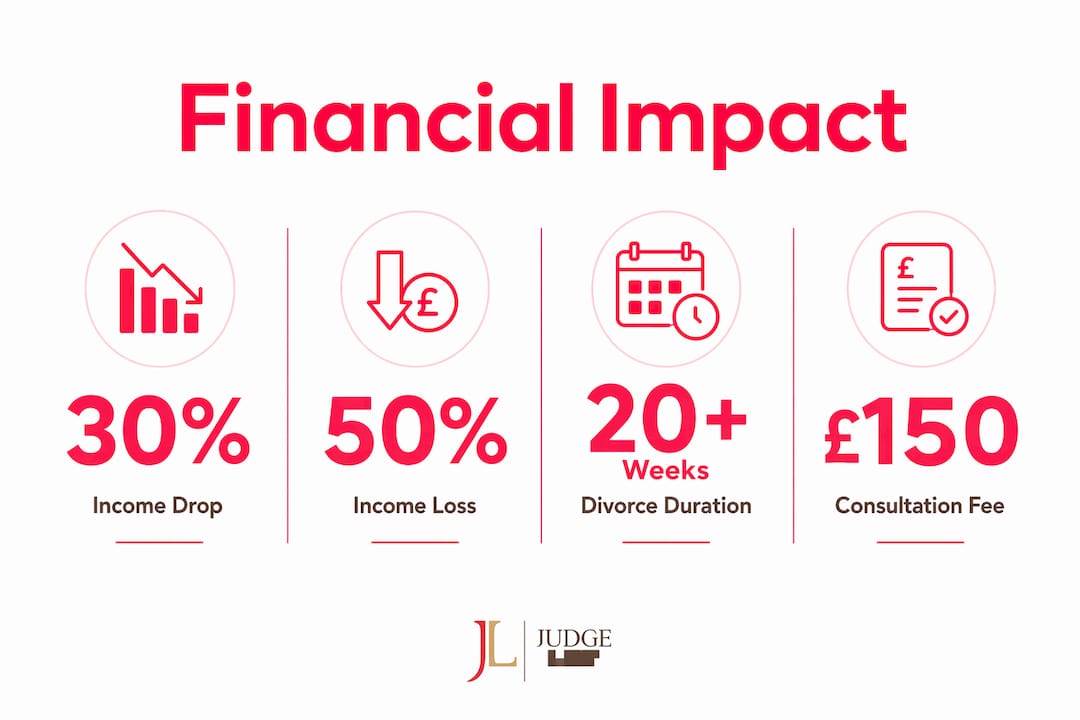
Aviva research found average separation costs of around £14,561 per household when legal fees, housing transition costs, and related expenses are combined. That figure does not include ongoing changes to income or pension entitlement.
Documents to gather before you speak to a solicitor
- Last three years of bank statements for all accounts, joint and individual
- Mortgage statements and property valuations
- Pension statements for both parties, including any workplace and private pensions
- Payslips and P60s for the last two years
- Details of any investments, ISAs, or savings
- Wills, life insurance policies, and beneficiary nominations
- Any existing prenuptial or postnuptial agreements
Key financial risks and planning priorities
| Area | What to watch for | Why it matters |
|---|---|---|
| Pensions | Waiving rights in favour of the family home | Pension sharing orders can be decisive for long-term security |
| Housing | Assuming you can afford to keep the property alone | Running costs and mortgage affordability change on a single income |
| Debt | Joint credit agreements and overdrafts | Both parties remain liable until formally separated |
| Income | Short-term drop in household income (average 30% for half of divorcees) | Budget for at least several months of reduced income |
| Legal costs | Uncontested vs contested proceedings | Costs vary significantly depending on whether matters are agreed |
The University of Bristol’s Fair Shares research found that the median total asset pool for divorcing couples in England and Wales was £135,000, and 17% of divorcees had no assets to divide at all. Most divorces involve modest wealth, not the high-value cases that dominate media coverage.
Pro Tip: A session with a financial adviser who specialises in divorce, sometimes called a Chartered Financial Planner or a Pension on Divorce Expert (PODE), can be more cost-effective than discovering a pension imbalance after the financial order is sealed. Ask your solicitor whether a PODE referral is appropriate in your case.
The UK divorce process: what happens and how long it takes
England and Wales moved to a no-fault divorce system in April 2022. You no longer need to blame your spouse or prove adultery or unreasonable behaviour. You simply state that the marriage has irretrievably broken down. Both parties can apply jointly, or one party can apply alone.
The basic legal stages run in this order:
- Apply online or by post. Submit the divorce application to the court, paying the court fee (currently £593 for most applicants, though fee remission is available on low incomes).
- Conditional order. After a minimum 20-week reflection period from the date of application, you can apply for a conditional order (formerly the decree nisi). The court confirms there is no reason the divorce cannot proceed.
- Final order. Six weeks and one day after the conditional order, you can apply for the final order (formerly the decree absolute). This legally ends the marriage.
- Financial settlement. This runs in parallel and is not automatic. A financial consent order, sealed by the court, is the only way to achieve a clean break and prevent future financial claims.
The 20-week reflection period is a statutory minimum, not an average. In practice, court backlogs, contested financial matters, and delays in serving papers mean the full process from application to final order commonly takes six months to over a year. Financial proceedings, if contested, can extend the timeline considerably further.
Solicitor fees vary depending on whether matters are agreed or disputed. An uncontested divorce with a straightforward consent order will cost considerably less than contested financial proceedings. Getting a clear cost estimate at the outset is one of the most useful things a solicitor can do for you. Judge Law’s guide to divorce costs and first steps sets out what to expect.
Mediation can reduce both cost and time significantly. A Mediation Information and Assessment Meeting (MIAM) is required before most court applications, and many couples resolve financial and parenting matters through mediation without ever attending a hearing.
Practical steps to take this week if you think divorce is right
You do not need to have made a final decision before taking these steps. They protect you regardless of what you decide.
This week
- Secure copies of key financial documents. Photographs stored in a private cloud account are sufficient if you cannot remove originals.
- Open a personal bank account in your name only if you do not already have one.
- Check what benefits or tax credits you currently receive and whether your entitlement would change after separation.
- If you are at risk of harm, contact the National Domestic Abuse Helpline (0808 2000 247) and consider whether you need to leave before taking any other steps.
- Read Judge Law’s solicitor’s guide to what to do if your marriage is ending for a structured overview of your options.
Within the first month
- Review your will. An unchanged will can result in your spouse inheriting your estate if you die before the final order is made. Nearly 900,000 divorced people in the UK have not updated their wills after separation.
- Check pension and life insurance beneficiary nominations. These sit outside your will and are not automatically changed by separation or even by the final divorce order.
- Notify your mortgage lender if you are considering leaving the family home, and take advice before doing so. Leaving voluntarily can affect your rights.
- Seek legal advice before agreeing to anything financial with your spouse, even informally.
Documents checklist:
- Bank statements (all accounts, last 3 years)
- Mortgage deed and recent statement
- Pension statements for both parties
- Payslips and P60s
- Life insurance policies and beneficiary forms
- Council tax and utility account details
- Wills and any existing legal agreements
One in six recent divorces in the UK were delayed for financial reasons, with income concerns, rising living costs, and the direct cost of divorce cited most often. Preparing your financial picture early reduces the likelihood that cost alone forces you to delay a decision you have already made.
What a family solicitor actually does and what to ask them
A solicitor is not just someone who files paperwork. In a divorce, they give you legal advice tailored to your specific circumstances, help you understand what a fair financial settlement looks like, draft and negotiate financial consent orders, advise on child arrangements, and represent you if matters become contested. That combination of advice and advocacy is what distinguishes a solicitor from a DIY divorce service.
Solicitors regulated by the Solicitors Regulation Authority (SRA) are bound by professional conduct rules that protect you. They must act in your best interests, keep your information confidential, and be transparent about fees. Judge Law is SRA-regulated (registration number 634380), which means those obligations apply to every piece of advice given.
At an initial paid consultation, a solicitor should be able to give you a realistic picture of your legal position, the likely range of outcomes for financial and child matters, and a clear estimate of what the process will cost. You should leave knowing what your next step is.
Questions to ask at an initial consultation:
- What is a realistic range of outcomes for the financial settlement in my situation?
- How are pensions likely to be treated, given our respective pension values?
- What are the likely costs if matters are agreed, and if they are contested?
- How long is the process likely to take in my circumstances?
- What should I do, and what should I avoid doing, before we file?
What to bring:
- A summary of your financial position (assets, debts, income, pensions)
- Details of any children, their ages, and current living arrangements
- Any correspondence or agreements already made with your spouse
- Your questions, written down
Judge Law’s family law solicitors offer paid initial consultations from £150. That hour gives you specific legal advice on your situation, not generic information you could find online.
What people most often underestimate when deciding whether to divorce
The financial shock of the first year is well documented, but the administrative weight of separation is something almost nobody anticipates fully. Updating a will takes an appointment and a fee. Changing pension beneficiaries requires contacting each scheme individually. Removing a spouse from a joint mortgage, if you intend to keep the property, requires a formal transfer of equity and lender consent. None of these tasks is complicated, but they accumulate at a point when your attention and energy are already stretched.
The emotional surprises tend to run in the opposite direction from what people expect. Relief and grief coexist, and that can be disorienting. Many people expect to feel better quickly once the decision is made. Some do. Others find that the grief arrives later, sometimes after the final order, when the administrative reality of a new life sets in. Social shifts take longer than expected too. A social circle built around a couple does not simply redistribute itself. Building new routines and relationships takes months, sometimes years.
What this means practically is that the delay time, if finances require you to wait before filing, is not wasted time. Use it to gather documents, take financial advice, update your will, and build the factual base that will make the legal process faster and less expensive when you are ready.
Useful sources and further reading
Legal guidance and process:
- GOV.UK divorce guidance – the authoritative source for eligibility, court fees, and procedural steps in England and Wales
- Judge Law: what to do if your marriage is ending – a solicitor-authored guide to readiness checks and legal options
- Judge Law: how to file for divorce in England and Wales – step-by-step procedural guide
Financial research and statistics:
- Legal and General: Holy Matri-money (2025) – data on delayed divorces, income drops, and the financial impact of separation
- Legal and General: The Divorce Gap (2025) – research on gendered financial outcomes after divorce
- University of Bristol: Fair Shares report – the most comprehensive study of financial arrangements in divorce in England and Wales, led by Professor Emma Hitchings
Emotional and wellbeing support:
- NHS Talking Therapies – free psychological therapy for adults in England
- National Domestic Abuse Helpline: 0808 2000 247 (free, 24 hours)
| Source | Type | Most useful for |
|---|---|---|
| GOV.UK divorce | Primary legal | Process, fees, eligibility |
| Legal and General (2025) | Financial research | Income impact, delayed divorces |
| University of Bristol Fair Shares | Academic research | Asset division, pension risks |
| Judge Law solicitor guides | Legal guidance | Practical next steps, UK-specific advice |
| NHS Talking Therapies | Support service | Emotional wellbeing during and after divorce |
This article is general information, not legal advice. Your situation will have specific facts that affect the outcome. Confirm the current rules with GOV.UK or speak to a qualified solicitor before making decisions.
FAQ
Is divorce worth it if you have children?
Research consistently shows that children’s long-term outcomes depend more on the level of parental conflict than on whether parents separate. A low-conflict divorce is less harmful than a high-conflict marriage.
What is the biggest financial mistake people make in divorce?
Waiving pension rights in favour of keeping the family home is the most common and costly error, particularly for those who were out of the workforce or worked part time during the marriage.
Does divorce make people happier?
Some studies find no average happiness gain for unhappy spouses who divorced and remarried compared with those who stayed. Outcomes vary significantly depending on individual circumstances, the level of conflict in the marriage, and the support available after separation.
How long does divorce take in England and Wales?
The minimum statutory period is 20 weeks from application to conditional order, plus a further six weeks and one day to the final order. In practice, court backlogs and financial proceedings mean the full process commonly takes six months to over a year.
Should I speak to a solicitor before deciding whether to divorce?
Yes. An initial paid consultation gives you a realistic picture of your legal position and likely financial outcomes before you commit to any course of action. Judge Law offers paid initial consultations from £150.